The Tesla Roadster's 0-60 Claim: Separating Marketing From Physics
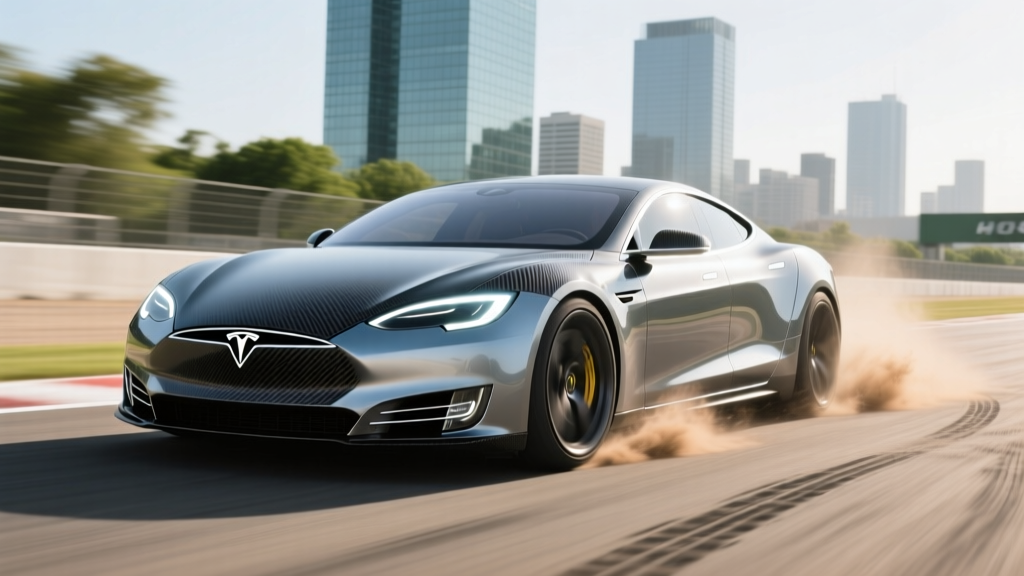
When Tesla first unveiled the second-generation Roadster in 2017, the headline number was staggering: a 0-60 mph time of 1.9 seconds. That figure — if achieved in production form — would make it the quickest production car ever built, outpacing Rimac, Bugatti, and every internal-combustion hypercar on record. But as we move deeper into 2026 with the Roadster still listed as "announced" and not yet in customer hands, the question persists: what does the Tesla Roadster 0-60 claim actually mean for real-world buyers, and how do the rest of the specs stack up under scrutiny?
This profile examines every published specification Tesla has released for the next-gen Roadster, pairs those numbers with real-world EV physics, and clarifies what's confirmed versus what remains preliminary. Because the vehicle is not yet in production, all figures below carry an "announced/estimated" designation per Tesla's own communications.
Full Spec Sheet: Tesla Roadster (Announced)
| Specification | Value |
|---|---|
| 0-60 mph | 1.9 seconds (claimed, with SpaceX package) |
| Top Speed | 250+ mph (claimed) |
| Quarter Mile | 8.8 seconds (claimed) |
| Horsepower | ~1,000+ hp (estimated, tri-motor AWD) |
| Drivetrain | AWD — Tri-Motor (1 front, 2 rear) |
| Battery Capacity | ~200 kWh (announced, NMC chemistry expected) |
| EPA Range (Estimated) | 620 miles (Tesla claim, pre-EPA certification) |
| Peak DC Fast Charge | Not officially published; expected 250-350 kW |
| 10-80% DC Charge Time | Estimated 30-40 minutes (based on 200 kWh pack) |
| Level 2 Home Charging | Expected 11.5 kW / ~44 mi/hr (48A) |
| Seating | 2+2 (two front, two small rear seats) |
| Cargo Volume | Not published; estimated <5 cu ft total |
| Base MSRP (Announced) | $200,000 (base); $250,000 (Founders Series) |
| Reservation Deposit | $50,000 (fully refundable historically) |
| Federal Tax Credit (§30D) | Not eligible — exceeds MSRP cap |
| Battery Warranty | Expected 8 yr / 150,000 mi (based on Tesla precedent) |
Range Reality: 620 Miles Claimed, But What Will You Actually Get?
Tesla has stated a target range of 620 miles for the Roadster, which would require the massive ~200 kWh battery pack. For context, the largest battery currently in a production Tesla is the Model S's ~100 kWh pack. A 200 kWh pack would be roughly double the energy capacity of any Tesla sedan, which is physically plausible given the Roadster's larger chassis and the energy density improvements in modern NMC (nickel manganese cobalt) cells.
EPA sticker (estimated): 620 miles
Real-world highway (70-80 mph): ~450-500 miles
Cold weather (below 32°F): ~380-440 miles
Aggressive/canyon driving: ~300-380 miles
At hypercar speeds and with a heavy 200 kWh pack, aerodynamic drag and mass will erode range faster than in a sedan. Expect real-world figures 20-35% below the sticker depending on conditions.
The 620-mile figure, even if certified by the EPA, assumes a mix of city and moderate-speed driving. At sustained highway speeds above 75 mph, aerodynamic drag increases with the square of velocity, and any sports car — electric or not — will see significant range compression. Cold weather further reduces lithium-ion battery efficiency by 15-30%, a well-documented phenomenon across all EV chemistries.
Charging Speed: The 200 kWh Problem
A 200 kWh battery introduces a charging challenge that no current production EV faces. Even at Tesla's V3 Supercharger peak of 250 kW, filling a 200 kWh pack from 10% to 80% would require pushing roughly 140 kWh into the battery. At a sustained 250 kW (which no EV maintains across the full curve due to thermal and chemistry limits), that's approximately 34 minutes. Realistically, with charge-curve tapering above 50-60% SoC, expect 38-45 minutes on a V3 Supercharger.
| Charging Level | Power (kW) | Miles Added Per Hour | 10-80% Time |
|---|---|---|---|
| Level 1 (120V / 12A) | 1.4 kW | ~5 mi/hr | ~100 hours |
| Level 2 (240V / 48A) | 11.5 kW | ~44 mi/hr | ~12-14 hours |
| DC Fast (V3 Supercharger) | 250 kW (peak) | ~900+ mi/hr (peak) | ~38-45 min |
| DC Fast (V4 Supercharger) | 350 kW (expected peak) | ~1,200+ mi/hr (peak) | ~28-35 min |
The key insight for prospective Roadster owners: a 200 kWh battery makes Level 2 overnight charging essential. At 11.5 kW, a full charge from near-empty takes roughly 17 hours. Most owners will charge between 20-80% daily, which fits within a 7-8 hour overnight window. DC fast charging will be adequate for road trips but noticeably slower in absolute time than a Model 3 or Model Y due to the sheer battery volume.
Performance: Understanding the 1.9-Second 0-60 Claim
The Tesla Roadster 0-60 time of 1.9 seconds, as announced, includes the SpaceX cold-gas thruster package — a set of compressed-air thrusters positioned around the vehicle to increase downforce and traction during launch. Without this package, Tesla has not published a standalone 0-60 figure, though industry analysts estimate the base tri-motor Roadster at approximately 2.5-3.0 seconds.
For reference, the current quickest production EVs include:
- Rimac Nevera: 1.85 seconds (verified, $2.2M)
- Pininfarina Battista: 1.86 seconds (verified, $2.8M)
- Lucid Air Sapphire: 1.89 seconds (verified, $249,000)
- Tesla Model S Plaid: 1.99 seconds (verified, $89,990)
Achieving 1.9 seconds requires more than raw power — it demands exceptional tire grip, precise torque vectoring across all three motors, and a launch surface with adequate friction. Real-world 0-60 times on public roads (asphalt, varying temperature, non-prepped surface) will typically be 0.2-0.5 seconds slower than controlled-track claims. The tri-motor AWD system, with one motor driving the front axle and two driving the rear, enables torque vectoring that should provide exceptional launch traction.
Pricing, Tax Credits, and the $200,000 Question
Tesla has announced two pricing tiers for the Roadster:
- Base Roadster: $200,000 MSRP
- Founders Series: $250,000 MSRP (limited to first 1,000 units, requires full payment upfront)
| Trim | MSRP | §30D Federal Credit | Effective Price |
|---|---|---|---|
| Base Roadster | $200,000 | $0 (exceeds $55K sedan cap) | $200,000 |
| Founders Series | $250,000 | $0 (exceeds $55K sedan cap) | $250,000 |
Under current IRS §30D rules, the federal EV tax credit caps eligible vehicles at $55,000 MSRP for sedans and $80,000 for SUVs, vans, and trucks. The Roadster, classified as a sedan/sports car, far exceeds the $55,000 threshold. Additionally, buyer income caps ($150,000 single / $300,000 joint modified AGI) and battery critical-mineral sourcing requirements would further complicate eligibility even if the price were within range. In short: the Roadster does not qualify for the $7,500 federal EV tax credit.
State-level incentives vary. Some states offer rebates or tax credits with higher MSRP caps or no cap at all, but these are jurisdiction-specific. Consult your state's DMV or energy office for current programs.
Tech, Interior, and Driver Assistance
Tesla has been sparse with interior details, but based on the prototype shown and Tesla's current production technology, the Roadster is expected to feature:
- A removable glass roof panel (targa-style)
- Minimalist interior with a central touchscreen (likely 15-17")
- Autopilot hardware (HW4 or later) with basic driver-assist features
- 2+2 seating — rear seats suitable for children or cargo, not adults
- Over-the-air software updates for performance tuning and feature additions
The Roadster's standout tech will likely be its performance software — Tesla has a history of unlocking additional acceleration modes via OTA updates (as seen with Model S Plaid's "Cheetah Stance" launch mode). Expect configurable torque distribution, adjustable regen levels, and track-mode telemetry logging.
Pros and Cons: Honest Assessment
- Sub-2-second 0-60 (with SpaceX package) would be a production-car record
- 620-mile range target is class-leading for any performance EV
- Tri-motor AWD with torque vectoring offers exceptional handling potential
- Tesla Supercharger network access (17,000+ stations in North America)
- OTA updates can improve performance post-purchase
- Relative value vs. Rimac Nevera ($2.2M) or Battista ($2.8M)
- Not yet in production — years of delays since 2017 announcement
- $200,000+ price with no federal tax credit eligibility
- 200 kWh battery means long charge times and heavy curb weight (~4,500+ lbs est.)
- 2+2 seating limits practicality; tiny cargo area
- SpaceX thruster package adds complexity, cost, and regulatory uncertainty
- No independent EPA, IIHS, or NHTSA testing data exists
- Insurance costs for a $200K+ EV hypercar will be extreme
Who Is the Tesla Roadster Actually For?
The Roadster targets a narrow buyer profile: high-net-worth enthusiasts who want headline-grabbing performance and are comfortable with Tesla's risk profile on an unreleased, low-volume vehicle. It is not a commuter, a family car, or a practical daily driver. Think of it as Tesla's answer to the Porsche 911 Turbo S or the Rimac Nevera — a halo car that demonstrates what the company's technology can achieve at the extreme edge.
Choose the Roadster if:
- You want the quickest-accelerating production car on paper
- You have garage space for a dedicated weekend/track car
- You value Tesla's software ecosystem and Supercharger access
- $200,000+ is within your discretionary vehicle budget
Look elsewhere if:
- You need a daily driver with practical cargo and passenger space
- You want a proven, currently-deliverable hypercar (see Rimac, Lotus Evija)
- You're sensitive to the risk of further production delays
- You want federal tax credit assistance on your EV purchase
Frequently Asked Questions
What is the real-world range of the Tesla Roadster?
Tesla claims 620 miles, but this is not yet EPA-certified. Based on the physics of a heavy sports car with a 200 kWh pack, expect 450-500 miles on the highway, 380-440 in cold weather, and 300-380 during aggressive driving. These are estimates until independent testing is possible.
How fast does the Tesla Roadster charge?
Tesla has not published official charge rates. Based on the expected 200 kWh NMC battery, DC fast charging at 250 kW (V3 Supercharger) should take approximately 38-45 minutes from 10-80%. V4 Superchargers at 350 kW could reduce this to 28-35 minutes. Home Level 2 charging at 11.5 kW adds roughly 44 miles per hour.
How much does the Tesla Roadster cost after tax credits?
The base Roadster is listed at $200,000 MSRP and the Founders Series at $250,000. Neither qualifies for the $7,500 federal §30D tax credit because both exceed the $55,000 MSRP cap for sedans. Your effective price is the full MSRP plus destination, taxes, and registration. Some state incentives may apply — check your local programs.
Is the Tesla Roadster worth buying vs. competitors?
At $200,000, the Roadster undercuts the Rimac Nevera ($2.2M) and Lotus Evija ($2.3M) dramatically while claiming similar or better acceleration. However, neither the Nevera nor Evija has been delayed for 8+ years. If Tesla delivers on specs, it's exceptional value in the hypercar segment. If delays continue, buyers may prefer proven alternatives or the Tesla Model S Plaid at $89,990 for a fraction of the cost with verified 1.99-second 0-60 performance.
Does the Tesla Roadster qualify for the federal EV tax credit?
No. Under current IRS §30D regulations, the Roadster's $200,000+ MSRP far exceeds the $55,000 sedan cap. Additionally, buyer income limits ($150K single / $300K joint) and battery sourcing requirements further restrict eligibility. The credit is not available for this vehicle.
When will the Tesla Roadster actually ship?
As of early 2026, Tesla has not confirmed a firm production start date. The vehicle was originally announced in November 2017 with a projected 2020 delivery. Multiple delays have pushed this timeline repeatedly. Elon Musk indicated in 2024 that the Roadster would begin production after other priority programs. Treat any delivery timeline as speculative until Tesla confirms orders and begins deliveries.