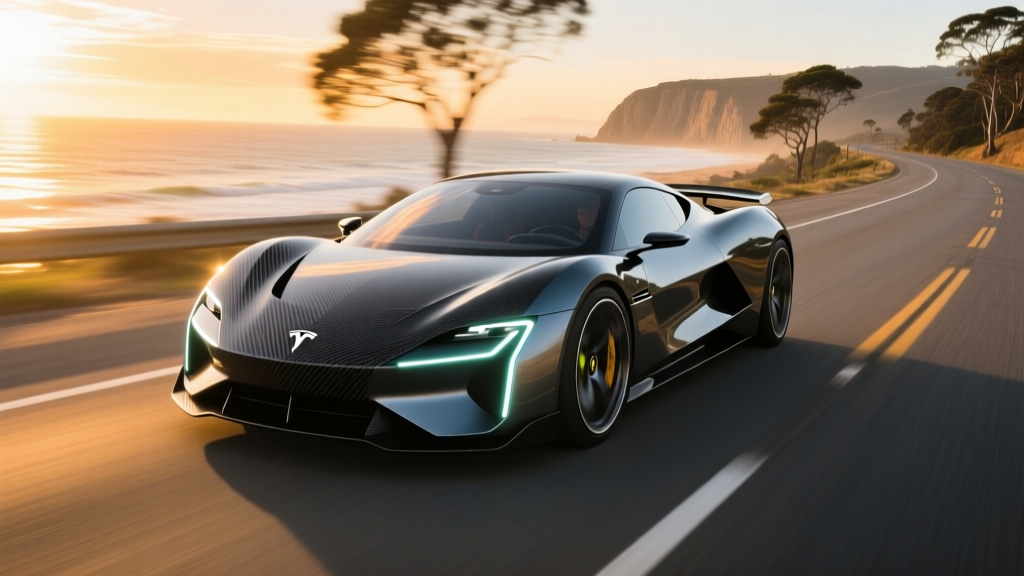
The original Tesla Roadster put the company on the map in 2008. Its successor has been promised since 2017, delayed repeatedly, and now — as of early 2026 — Tesla says the new Roadster will finally reach production. With a claimed sub-1.0-second 0-60 mph time and a 200 kWh battery pack, the upcoming Roadster is engineered to shatter performance records and challenge every notion of what an electric sports car can do. But with a price tag well north of $200,000 and specs that remain preliminary, how much of the hype holds up to scrutiny?
This preview breaks down every confirmed and claimed specification, contextualizes the engineering, and tells you exactly what to expect when (and if) the Roadster reaches driveways.
Performance: The Tesla Roadster 0-60 MPH Claim Explained
The headline number is staggering: Tesla claims the Roadster will achieve a 0-60 mph time of under 1.0 second when equipped with the optional SpaceX cold-gas thruster package. Without the thruster pack, Tesla has previously indicated a 0-60 mph time of approximately 1.9 seconds — which would still tie or beat the current Rimac Nevera and pin it against the fastest production cars ever made.
| Metric | Claimed Figure |
|---|---|
| 0-60 mph (base) | ~1.9 seconds |
| 0-60 mph (SpaceX package) | <1.0 second |
| Top Speed | 250+ mph |
| Quarter Mile | ~8.8 seconds (claimed) |
| Drivetrain | Tri-Motor AWD |
| Horsepower | 1,000+ hp (estimated) |
| Torque | 10,000 Nm / ~7,375 lb-ft at wheels (claimed) |
For reference, the Tesla Model S Plaid — currently one of the quickest production sedans — hits 0-60 mph in 1.99 seconds with 1,020 horsepower from its tri-motor setup. The Roadster is expected to use an evolution of this architecture, tuned for even more aggressive torque delivery and aided by the lower weight and aerodynamic profile of a two-seat sports car.
Battery, Range, and Efficiency
Tesla has stated the Roadster will carry a 200 kWh battery pack — roughly double the usable capacity of a Model S Long Range and the largest pack ever fitted to a production Tesla. The cell chemistry is expected to be a high-nickel NMC (nickel manganese cobalt) or NCA (nickel cobalt aluminum) formulation optimized for energy density rather than the LFP chemistry used in Tesla's standard-range models. The priority here is packing maximum energy into a sports-car footprint.
The claimed EPA-equivalent range target is 620 miles. If certified, that would make the Roadster the longest-range production EV ever sold, surpassing the Lucid Air Grand Touring's EPA-rated 516 miles.
Efficiency figures (MPGe and kWh/100mi) have not been published by the EPA, as the vehicle is not yet in production. Given the 200 kWh pack and 620-mile target, the implied efficiency would be approximately 32 kWh/100mi — reasonable for a high-performance, all-wheel-drive sports car but less efficient than a sedan like the Model 3 (24-26 kWh/100mi).
Charging Speed: DC Fast and Home Level 2
Charging a 200 kWh battery is a significant engineering challenge. Tesla has not published official DC fast-charge peak rates for the Roadster, but based on the company's 4680 cell architecture and the V4 Supercharger network's capabilities, a peak rate of 250-350 kW is plausible. At 350 kW peak (unlikely to be sustained), a 10-80% charge would take roughly 35-45 minutes. At a more conservative sustained average, expect closer to 40-50 minutes for a 10-80% session.
| Charging Level | Power (kW) | Estimated Time / Rate |
|---|---|---|
| Level 1 (120V, 12A) | ~1.4 kW | ~4 mi/hr — impractical for 200 kWh |
| Level 2 (240V, 48A) | ~11.5 kW | ~17-18 hours (0-100%) |
| Level 2 (240V, 80A — Wall Connector) | ~19.2 kW | ~10-11 hours (0-100%) |
| DC Fast Charge (V4 Supercharger) | 250-350 kW (est.) | ~40-50 min (10-80%) |
The sheer size of the 200 kWh pack means home charging on a standard Level 2 setup will take overnight and then some. Owners will want a high-amperage Level 2 circuit (60A or 80A breaker feeding a 48A or 80A charger) to make daily top-ups practical. For daily driving of 40-80 miles, an overnight session at 11.5 kW adds roughly 130-140 miles — more than enough for most commutes.
One advantage of the large pack: you'll rarely need to charge to 100%. Keeping daily charges between 20-80% preserves long-term battery health while still providing ~370 miles of usable range — more than most owners will use in a week.
Pricing, Trims, and Federal Tax Credit Eligibility
When originally announced in 2017, Tesla projected a base price of around $200,000, with the Founders Series (limited to the first 1,000 reservations) priced at $250,000. As of 2026, no updated official MSRP has been published, but industry estimates place the base Roadster at $200,000-$250,000 given inflation, battery costs, and the exotic engineering involved.
| Trim / Package | Estimated MSRP | §30D Credit Eligible? |
|---|---|---|
| Roadster (base) | ~$200,000 | No — exceeds MSRP cap |
| Roadster + SpaceX Package | ~$250,000+ | No — exceeds MSRP cap |
| Founders Series (first 1,000) | $250,000 | No — exceeds MSRP cap |
Under current IRS §30D rules, the federal clean vehicle credit of up to $7,500 has an MSRP cap of $80,000 for sedans and $80,000 for sports cars/vans/SUVs classified as non-trucks. At any projected price above $200,000, the Roadster will categorically not qualify for the federal tax credit. Buyers should also be aware of adjusted gross income caps ($300,000 for joint filers, $150,000 for single filers) and battery component/critical mineral sourcing requirements — though none of these matter when the MSRP cap is exceeded first.
Interior, Cargo, and Practicality
The Roadster is a 2+2 sports car (two front seats, two small rear seats), though the rear seats are best suited for children or cargo overflow. Tesla has shown a minimalist interior consistent with its design language: a central touchscreen (likely 15-17 inches), a yoke-style steering wheel, and a glass roof panel that is removable and stores in the trunk.
Cargo space is limited by the mid-engine battery layout and sports-car proportions. Expect a small front trunk (frunk) and a rear cargo area totaling approximately 5-8 cubic feet combined — enough for a weekend bag for two, but not a road-trip hauler. Legroom figures have not been published, but the low-slung seating position will challenge taller drivers (6'2"+).
This is not a practical daily driver. It is a weekend car, a track toy, and a statement piece. Owners will likely pair it with a more practical vehicle for commuting and errands.
Tech, Driver Assistance, and the SpaceX Thruster Package
The Roadster is expected to ship with Tesla's latest hardware suite, including the HW4 (or newer) Autopilot computer, enabling Tesla Autopilot and Full Self-Driving (Supervised) functionality.
Beyond standard Tesla tech, the Roadster's most distinctive feature is the optional SpaceX cold-gas thruster package. Developed in collaboration with SpaceX, this system uses compressed air stored in tanks to fire small thrusters at strategic points around the car. The effect: increased downforce during hard acceleration and cornering, enabling the sub-1.0-second 0-60 mph claim and dramatically improved lateral grip on a track.
This is not a gimmick — it's a genuine performance differentiator that no other production car offers. However, the thruster tanks will require periodic refilling (likely at a Tesla service center), and the system adds weight and complexity. Real-world reliability and maintenance costs for this system are entirely unknown.
Warranty and Long-Term Ownership
Tesla has not published Roadster-specific warranty terms, but based on the company's current warranty structure for performance models like the Model S Plaid, buyers can reasonably expect:
- Battery & Drive Unit Warranty: 8 years / 150,000 miles, with a minimum 70% battery capacity retention guarantee
- Vehicle Limited Warranty: 4 years / 50,000 miles bumper-to-bumper
The 200 kWh pack will be expensive to replace out of warranty. While Tesla does not publish replacement pricing for unreleased models, a Model S battery replacement currently runs approximately $15,000-$22,000 for a ~100 kWh pack. A 200 kWh Roadster pack could cost $30,000-$40,000+ if replacement is needed beyond the warranty period. Given the high-nickel chemistry and the performance demands placed on the cells, long-term degradation data will be critical to watch once the first production units accumulate mileage.
Tesla Roadster vs. Key Competitors
The Roadster occupies a rarefied space. Its closest competitors are all electric hypercars or ultra-high-performance EVs:
| Vehicle | 0-60 mph | Range (EPA) | Price | Status |
|---|---|---|---|---|
| Tesla Roadster | <1.0s (w/ SpaceX) | 620 mi (claimed) | ~$200,000+ | Announced |
| Rimac Nevera | 1.74s | ~340 mi (WLTP) | $2,200,000 | Available (150 units) |
| Lotus Evija | <3.0s | ~217 mi (WLTP) | $2,300,000 | Limited production |
| Tesla Model S Plaid | 1.99s | 396 mi (EPA) | $89,990 | Available |
| Lucid Air Sapphire | 1.89s | 427 mi (EPA) | $249,000 | Available |
The Roadster's value proposition is clear: hypercar performance at a fraction of the price of a Rimac or Lotus. A $200,000-$250,000 price point undercuts the Nevera by nearly 90%. The trade-off is availability — the Nevera and Evija exist today; the Roadster does not. The Model S Plaid remains the pragmatic alternative: similar straight-line speed, four doors, a proven platform, and a sub-$90,000 price.
Who Should Buy the Tesla Roadster?
The Tesla Roadster is for you if:
- You want record-breaking acceleration and are willing to wait for an announced product
- You value Tesla's Supercharger network and software ecosystem
- You want hypercar performance without the $2M+ hypercar price
- You already own a practical daily driver and want a weekend/track car
Look elsewhere if:
- You need a car today — the Roadster is not yet in production
- You need cargo space, rear-seat practicality, or daily-driver comfort
- You want proven long-term reliability data on a 200 kWh pack
- You're counting on the federal tax credit (it will not qualify)
Frequently Asked Questions
What is the real-world range of the Tesla Roadster?
Tesla claims 620 miles of range, but this figure has not been EPA-certified. In real-world highway driving at 75 mph, expect approximately 450-520 miles. In cold weather, reduce that by 15-25%. Track use at sustained high speeds will dramatically reduce range, potentially below 150 miles per charge.
How fast does the Roadster charge?
Official DC fast-charge specs have not been published. Based on Tesla's V4 Supercharger capabilities and the 200 kWh pack size, expect peak rates of 250-350 kW and a 10-80% charge time of approximately 40-50 minutes. Home Level 2 charging at 11.5 kW will take roughly 17-18 hours for a full charge; an 80A circuit reduces this to about 10-11 hours.
Does the Tesla Roadster qualify for the federal EV tax credit?
No. Under IRS §30D rules, the clean vehicle credit has an MSRP cap of $80,000 for passenger cars. At an estimated $200,000+, the Roadster far exceeds this limit and will not be eligible for the $7,500 federal credit regardless of buyer income or battery sourcing.
Is the Tesla Roadster worth buying vs. the Model S Plaid?
If you need a car now, the Model S Plaid offers 1.99-second 0-60 mph performance, 396 miles of EPA range, four doors, and a proven platform for $89,990. The Roadster is a speculative purchase — you're betting on Tesla's ability to deliver on extraordinary claims, waiting for an undefined production date, and paying more than double. For pure performance-per-dollar today, the Plaid wins. For collectors and enthusiasts willing to wait, the Roadster promises to be a landmark vehicle.
When will the Tesla Roadster be available?
Tesla has indicated a production timeline in the 2025-2026 window, but the vehicle has been delayed multiple times since its 2017 unveiling. Reservation holders should expect potential further delays. No firm delivery date has been confirmed as of early 2026.
What are the biggest pros and cons?
Pros: Record-breaking claimed acceleration; 620-mile range target; access to Tesla's Supercharger network; sub-$250K pricing vs. $2M+ hypercar competitors; SpaceX thruster technology is unique in the industry.
Cons: Not yet in production — availability remains uncertain; 200 kWh pack means long home charging times; no federal tax credit eligibility; SpaceX thruster maintenance and refilling costs are unknown; minimal cargo and rear-seat space; no real-world reliability data exists.