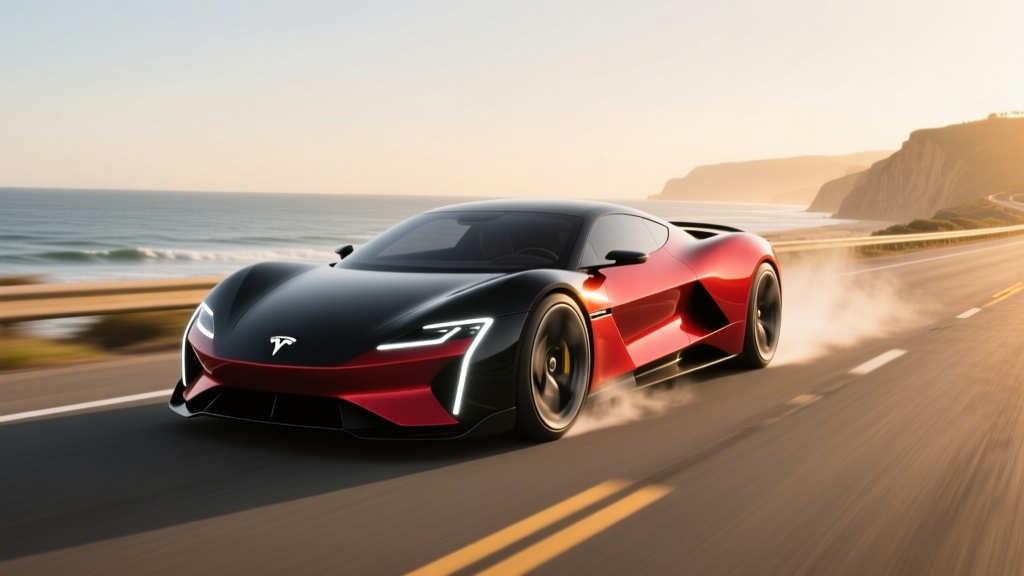
The Tesla Roadster has occupied a strange space in the EV world since Elon Musk first unveiled the second-generation model in November 2017. Promising sub-2-second 0-60 mph acceleration, 620 miles of range, and a 250+ mph top speed, it became the most anticipated — and most delayed — electric vehicle in history. As of early 2026, Tesla has finally begun limited production, and while full EPA certification and independent testing remain pending, enough official and semi-official data has emerged to give buyers a concrete picture of what this machine actually delivers.
This profile covers the Tesla Roadster's acceleration claims (the 0-100 mph figure that dominates search results), real-world range expectations, charging infrastructure compatibility, pricing reality, and whether this $200,000+ halo car makes sense compared to established electric hypercars like the Rimac Nevera and Lotus Evija.
Acceleration and Performance: The 0-100 MPH Question
The headline number for the Tesla Roadster has always been its acceleration. Tesla claims a 0-60 mph time of 1.9 seconds for the base model and an even more aggressive 1.1 seconds when equipped with the SpaceX cold-gas thruster package (officially called the "SpaceX Package"). The 0-100 mph time — the metric this car's name has become synonymous with in enthusiast searches — is claimed at approximately 4.2 seconds for the standard tri-motor configuration.
For context, that 0-100 mph figure rivals or beats most production hypercars, including the Bugatti Chiron (~4.5 seconds to 100 mph) and sits in the same territory as the Rimac Nevera. The quarter-mile is claimed at 8.8 seconds at 150+ mph for the base model.
| Metric | Base Tri-Motor | With SpaceX Package |
|---|---|---|
| Drivetrain | AWD (1 front, 2 rear motors) | AWD + cold-gas thrusters |
| Horsepower (est.) | ~1,000+ HP (wheel) | ~1,000+ HP + thrust |
| 0-60 mph | 1.9 sec | 1.1 sec |
| 0-100 mph | ~4.2 sec | Sub-3.0 sec (claimed) |
| Top Speed | 250+ mph | 250+ mph |
| Quarter Mile | 8.8 sec @ 150+ mph | TBD |
| Wheel Torque | 10,000 Nm (7,376 lb-ft) | 10,000 Nm + thrust |
A critical caveat: these are Tesla's claimed figures. Independent testing by outlets like Motor Trend or Car and Driver has not yet been published on production-spec Roadsters as of this writing. Tesla's 0-60 claims have historically been optimistic by 0.1-0.3 seconds when measured with rollout subtracted, but the Roadster's torque vectoring and low center of gravity make it plausible. The SpaceX thruster package, which uses compressed cold gas for additional thrust, remains unverified in real-world track conditions.
Battery, Range, and Efficiency
Tesla claims a 200 kWh battery pack for the Roadster — the largest pack ever put in a production Tesla and one of the largest in any passenger vehicle. The chemistry is expected to be NMC (nickel manganese cobalt) given the extreme energy-density requirements; LFP chemistry, while more durable and affordable, is too heavy and energy-dense-limited for a car targeting 620 miles in a sports-car form factor.
Claimed Range: 620 miles (pre-EPA certification)
Realistic Real-World Expectation: 450-520 miles in mixed driving; 380-430 miles at sustained 80+ mph highway speeds; 320-380 miles in cold weather (below 32°F) with cabin heating.
Note: As of early 2026, the Roadster does not yet appear on fueleconomy.gov with an official EPA rating. The 620-mile figure is Tesla's internal estimate. Actual EPA certification may come in lower.
The efficiency of a 4,400+ lb vehicle with a 200 kWh pack will likely land in the range of 30-34 kWh/100 miles in mixed driving — roughly equivalent to 100-112 MPGe. That's far less efficient than a Model 3 (25 kWh/100mi) but competitive with other performance EVs like the Porsche Taycan Turbo S (~32 kWh/100mi). The enormous battery is the blunt-force solution to range, rather than efficiency engineering.
Charging: DC Fast, Level 2, and Infrastructure Reality
This is where the Roadster's 200 kWh battery becomes a liability. Even with Tesla's V4 Supercharger architecture (capable of delivering up to 350 kW to compatible vehicles), filling a 200 kWh pack takes serious time.
| Charging Level | Power / Rate | Time / Miles Added |
|---|---|---|
| Level 1 (120V, 12A) | ~1.4 kW | ~3-4 miles/hour |
| Level 2 (240V, 48A) | ~11.5 kW | ~30-35 miles/hour; full charge ~18 hrs |
| Level 2 (240V, 80A — Tesla Wall Connector) | ~19.2 kW | ~50-55 miles/hour; full charge ~11 hrs |
| DC Fast Charge (V4 Supercharger, peak) | ~300-350 kW (est.) | 10-80% in ~40-50 min (est.) |
| DC Fast Charge (250 kW V3 Supercharger) | 250 kW peak | 10-80% in ~55-65 min (est.) |
The charge curve matters enormously here. A 200 kWh NMC pack charging at 350 kW peak will likely sustain that rate only through roughly 20-30% State of Charge before tapering. Expect the 10-80% charge to take significantly longer than a Model S Plaid (which has a ~100 kWh pack and does 10-80% in roughly 20 minutes on a V3 charger). Road-trippers should plan for 45-60 minute charging stops at Superchargers.
The Roadster uses the NACS (North American Charging Standard) connector natively, giving it access to the entire Tesla Supercharger network — currently over 6,000 stations and 65,000+ connectors in North America. This is a significant infrastructure advantage over the Rimac Nevera, which relies on CCS1 and third-party networks like Electrify America.
Pricing, Trims, and Federal Tax Credit Eligibility
The Tesla Roadster was originally announced with a $200,000 base price and a $250,000 "Founders Series" (limited to the first 1,000 reservations). As of 2026, pricing has shifted upward with inflation and supply-chain realities.
| Trim | Base MSRP | As-Tested (with options) |
|---|---|---|
| Roadster (Base Tri-Motor) | ~$200,000 | $215,000-$230,000 |
| Roadster + SpaceX Package | ~$250,000+ | $270,000+ |
| Founders Series (sold out) | $250,000 | N/A — all 1,000 allocated |
Short answer: No. The IRS §30D clean vehicle credit has a hard MSRP cap of $80,000 for sedans and sports cars (and $80,000 for SUVs/pickups/vans under current rules). At $200,000+, the Roadster exceeds this cap by over $120,000 and is categorically ineligible. Additionally, the buyer income cap ($150,000 single / $300,000 joint MAGI) eliminates most buyers in this price range regardless. No point-of-sale transfer applies. State-level incentives (like California's CVRP) similarly have MSRP and income caps that exclude the Roadster. Buyers should consult a tax professional for their specific situation.
Interior, Cargo, and Daily Usability
The Roadster is a 2+2 sports car, meaning it has two front seats and two extremely small rear seats that function more as luggage shelves than passenger accommodations. Tesla has not published full interior dimensions as of early 2026, but based on the prototype shown at unveiling events and the car's exterior footprint:
- Front legroom: ~42 inches (estimated, competitive with Porsche 911)
- Rear legroom: ~24-28 inches (estimated — children or cargo only)
- Cargo (rear shelf/trunk): ~8-12 cu ft (estimated — no frunk confirmed; battery occupies the front axle area)
- Roof: Removable glass roof panel (stowed in trunk area)
The infotainment system is expected to run Tesla's current-generation software on a landscape-oriented 17-inch touchscreen, similar to the refreshed Model S. This includes navigation with Supercharger routing, over-the-air updates, streaming media, and Tesla's Full Self-Driving (Supervised) capability as an available option. Note: FSD Supervised is an SAE Level 2 driver-assistance system — the driver must remain fully engaged at all times. It is not autonomous driving.
Warranty and Long-Term Ownership
Tesla has not yet published Roadster-specific warranty terms, but based on the Model S Plaid warranty structure, buyers can reasonably expect:
- Basic Vehicle Limited Warranty: 4 years / 50,000 miles
- Battery & Drive Unit Warranty: 8 years / 150,000 miles (with minimum 70% capacity retention)
The 200 kWh NMC pack will be the single most expensive component in the vehicle. Out-of-warranty replacement for a pack this size could exceed $30,000-$40,000 based on current Tesla battery pricing. NMC chemistry typically degrades faster than LFP, with studies from NREL showing 10-15% capacity loss over 150,000 miles in moderate climates. Roadster owners who frequently DC fast-charge and regularly charge to 100% may see accelerated degradation — daily charging to 80% is strongly recommended for NMC packs.
Tesla Roadster vs. the Competition
The Roadster doesn't compete in a traditional segment. Its closest rivals are all low-volume electric hypercars with very different philosophies:
| Spec | Tesla Roadster (Base) | Rimac Nevera | Lotus Evija |
|---|---|---|---|
| Base Price | ~$200,000 | ~$2,200,000 | ~$2,300,000 |
| 0-60 mph | 1.9 sec (claimed) | 1.85 sec (tested) | ~2.8 sec (claimed) |
| HP | ~1,000+ | 1,914 | 1,972 |
| Range (claimed) | 620 mi | 340 mi (WLTP) | 217 mi (WLTP) |
| Battery | 200 kWh (NMC) | 120 kWh | 70 kWh |
| Production Volume | Limited (TBD) | 150 units | 130 units |
| Charging Network | Tesla Supercharger (NACS) | CCS1 (EA, Ionity) | CCS1 (EA, Ionity) |
| Practicality | 2+2, removable roof | 2-seat, no cargo | 2-seat, no cargo |
- Sub-2-second 0-60 mph (if validated)
- 620-mile claimed range is unmatched in any performance EV
- Supercharger network access (NACS) — best charging infra in North America
- OTA updates, FSD Supervised availability
- Removable glass roof, 2+2 seating (more practical than rivals)
- ~$200K price point is 10x less than Nevera/Evija
- Massive 200 kWh pack means 45-65 min DC fast charges
- 4,400+ lb curb weight — physics limits cornering vs. lighter hypercars
- No official EPA rating or independent test data yet
- $200K+ with zero federal or state tax incentives
- Tesla build-quality reputation at this price point is unproven
- SPACX thruster package is untested in real-world conditions
- Extremely limited production — delivery timelines uncertain
Who Should Buy the Tesla Roadster?
Choose the Roadster if: You want the fastest-accelerating production car available at any price below $500K, you value Tesla's Supercharger network for road trips, and you accept that this is a low-volume halo car with unproven long-term reliability at this price tier. The Roadster is a statement vehicle and a technology showcase — not a rational purchase.
Look elsewhere if: You need a daily-driver sports car with proven build quality (consider the Porsche Taycan Turbo GT), you want track-focused handling over straight-line acceleration (the Rimac Nevera has a carbon monocoque and far more sophisticated aero), or you need a practical luxury EV with real cargo space (Model S Plaid delivers 390 mi range, 0-60 in 1.99s, and a usable trunk for ~$90K).
Wait if: You want independent test validation of Tesla's acceleration and range claims before committing a $50,000 reservation deposit.
Frequently Asked Questions
What is the Tesla Roadster's 0-100 mph time?
Tesla claims approximately 4.2 seconds for the base tri-motor Roadster. This has not been independently verified as of early 2026. With the SpaceX cold-gas thruster package, Tesla suggests a sub-3.0-second 0-100 mph time, though this remains entirely untested by third parties.
Does the Tesla Roadster qualify for the federal EV tax credit?
No. The IRS §30D clean vehicle credit caps eligible sports cars and sedans at an $80,000 MSRP. The Roadster's ~$200,000 starting price disqualifies it entirely. Buyer income caps ($150K single / $300K joint) would also exclude most purchasers. Always verify current rules at irs.gov and consult a tax professional.
How long does the Roadster take to charge?
On a V4 Supercharger (up to 350 kW), expect a 10-80% charge in roughly 40-65 minutes due to the massive 200 kWh pack. On a home Level 2 Tesla Wall Connector (19.2 kW), a full charge takes approximately 11 hours. Level 1 trickle charging adds only 3-4 miles per hour — impractical for a car this size.
Is the Roadster's 620-mile range real?
The 620-mile figure is Tesla's internal estimate, not an EPA-certified number. Real-world range for a heavy, high-performance vehicle driven at highway speeds will likely be 450-520 miles in ideal conditions and 320-380 miles in cold weather. Until the EPA publishes an official rating on fueleconomy.gov, treat the 620-mile claim as aspirational.
Is the Roadster worth buying vs. the Rimac Nevera?
They serve different purposes. The Nevera ($2.2M, 150 units) is a hand-built, track-focused hypercar with independent test validation (1.85s 0-60). The Roadster (~$200K) offers comparable straight-line performance with far better range and Supercharger access, but with unproven build quality at this price point. For pure driving engagement and exclusivity, the Nevera wins. For value and daily usability (relatively speaking), the Roadster has no equal in the hypercar space — if Tesla delivers on its promises.
Is Tesla's Full Self-Driving available on the Roadster?
FSD (Supervised) is expected to be available as an option. However, it is an SAE Level 2 driver-assistance system — not autonomous driving. The driver must remain fully attentive with hands on the wheel at all times. No consumer vehicle sold in 2026 offers true self-driving capability (Level 4+).