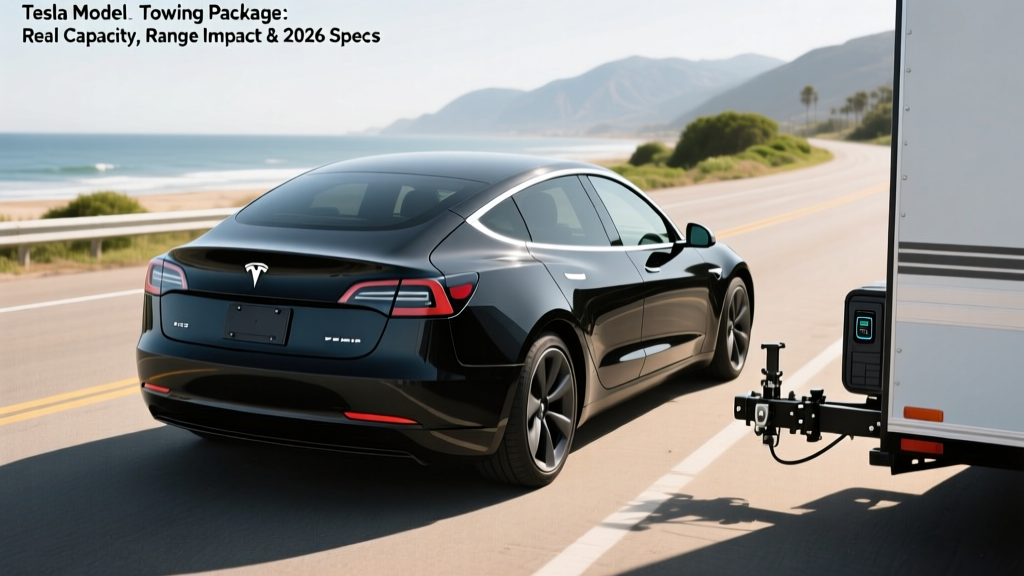
The Tesla Model 3 was never designed as a workhorse hauler, but the addition of a factory tow hitch has opened light-duty utility for sedan buyers who need to pull a small trailer, bike rack, or jet ski. If you've been searching for details on the Tesla Model 3 towing package, you've likely noticed that information is scattered and sometimes contradictory. This profile cuts through the noise with exact specs, real-world range impact while towing, and whether the Model 3's tow rating makes practical sense for your use case in 2026.
Tesla Model 3 Towing Package: What's Included and What It Can Pull
The Tesla Model 3 tow package consists of a factory-installed tow hitch receiver and the software-enabled towing mode. In the US market, the package costs $1,000 at the time of order and cannot be retrofitted through Tesla's service centers after delivery — you must select it at purchase. The hitch is a 1.25-inch receiver (Class I equivalent), and the wiring harness is integrated into the vehicle's electrical system.
Here is the critical number: the Model 3 Long Range AWD carries a maximum tow rating of 2,060 lbs (935 kg). The Rear-Wheel Drive (RWD) base model is not rated for towing in the US market. This is a light-duty rating suitable for:
- Small utility trailers (4×8 ft, unloaded ~800 lbs)
- Two-bike or four-bike hitch racks (150–300 lbs loaded)
- Jet skis on a single-axle trailer (~1,500–1,800 lbs)
- Lightweight teardrop campers (1,200–1,800 lbs dry)
It is not suitable for boat trailers over 2,000 lbs, enclosed cargo trailers, horse trailers, or any travel trailer that approaches the 2,060-lb ceiling when loaded. Always factor in the weight of cargo, fluids, and gear loaded onto or into whatever you're towing.
| Specification | Long Range AWD | RWD (Base) | Performance |
|---|---|---|---|
| Max Tow Rating | 2,060 lbs | Not rated | Not rated |
| Hitch Receiver Size | 1.25 in (Class I) | N/A | N/A |
| Tow Package Cost | $1,000 | N/A | N/A |
| Tongue Weight Max | ~200 lbs | N/A | N/A |
| Trailer Brake Controller | Not included | N/A | N/A |
One important note: Tesla does not include a trailer brake controller, and the Model 3's electrical architecture does not natively support one. For trailers near the 2,060-lb limit, this means you're relying entirely on the trailer's own inertia or surge brakes, if equipped.
Range, Battery, and the Towing Penalty
The 2026 Tesla Model 3 Long Range AWD carries an EPA-estimated range of 341 miles on its 75 kWh usable battery pack (approximately 82 kWh gross). Tesla uses a lithium-ion chemistry with a nickel-manganese-cobalt (NMC) cathode in the Long Range variant, chosen for its higher energy density compared to the LFP (lithium iron phosphate) chemistry found in the base RWD model.
EPA estimate: 341 miles (Long Range AWD). Expect 280–310 miles in mixed highway driving at 70+ mph, and as low as 220–250 miles in freezing temperatures (below 32°F) due to battery resistance and cabin heating demands.
Towing impact: When pulling a 1,500–2,000 lb trailer, expect range to drop by 35–50%. That same 341-mile EPA range becomes approximately 170–220 miles under load at highway speeds. Aerodynamic drag from the trailer is the primary culprit, and this penalty worsens at speeds above 60 mph.
The range reduction while towing is the single biggest practical limitation of the Model 3 tow package. On a road trip from Denver to Moab (roughly 350 miles), you'd need at least two charging stops while towing — compared to zero or one unladen. Plan routes around Supercharger availability and expect 20–30 minute charge breaks at each stop.
| Spec | Value |
|---|---|
| EPA Range | 341 miles |
| Battery (Usable/Gross) | 75 kWh / ~82 kWh (NMC) |
| Efficiency | 132 MPGe combined / 25 kWh/100mi |
| Drivetrain | Dual-motor AWD |
| Horsepower | 346 hp (combined) |
| 0–60 mph | 4.2 seconds |
| Top Speed | 125 mph |
| Max DC Fast Charge | 250 kW (peak) |
| 10–80% DC Charge Time | ~27 minutes |
| Level 2 Home Charge Rate | 11.5 kW (~44 mi/hr) |
| Cargo Volume (Trunk + Frunk) | 23.0 cu ft + 3.1 cu ft |
| Rear Legroom | 35.3 inches |
| Battery Warranty | 8 years / 120,000 miles |
| Basic Vehicle Warranty | 4 years / 50,000 miles |
Charging Speed: DC Fast, Level 2, and Towing-Route Planning
The Model 3 Long Range supports a peak DC fast-charge rate of 250 kW on V3 and V4 Tesla Superchargers. In practice, the charge curve peaks briefly and tapers significantly above 50% state of charge. The 10–80% charge takes approximately 27 minutes under optimal conditions (battery preconditioned via navigation routing to a Supercharger).
At home on a Level 2 charger (240V, 48A circuit), the onboard charger accepts up to 11.5 kW, adding roughly 44 miles of range per hour. A full overnight charge from 20% to 100% takes about 7–8 hours on a Tesla Wall Connector or equivalent Level 2 unit.
For towing trips, the practical charging picture looks like this:
- Preconditioning matters: Always navigate to your Supercharger stop via the Tesla app or in-car nav. This warms the battery to optimal charging temperature, which can shave 5–10 minutes off the session.
- Towing range = shorter legs: With ~180 miles of real towing range, plan Supercharger stops every 150 miles to maintain a safety buffer.
- Destination charging: At campsites or trailheads with 240V outlets (NEMA 14-50), you can recover roughly 44 mi/hr — enough to fully replenish overnight.
The Tesla Supercharger network remains the most reliable DC fast-charging ecosystem in the US, though the Model 3 now also supports NACS-native charging at third-party stations opening to Tesla-connector vehicles. You no longer need a CCS adapter at non-Tesla chargers that have adopted the NACS standard.
Performance and Driving Dynamics While Towing
The Model 3 Long Range AWD produces 346 horsepower and achieves a 0–60 mph time of 4.2 seconds unladen. Dual electric motors provide instant torque at all RPMs, which translates to confident merging and hill-climbing even with a trailer attached. Unlike a gas engine that needs to downshift and build revs, the electric powertrain delivers linear acceleration under load.
That said, the Model 3's low curb weight (~4,030 lbs) means a 2,000-lb trailer represents nearly 50% of the vehicle's mass. This affects:
- Braking distance: Increased significantly. Regen braking helps slow the combination, but the Model 3's friction brakes are sized for the sedan alone. Allow extra following distance.
- Handling: The low center of gravity (battery pack under the floor) helps stability, but crosswinds and passing semis will push the combination around more than a heavier tow vehicle like a Model X or a midsize truck.
- Suspension: The Model 3's sport-tuned suspension was not engineered for tongue weight. You may notice rear sag with heavier tongue loads approaching 200 lbs.
Pricing, Trims, and Federal Tax Credit Eligibility
For the 2026 model year, the Model 3 lineup starts at $38,990 for the RWD base model (which cannot tow). The Long Range AWD — the only tow-capable variant — starts at $45,740, with the tow package adding $1,000, bringing the minimum tow-equipped price to $46,740 before destination fees.
| Trim | Base MSRP | + Tow Package | Est. After §30D Credit |
|---|---|---|---|
| RWD | $38,990 | Not available | ~$31,490* |
| Long Range AWD | $45,740 | $46,740 | ~$39,240* |
| Performance | $52,990 | Not available | ~$45,490* |
*Estimated after $7,500 federal tax credit. Actual eligibility depends on buyer income, battery sourcing, and point-of-sale transfer rules.
The IRS §30D federal EV tax credit offers up to $7,500 for qualifying buyers, but eligibility is layered:
- MSRP cap: Sedans must be priced at or below $55,000. The Model 3 Long Range with tow package clears this easily.
- Income cap: Modified adjusted gross income must not exceed $150,000 (single), $225,000 (head of household), or $300,000 (joint filing).
- Battery sourcing: The $7,500 credit splits into two halves — $3,750 for critical minerals and $3,750 for battery component sourcing. Tesla's battery supply chain has shifted significantly toward North American and FTA-partner sourcing, but the exact credit amount (full $7,500 vs. $3,750) can change based on current-year battery component origin. Always verify on the IRS qualified vehicles list before purchasing.
- Point-of-sale transfer: As of 2024, buyers can transfer the credit to the dealer at purchase, reducing the out-of-pocket price immediately rather than waiting for a tax refund.
Interior, Tech, and Daily Usability
The refreshed Model 3 interior (post-"Highland" redesign) features a minimalist cabin anchored by a 15.4-inch central touchscreen that controls virtually all vehicle functions. There are no physical buttons for climate, mirrors, or glovebox — everything routes through the display. This is polarizing: some owners love the clean aesthetic, while others find it distracting while driving.
Key tech features include:
- Autopilot (standard): Adaptive cruise control and lane-centering — an SAE Level 2 driver-assist system. The driver must remain fully engaged with hands on the wheel.
- Full Self-Driving (Supervised): Optional $8,000 upgrade adding automatic lane changes, traffic light recognition, and navigate-on-Autopilot. Still Level 2 — not autonomous driving.
- Ventilated front seats: Added in the Highland refresh, a meaningful comfort upgrade for long drives.
- Rear-seat entertainment screen: An 8-inch display for rear passengers (climate and media controls).
- Ambient lighting and acoustic glass: Significantly improved cabin quietness over the pre-2024 Model 3.
Cargo space totals 23.0 cubic feet in the trunk plus 3.1 cubic feet in the front trunk (frunk). Rear legroom is 35.3 inches, adequate for adults on shorter trips but tight for taller passengers on long hauls. The rear seat folds 60/40 for longer cargo, though the sedan's trunk opening limits what you can load compared to a hatchback or crossover.
Pros, Cons, and the Verdict on Towing
- 250 kW peak DC fast charging
- Supercharger network reliability
- Instant torque for confident towing acceleration
- Low running costs (~$0.04–0.08/mi on home electricity)
- Strong safety ratings (IIHS Top Safety Pick+)
- Over-the-air updates improve features over time
- 2,060-lb tow rating is very limited
- 35–50% range loss while towing
- No trailer brake controller support
- 1.25-inch receiver limits hitch accessory options
- Screen-dependent controls can distract
- Tow package must be ordered at purchase — no retrofit
Who Should Buy the Model 3 With the Tow Package?
The Tesla Model 3 towing package makes sense for a narrow buyer profile: someone who primarily drives the car as a daily commuter and needs occasional, light-duty towing — a bike rack for weekend trail rides, a small utility trailer for hardware store runs, or a lightweight jet ski trailer for lake days within a 150-mile radius.
It does not make sense if:
- You need to tow a camper trailer on multi-day road trips (range loss makes this impractical)
- Your trailer weighs over 1,800 lbs loaded
- You regularly tow in mountainous terrain (range and brake concerns compound)
- You need a 2-inch receiver for heavy-duty hitch accessories
If towing is a frequent or heavy-duty need, the Tesla Model Y (3,500-lb rating, hatchback utility) or a dedicated electric truck like the Ford F-150 Lightning (7,700–10,000 lbs) are far more capable choices. The Model 3 tow package is a convenience add-on, not a workhorse solution.
Frequently Asked Questions
Can the Tesla Model 3 tow a small camper trailer?
Only very lightweight teardrop campers under 1,800 lbs loaded. The 2,060-lb max rating leaves little margin, and the 35–50% range reduction while towing means a 341-mile EPA range drops to roughly 170–220 miles. Plan charging stops accordingly.
Can I add the tow hitch after delivery?
Not through Tesla. The tow package must be selected at the time of order. Third-party hitches exist, but using one may void portions of the vehicle warranty and will not activate the car's software towing mode.
Does the Model 3 tow package include trailer sway control?
Tesla's stability control system provides basic trailer sway mitigation through brake application and torque reduction, but it is not as sophisticated as the dedicated trailer sway control systems found in trucks and larger SUVs.
How does the Model 3 tow rating compare to the Model Y?
The Tesla Model Y Long Range is rated to tow 3,500 lbs — nearly 70% more than the Model 3 — and offers hatchback cargo utility. If towing is a priority, the Model Y is the stronger Tesla sedan-adjacent choice.
Does towing affect the Model 3 battery warranty?
Towing within the rated 2,060-lb limit does not void the battery or powertrain warranty (8 years/120,000 miles for Long Range). However, damage caused by overloading or improper towing setup would not be covered.