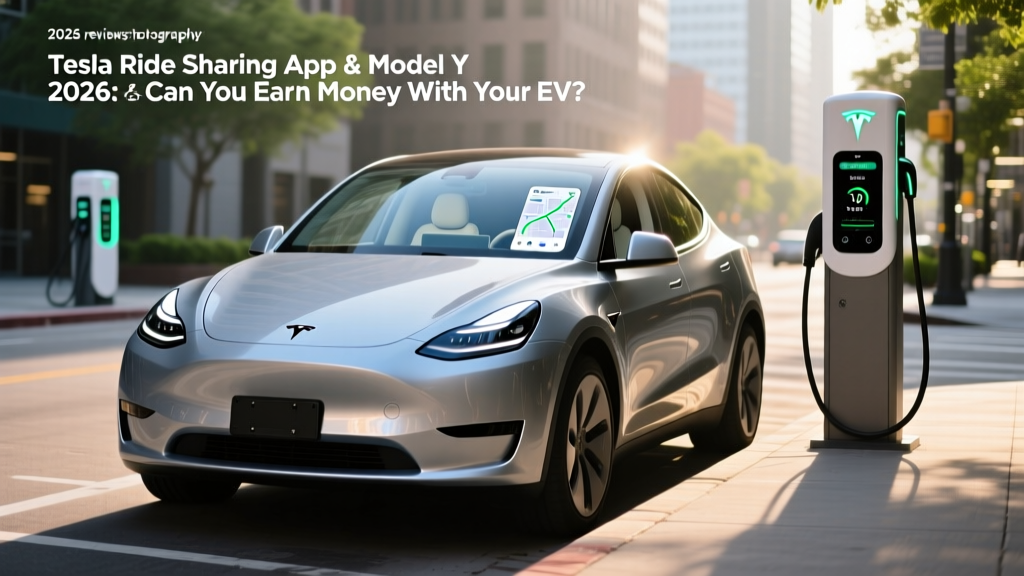
The idea of putting your Tesla to work has intrigued owners since Elon Musk first teased a Tesla Network. As of 2026, the conversation around a Tesla ride sharing app continues to evolve — but the vehicle at the center of that ambition remains the Tesla Model Y. Whether you're evaluating the Model Y as a daily driver, a family hauler, or a potential revenue-generating asset for future Tesla ride-hailing or third-party platforms like Uber and Lyft, you need hard data on range, charging speed, operating costs, and total ownership economics. This review delivers exactly that.
The Tesla Ride Sharing App Landscape in 2026
Tesla has signaled intentions to launch a proprietary ride-hailing network — sometimes referred to as the Tesla Network — that would allow owners to deploy their vehicles for autonomous or semi-autonomous ride sharing. As of early 2026, Tesla has begun limited pilot programs in select metro areas (Austin, Phoenix, and parts of the Bay Area) using vehicles equipped with Hardware 4.0 and the latest FSD (Supervised) software. However, a fully open, consumer-accessible Tesla ride sharing app where any owner can list their car is not yet broadly available nationwide.
What is available today: Tesla owners can use their Model Y on platforms like Uber and Lyft, provided they meet those platforms' vehicle age and condition requirements. The Model Y's low per-mile electricity cost and minimal maintenance make it one of the most profitable vehicles for ride-share drivers — if the math works in your market.
2026 Tesla Model Y: Full Spec Breakdown
The 2026 Model Y received a significant refresh (internally dubbed "Juniper") with updated styling, improved suspension tuning, a quieter cabin, and revised powertrain efficiency. Here are the numbers that matter for ownership — and for ride-share economics.
| Spec | Long Range AWD | Performance |
|---|---|---|
| EPA Range | 320 miles | 295 miles |
| Battery (usable) | ~78 kWh, NMC | ~78 kWh, NMC |
| Drivetrain | Dual-motor AWD | Dual-motor AWD |
| Horsepower | 384 hp | 456 hp |
| 0-60 mph | 4.8 sec | 3.5 sec |
| MPGe (combined) | 121 MPGe | 111 MPGe |
| Efficiency | 28 kWh/100 mi | 30 kWh/100 mi |
| Max DC Fast Charge | 250 kW | 250 kW |
| 10-80% DC Time | ~25 min | ~25 min |
| Level 2 (11.5 kW) | ~44 mi/hr | ~44 mi/hr |
| Base MSRP | $44,990 | $51,490 |
Source: fueleconomy.gov and Tesla.com official specifications.
Real-World Range: What the EPA Sticker Doesn't Tell You
EPA Estimate: 320 miles
Real-World Highway (70-75 mph): ~265-285 miles
Real-World City / Ride-Share Driving: ~290-310 miles
Cold Weather (below 32°F): ~220-255 miles (20-30% reduction)
With Heat Pump Active (moderate cold): ~255-280 miles
For ride-share drivers, the city-heavy stop-and-go driving pattern actually favors EVs. Regenerative braking recovers energy that would be lost in a gas car, and the Model Y's efficiency at low speeds is excellent. Expect to squeeze close to the EPA 320-mile figure during urban ride-share shifts in mild weather. Highway-heavy airport runs will pull that number down to roughly 270 miles.
The 2026 Juniper refresh includes an improved heat pump that reduces cold-weather range loss compared to prior model years — but physics is physics. If you drive in Minneapolis or Chicago winters, budget for 20-30% range reduction and plan charging accordingly.
Charging Speed: The Make-or-Break for Ride-Share Use
If you're driving for a ride-share service, charging downtime is lost revenue. The Model Y's charging profile is strong but not class-leading in 2026.
| Level | Power | Speed | Notes |
|---|---|---|---|
| Level 1 (120V) | ~1.4 kW | ~4 mi/hr | Emergency only |
| Level 2 (240V, 48A) | 11.5 kW | ~44 mi/hr | Full charge in ~7.5 hrs |
| DC Fast (Tesla Supercharger V3) | 250 kW peak | ~175 mi in 15 min | Tapers above 60% |
| DC Fast (CCS adapter) | Up to 250 kW | Varies by station | Non-Tesla networks |
Charging curve reality: The 250 kW peak only holds roughly between 10-30% State of Charge (SoC). From 30-60%, you'll see ~175-200 kW. Above 60%, the curve tapers significantly — expect ~80-100 kW from 60-80%, and a slow trickle above 85%. For ride-share drivers, the practical strategy is to charge from 15-70% (about 18-20 minutes at a V3 Supercharger), which adds roughly 180 miles of range. Charging past 80% is rarely worth the time unless you're parking overnight.
The 2026 Model Y uses the NACS connector natively, meaning seamless plug-and-charge at all Tesla Supercharger stations. Tesla also includes a CCS adapter for access to Electrify America, EVgo, and other networks — critical for ride-share drivers in areas with limited Supercharger coverage.
Pricing, Tax Credits, and Ride-Share Economics
| Trim | MSRP | Est. Credit | Net Price |
|---|---|---|---|
| Long Range AWD | $44,990 | Up to $7,500* | ~$37,490* |
| Performance | $51,490 | Up to $7,500* | ~$43,990* |
*Under IRS §30D, the federal EV tax credit is up to $7,500 — but eligibility depends on multiple factors that change frequently. As of 2026:
- MSRP Cap: SUVs must be under $80,000 (Model Y qualifies comfortably)
- Buyer Income Cap: Modified AGI must not exceed $150,000 (single) / $300,000 (joint)
- Battery Sourcing: Critical minerals and battery components must meet escalating domestic-sourcing thresholds. Tesla's US-built battery cells have generally met these requirements, but verify at irs.gov before purchase
- Point-of-Sale Transfer: As of 2024+, you can transfer the credit to the dealer at purchase, reducing your out-of-pocket cost immediately rather than waiting for a tax return
Ride-share cost-per-mile analysis: At the US average residential electricity rate of ~$0.16/kWh (EIA data), charging a Model Y Long Range costs roughly $4.48 for 100 miles of range — or $0.045/mile. Compare that to a Toyota Camry at ~30 MPG and $3.40/gallon gas: $0.113/mile. Over 40,000 miles of ride-share driving per year, the Model Y saves approximately $2,720 in fuel alone. Factor in eliminated oil changes and reduced brake wear (thanks to regenerative braking), and the operating-cost advantage grows.
Interior, Cargo, and Passenger Comfort
Ride-share passengers care about space and comfort. The 2026 Juniper refresh improved rear-seat cushioning and added acoustic glass, making the Model Y noticeably quieter than prior years.
- Rear legroom: 41.6 inches — generous for passengers up to ~6'2"
- Cargo (rear seats up): 30.2 cu ft
- Cargo (rear seats folded): 72.1 cu ft
- Frunk: 4.1 cu ft — useful for ride-share supplies, charging cables
- Front trunk + cargo total: 76.2 cu ft maximum
For UberX and Lyft Standard, the Model Y offers more rear-seat room than most midsize sedans. The panoramic glass roof creates an airy feel that passengers consistently rate highly. The minimalist interior (single 15.4-inch center touchscreen, no instrument cluster) is polarizing for some drivers but keeps the cabin uncluttered.
The 2026 model adds ventilated front seats, ambient lighting, and power-folding second-row seats — all welcome upgrades for a vehicle you'll spend 6-10 hours a day inside.
Driver Assistance, Tech, and the FSD Question
Tesla Autopilot and FSD (Supervised) are Level 2 driver-assistance systems. The driver must remain fully attentive, hands on or near the wheel, and ready to intervene at any moment. These systems do NOT make the Model Y self-driving. Autonomous Level 4 ride-hailing is currently only available through Waymo (in Phoenix, San Francisco, Los Angeles, and Austin) and Zoox (limited Las Vegas operations). Never use FSD as a substitute for active driving.
The 2026 Model Y ships with Hardware 4.0 (AI4) and includes:
- Basic Autopilot (included): Traffic-aware cruise control, lane centering, automatic emergency braking, blind-spot monitoring
- FSD Supervised ($8,000 add-on or $99/month): Adds automatic lane changes, on/off-ramp navigation, traffic-light and stop-sign recognition, and assisted parking. Requires active driver supervision
- Sentry Mode: Cameras record surroundings when parked — valuable for ride-share vehicles in urban environments
- Dashcam: Built-in recording with USB export for incident documentation
For ride-share drivers, FSD's value is debatable. It reduces fatigue on highway segments (airport runs, inter-city trips), but city driving still demands constant intervention. The $8,000 purchase price is hard to justify purely for ride-share use; the $99/month subscription is more practical if you want to test it during high-volume driving weeks.
Battery Warranty, Longevity, and Replacement Costs
Tesla warrants the Model Y's battery and drive unit for 8 years or 120,000 miles (Long Range/Performance), whichever comes first, with a minimum 70% capacity retention threshold. This is competitive with the industry standard.
The Model Y uses NMC (nickel manganese cobalt) battery chemistry, which offers higher energy density than LFP (lithium iron phosphate) but is more sensitive to sustained high SoC. For maximum longevity:
- Set daily charge limit to 80% (Tesla's own recommendation for NMC)
- Avoid frequent 100% charges unless needed for a long trip
- Minimize DC fast-charging sessions above 2-3 per week when possible
- Use preconditioning before fast charging to protect cell health
Real-world degradation data from Tesla's fleet suggests ~5-8% capacity loss over the first 100,000 miles, after which the curve flattens. A full battery replacement outside warranty runs approximately $12,000-$16,000 at current pricing — a cost to factor into long-term ride-share economics if you plan to drive past 150,000 miles.
Pros, Cons, and the Verdict
Pros
- Lowest cost-per-mile in its class ($0.045/mi on avg electricity)
- Supercharger network — still the most reliable DC fast-charging ecosystem
- Strong resale value relative to most EVs
- Spacious rear seat and cargo area for ride-share passengers
- Over-the-air updates continuously add features
- Sentry Mode and dashcam reduce liability risk
Cons
- No dedicated Tesla ride sharing app broadly available yet
- FSD ($8,000 or $99/mo) doesn't eliminate driver workload
- Insurance premiums 20-40% higher than comparable gas SUVs
- NMC battery requires 80% daily charge limit discipline
- Touchscreen-only controls frustrate some high-mileage drivers
- DC fast-charge peak of 250 kW trails Hyundai/Kia's 350 kW capability
Who Should Buy the Model Y for Ride-Share or Daily Use?
Choose the Model Y if:
- You drive 30,000+ miles/year and want the lowest per-mile operating cost
- You have access to home Level 2 charging (essential for ride-share schedules)
- You operate in a city with good Supercharger coverage for mid-shift top-ups
- You value over-the-air updates and Tesla's software ecosystem
- You want a vehicle that may eventually qualify for Tesla's own ride-hailing network
Look elsewhere if:
- You need a dedicated, proven ride-share platform today (Waymo vehicles aren't consumer-purchasable; consider driving a Model Y on Uber/Lyft instead)
- You lack home charging access — public-only charging erodes the cost advantage
- You prioritize a traditional instrument cluster or physical controls (consider the Hyundai Ioniq 5 or Kia EV6)
- You need 350 kW+ DC fast-charging for minimal downtime (Hyundai Ioniq 5 charges 10-80% in ~18 min)
Frequently Asked Questions
Is there an official Tesla ride sharing app available in 2026?
Tesla has launched limited ride-hailing pilot programs in select cities using FSD-equipped vehicles, but a broadly available consumer Tesla ride sharing app where any owner can earn money is not yet live nationwide. Most Tesla owners earning ride-share income use third-party platforms like Uber and Lyft.
What is the real-world range of the 2026 Model Y?
The EPA rates the Long Range AWD at 320 miles. In real-world mixed driving, expect 280-310 miles. Highway-only driving at 75 mph drops that to ~265-285 miles. Cold weather (below 32°F) can reduce range by 20-30%, bringing it to 220-255 miles.
How fast does the Model Y charge at home and on DC fast chargers?
At home on a Level 2 (240V, 48A) charger, the Model Y adds roughly 44 miles of range per hour, fully charging in about 7.5 hours. On a Tesla V3 Supercharger (250 kW peak), a 10-80% charge takes approximately 25 minutes, adding roughly 175 miles in the first 15 minutes.
Does the 2026 Model Y qualify for the federal EV tax credit?
The Model Y qualifies for up to $7,500 under IRS §30D, provided the buyer meets income caps ($150,000 single / $300,000 joint MAGI), the vehicle MSRP is under $80,000 (it is), and battery sourcing requirements are met at time of purchase. Verify current eligibility at irs.gov before buying, as sourcing rules tighten annually.
Is the Model Y worth buying vs. competitors like the Ioniq 5 or EV6?
The Model Y wins on Supercharger network access, software integration, and cargo space. The Hyundai Ioniq 5 and Kia EV6 win on DC fast-charging speed (800V architecture, 10-80% in ~18 min), physical controls, and slightly lower starting prices. For ride-share drivers who value charging-network reliability above all, the Model Y remains the pragmatic choice.
How much does insurance cost for a ride-share Model Y?
Expect $2,400-$3,600/year for personal use, and $3,600-$5,400+/year with a ride-share endorsement, depending on your state, driving record, and coverage level. Tesla Insurance is available in many states and can be competitive — get quotes from multiple providers before committing.
Safety: The 2026 Model Y carries a 5-star overall rating from NHTSA and is an IIHS Top Safety Pick+. Always verify current ratings for your model year.