The Short Answer on Honda's EV Strategy Reversal
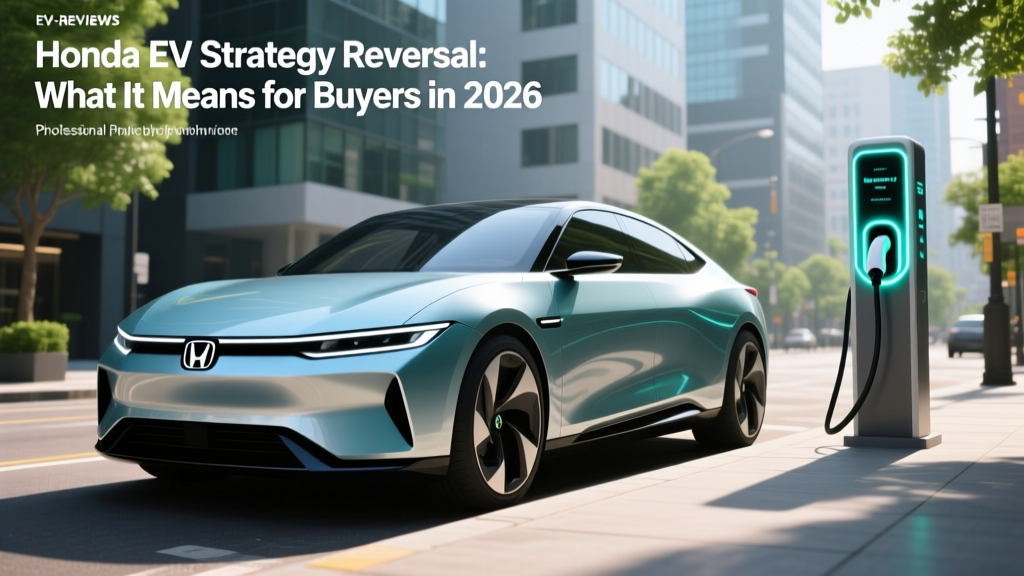
Honda's EV strategy reversal — announced through 2025 and unfolding into the 2026 model year — represents a significant pullback from the company's earlier all-electric ambitions. After initially targeting 100% EV and fuel-cell sales by 2040, Honda has pivoted toward a heavier emphasis on hybrids (HEVs and PHEVs) while slowing its battery-electric vehicle (BEV) rollout. The Prologue, built on GM's Ultium platform, remains Honda's only widely available EV in the U.S. for 2026, while the planned 0 Series EVs (built on Honda's proprietary architecture) have been pushed to later model years. For buyers, this means: if you want a Honda-branded electrified vehicle today, a hybrid like the CR-V Hybrid or Accord Hybrid is the most mature, readily available option. If you're set on a Honda BEV, the Prologue is your current choice — but expect a more Honda-native EV lineup no earlier than the 2027–2028 timeframe.
What Triggered the Honda EV Strategy Reversal?
Honda's pivot didn't happen in a vacuum. Several converging pressures forced a reassessment:
- Slower-than-expected EV adoption in North America. U.S. BEV market share growth decelerated through 2025, with consumers gravitating toward hybrids as a lower-risk bridge technology. Toyota's hybrid-heavy strategy proved more profitable during this period, providing a competitive template.
- The GM partnership's limitations. The Prologue and Acura ZDX, both built on GM's Ultium battery platform, gave Honda a fast market entry but limited differentiation. Honda acknowledged that long-term competitiveness requires proprietary EV architecture.
- Tariff and supply chain recalibration. Shifts in U.S. trade policy and critical-mineral sourcing rules under IRS §30D complicated battery supply planning for imported EVs.
- Profitability concerns. Honda, like most legacy automakers, has lost money or broken even on many EV models. Hybrids carry higher margins with lower retooling costs.
The result: Honda revised its 2030 EV sales targets downward, reallocated R&D spending toward hybrid powertrains, and committed to its proprietary "0 Series" EV platform as a longer-term play rather than a near-term volume driver.
What Honda Electrified Vehicles Can You Actually Buy in 2026?
Here's the current Honda electrified lineup available to U.S. buyers:
| Model | Type | EPA Range / MPG | Battery / Powertrain | Starting MSRP |
|---|---|---|---|---|
| Prologue | BEV | 296 mi (EPA); ~240–260 mi real-world highway | 85 kWh usable (NMC), Ultium platform | $47,400 |
| CR-V Hybrid | HEV | 40 city / 34 hwy / 37 combined MPG | 2.0L Atkinson + 2-motor hybrid, 1.06 kWh battery | $34,650 |
| Accord Hybrid | HEV | 51 city / 44 hwy / 48 combined MPG | 2.0L Atkinson + 2-motor hybrid, 1.06 kWh battery | $33,655 |
| CR-V e:FCEV (limited) | PHEV / FCEV | ~270 mi combined (hydrogen + plug-in battery) | Fuel cell + 17.7 kWh plug-in battery | Lease only, California |
Key takeaway: The Prologue is Honda's only mass-market EV. The upcoming 0 Series sedans and SUVs — teased at CES with thin-battery-pack architecture and a dedicated Honda EV platform — remain in pre-production. Honda has not confirmed U.S. pricing or exact availability beyond a general 2027–2028 window.
Honda Prologue: The Current EV Option in Detail
If you're committed to a Honda BEV today, the Prologue is your option. Here's what the numbers look like:
| Spec | Value |
|---|---|
| EPA Range (FWD) | 296 miles |
| EPA Range (AWD) | 281 miles |
| Battery (usable) | 85 kWh, NMC chemistry |
| Peak DC Fast Charge | 155 kW (CCS) |
| 10–80% DC Charge Time | ~30 minutes (preconditioned) |
| Level 2 Charge Rate | 11.5 kW (~30 mi/hr) |
| Horsepower (AWD) | 288 hp / 332 lb-ft torque |
| 0–60 mph | ~5.9 seconds (AWD) |
| MPGe (FWD combined) | 99 MPGe |
| Battery Warranty | 8 years / 100,000 miles |
| Starting MSRP (EX FWD) | $47,400 |
Real-World Range Expectations vs. EPA Sticker
The Prologue's 296-mile EPA figure assumes moderate temperatures and mixed driving. In practice:
- Highway-only at 75 mph: Expect ~240–260 miles. Aerodynamic drag dominates at speed, and the Prologue's boxy SUV shape works against efficiency.
- Cold weather (below 32°F): Range drops 20–30%, putting realistic winter range at ~195–235 miles depending on cabin heat usage. The Prologue uses a resistive heater on some trims rather than a heat pump, which draws more energy.
- City / moderate driving: You can approach or even exceed the EPA estimate thanks to regenerative braking recapturing energy in stop-and-go traffic.
Prologue vs. Honda Hybrids: Cost and Ownership Comparison
This is where Honda's strategy reversal becomes a practical buyer question. Should you go EV with the Prologue, or opt for a proven hybrid like the CR-V Hybrid? Here's a 5-year cost breakdown assuming 15,000 miles/year, $0.14/kWh home electricity, $3.40/gallon gasoline, and no federal tax credit (see eligibility notes below):
| Cost Factor | Prologue AWD ($49,400) | CR-V Hybrid AWD ($37,250) |
|---|---|---|
| Purchase Price | $49,400 | $37,250 |
| Federal Tax Credit (§30D) | $0–$7,500 (see eligibility) | $0 (hybrids don't qualify for §30D) |
| Energy/Fuel (5 yrs, 75K mi) | $3,675 (home charging) | $7,875 (gas at 34 MPG combined) |
| Maintenance (5 yrs) | ~$1,500 (no oil changes, fewer fluid swaps) | ~$3,200 (oil, filters, transmission fluid) |
| Insurance (5 yrs avg) | ~$11,500 (EV premium ~15–20%) | ~$9,800 |
| Estimated Depreciation | ~$24,700 (~50%) | ~$14,900 (~40%) |
| 5-Year Total (before credit) | ~$90,775 | ~$73,025 |
| 5-Year Total (with $7,500 credit) | ~$83,275 | ~$73,025 |
What the numbers reveal: Even with a full $7,500 federal credit, the Prologue costs roughly $10,000 more over 5 years, primarily due to higher purchase price and steeper EV depreciation. The energy and maintenance savings are real — about $5,900 over 5 years — but they don't close the gap. The hybrid wins on pure economics for most buyers unless you qualify for the maximum credit, drive mostly in the city (where the Prologue's efficiency shines), and plan to keep the vehicle well beyond 5 years.
Source: Efficiency figures from fueleconomy.gov; insurance estimates based on industry averages for mid-size EVs vs. hybrid SUVs.
Federal Tax Credit: Does the Prologue Qualify?
The Prologue's eligibility for the §30D federal clean vehicle credit is not guaranteed and depends on several factors that shift regularly:
§30D Credit Eligibility Checklist — 2026 Rules
| Requirement | Detail |
|---|---|
| MSRP Cap | SUVs: ≤$80,000; Sedans: ≤$55,000. Prologue qualifies (MSRP under $60K). |
| Buyer Income Cap | AGI ≤$300K (joint), ≤$225K (head of household), ≤$150K (individual). |
| Battery Component Sourcing | Must meet escalating North American assembly thresholds. Verify current-year compliance on the IRS list. |
| Critical Minerals | Must meet escalating U.S./FTA-partner sourcing requirements for battery minerals. |
| Point-of-Sale Transfer | Buyers can transfer the credit to the dealer for an immediate price reduction, subject to eligibility. |
Critical note: Because the Prologue is built on GM's Ultium platform (manufactured in the U.S.), it has had favorable sourcing positioning. However, the critical-minerals and battery-component thresholds tighten annually. Always verify current eligibility on IRS.gov before purchase, and consult a tax professional for your specific situation.
The Hybrid Case: Why Honda's Reversal Makes Sense for Many Buyers
Honda's strategic pivot toward hybrids reflects genuine buyer behavior data. Here's why a CR-V Hybrid or Accord Hybrid may be the smarter move for a large segment of the market:
No charging infrastructure required. If you live in an apartment, lack a garage, or rely on street parking, home Level 2 charging installation (typically $800–$2,500 for a 240V/48A circuit, plus potential panel upgrades at $1,500–$4,000) is a real barrier. Hybrids eliminate this entirely.
Proven reliability with low risk. Honda's two-motor hybrid system has been in production since 2014 and refined across multiple generations. The 1.06 kWh hybrid battery is small, inexpensive to replace if needed, and carries an 8-year/100,000-mile warranty.
No range anxiety in cold climates. Hybrids don't suffer the 20–30% range loss that BEVs experience in freezing temperatures. Your CR-V Hybrid's 37 MPG combined doesn't change much whether it's 85°F or 15°F outside.
Lower upfront cost. A well-equipped CR-V Hybrid Sport-L starts around $37,250 — roughly $12,000 less than a Prologue EX. That's a meaningful difference in monthly payments.
What About Honda's 0 Series EVs?
Honda's 0 Series represents the company's long-term EV answer: proprietary platforms with thin battery packs, rear-wheel-drive bias, and a claimed focus on lightweight efficiency. Concepts shown include a sedan and an SUV, with Honda claiming:
- A new dedicated EV architecture (not borrowed from GM)
- Thinner battery packs for lower vehicle height and improved aerodynamics
- Targeted energy density improvements
- Level 3 autonomous driving capability on highways (eyes-off, under specific conditions) — a claim worth watching but not yet validated in production
The catch: These vehicles are announced, not yet on sale. Honda has indicated a 2026 debut in Japan with U.S. availability following, but exact model-year timing, U.S. pricing, EPA range figures, and charging specs remain unconfirmed. Treat all published specs as preliminary. If you need a vehicle in the next 6–12 months, the 0 Series is not an option.
Decision Framework: Which Honda Electrified Vehicle Is Right for You?
Choose the Prologue EV if:
- You have reliable home Level 2 charging (garage or driveway with 240V access)
- Your daily commute is under 100 miles round-trip
- You qualify for the §30D tax credit (check income and sourcing rules)
- You want zero tailpipe emissions for local air quality
- You're comfortable with ~240 miles of real-world highway range and planning stops on longer trips
Choose the CR-V Hybrid or Accord Hybrid if:
- You lack home charging access or don't want to invest in installation
- You regularly drive in extreme cold (sub-freezing for weeks at a time)
- You take frequent road trips over 300 miles and don't want to plan around DC fast chargers
- Lower upfront cost and total cost of ownership is your priority
- You want a proven powertrain with a long track record and strong resale value
Wait for the 0 Series if:
- You're not in a rush to buy (2027–2028 timeline)
- You want a Honda-engineered EV rather than a GM-platform vehicle
- You're willing to gamble on first-year production of a new platform
Frequently Asked Questions
Is Honda abandoning electric vehicles entirely?
No. Honda's EV strategy reversal is a recalibration, not an exit. The Prologue remains on sale, and the 0 Series EVs are still in development. Honda has reduced its near-term EV volume targets and reallocated resources toward hybrids, but the company still plans to sell battery-electric vehicles long-term. The shift reflects market reality: hybrid demand is surging while BEV adoption growth has slowed.
Will the Honda Prologue get the §30D $7,500 tax credit in 2026?
It depends on current-year battery sourcing compliance and your personal income. The Prologue's GM Ultium underpinnings have given it favorable positioning for North American assembly requirements, but critical-mineral thresholds tighten each year. Check the fueleconomy.gov tax credit tool for the latest eligibility and consult a tax professional before relying on the credit in your purchase decision.
How does the Prologue's charging speed compare to competitors?
The Prologue peaks at 155 kW on DC fast charging — adequate but not class-leading. The Hyundai Ioniq 5 peaks at ~240 kW (10–80% in roughly 18 minutes), and the Tesla Model Y can sustain high rates on the Supercharger network. The Prologue's 10–80% charge takes approximately 30 minutes when preconditioned, which is acceptable for road trips but noticeably slower than 800V-architecture competitors. Note that the Prologue uses CCS1; Honda has not yet confirmed NACS adoption for this model, though future 0 Series vehicles may use NACS.
Should I buy a Prologue now or wait for Honda's next-gen EVs?
If you need a vehicle now and the Prologue fits your needs, it's a competent mid-size electric SUV with adequate range and comfortable driving dynamics. However, know that you're buying a vehicle built on another automaker's platform (GM Ultium) during a period of strategic transition. Depreciation risk is higher than usual given Honda's shifting EV plans. If you can wait 18–24 months, Honda's proprietary 0 Series may offer a more differentiated product — though with first-year-model risk.
Are Honda hybrids more reliable than the Prologue EV?
Honda's hybrid powertrain has a decade-long track record in the U.S. market, with the two-motor system proving durable across the Accord, CR-V, and Civic lineups. The Prologue, as a first-generation EV on a borrowed platform, simply doesn't have equivalent long-term reliability data yet. EVs generally have fewer moving parts (no engine, no transmission), but battery degradation, software issues, and charging-system reliability are the relevant long-term unknowns. The 8-year/100,000-mile battery warranty provides a floor of protection.
What's the real cost to charge a Prologue at home?
At the U.S. average residential electricity rate of ~$0.16/kWh (as of late 2025, per EIA data), a full 85 kWh charge costs roughly $13.60 and provides around 296 EPA miles. That works out to about $0.046 per mile — compared to roughly $0.105 per mile for a 34 MPG hybrid at $3.40/gallon gas. If you drive 15,000 miles per year, home charging the Prologue costs about $690 annually versus $1,575 for gas in the CR-V Hybrid. However, public DC fast charging at $0.35–$0.50/kWh raises the per-mile cost to $0.10–$0.15, nearly matching gas. Home charging access is the key economic variable.