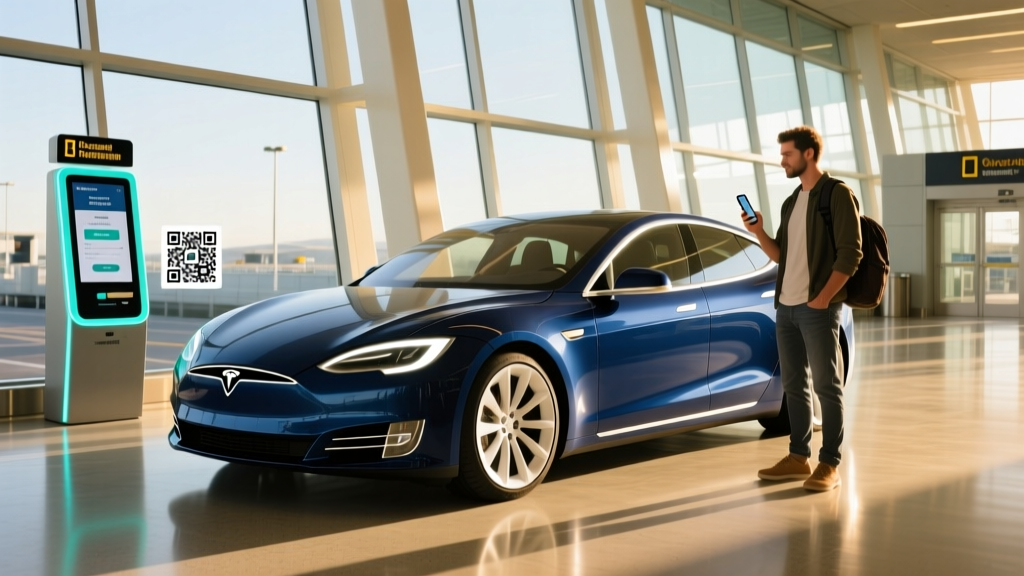
If you've typed "Tesla rental SFO" into a search bar recently, you're not alone. San Francisco International Airport remains one of the busiest EV-rental gateways in the country, with Hertz, Avis, and boutique fleets offering Tesla Model 3 and Model Y vehicles to Bay Area visitors and locals testing the EV lifestyle. But a weekend rental at $120-$220 per day adds up fast — and it often serves as a gateway drug to ownership.
This guide bridges the gap between renting and buying. We'll walk through the exact 2026 specs for the Tesla models you're most likely to find in SFO rental fleets, translate EPA numbers into real-world expectations for Bay Area driving, and run the math on whether that rental spend makes a purchase worth considering.
Which Tesla Models Show Up in SFO Rental Fleets?
The two models dominating airport rental lots in 2026 are the Tesla Model 3 Rear-Wheel Drive (the refreshed "Highland" platform) and the Tesla Model Y Long Range AWD. Occasionally you'll find a Model 3 Long Range or a Performance variant, but the base trims are the fleet workhorses. Here's what you're actually getting when you pull up to the rental counter:
| Specification | Model 3 RWD (Highland) | Model Y Long Range AWD |
|---|---|---|
| EPA Range | 341 miles | 320 miles |
| Battery (Usable) | ~60 kWh (LFP) | ~78 kWh (NMC) |
| Drivetrain | RWD, single motor | Dual-motor AWD |
| Horsepower | 271 hp | 384 hp |
| 0–60 mph | 5.8 seconds | 4.8 seconds |
| Peak DC Fast Charge | 170 kW | 250 kW |
| 10–80% DCFC Time | ~25 min | ~22 min |
| Level 2 Home Charging | 11.5 kW (~44 mi/hr) | 11.5 kW (~44 mi/hr) |
| Efficiency (EPA) | 132 MPGe / 25 kWh/100mi | 117 MPGe / 29 kWh/100mi |
| Cargo Volume | 23 cu ft (trunk + frunk) | 76 cu ft (seats folded) |
| Base MSRP (2026) | $38,990 | $48,990 |
| Battery/Drive Warranty | 8 yr / 100,000 mi | 8 yr / 120,000 mi |
Sources: fueleconomy.gov, Tesla.com official specs.
Real-World Range: What the EPA Sticker Won't Tell You
EPA Estimate vs. Reality
Model 3 RWD: EPA 341 miles. Expect ~280–310 miles in mixed real-world driving. Sustained 75 mph highway travel drops this to roughly 260–280 miles. Cold weather (below 40°F) can shave 15–25% off, bringing it to ~230–260 miles.
Model Y LR AWD: EPA 320 miles. Expect ~265–290 miles mixed. Highway-heavy trips at 75+ mph yield ~250–270 miles. Cold weather reduces range to ~220–250 miles.
LFP batteries (Model 3 RWD) tolerate regular 100% charging without degradation concerns, so you can actually use the full rated capacity daily — a meaningful advantage over NMC for renters and owners who need maximum range every morning.
For Bay Area renters, the practical implication is straightforward. A Model 3 RWD with a full charge can comfortably handle a round-trip from SFO to Napa (~140 miles), SFO to Monterey (~230 miles round-trip with a buffer), or SFO to Sacramento (~190 miles round-trip) without stopping to charge. A trip to Lake Tahoe (~380 miles round-trip with elevation gain) will require at least one Supercharger stop — plan for 20–25 minutes in Harris Ranch or Sacramento.
The Model Y's dual-motor AWD system adds confidence on the foggy, rain-slicked stretches of I-280 and Highway 1, but you're trading roughly 20–50 miles of range for that traction depending on conditions.
Charging Speed: Superchargers, Destination Chargers, and the 80% Taper
One of the strongest arguments for renting a Tesla at SFO — and for eventually buying one — is access to the Tesla Supercharger network, which in 2026 includes over 6,000 V3 and V4 stalls across North America. Here's what charging actually looks like in practice:
| Charging Level | Power (kW) | Model 3 RWD Speed | Model Y LR Speed | Best Use Case |
|---|---|---|---|---|
| Level 1 (120V outlet) | ~1.4 kW | ~3–5 mi/hr | ~3–5 mi/hr | Emergency / overnight trickle |
| Level 2 (240V home/public) | 7.7–11.5 kW | ~30–44 mi/hr | ~30–44 mi/hr | Daily home charging, hotels |
| DC Fast (V3 Supercharger) | Up to 250 kW | Peak 170 kW, ~25 min 10–80% | Peak 250 kW, ~22 min 10–80% | Road trips, quick top-ups |
Understanding the charge curve taper: Peak kW rates (170 kW for the Model 3 RWD, 250 kW for the Model Y LR) only apply at a low state of charge, typically 10–30%. As the battery fills past 50%, the charge rate gradually drops. By 80%, you might be pulling 40–60 kW. This is why manufacturers quote 10–80% times rather than 0–100% — the final 20% can take as long as the first 70%. For road-tripping renters, the practical move is to charge to 80% and get back on the road rather than waiting for a full battery.
If you're renting and staying at a Bay Area hotel, many properties now feature Level 2 Tesla Destination Chargers or universal J1772 stations (Tesla includes a J1772 adapter with every vehicle). A night at a hotel with Level 2 charging easily adds 200+ miles — enough to reset for the next day's driving.
Behind the Wheel: Performance, Tech, and the FSD Reality Check
The Model 3 Highland refresh brought meaningful improvements that rental fleets have been absorbing since late 2024. The cabin is noticeably quieter thanks to acoustic glass, the suspension absorbs Bay Area's rougher stretches of I-880 more gracefully, and the ventilated front seats matter during Central Valley summer heat.
The 15.4-inch center touchscreen runs everything — climate, navigation, media, vehicle settings. There's no instrument cluster; speed and navigation instructions appear in the upper-left corner of the main screen. If you're coming from a traditional rental, give yourself 10 minutes in the parking lot to learn the basics before merging onto 101.
Driver-Assist, Not Self-Driving
Tesla's Autopilot (included) and Full Self-Driving Supervised (optional, ~$8,000 or $99/month) are SAE Level 2 systems. That means the car handles steering, acceleration, and braking on highways, but you must keep your eyes on the road and hands available to take over at any moment. FSD Supervised can navigate city streets and stoplights, but it is not autonomous — it makes errors, misses construction zones, and requires constant driver supervision. Only Waymo-style robotaxis operating in geofenced areas qualify as Level 4. Do not treat any Tesla driver-assist as a substitute for an attentive driver.
Most SFO rental Teslas come with basic Autopilot (Traffic-Aware Cruise Control and Autosteer) rather than FSD. That's genuinely sufficient for highway driving to Monterey, Sacramento, or Wine Country. The lane-centering is precise, and the adaptive cruise handles stop-and-go traffic on the Bay Bridge with ease.
The Math: Renting vs. Buying a Tesla in the Bay Area
Let's put real numbers to the decision. A Tesla rental at SFO through a major agency typically runs $130–$200 per day before fees in 2026. Enterprise, Hertz, and specialty EV renters like Fair offer varying terms.
| Model / Trim | Base MSRP | As-Tested (Typical) | §30D Credit Eligible? | Effective Price (w/ Credit) |
|---|---|---|---|---|
| Model 3 RWD | $38,990 | $40,500 (w/ paint) | Yes — up to $7,500* | ~$33,000 |
| Model 3 Long Range AWD | $45,990 | $48,000 | Yes — up to $7,500* | ~$40,500 |
| Model Y Long Range AWD | $48,990 | $51,000 | Yes — up to $7,500* | ~$43,500 |
| Model Y Performance | $52,490 | $54,500 | Yes — up to $7,500* | ~$47,000 |
*The IRS §30D federal tax credit has strict eligibility rules for 2026:
- MSRP caps: Vans/SUVs/pickups must be under $80,000; sedans under $55,000. All Model 3 and Model Y trims listed above qualify.
- Buyer income caps: Modified AGI must not exceed $150,000 (single), $225,000 (head of household), or $300,000 (joint filers).
- Battery sourcing: Increasing percentages of critical minerals and battery components must be sourced from the U.S. or free-trade-agreement partners. Tesla's supply chain has largely met these thresholds for 2026, but verify the specific VIN on fueleconomy.gov before purchasing.
- Point-of-sale transfer: As of 2024, you can transfer the credit to the dealer at purchase, reducing your out-of-pocket cost immediately rather than waiting for a tax refund. This applies to 2026 purchases.
- Tax liability: The credit is non-refundable if claimed on your tax return — you need sufficient tax liability. The point-of-sale transfer bypasses this limitation.
The breakeven calculation: If you rent a Tesla at SFO for 5+ days per month (say, $160/day average = $800/month = $9,600/year), you're spending enough over 4 years to cover the price difference between a base Model 3 RWD after tax credits and a comparable gas sedan — with the Tesla's lower per-mile energy cost adding further savings. At PG&E's average residential rate of ~$0.32/kWh (2026), charging a Model 3 at home costs roughly $0.08–$0.10 per mile. A comparable gas car at 30 MPG with $4.50/gallon fuel runs ~$0.15 per mile. Over 12,000 miles annually, that's a $600–$840/year energy savings.
Interior, Cargo, and Daily Practicality
The Model 3's minimalist cabin polarizes. There are no physical buttons — turn signals are on the steering wheel (yes, really), and climate controls live on the touchscreen. Rear legroom measures 35.3 inches, adequate for adults on shorter trips but tight for tall passengers on a drive to Tahoe. Cargo space totals 23 cubic feet (trunk plus front trunk/frunk), enough for two carry-on bags and a couple of backpacks.
The Model Y solves the space problem decisively. With rear seats folded, you get 76 cubic feet — genuine SUV utility for Costco runs, camping gear, or airport pickups with heavy luggage. Rear legroom stretches to 41.6 inches. If your SFO rental needs include family travel or hauling, the Model Y is the clear choice and worth the ~$30–$50/day premium most rental agencies charge.
Both models include a HEPA air filtration system (Bioweapon Defense Mode) that's genuinely excellent for Bay Area wildfire smoke season — a feature many renters don't discover until they need it.
Pros and Cons: The Honest Assessment
Pros
- Access to the Supercharger network — the most reliable DC fast-charging ecosystem in the U.S.
- Best-in-class efficiency: 25 kWh/100mi (Model 3) means lower charging costs than most competitors
- Over-the-air updates continuously improve the vehicle; a 2024 Highland Model 3 in a 2026 rental fleet may have features it didn't ship with
- LFP battery in Model 3 RWD can be charged to 100% daily without long-term degradation concerns
- Strong regenerative braking enables one-pedal driving, reducing brake wear
- Excellent safety ratings: 5-star NHTSA overall, IIHS Top Safety Pick+
Cons
- No physical controls — the touchscreen-only interface frustrates some drivers, especially for turn signals and wiper adjustments
- Model 3 rear seat is tight for tall adults on long trips
- Ride quality on rough pavement is firm; Highland improved it, but it's still sportier than a Camry
- Insurance costs run 15–30% higher than comparable gas sedans in the Bay Area
- Rental units may have high mileage and cosmetic wear; inspect before driving off the lot
- FSD Supervised ($8,000 or $99/mo) is expensive and still requires full driver attention — poor value for most renters and many buyers
Who Should Rent, and Who Should Buy?
Rent a Tesla at SFO if:
- You visit the Bay Area 1–3 times per year and want EV access without ownership commitment
- You're testing whether an EV fits your driving patterns before purchasing
- You need a car for 3–7 days and can charge overnight at your hotel or rental property
- Your trip is primarily city and suburban driving where range isn't a concern
Buy a Tesla if:
- You're spending $800+/month on rentals (5+ days/month) — ownership breakeven arrives within 3–4 years
- You have access to home Level 2 charging (garage or dedicated parking with 240V access)
- Your daily commute is under 80 miles round-trip, making overnight home charging sufficient
- You qualify for the §30D tax credit and can use the point-of-sale transfer to reduce upfront cost
- You want the lowest per-mile energy cost of any vehicle in its class
Frequently Asked Questions
Can I use Tesla Superchargers with my SFO rental?
Yes. All Tesla rentals include Supercharger access. The cost is billed to the renter — typically $0.25–$0.48/kWh in the Bay Area in 2026, depending on the station and time of day. Some rental agencies pre-load a charging account; others require you to set one up via the car's touchscreen. Expect to pay $15–$25 for a 10–80% charge on a Model 3.
What happens if I run out of charge in a rental Tesla?
Tesla's navigation system is conservative and accurate — it will warn you well in advance if you won't reach your destination or a charger. If you do run the battery to zero, Tesla roadside assistance can arrange a flatbed tow to the nearest Supercharger. The rental agency may pass the tow cost to you, so treat range warnings seriously.
Is a Tesla rental at SFO worth it vs. renting a hybrid?
For city-heavy Bay Area driving, a Tesla's efficiency (~$0.08–$0.10/mile on home/Level 2 charging) beats a hybrid on fuel cost, but rental charging adds complexity if you lack overnight charging access. If your hotel doesn't have EV charging and you're doing 200+ miles daily, a hybrid rental may be more practical. If you have charging access and want the driving experience, the Tesla wins on performance and tech.
Does the Tesla Model 3 qualify for the full $7,500 federal tax credit in 2026?
The Model 3 RWD and Long Range AWD are listed as eligible on fueleconomy.gov for 2026, but eligibility depends on battery-sourcing compliance for the specific VIN, your income (under $150K single / $300K joint), and the vehicle's MSRP (under $55,000 for sedans). Always verify the exact VIN before purchase and consult a tax professional regarding your personal eligibility.
How does cold weather affect range on a Tahoe trip?
Driving from SFO to Lake Tahoe involves both cold temperatures (often below 30°F at elevation) and a 6,000+ foot climb. Expect 20–30% range reduction versus the EPA sticker. A Model 3 RWD with 341 EPA miles will realistically deliver 230–270 miles in those conditions. Plan a Supercharger stop in Sacramento or Folsom on the way up. Preconditioning the battery via the Tesla app before charging will significantly improve your charge speed at the stop.
What's the best Tesla model to rent at SFO for a family of four?
The Model Y Long Range AWD is the stronger pick for families. It offers 76 cubic feet of cargo space with seats folded, genuine rear-seat comfort for adults, dual-motor AWD for rainy Bay Area winters, and 320 miles of EPA range. Two car seats fit in the rear with room to spare. The Model 3 works for a couple or a family with small children on shorter trips, but the rear seat and trunk limitations become apparent quickly with four passengers and luggage.