Understanding Regenerative Braking in Tesla Vehicles
If you've watched a Tesla slow to a stop without the driver touching the brake pedal, you've witnessed regenerative braking in action. But what is regenerative braking in a Tesla, exactly, and why does it matter for your daily driving and long-term ownership costs?
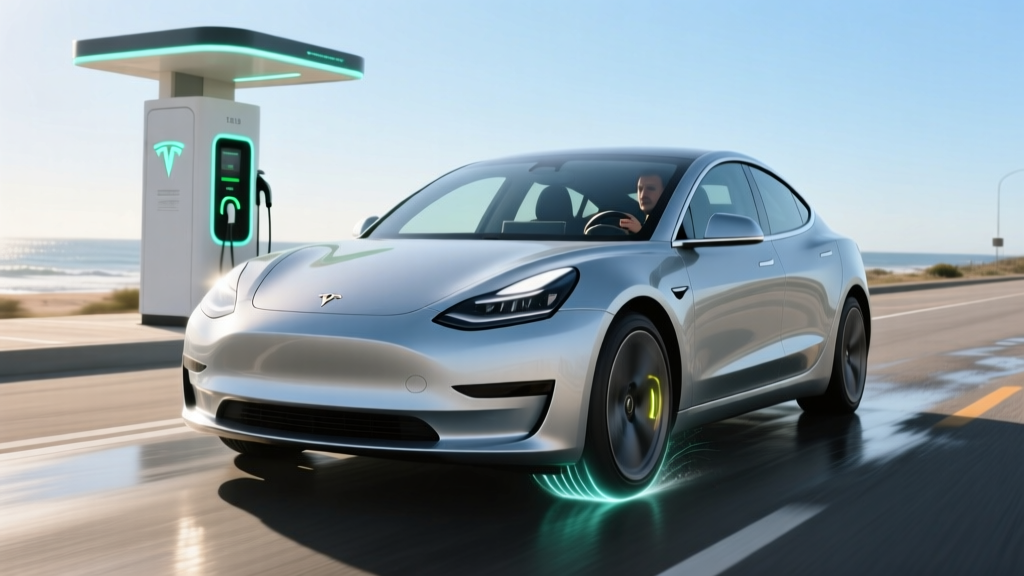
Regenerative braking (often shortened to "regen") is the process by which Tesla's electric motors reverse their function during deceleration. Instead of consuming electricity to create forward motion, the motors act as generators — converting the vehicle's kinetic energy back into electrical energy and feeding it into the battery pack. This accomplishes two things simultaneously: it slows the car without relying on the friction brakes, and it recaptures energy that a conventional gas car would simply waste as heat.
Every Tesla sold since 2020 defaults to a "Standard" regen mode that enables what owners call one-pedal driving. Lift off the accelerator, and the car begins decelerating noticeably — often strongly enough to bring you to a complete stop at a traffic light without ever pressing the brake pedal. Tesla removed the user-adjustable regen setting from the in-car menu starting with the 2020.36 software update, meaning the system applies a consistent, aggressive regen profile across all current models (Model 3, Model Y, Model S, Model X, and the refreshed Cybertruck).
How Tesla's Regen System Actually Works
When you release the accelerator in a Tesla, the vehicle's powertrain controller commands the motor(s) to apply negative torque. The permanent-magnet synchronous reluctance motors (or induction motors, depending on model and axle) create electromagnetic resistance against the drivetrain. This resistance is what you feel as deceleration — typically between 0.2g and 0.3g of braking force at highway speeds, tapering as speed drops.
The electricity generated during this process flows back through the inverter and into the high-voltage battery pack. On a long downhill grade, you can watch the energy meter on the touchscreen push into the green "charging" zone — a visual confirmation that you're adding range back to the battery simply by coasting downhill.
Friction Brake Blending and Hold Mode
Tesla vehicles blend regenerative and friction braking seamlessly. At very low speeds (typically below 5 mph), regen effectiveness diminishes because there's insufficient kinetic energy to generate meaningful current. At this point, the hydraulic friction brakes engage automatically to bring the car to a full stop. Tesla's "Hold Mode" — the default stop-mode setting — then holds the vehicle stationary using the friction brakes without requiring you to keep your foot on the brake pedal. The brake lights illuminate automatically during regen deceleration (when deceleration exceeds a threshold) and remain lit while stopped in Hold Mode, so following traffic knows you're slowing or stopped.
Range Impact: How Much Energy Does Regen Actually Recapture?
The energy recaptured through regenerative braking varies dramatically based on driving conditions. Here's what Tesla owners typically observe:
- City/stop-and-go driving: Regen can recapture 15–25% of energy that would otherwise be lost, extending effective range by roughly 10–20 miles on a full charge compared to a hypothetical EV without regen.
- Highway cruising: Minimal regen benefit — steady-speed driving rarely triggers deceleration. This is why EPA highway range figures are typically lower than city figures for EVs (the opposite of gas cars).
- Mountain descents: Extended downhill grades can add 5–15+ miles of range back to the pack, depending on elevation change and vehicle mass.
- Cold weather: A cold battery cannot accept charge as quickly. In sub-40°F conditions, regen may be significantly reduced (or temporarily disabled) until the battery warms up through driving or preconditioning. Expect 20–30% less regen effectiveness in winter until the pack reaches operating temperature.
Tesla Model Lineup: Specs, Range, and Efficiency at a Glance
Regenerative braking operates identically across all current Tesla models. Here's how the 2025–2026 lineup stacks up on the metrics that matter most to buyers:
| Spec | Model 3 LR AWD | Model Y LR AWD | Model S LR | Model X LR |
|---|---|---|---|---|
| EPA Range | 341 mi | 320 mi | 402 mi | 335 mi |
| Battery (usable) | ~75 kWh (NMC) | ~75 kWh (NMC) | ~95 kWh (NMC) | ~95 kWh (NMC) |
| Efficiency (MPGe) | 134 MPGe | 122 MPGe | 124 MPGe | 109 MPGe |
| 0–60 mph | 4.2 sec | 4.8 sec | 3.1 sec | 3.8 sec |
| Horsepower | 346 hp | 384 hp | 670 hp | 670 hp |
| Drivetrain | Dual-motor AWD | Dual-motor AWD | Dual-motor AWD | Dual-motor AWD |
| Cargo (rear seats up) | 23 cu ft | 30 cu ft | 28 cu ft | 37 cu ft (+frunk) |
| Rear Legroom | 35.2 in | 36.4 in | 35.4 in | 37.1 in |
Source: fueleconomy.gov and Tesla specifications. Efficiency figures based on EPA combined cycle.
Charging Speeds: DC Fast Charging and Home Level 2
Regenerative braking feeds energy back into the battery at relatively low power levels — typically 20–60 kW during hard deceleration, tapering quickly. But when you need to charge from the grid, Tesla's charging infrastructure and onboard hardware determine your wait times.
| Charging Level | Power (kW) | Rate | 10–80% Time |
|---|---|---|---|
| Level 1 (120V household) | ~1.4 kW | 3–5 mi/hr | N/A (overnight only) |
| Level 2 (240V home/work) | 7.7–11.5 kW | 30–44 mi/hr | 6–9 hours |
| DC Fast Charge (V3 Supercharger) | Peak 250 kW | ~1,000 mi/hr peak | ~25–30 min |
| DC Fast Charge (V4 Supercharger) | Peak 350 kW* | ~1,200+ mi/hr peak | ~18–22 min* |
*V4 Supercharger peak rates require compatible newer-model vehicles with updated battery architectures. Sustained peak rates last only minutes before the charge curve tapers — a 250 kW peak does not mean 250 kW average. Expect average DC charging power of 120–170 kW across a 10–80% session on a V3 Supercharger.
All current Tesla models use the NACS (North American Charging Standard) connector natively — the same connector Tesla has used since 2012 and which most other automakers are now adopting through 2025–2026. This gives Tesla owners access to the Supercharger network (17,000+ stalls in North America) without adapters, as well as third-party networks that now support NACS.
Pricing and Federal Tax Credit Eligibility
Tesla's pricing has shifted frequently, but here are the base MSRPs for the current 2025 lineup as of early 2026:
| Model | Base MSRP | §30D Credit Eligible? | Effective Price* |
|---|---|---|---|
| Model 3 RWD | $38,990 | Yes — up to $7,500 | ~$31,490 |
| Model 3 LR AWD | $45,490 | Yes — up to $7,500 | ~$37,990 |
| Model Y LR AWD | $44,990 | Yes — up to $7,500 | ~$37,490 |
| Model S LR | $79,990 | No (exceeds MSRP cap) | $79,990 |
| Model X LR | $84,990 | No (exceeds MSRP cap) | $84,990 |
*Effective price assumes full $7,500 credit via point-of-sale transfer. Eligibility depends on buyer income limits, battery critical-mineral sourcing requirements, and MSRP caps. See IRS §30D guidelines for current rules. The MSRP cap is $55,000 for sedans (Model 3) and $80,000 for SUVs/trucks (Model Y). Model S and Model X exceed these caps.
Tax Credit Checklist for Tesla Buyers
- Income caps: Modified AGI must not exceed $150,000 (single), $225,000 (head of household), or $300,000 (joint filers)
- MSRP caps: $55,000 for sedans; $80,000 for SUVs, vans, and pickup trucks
- Battery sourcing: Increasing percentages of critical minerals and battery components must be sourced from the U.S. or free-trade-agreement partners (requirements tighten annually through 2029)
- Point-of-sale transfer: You can transfer the credit to the dealer at purchase, reducing your out-of-pocket cost immediately — no need to wait until tax filing
- One vehicle per SSN: You may claim the credit on one new clean vehicle per year, and one used clean vehicle per three years
Tesla Warranty Coverage and Battery Longevity
Tesla provides the following warranty coverage across its lineup:
- Basic Vehicle Limited Warranty: 4 years or 50,000 miles, whichever comes first
- Battery and Drive Unit Warranty:
- Model 3 RWD: 8 years or 100,000 miles (whichever comes first), with minimum 70% capacity retention
- Model 3 LR / Model Y LR / Model S / Model X: 8 years or 120,000 miles, with minimum 70% capacity retention
The 70% retention threshold is the industry-standard definition of battery end-of-life for warranty purposes. In practice, Tesla's NMC battery packs in the Model 3 and Model Y Long Range variants have demonstrated approximately 8–12% degradation after 100,000 miles based on aggregated owner data — meaning most packs retain 88–92% of original capacity well within the warranty period. Tesla's battery management system (BMS) actively manages cell temperatures and limits charge/discharge rates to minimize degradation.
Pros and Cons of Tesla's Regen and Overall Package
✅ Pros
- Aggressive regen enables true one-pedal driving in city traffic — reduces brake wear to near zero (many owners report 80,000+ miles on original brake pads)
- Recaptured energy extends effective range in stop-and-go and hilly terrain
- Supercharger network remains the most reliable DC fast-charging ecosystem in North America
- Over-the-air updates continuously improve vehicle functionality
- Strong resale value relative to most EV competitors
- Minimalist interior with responsive 15.4" touchscreen and fast infotainment
❌ Cons
- No user-adjustable regen setting — you cannot reduce regen strength if you prefer a coasting feel
- Reduced regen in cold weather until battery warms, which can surprise new EV drivers with unexpectedly long stopping distances
- No traditional instrument cluster — all information routes through the center screen (distracting for some)
- Build quality inconsistency reported by some owners (panel gaps, trim alignment)
- Autopilot/FSD remains Level 2 — requires constant driver supervision despite marketing language
- Insurance premiums tend to be higher than comparable ICE vehicles due to repair costs
Who Should Buy a Tesla (and Who Shouldn't)
Best for: Urban and suburban commuters who benefit most from regen braking's energy recapture and one-pedal convenience. The Model 3 and Model Y are ideal for daily drivers covering 20–80 miles per day with home Level 2 charging access. Road trippers who value Supercharger network reliability. Tech-forward buyers who prioritize OTA updates and minimalist interiors.
Consider alternatives if: You frequently tow heavy loads (Model Y max towing is 3,500 lbs; Model X is 5,000 lbs — both modest). You need third-row seating for adults (Model X third row is best for children). You want a traditional instrument cluster or physical buttons. You live in an area with limited Supercharger coverage and no home charging option. You prefer adjustable regen or a "coast" mode like that offered by Hyundai, Kia, or BMW.
Frequently Asked Questions
What is regenerative braking in a Tesla, in simple terms?
When you lift off the accelerator, Tesla's electric motors reverse direction and act as generators. This slows the car down (like engine braking in a gas car, but much stronger) and sends electricity back into the battery — recapturing energy that would otherwise be wasted as heat in the friction brakes.
Can I turn off regenerative braking in my Tesla?
No. Tesla removed the adjustable regen setting in late 2020. All current Tesla vehicles operate in "Standard" (maximum) regen mode at all times. If you prefer a coasting feel, you'll need to "feather" the accelerator — maintaining slight pressure rather than lifting off completely — to modulate deceleration.
Does regenerative braking replace the friction brakes entirely?
No. Regen handles the majority of daily deceleration, but friction brakes engage automatically at very low speeds (below ~5 mph), during emergency hard braking, and when the battery is full or too cold to accept regenerated energy. Tesla's friction brakes serve as a critical safety backup and are necessary for maximum stopping power.
How much range does regen braking add?
In city driving with frequent stops, regen can extend effective range by roughly 10–20 miles compared to driving without regen. On mountain descents, it can add 5–15+ miles depending on elevation change. On sustained highway cruising, regen provides minimal benefit because you're rarely decelerating.
Why does my Tesla have weak regen in cold weather?
Lithium-ion batteries cannot accept charge rapidly when cold (below ~50°F battery temperature). Tesla's BMS limits regen power to protect the cells from lithium plating — a degradation mechanism caused by forcing lithium ions into cold anodes too quickly. Use the Tesla app to precondition your battery before driving in cold weather; this warms the pack and restores full regen functionality.
Does the Tesla Model 3 qualify for the $7,500 federal tax credit?
As of 2026, the Model 3 RWD and Model 3 Long Range AWD qualify for up to $7,500 under IRS §30D, provided the buyer meets income limits ($150K single / $300K joint), the vehicle MSRP is under $55,000 (sedans), and battery sourcing requirements are met. The credit can be transferred at point of sale. Always verify current eligibility at irs.gov before purchasing, as sourcing rules tighten annually.
How does Tesla's regen compare to other EVs?
Tesla's regen is among the strongest in the industry, but it's not adjustable. Hyundai/Kia EVs (Ioniq 5, EV6) offer four regen levels via steering-wheel paddles including a true "coast" mode. BMW's iX and i4 offer adaptive regen that adjusts based on traffic ahead. Rivian allows regen strength customization. If adjustable regen is a priority, test-drive these competitors before committing to Tesla's fixed-regen approach.