Quick Verdict: The Model Y in 2026
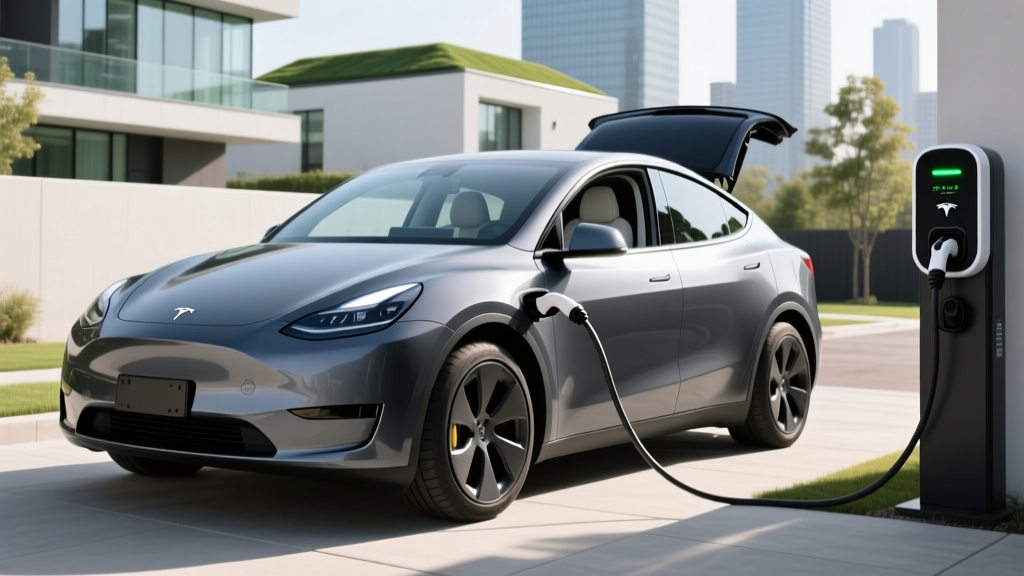
The 2026 Tesla Model Y remains the benchmark compact electric SUV — not because it's perfect, but because no competitor matches its combination of Supercharger network access, efficiency, and software integration. With the refreshed "Juniper" styling now fully rolled out, updated interior materials, and a starting price that undercuts several rivals, the Model Y Long Range AWD continues to dominate its segment. For buyers exploring the Tesla referral program Model Y purchase route, the referral incentive adds incremental value on top of an already compelling package.
2026 Tesla Model Y Specifications at a Glance
| Specification | Model Y RWD | Model Y Long Range AWD | Model Y Performance |
|---|---|---|---|
| EPA Range | 300 mi | 320 mi | 280 mi |
| Battery (usable) | ~60 kWh (LFP) | ~75 kWh (NMC) | ~75 kWh (NMC) |
| Drivetrain | Rear-Wheel Drive | Dual-Motor AWD | Dual-Motor AWD |
| Horsepower | 295 hp | 384 hp | 456 hp |
| 0-60 mph | 6.6 sec | 4.8 sec | 3.5 sec |
| Max DC Fast Charge | 170 kW | 250 kW | 250 kW |
| 10-80% DC Time | ~28 min | ~22 min | ~22 min |
| Level 2 Home Charge | 11.5 kW (~44 mi/hr) | 11.5 kW (~44 mi/hr) | 11.5 kW (~44 mi/hr) |
| MPGe (combined) | 125 MPGe | 117 MPGe | 105 MPGe |
| Efficiency | 27 kWh/100mi | 29 kWh/100mi | 32 kWh/100mi |
| Cargo (rear seats up) | 30.2 cu ft | 30.2 cu ft | 30.2 cu ft |
| Cargo (rear seats folded) | 72.0 cu ft | 72.0 cu ft | 72.0 cu ft |
| Rear Legroom | 38.4 in | 38.4 in | 38.4 in |
| Base MSRP | $44,990 | $48,990 | $53,990 |
Source: fueleconomy.gov and Tesla.com specifications. Prices exclude destination fee.
Battery Chemistry and What It Means for Ownership
The 2026 Model Y RWD uses a lithium iron phosphate (LFP) battery pack, while the Long Range AWD and Performance trims use nickel manganese cobalt (NMC) chemistry. This distinction matters for daily charging habits:
- LFP (RWD): Tesla recommends charging to 100% regularly. LFP cells tolerate full charges better and have longer cycle life, though they offer lower energy density (hence the shorter range in a lighter pack).
- NMC (Long Range/Performance): Tesla recommends a daily charge limit of 80% for longevity, reserving 100% for road trips. NMC provides higher energy density but degrades faster if habitually held at full state of charge.
Both chemistries are covered by Tesla's 8-year/120,000-mile battery and drive unit warranty (100,000 miles on the RWD), guaranteeing a minimum of 70% capacity retention over the warranty period. Real-world degradation data from fleet studies suggests most Model Y packs retain 90-94% capacity after 50,000 miles, with the curve flattening significantly after the initial break-in period.
Charging Speed and Infrastructure
Charging remains one of Tesla's strongest advantages. The Model Y Long Range and Performance trims accept up to 250 kW at V3/V4 Superchargers, adding approximately 175 miles of range in 15 minutes under ideal conditions. The RWD trim peaks at 170 kW due to its smaller LFP pack.
| Charging Method | Power (kW) | Miles Added per Hour | Notes |
|---|---|---|---|
| Level 1 (120V household) | ~1.4 kW | ~5 mi/hr | Emergency/top-up only |
| Level 2 (240V, 48A Wall Connector) | 11.5 kW | ~44 mi/hr | Full charge overnight (~7-8 hrs) |
| Level 2 (240V, 32A Mobile Connector) | 7.7 kW | ~30 mi/hr | NEMA 14-50 outlet |
| DC Fast (V3 Supercharger) | Up to 250 kW | ~700+ mi/hr (peak) | 10-80% in ~22 min (LR/Perf) |
| DC Fast (CCS via adapter) | Up to 150 kW | Varies | Non-Tesla networks; speed depends on station |
Charging curve reality: The 250 kW peak on Long Range and Performance trims is sustained only between approximately 10-30% state of charge. By 50% SoC, the rate drops to roughly 150 kW, and above 80%, it falls below 60 kW. This is why Tesla's quoted "10-80%" time of ~22 minutes is the practical metric — charging beyond 80% at a DC fast charger is rarely worth the wait unless you absolutely need the miles.
The Model Y now ships with a NACS (North American Charging Standard) port natively. Tesla's Supercharger network — over 6,000 V3/V4 stalls across the U.S. — remains the most reliable DC fast-charging network available, with real-world uptime consistently above 95%.
Pricing, Tax Credits, and the Tesla Referral Program
Here's where the numbers get interesting for 2026 buyers. The Model Y Long Range AWD starts at $48,990 before destination, and the RWD at $44,990. Both fall under the IRS §30D MSRP cap of $80,000 for SUVs, making them potentially eligible for the $7,500 federal tax credit — but eligibility depends on several factors that change periodically.
| Trim | MSRP | Est. §30D Credit | Effective Price | Referral Savings |
|---|---|---|---|---|
| RWD | $44,990 | Up to $7,500* | ~$37,490 | Varies (see below) |
| Long Range AWD | $48,990 | Up to $7,500* | ~$41,490 | Varies (see below) |
| Performance | $53,990 | Up to $7,500* | ~$46,490 | Varies (see below) |
*Federal tax credit eligibility depends on battery critical-mineral and component sourcing requirements, buyer income caps ($150K single / $300K joint AGI), and MSRP limits. Rules are subject to change — verify at irs.gov or consult a tax professional. The credit can now be transferred to the dealer at point of sale as an upfront discount.
The Tesla Referral Program for Model Y Buyers
The Tesla referral program Model Y incentive has evolved several times, and in 2026 it typically offers both the referrer and the new buyer a modest benefit — historically ranging from $500 to $1,000 off the purchase price, Tesla credits toward accessories or Supercharging, or loyalty rewards. The exact value fluctuates based on Tesla's current promotional cycle.
How it works: An existing Tesla owner shares their referral link. When you order a new Model Y through that link, both parties receive the active incentive. The discount is applied at delivery and stacks with the federal tax credit (the referral discount reduces the purchase price; the tax credit is claimed separately or transferred at point of sale).
Practical tip: The referral savings are modest compared to the $7,500 federal credit, but they're essentially free money if you know a Tesla owner. Ask in EV owner forums or social media groups — most owners are happy to share their link. Check Tesla's current referral terms on their website before ordering, as the program details change without much notice.
Performance, Driving Dynamics, and Technology
The 2026 Model Y Long Range AWD delivers 384 horsepower and a 4.8-second 0-60 mph time — quick enough to merge confidently onto any highway and overtake without drama. The Performance trim drops that to 3.5 seconds with 456 hp, putting it in sports-car territory. The RWD variant's 6.6-second sprint is adequate for daily driving but noticeably less urgent.
Ride quality on the Juniper-refreshed Model Y has improved meaningfully over pre-2025 versions. Tesla retuned the suspension and added acoustic glass, reducing cabin noise at highway speeds. The steering remains quick but somewhat numb — this is a vehicle optimized for efficiency and tech, not feedback.
Driver Assistance: Autopilot and FSD (Supervised)
FSD (Supervised) costs $8,000 upfront or $99/month in 2026. Whether it's worth the premium depends on your commute. On well-marked highways, Autopilot (included standard) handles 95% of what most drivers need. FSD adds value in complex urban navigation but still requires constant supervision and occasionally makes conservative or unpredictable decisions at construction zones and unprotected left turns.
Infotainment and Interior
The 15.4-inch center touchscreen controls virtually everything — there are no physical buttons for climate or mirrors. The Juniper update brought ambient lighting, ventilated front seats, a rear-seat touchscreen for passengers, and power-folding second-row seats. Build quality has closed the gap with European competitors, though some owners still report minor panel inconsistencies.
Notable tech includes:
- Over-the-air software updates that add features post-purchase
- Sentry Mode (360° camera recording when parked)
- Dog Mode and Camp Mode for climate management
- Native navigation with real-time Supercharger routing and battery preconditioning
- V2L (vehicle-to-load) capability via aftermarket adapters
Who Should Buy the 2026 Model Y?
Choose the Model Y Long Range AWD if: You need AWD for weather, want 320 miles of EPA range for road trips, and value Supercharger network access for long-distance travel. Ideal for families and commuters covering 30-80 miles daily.
Choose the Model Y RWD if: You live in a mild climate, commute under 50 miles daily, want the lowest purchase price, and prefer LFP battery longevity. Best value in the lineup.
Choose the Model Y Performance if: Acceleration matters to you and you're willing to sacrifice 40 miles of range for 3.5-second sprints and track mode.
Look elsewhere if: You need three rows (consider the Model X or Kia EV9), prefer physical buttons, tow more than 3,500 lbs, or live in an area with limited home-charging options and no nearby Superchargers.
How the Model Y Stacks Up Against Competitors
The Model Y's primary rivals include the Ford Mustang Mach-E, Hyundai Ioniq 5, Kia EV6, and BMW iX3. Here's how the Long Range AWD compares on the metrics that matter:
- Range advantage: At 320 miles EPA, the Model Y LR outpaces the Mach-E Extended Range AWD (~290 mi) and Ioniq 5 Long Range AWD (~290 mi).
- Charging speed: The Ioniq 5 and EV6 charge faster (10-80% in ~18 minutes on 350 kW chargers) thanks to their 800V architecture. The Model Y's 400V system peaks at 250 kW.
- Network access: Tesla's Supercharger network remains the most reliable. Competitors now access Superchargers via NACS adapters, but native Tesla integration (automatic routing, preconditioning, plug-and-charge billing) is still seamless.
- Interior space: The Ioniq 5 offers more rear legroom and a flat floor. The Model Y's cargo area is competitive but the sloping roofline limits tall-item utility.
- Price: The Model Y is priced aggressively, especially after the federal credit. The Mach-E and Ioniq 5 often start lower but can exceed the Model Y when comparably equipped.
Pros
- Class-leading EPA range (320 mi LR AWD)
- Supercharger network integration
- Strong efficiency (27-29 kWh/100mi)
- Continuous OTA feature updates
- LFP option for daily 100% charging (RWD)
- Federal tax credit eligible (verify sourcing rules)
- Low total cost of ownership vs. gas equivalents
Cons
- 400V architecture charges slower than 800V rivals
- No physical buttons — everything through touchscreen
- FSD (Supervised) costs $8,000 and still requires full attention
- Rear visibility limited by sloping roofline
- Insurance premiums 15-30% higher than gas equivalents
- Panel gap inconsistencies still reported by some owners
- Referral program value fluctuates unpredictably
Warranty and Long-Term Ownership
Tesla covers the 2026 Model Y with:
- Basic vehicle warranty: 4 years / 50,000 miles
- Battery and drive unit: 8 years / 120,000 miles (Long Range & Performance) or 8 years / 100,000 miles (RWD), with a minimum 70% capacity retention guarantee
Insurance costs are a real ownership factor. Model Y premiums average $2,200-$3,200 annually depending on state, driving record, and coverage level — significantly more than a comparably priced gas SUV. Tesla offers its own insurance product in many states, which uses real-time driving data and can be cheaper for safe drivers, but availability varies.
Maintenance costs are minimal: no oil changes, no spark plugs, cabin air filter replacement every 2-3 years, tire rotation every 6,250 miles, and brake fluid checks. Regenerative braking dramatically extends pad life — many owners report original brake pads beyond 80,000 miles.
Frequently Asked Questions
What is the real-world range of the 2026 Tesla Model Y?
The EPA rates the Long Range AWD at 320 miles and the RWD at 300 miles. In real-world highway driving at 70-75 mph, expect 270-290 miles for the LR and 250-270 for the RWD. In freezing weather with cabin heat, subtract another 15-25%. Preconditioning the battery while plugged in helps mitigate cold-weather losses.
How fast does the Model Y charge at home and on the road?
At home on a Level 2 Tesla Wall Connector (48A, 240V), the Model Y adds approximately 44 miles of range per hour, fully charging overnight in 7-8 hours. On a V3 Supercharger, the Long Range and Performance trims charge from 10-80% in about 22 minutes, peaking at 250 kW. The RWD peaks at 170 kW and takes roughly 28 minutes for the same 10-80% session.
How much does the Model Y cost after federal tax credits?
If you qualify for the full $7,500 §30D credit (subject to income limits, battery sourcing rules, and MSRP caps), the Long Range AWD drops to approximately $41,490 and the RWD to about $37,490. The credit can be transferred at point of sale as an instant discount. Verify current eligibility at irs.gov, as sourcing requirements have tightened in recent years.
Does the Tesla referral program actually save money on a Model Y?
Yes, but modestly. The Tesla referral program for Model Y purchases typically offers $500-$1,000 in savings or credits for both the referrer and the buyer. The exact incentive changes frequently — sometimes it's a purchase discount, sometimes Supercharging credits or accessory credits. It stacks with the federal tax credit. Check Tesla's website for the current active offer before ordering.
Is the Model Y worth buying over the Hyundai Ioniq 5 or Ford Mach-E?
The Model Y wins on range (320 vs. ~290 mi), Supercharger network integration, and software ecosystem. The Ioniq 5 charges faster on 350 kW stations (18 vs. 22 min 10-80%) and offers a more spacious rear seat. The Mach-E provides a more traditional driving feel and physical controls. If long-distance travel and charging reliability are your top priorities, the Model Y still holds the edge. If interior space or charging speed matter more, test-drive the Ioniq 5.
Is Tesla's Full Self-Driving worth the $8,000 cost?
For most buyers, no. Standard Autopilot (included) handles highway lane centering and adaptive cruise well. FSD (Supervised) adds assisted city-street navigation, traffic light recognition, and more automated lane changes — but it remains an SAE Level 2 system requiring constant driver attention. It's a convenience feature, not a replacement for driving. The $99/month subscription is a lower-risk way to try it before committing $8,000.
What is the Model Y's towing capacity?
The 2026 Model Y is rated to tow 3,500 pounds when properly equipped with Tesla's tow hitch. That's sufficient for a small utility trailer or a pair of jet skis but not for a large camper or boat. Towing reduces range by approximately 30-50% depending on trailer weight and aerodynamics.
Safety ratings: The Model Y earned a 5-star overall rating from NHTSA and a TOP SAFETY PICK+ designation from IIHS. Always verify current ratings for the specific model year.