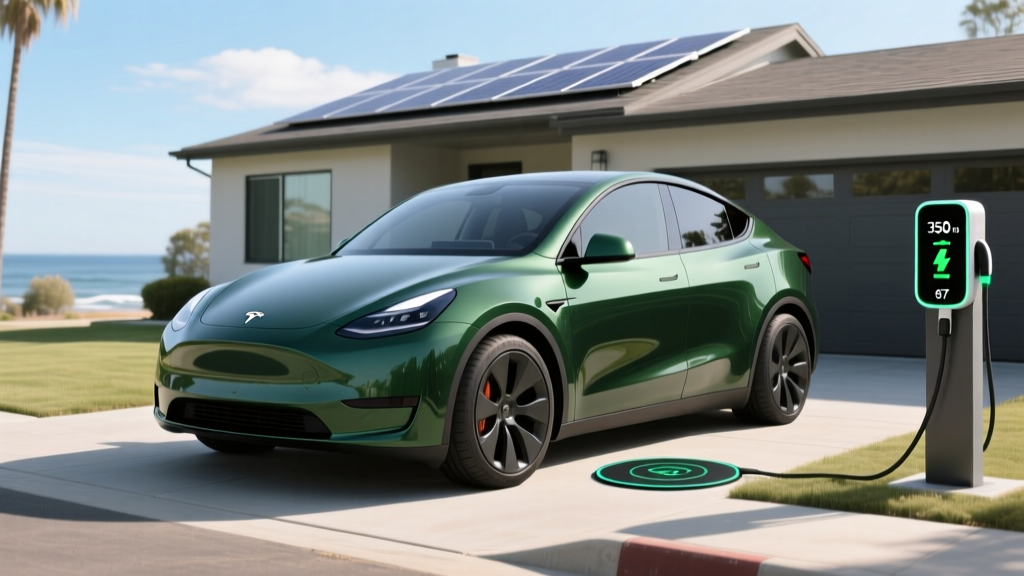
Tesla's long-rumored compact, affordable EV — internally codenamed "Redwood" — has finally entered pre-order territory for the 2026 model year. Positioned below the Model 3 in Tesla's lineup, the Redwood aims to undercut the $30,000 barrier before incentives, making it a direct threat to the Chevrolet Equinox EV, Hyundai Kona Electric, and Nissan Leaf successor. But pre-ordering an EV with preliminary specs requires careful scrutiny. Here is everything confirmed, estimated, and still unknown about the Tesla Redwood as reservations open.
What the Tesla Redwood Pre-Order Actually Gets You
As of early 2026, Tesla is accepting refundable reservation deposits for the Redwood through its website and app. The base configuration is a single-motor rear-wheel-drive compact hatchback/crossover built on a next-generation unboxed platform at Giga Texas. Deliveries are expected to begin in the second half of 2026 for reservation holders in the United States, with international markets following in 2027.
A pre-order today locks in your place in the delivery queue — it does not guarantee a specific delivery date, final price, or exact spec. Tesla has a history of adjusting pricing and features between reservation and delivery (as seen with the Cybertruck and refreshed Model 3 Highland). Treat the figures below as Tesla's published estimates, subject to EPA certification finalization before deliveries begin.
Estimated Range, Battery, and Efficiency
Real-World Expectation: Highway driving at 75 mph typically yields 85-90% of EPA range (~270-290 mi for Long Range). In sub-freezing temperatures, expect a 20-30% reduction, dropping the Standard RWD to roughly 185-210 miles on a full charge. Tesla's heat pump and battery preconditioning help mitigate cold losses, but physics is physics — smaller batteries feel cold-weather range loss more acutely.
The Redwood is expected to use a lithium iron phosphate (LFP) battery pack for the Standard RWD trim and a nickel manganese cobalt (NMC) pack for the Long Range AWD variant. LFP chemistry trades some energy density for lower cost, longer cycle life, and the ability to charge routinely to 100% without degradation concerns — a significant daily-use advantage for the base model.
| Spec | Standard RWD | Long Range AWD |
|---|---|---|
| EPA Range (est.) | ~265 mi | ~320 mi |
| Battery Capacity (usable) | ~55 kWh (LFP) | ~72 kWh (NMC) |
| Chemistry | LFP | NMC |
| Drivetrain | RWD, single motor | AWD, dual motor |
| Horsepower | ~220 hp | ~340 hp |
| 0-60 mph | ~6.2 sec | ~4.5 sec |
| Efficiency (est.) | ~130 MPGe / 26 kWh/100mi | ~125 MPGe / 27 kWh/100mi |
| Max DC Fast Charge | ~150 kW | ~175 kW |
| 10-80% DCFC Time | ~28 min | ~25 min |
| Level 2 Home Charge | 11.5 kW (~37 mi/hr) | 11.5 kW (~42 mi/hr) |
| Base MSRP | $24,990 | $32,990 |
| Battery Warranty | 8 yr / 100,000 mi | 8 yr / 120,000 mi |
Charging Speed: DC Fast, Level 2, and Real-World Curve
The Redwood is expected to support up to 150 kW peak DC fast charging on the Standard RWD and 175 kW on the Long Range AWD via the NACS connector, granting native access to Tesla's Supercharger network — still the most reliable public charging infrastructure in the U.S. per Tesla's Supercharger page.
| Level | Power | Speed | Notes |
|---|---|---|---|
| Level 1 (120V) | 1.4 kW | ~4-5 mi/hr | Emergency/trickle only |
| Level 2 (240V home) | 11.5 kW | 37-42 mi/hr | Full charge overnight (~6-7 hr) |
| DC Fast Charge | 150-175 kW peak | 10-80% in ~25-28 min | Tapers significantly above 80% |
A critical nuance for buyers: the 150-175 kW figure is a peak rate, not a sustained rate. Based on Tesla's charge-curve behavior on the Model 3 LFP, expect the Redwood Standard RWD to sustain roughly 120-130 kW through 50% SoC, tapering to ~80 kW by 70%, and dropping below 40 kW past 85%. The 10-80% time of ~28 minutes is realistic; a 10-100% session will take closer to 45-50 minutes. For road trips, plan stops around the 80% mark to avoid the painful top-off taper.
At home on a Level 2 wall connector (48A circuit), the Redwood will add roughly 37-42 miles of range per hour of charging — sufficient to fully replenish either battery overnight on a standard 240V/60A circuit. Installation costs for a home Level 2 setup typically range from $800 to $2,500 depending on panel capacity and conduit run, per licensed electrician estimates.
Performance, Dimensions, and Cargo Space
The Redwood slots below the Model 3 in size, targeting the compact crossover segment. Expected exterior dimensions place it roughly 10 inches shorter than the Model 3, with a slightly elevated ride height for crossover practicality.
- Length: ~176 inches (estimated)
- Wheelbase: ~108 inches
- Cargo (behind rear seats): ~24 cu ft
- Cargo (rear seats folded): ~55 cu ft
- Frunk: ~3 cu ft (small, cable storage)
- Rear legroom: ~35 inches
- Ground clearance: ~6.5 inches
The single-motor RWD produces an estimated 220 hp — adequate for commuting and highway merging but not thrilling. The dual-motor Long Range AWD bumps output to ~340 hp with a 4.5-second 0-60 mph time, competitive with the Volkswagen ID.4 AWD and Hyundai Ioniq 5 AWD. Neither variant is expected to offer meaningful towing capacity (likely 1,000 lb max or unrated for towing), so this is not a hauler.
Pricing, Trims, and Federal Tax Credit Eligibility
The headline number for the Tesla Redwood is a $24,990 base MSRP for the Standard RWD — a price point that, if it holds through production, undercuts every competing EV in its class. The Long Range AWD starts at an estimated $32,990.
| Trim | Base MSRP | Est. §30D Credit | Net Price (if eligible) |
|---|---|---|---|
| Standard RWD | $24,990 | Up to $7,500 | ~$17,490 |
| Long Range AWD | $32,990 | Up to $7,500 | ~$25,490 |
However, the IRS §30D federal tax credit eligibility is not automatic. For 2026, buyers must meet all of the following:
- MSRP cap: Vehicle MSRP must not exceed $55,000 for sedans/hatchbacks — both Redwood trims clear this easily.
- Income cap: Modified adjusted gross income (MAGI) must not exceed $150,000 (single), $225,000 (head of household), or $300,000 (joint).
- Battery sourcing: A percentage of critical minerals and battery components must be sourced from the U.S. or free-trade-agreement countries. Tesla's LFP cells have historically been sourced from CATL in China, which could disqualify the Standard RWD from the full $7,500 credit. The Long Range NMC variant, likely using Panasonic cells from Giga Nevada, has a stronger chance of qualifying for the full amount.
- Point-of-sale transfer: Eligible buyers can transfer the credit to the dealer at purchase, reducing the out-of-pocket price immediately rather than waiting for a tax refund.
The battery-sourcing requirement is the biggest wildcard. Tesla has been working to localize LFP cell production, but as of early 2026, it remains unclear whether the Standard RWD's LFP pack will meet the critical-minerals threshold for the full credit. Buyers should verify eligibility on fueleconomy.gov once the Redwood receives official EPA certification, and consult a tax professional for personal eligibility.
Tech, Driver Assistance, and Interior
The Redwood's interior follows Tesla's minimalist playbook: a single 15.4-inch center touchscreen handles all infotainment, climate, and vehicle controls. There is no traditional instrument cluster — speed and navigation appear on the left third of the main display. Expect wireless Apple CarPlay and Android Auto (finally standard on Tesla's 2025+ vehicles), a premium audio system with 8+ speakers, and over-the-air software updates.
Driver assistance includes Tesla's Basic Autopilot as standard (adaptive cruise control, lane centering, automatic emergency braking). Full Self-Driving (Supervised) remains an optional $8,000 add-on or $99/month subscription. It is critical to understand that FSD Supervised is an SAE Level 2 system — the driver must remain fully engaged, hands on or near the wheel, and eyes on the road at all times. It is not autonomous driving.
Notable tech features include Tesla's app-based phone-as-key, Sentry Mode dashcam recording, a heat pump for efficient cabin heating (critical for cold-weather range preservation), and vehicle-to-load (V2L) capability rumored for powering external devices up to ~2 kW — useful for camping or emergency backup, though Tesla has not confirmed V2L specs at launch.
How the Redwood Compares to Key Competitors
The Redwood enters a segment that has become fiercely competitive by 2026. Here is how the preliminary specs stack up against confirmed rivals:
| Vehicle | EPA Range | Base MSRP | Max DCFC | 0-60 mph |
|---|---|---|---|---|
| Tesla Redwood Std RWD | ~265 mi | $24,990 | 150 kW | ~6.2 sec |
| Chevrolet Equinox EV 2LT | 319 mi | $33,600 | 150 kW | ~7.5 sec |
| Hyundai Kona Electric SEL | 261 mi | $32,975 | 100 kW | ~7.3 sec |
| Volkswagen ID.4 Standard | 206 mi | $38,995 | 170 kW | ~7.7 sec |
| Nissan Leaf (next-gen) | ~250 mi (est.) | ~$29,000 | ~100 kW | ~7.0 sec |
The Redwood's price advantage is substantial — $4,000-$9,000 below most competitors before incentives. Its Supercharger network access is also a meaningful differentiator for road-trip reliability, though competitors now have growing access via adapters and expanding CCS networks. The trade-off: Tesla's minimalist interior, panel-gap variability, and lack of physical controls (no turn signal stalk, no volume knob) remain polarizing.
Pros
- Lowest base MSRP in the compact EV segment
- Native Supercharger network access (NACS)
- LFP battery allows routine 100% charging (Standard RWD)
- Strong efficiency (~130 MPGe) minimizes charging costs
- OTA updates and Tesla app ecosystem
- Heat pump standard for cold-weather efficiency
Cons
- LFP Standard RWD may not qualify for full §30D credit (sourcing rules)
- Minimalist interior lacks physical controls and traditional gauges
- Cargo space smaller than Equinox EV and ID.4
- No meaningful towing capacity
- Tesla service center capacity remains strained in some markets
- FSD subscription cost adds up; Level 2 only
Who the Tesla Redwood Is Best For
Choose the Redwood Long Range AWD if: You regularly drive 60+ miles daily, face cold winters where range loss matters, need dual-motor traction, or want the stronger likelihood of full §30D credit eligibility via NMC/Panasonic battery sourcing.
Look elsewhere if: You need a family vehicle with generous rear-seat space and cargo volume (consider the Equinox EV or Ioniq 5), require towing capability, prefer physical buttons and a traditional instrument cluster, or live in an area with limited Tesla service infrastructure.
Frequently Asked Questions
What is the real-world range of the Tesla Redwood?
The EPA-estimated range is ~265 miles for the Standard RWD and ~320 miles for the Long Range AWD. In real-world highway driving at 70-75 mph, expect roughly 225-240 miles from the Standard and 270-290 from the Long Range. In freezing temperatures, subtract 20-30% from those figures. The LFP Standard RWD's smaller 55 kWh battery makes cold-weather planning more critical.
How fast does the Redwood charge at home and on the road?
At home on a Level 2 (240V) wall connector, the Redwood charges at up to 11.5 kW, adding 37-42 miles of range per hour — a full overnight charge for either battery. On DC fast chargers, peak rates reach 150 kW (Standard) or 175 kW (Long Range), achieving a 10-80% charge in approximately 25-28 minutes. Charging slows considerably above 80% SoC.
Does the Tesla Redwood qualify for the $7,500 federal EV tax credit?
It depends on the trim and your personal tax situation. Both trims fall well under the $55,000 MSRP cap, and most buyers will fall within income limits. The key variable is battery sourcing: the Long Range NMC variant (likely Panasonic cells from Nevada) has a strong chance of full eligibility, while the Standard RWD's LFP pack faces uncertainty due to critical-mineral sourcing requirements. Always verify on fueleconomy.gov after EPA certification and consult a tax professional.
Is the Redwood worth pre-ordering versus buying a competitor today?
If you can wait for deliveries in late 2026 and the price holds near $24,990, the Redwood offers the best value proposition in the segment. However, if you need a vehicle now, the Chevrolet Equinox EV (319 mi range, $33,600) and Hyundai Kona Electric (261 mi, $32,975) are proven, available alternatives with confirmed tax credit eligibility. Pre-ordering also carries the risk of spec or price changes before delivery.
What are the biggest drawbacks of the Tesla Redwood?
The main concerns are the minimalist interior with no physical controls (Tesla removed turn signal stalks in recent models), uncertain LFP tax credit eligibility, limited cargo space versus competitors, no towing rating, and Tesla's variable build quality and service-center wait times in some regions. The FSD subscription model also adds ongoing cost for what remains a Level 2 driver-assist system.
When will Redwood deliveries begin?
Tesla has targeted the second half of 2026 for initial U.S. deliveries from Giga Texas, with reservation holders receiving priority based on deposit date and configuration. International markets are expected in 2027. As with all Tesla pre-orders, timelines are estimates and subject to production ramp delays.
Note: All specifications in this article are based on Tesla's published preliminary estimates and industry reporting as of early 2026. Final EPA range, pricing, and tax credit eligibility will be confirmed closer to delivery. Always verify current figures on tesla.com and fueleconomy.gov before making a purchase decision.