Tesla Quicksilver Model Y at a Glance
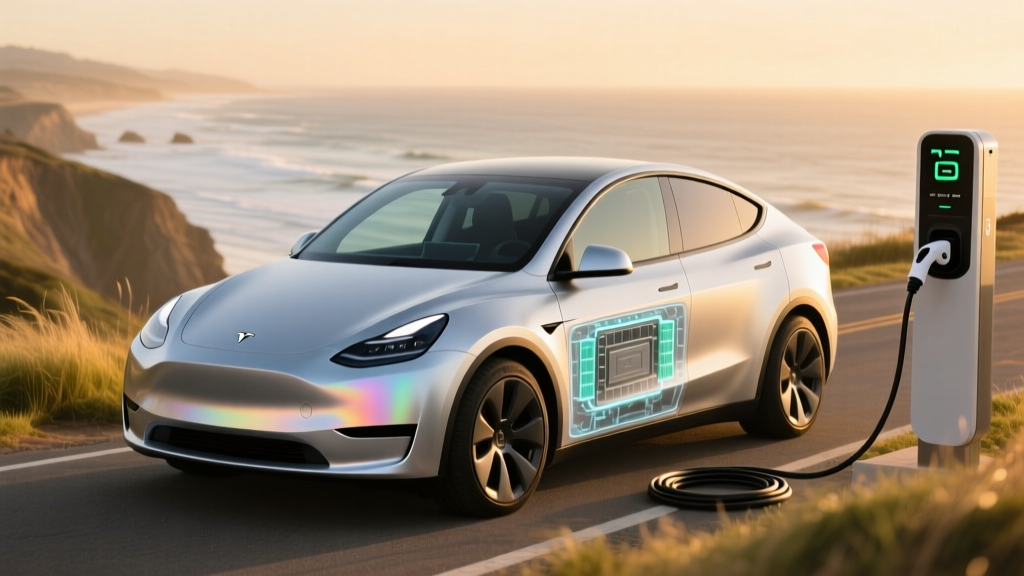
The Quicksilver exterior first appeared on the refreshed Model Y (internally dubbed "Juniper") as a premium paint option replacing the former Midnight Silver Metallic. For 2026, the Quicksilver Model Y remains one of the most sought-after configurations of the best-selling EV in the United States. This review covers the Long Range AWD variant in Quicksilver — examining whether the $1,500 paint premium is worth it, and more importantly, how the underlying Juniper platform performs in range, charging, comfort, and value against a rapidly closing competitive field.
| Specification | Value |
|---|---|
| EPA Range | 320 miles |
| Battery (usable) | ~75 kWh, NMC (2170 cells) |
| Drivetrain | Dual-Motor AWD |
| Horsepower | 384 hp (combined) |
| 0–60 mph | 4.8 seconds |
| Peak DC Fast Charge | 250 kW (V3 Supercharger) |
| 10–80% DC Charge Time | ~27 minutes |
| Level 2 Home Charging | 11.5 kW / ~44 mi/hr |
| Efficiency | 122 MPGe combined / 28 kWh/100 mi |
| Cargo (rear seats up / folded) | 30.2 / 72.1 cu ft |
| Rear Legroom | 41.6 in (Juniper refresh) |
| Battery Warranty | 8 years / 120,000 miles (≥70% retention) |
| Base MSRP (Quicksilver) | $49,490 (incl. destination) |
Real-World Range: What the EPA Sticker Doesn't Tell You
The EPA rates the 2026 Model Y Long Range AWD at 320 miles. In practice, real-world range varies meaningfully based on speed, temperature, and terrain — a pattern consistent across all EVs but critical for road-trip planning.
EPA Sticker: 320 miles
Real-World Highway (70–75 mph, mild weather): ~270–285 miles
Mixed City/Suburban Driving: ~300–315 miles (regen braking recovers energy in stop-and-go traffic)
Cold Weather (below 32°F, highway): ~220–250 miles — a 20–30% reduction typical for NMC chemistry without aggressive cabin preconditioning
The Juniper refresh improved the Model Y's drag coefficient to approximately 0.23 Cd, which helps highway efficiency relative to the pre-2025 model. The heat pump, standard since 2021, continues to mitigate cold-weather range loss better than resistive cabin heating — but physics still wins in sub-freezing temperatures. On a 300-mile winter road trip through the Rockies, expect at least one 20-minute Supercharger stop even with a full battery at departure.
Charging Speed: Supercharger Network Advantage
Charging is where Tesla ownership still diverges sharply from the rest of the EV market. The Model Y Long Range AWD supports up to 250 kW on V3 Superchargers and, increasingly, on V4 Supercharger stalls with integrated CCS/NACS architecture.
| Charging Level | Power (kW) | Speed | Notes |
|---|---|---|---|
| Level 1 (120V household) | ~1.4 kW | ~4 mi/hr | Emergency/trickle only |
| Level 2 (240V home Wall Connector) | 11.5 kW | ~44 mi/hr | Full charge in ~7 hours; requires 60A circuit |
| Level 2 (public AC) | 7.2–19.2 kW | 28–44 mi/hr | Varies by station |
| DC Fast (V3 Supercharger) | Up to 250 kW | 10–80% in ~27 min | Peak rate sustained to ~50% SoC, then tapers |
| DC Fast (V4 Supercharger) | Up to 250 kW | 10–80% in ~25 min | Newer stalls; slightly improved curve |
| DC Fast (non-Tesla CCS via adapter) | Up to 150–250 kW | Varies | Electrify America, EVgo; reliability varies |
The charge curve matters more than peak kW. The Model Y holds near-peak rates from roughly 10% to 50% state of charge, then progressively tapers. Charging from 80% to 100% on DC can take nearly as long as 10% to 80% — a characteristic shared with all lithium-ion packs but one that frustrates first-time EV owners who don't plan stops around the 80% mark. For daily driving, Tesla recommends charging to 80% (or 100% for LFP models, which the Model Y Long Range is not — it uses NMC chemistry).
For home charging, the Tesla Wall Connector on a dedicated 60-amp circuit delivers the full 11.5 kW the onboard charger can accept. Expect a professional installation cost of $800–$2,000 depending on panel capacity and conduit run length. If your home has a 100-amp main panel, a panel upgrade ($1,500–$3,000) may be necessary.
Performance and Driving Dynamics
The dual-motor AWD powertrain produces 384 horsepower and delivers a 4.8-second 0–60 mph time — brisk for a family crossover and comfortably quicker than the Hyundai Ioniq 5 (5.1s AWD) or Ford Mustang Mach-E Extended Range AWD (5.5s). The instant torque delivery makes merging and passing effortless, and the low center of gravity (battery pack under the floor) keeps body roll well-controlled through corners.
The Juniper update introduced a retuned adaptive suspension with improved damping over rough pavement — a legitimate complaint about the pre-2025 Model Y was its firm ride on broken urban roads. The 2026 model absorbs potholes and expansion joints noticeably better while retaining the responsive steering feel Tesla owners expect. Road noise insulation has also improved, with acoustic glass now standard on all windows.
Towing capacity remains 3,500 pounds when properly equipped — adequate for a small utility trailer or a pair of jet skis, but not competitive with the Rivian R1S or F-150 Lightning for serious towing duty.
Interior, Tech, and the Minimalist Trade-Off
The 2026 Model Y interior continues Tesla's minimalist approach: a single 15.4-inch center touchscreen handles virtually all vehicle controls, navigation, media, and climate functions. The Juniper refresh added a ventilated front seat option, ambient lighting with 256 colors, a rear-seat 8-inch entertainment screen, and power-folding second-row seats — addressing several of the most common criticisms from reviewers and owners alike.
Build quality has measurably improved since Tesla's Fremont and Austin production lines matured. Panel gaps are tighter, interior material quality is up (vegan leather with soft-touch surfaces), and the rattle-prone reputation of early Model Y vehicles has largely been resolved in 2025+ production.
Autopilot and FSD (Supervised): Every Model Y ships with Autopilot (Traffic-Aware Cruise Control and Autosteer), which is a competent SAE Level 2 driver-assistance system. Full Self-Driving (Supervised) remains an $8,000 option or $99/month subscription. Despite the name, FSD is still Level 2 — the driver must remain fully engaged, hands on or near the wheel, and eyes on the road at all times. It handles complex urban intersections and highway interchanges with increasing competence but is not autonomous driving. Only Level 4 services like Waymo operate without a human driver.
⚠️ Autopilot/FSD is NOT self-driving. Both are SAE Level 2 systems requiring continuous driver supervision. You are legally and operationally responsible for the vehicle at all times. NHTSA continues to investigate Tesla Autopilot/FSD incidents — never treat these systems as a substitute for attentive driving.
Pricing, Trims, and Federal Tax Credit Eligibility
The 2026 Model Y is offered in three primary trims. Quicksilver is available across all trims as a $1,500 premium paint option.
| Trim | Base MSRP | + Quicksilver | Est. After §30D Credit* |
|---|---|---|---|
| Long Range RWD | $44,990 | $46,490 | From ~$38,990 |
| Long Range AWD | $47,990 | $49,490 | From ~$41,990 |
| Performance | $52,490 | $53,990 | From ~$46,490 |
*Federal §30D credit up to $7,500. Eligibility depends on buyer income, battery component sourcing, and critical mineral requirements. Point-of-sale transfer available at participating dealers. Verify current rules at IRS.gov before purchasing.
The §30D federal tax credit has specific requirements that change periodically. As of 2026, key eligibility factors include:
- MSRP Cap: SUVs/crossovers must have an MSRP at or below $80,000 — all Model Y trims qualify.
- Income Cap: Modified AGI must not exceed $150,000 (single), $225,000 (head of household), or $300,000 (joint).
- Battery Sourcing: Increasingly strict critical mineral and battery component requirements must be met for the full $7,500. Partial credits ($3,750) may apply if only one sourcing threshold is met.
- Point-of-Sale Transfer: Buyers can transfer the credit to the dealer at purchase, reducing the upfront price rather than waiting for a tax refund.
Tesla's US-built vehicles (Austin, TX assembly) have generally qualified for at least partial credits, but battery component sourcing rules tighten annually. Confirm your specific eligibility with a tax professional and the IRS Clean Vehicle credit lookup tool before finalizing your order.
Efficiency and Operating Costs
The Model Y Long Range AWD achieves an EPA-rated 122 MPGe combined (28 kWh per 100 miles). This translates to roughly $0.04–$0.06 per mile on home electricity (at $0.14/kWh national average) versus $0.12–$0.16 per mile for a comparable gas-powered crossover at $3.50/gallon and 25 MPG combined.
Over 15,000 miles per year, home charging saves approximately $1,200–$1,500 annually versus gasoline. Public DC fast charging is more expensive — typically $0.30–$0.48/kWh at Superchargers and third-party networks — but most Tesla owners do 80%+ of their charging at home.
Who Should Buy the Quicksilver Model Y?
Choose the Model Y Long Range AWD (Quicksilver) if:
- You need a family EV with strong range (320 mi EPA), excellent cargo space (72 cu ft), and access to the most reliable DC fast-charging network in the US.
- You value over-the-air updates, best-in-class software, and a proven Supercharger ecosystem for road trips.
- You want a premium-looking exterior without the $2,500 Ultra Red or the fingerprint-magnet issues of solid black.
Consider competitors if:
- You want a more conventional interior with physical buttons and a traditional instrument cluster (Hyundai Ioniq 5, Kia EV6).
- You need more than 3,500 lbs towing capacity (Rivian R1S, Ford F-150 Lightning).
- You prioritize ride comfort over sporty handling (Genesis GV60, BMW iX).
- You want a lower entry price and are willing to accept less range (Chevrolet Equus EV, base Ioniq 5).
✅ Pros
- 320-mile EPA range covers most road trips with a single stop
- Supercharger network: 6,000+ V3/V4 stalls in the US — the most reliable public DC network
- Best-in-class software, OTA updates, and mobile app integration
- Strong efficiency (122 MPGe) keeps operating costs low
- Juniper refresh significantly improved ride quality and interior materials
- Quicksilver paint is durable, hides minor scratches well, and doesn't show water spots like black
❌ Cons
- No physical buttons — all climate/media controls are touchscreen-only
- Turn signal stalks removed in Juniper refresh (steering-wheel-mounted buttons instead)
- Insurance premiums run 15–25% higher than comparable gas crossovers
- 3,500-lb towing limit is modest for the class
- FSD (Supervised) remains expensive at $8,000 and is still Level 2 — not autonomous
- Rear visibility is compromised by the sloping roofline; camera dependency is heavy
Competitive Comparison: Model Y vs. the Field
The Model Y's dominance is being challenged from multiple directions. Here's how it stacks up against key rivals at a glance:
| Model | EPA Range | 0–60 | Peak DC kW | Starting MSRP |
|---|---|---|---|---|
| Tesla Model Y LR AWD | 320 mi | 4.8s | 250 kW | $47,990 |
| Hyundai Ioniq 5 LR AWD | 290 mi | 5.1s | 240 kW | $49,500 |
| Kia EV6 LR AWD | 282 mi | 5.2s | 240 kW | $48,700 |
| Ford Mustang Mach-E ER AWD | 305 mi | 5.5s | 150 kW | $48,995 |
| BMW iX xDrive50 | 324 mi | 4.6s | 200 kW | $87,250 |
The Model Y leads or matches competitors on range, charging speed, and price. Its weakest points relative to the Ioniq 5 and EV6 are interior design originality and physical control availability. Against the Mach-E, the Tesla holds a significant charging-speed advantage (250 kW vs 150 kW). The BMW iX is a luxury-class vehicle at nearly double the price — a different segment entirely.
Frequently Asked Questions
What is the real-world range of the Tesla Quicksilver Model Y?
The EPA rates it at 320 miles. Expect ~270–285 miles on the highway in mild weather, ~300+ in city driving with regenerative braking, and ~220–250 miles in cold-weather highway driving below freezing. Preconditioning the battery via the Tesla app before departure helps mitigate cold-weather losses.
How fast does the Model Y charge at home and on the road?
At home on a Level 2 Wall Connector (11.5 kW), you'll add roughly 44 miles of range per hour — a full overnight charge covers most daily needs. On a V3 or V4 Supercharger (250 kW peak), a 10–80% charge takes approximately 25–27 minutes. Charging slows significantly above 80% SoC to protect battery longevity.
Does the 2026 Model Y qualify for the $7,500 federal EV tax credit?
It may. All Model Y trims fall under the $80,000 SUV MSRP cap. However, eligibility depends on your income (AGI limits apply), and battery component/critical mineral sourcing requirements that tighten annually. As of 2026, Tesla's US-assembled vehicles have generally qualified for at least partial credits. Confirm specifics at IRS.gov and with a tax professional.
Is Quicksilver worth the $1,500 premium over Pearl White?
Quicksilver is a multi-coat metallic that offers more depth and visual interest than Pearl White Multi-Coat (free). It hides light scratches and road grime better than Solid Black and doesn't attract fingerprints the way darker colors do. If you plan to keep the vehicle 3+ years and care about resale aesthetics, the premium is reasonable. If you're budget-focused, Pearl White is still an attractive, durable finish.
Is the Model Y still worth buying vs. newer competitors in 2026?
Yes, for most buyers. The Juniper refresh addressed the Model Y's biggest weaknesses (ride quality, interior materials, road noise) while retaining its core strengths: Supercharger access, software, efficiency, and cargo versatility. Competitors like the Ioniq 5 and EV6 offer more distinctive interiors and 800V charging architecture, but Tesla's network advantage and proven reliability at scale keep the Model Y at the top of the segment for practical EV buyers. According to fueleconomy.gov, the Model Y remains one of the most efficient AWD electric crossovers available.
What is the battery warranty on the 2026 Model Y?
Tesla covers the battery and drive unit for 8 years or 120,000 miles (whichever comes first) with a minimum 70% capacity retention guarantee. If the battery degrades below 70% of its original capacity within the warranty period, Tesla will repair or replace it. Real-world data from high-mileage Tesla owners suggests typical degradation of 8–12% over the first 100,000 miles for NMC packs — well within the warranty threshold.
Sources: EPA fuel economy data via fueleconomy.gov, Tesla official specifications, IRS Clean Vehicle Credit guidelines at IRS.gov.