Two Very Different Answers to the Electric Crossover Question
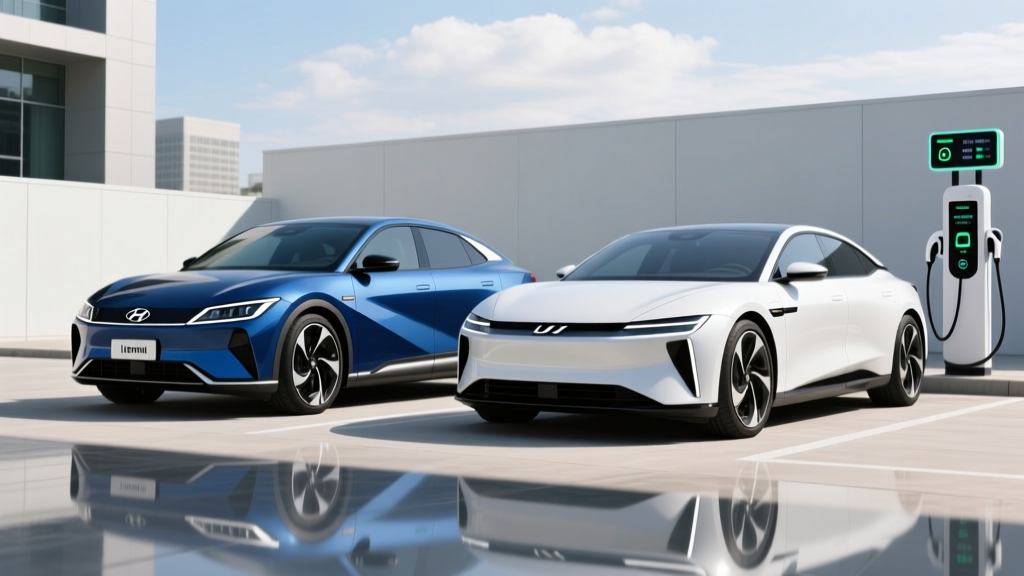
If you've been cross-shopping mid-premium electric vehicles in 2026, you've likely landed on two machines that occupy the same search results but answer fundamentally different questions. The Hyundai Ioniq 5 asks: "What's the smartest all-around EV for most people?" The Lucid Air Pure asks: "What's the most efficient luxury EV sedan money can buy?" Neither is wrong — but conflating them leads to bad purchase decisions.
This comparison breaks down the 2026 Hyundai Ioniq 5 (the refreshed model with NACS port and improved battery) against the 2026 Lucid Air Pure (Lucid's entry-level luxury sedan) across the metrics that actually matter to owners: real-world range, charging speed, total cost after federal credits, cargo practicality, and daily drivability. We'll also touch on where the Hyundai Ioniq 5 N and Lucid Air Sapphire sit for performance buyers, since those trims frequently appear in the same search queries.
| Spec | 2026 Hyundai Ioniq 5 (Long Range AWD) | 2026 Lucid Air Pure (RWD) |
|---|---|---|
| EPA Range | 318 miles | 419 miles |
| Battery (usable) | 84.0 kWh (NMC) | 88.0 kWh (NMC) |
| Drivetrain | Dual-motor AWD | Rear-wheel drive |
| Horsepower | 320 hp | 430 hp |
| 0-60 mph | 4.5 seconds | 3.8 seconds |
| Max DC Fast Charge | 240 kW (peak) | 200 kW (peak) |
| 10-80% DC Time | ~18 minutes | ~25 minutes |
| Level 2 Charge Rate | 10.9 kW (~37 mi/hr) | 19.2 kW (~65 mi/hr) |
| EPA Efficiency | 110 MPGe (31 kWh/100mi) | 140 MPGe (24 kWh/100mi) |
| Cargo Volume | 27.2 cu ft (rear seats up) + 0.85 cu ft frunk | 32.0 cu ft trunk + frunk |
| Base MSRP | $49,950 (SEL AWD) | $69,900 (Pure) |
| Battery Warranty | 10 yr / 100,000 mi | 8 yr / 100,000 mi |
Real-World Range: What the EPA Sticker Doesn't Tell You
The Lucid Air Pure's 419-mile EPA figure is legitimately class-leading for any production EV under $80,000, and it's achieved through a combination of low drag coefficient (0.20 Cd), a highly efficient powertrain, and relatively light weight for its battery size. But EPA numbers are tested on mixed city/highway cycles at moderate temperatures. Let's ground this in reality.
Real-World Range Expectations
Hyundai Ioniq 5 AWD (EPA 318 mi): Expect 270-290 miles in mixed driving, 240-260 miles sustained highway at 75 mph, and 200-220 miles in sub-30°F winter conditions. The heat pump (standard on 2026 models) mitigates some cold loss, but the boxy crossover shape creates more drag than Lucid's teardrop sedan.
Lucid Air Pure RWD (EPA 419 mi): Expect 360-380 miles mixed, 330-350 miles highway at 75 mph, and 290-320 miles in freezing weather. Lucid's efficiency advantage compounds at highway speeds — this is one of the few EVs where real-world highway range closely tracks EPA estimates.
For context, the average American drives 37 miles per day according to FHWA data. Both vehicles comfortably cover a week of commuting without charging. The gap matters most on road trips: the Lucid can do LA-to-Las Vegas (270 miles) on a single charge with buffer; the Ioniq 5 requires a 15-minute DC stop in Barstow.
Source: EPA fueleconomy.gov side-by-side comparison
Charging Speed: The Ioniq 5's 800-Volt Advantage
Here's where the Hyundai Ioniq 5 fights back decisively. Its E-GMP platform uses an 800-volt electrical architecture, which enables DC fast charging at up to 240 kW on compatible chargers (Electrify America's 350 kW stalls, Tesla Superchargers with NACS adapter on 2026 models). The Lucid Air Pure uses a 900-volt system but is software-limited to around 200 kW peak.
| Charging Level | Hyundai Ioniq 5 | Lucid Air Pure |
|---|---|---|
| Level 1 (120V, 1.4 kW) | ~4 mi/hr | ~5 mi/hr |
| Level 2 (240V, home) | 10.9 kW (~37 mi/hr) | 19.2 kW (~65 mi/hr) * |
| DC Fast Charge (peak) | 240 kW | 200 kW |
| 10-80% DC Time | ~18 minutes | ~25 minutes |
| Miles Added in 15 min DC | ~200 miles | ~180 miles |
* Lucid's 19.2 kW Level 2 rate requires a 80-amp hardwired home charger and a 100-amp dedicated circuit. Most homes with standard 48-amp Level 2 installations (11.5 kW) will see ~39 mi/hr for the Lucid and ~37 mi/hr for the Hyundai — effectively identical.
The Ioniq 5's 18-minute 10-80% time is among the fastest in any EV under $60,000. But there's a catch: that peak 240 kW only holds between roughly 10-55% state of charge. After 60%, the charge curve tapers significantly, dropping to ~100 kW by 75% and ~50 kW by 85%. This is normal lithium-ion behavior, but it means your actual charging stop on a road trip (where you arrive at 10-15% and leave at 80%) averages around 130-150 kW sustained.
The Lucid's curve is flatter but lower-peaked. It holds closer to 170-180 kW through 60% before tapering. Net result: the Ioniq 5 wins short stops (10-80%), but on a 15-95% fill, the gap narrows to just a few minutes because the Lucid's larger battery absorbs more total energy.
Price, Tax Credits, and the Total Cost Reality
This is where the Ioniq 5 vs Lucid Air comparison becomes less about specs and more about budget reality. The Hyundai starts nearly $20,000 below the Lucid, and after federal incentives, the gap widens further for most buyers.
| Trim / Configuration | MSRP | Federal §30D Credit | Effective Price |
|---|---|---|---|
| Ioniq 5 SE RWD | $44,550 | $7,500 (if eligible) | $37,050 |
| Ioniq 5 SEL AWD | $49,950 | $7,500 (if eligible) | $42,450 |
| Ioniq 5 Limited AWD | $56,400 | $7,500 (if eligible) | $48,900 |
| Lucid Air Pure | $69,900 | $7,500 (if eligible) | $62,400 |
| Lucid Air Touring | $79,900 | $7,500 (if eligible) | $72,400 |
§30D Federal Tax Credit Requirements (2026 Rules)
- MSRP Cap: Vans/SUVs/pickups ≤ $80,000; sedans ≤ $55,000. The Ioniq 5 qualifies as an SUV (all trims under $80K). The Lucid Air Pure is classified as a sedan — at $69,900 MSRP, it exceeds the $55,000 sedan cap and does NOT qualify for the new-vehicle credit.
- Income Cap: Modified AGI ≤ $150,000 (single), $225,000 (head of household), $300,000 (joint).
- Battery Sourcing: Critical minerals and battery components must meet escalating domestic-content thresholds per the Inflation Reduction Act. Verify current-year compliance on IRS.gov.
- Point-of-Sale Transfer: Eligible buyers can transfer the credit to the dealer for an upfront price reduction rather than waiting for tax filing.
This is the critical insight most comparison articles miss: the Lucid Air Pure does not qualify for the $7,500 federal tax credit because it's classified as a sedan with an MSRP above $55,000. The Ioniq 5, classified as a light truck/SUV, remains eligible across all trims. This makes the effective price gap closer to $25,000-$27,000, not $20,000.
State incentives vary widely — California's CVRP, Colorado's innovative motor vehicle credit, and others may apply to both vehicles. Check your state's energy office for current programs.
Daily Drivability: Cargo, Cabin, and the Crossover vs Sedan Question
The Ioniq 5's hatchback crossover layout provides 27.2 cubic feet behind the rear seats and 56.2 cubic feet with the 60/40 split folded. The flat floor and wide opening make it genuinely practical for Costco runs, dog crates, and IKEA trips. Rear legroom is 39.4 inches — generous for adults on long trips. The small 0.85 cu ft frunk holds charging cables but not much else.
The Lucid Air Pure, despite being a sedan, offers a surprisingly large 32.0 cubic feet of trunk space (with a power liftgate on 2026 models) plus a 3.4 cu ft frunk. Rear legroom is 37.3 inches. The trunk is deeper but narrower than the Ioniq 5's hatch, and the sedan's fixed rear window limits vertical cargo space. You can fit two large suitcases and a stroller; you cannot fit a bicycle without removing the front wheel.
Interior quality is where the Lucid justifies its premium. The cabin uses sustainable materials with genuine luxury fitment — tight seams, soft-touch surfaces, a 34-inch curved glass cockpit display. The Ioniq 5's interior is well-designed but uses more hard plastics, particularly on lower door panels and the center console base. Both vehicles use column-mounted shifters and offer ambient lighting, ventilated seats (standard on Lucid, available on Ioniq 5 Limited), and over-the-air software updates.
Driver Assistance and Tech: Both Level 2, Neither Self-Driving
SAE Automation Level: Level 2 (Driver Supervision Required)
Both the Hyundai Ioniq 5 (with Highway Driving Assist 2) and Lucid Air Pure (with DreamDrive Pro) are SAE Level 2 driver-assistance systems. They combine adaptive cruise control and lane-centering to reduce fatigue on highways, but the driver must remain fully engaged, hands on or near the wheel, and eyes on the road at all times. Neither system is self-driving.
Hyundai's HDA2 is competent but conservative — it handles lane changes when prompted via turn signal and maintains following distance smoothly, but it disengages in construction zones and struggles with faded lane markings. Lucid's DreamDrive Pro uses 32 sensors including a high-resolution lidar unit (standard on Touring, available on Pure), providing slightly better performance in low-visibility conditions and more confident highway merging.
Neither system matches the hands-free capability of GM's Super Cruise or Ford's BlueCruise on mapped highways. If hands-free driving on approved routes is a priority, neither vehicle currently offers it — though Lucid has announced future OTA updates that may enable conditional hands-free operation (not yet available as of 2026).
What These Systems Do NOT Do
- Navigate city streets autonomously or handle traffic lights without driver input
- Allow you to look away from the road, use a phone, or sleep
- Operate safely in heavy rain, snow, or construction zones without heightened driver attention
- Replace the need for driver's insurance liability — you remain responsible for the vehicle
Who Should Buy Which? A Decision Framework
Choose the Hyundai Ioniq 5 If:
- Your budget is $40,000-$55,000 after incentives
- You need hatchback cargo versatility (dogs, gear, kids' equipment)
- You road-trip frequently and value 18-minute DC fast-charge stops
- You want eligibility for the full $7,500 federal tax credit
- You prefer a higher seating position and crossover visibility
- 10-year/100,000-mile battery warranty matters for long-term ownership
Choose the Lucid Air Pure If:
- Your budget is $65,000+ and you prioritize range above all else
- You commute 60+ miles daily and want to charge only 2-3 times per week
- Luxury cabin quality and a premium sedan experience are non-negotiable
- You have reliable home Level 2 charging and rarely rely on public DC fast chargers
- You value class-leading efficiency (140 MPGe) and minimal energy cost per mile
The Verdict: Different Tools for Different Jobs
The 2026 Hyundai Ioniq 5 remains one of the best all-around EVs on the market for buyers who need practicality, fast charging, and value. At $42,450 after the federal credit (SEL AWD), it delivers 318 miles of EPA range, 18-minute fast-charge capability, and genuine hatchback utility. It's the EV I recommend most often to friends asking "what should I buy?"
The 2026 Lucid Air Pure is an engineering achievement — 419 miles from an 88 kWh battery at 140 MPGe is remarkable efficiency. But at $69,900 (no federal credit due to the sedan MSRP cap), it's a luxury purchase, not a value play. If range anxiety is your primary concern and budget allows, the Lucid eliminates it more thoroughly than any other EV under $80,000.
Neither vehicle is "better" in absolute terms. The Ioniq 5 is the smarter financial decision for most households. The Lucid Air Pure is the better EV for range-obsessed luxury buyers who can charge at home. Cross-shop them only if your budget genuinely spans both — and if it does, test-drive both in the same week. The driving experience gap is as significant as the spec sheet.
2026 Hyundai Ioniq 5 — Pros & Cons
Pros
- 18-minute 10-80% DC fast charging (800V architecture)
- Federal §30D tax credit eligible (all trims under $80K SUV cap)
- Practical hatchback cargo area (56.2 cu ft max)
- 10-year/100,000-mile battery warranty
- NACS charge port standard on 2026 models (Supercharger access)
Cons
- No hands-free driving mode (unlike Super Cruise/BlueCruise competitors)
- Real-world highway range drops to ~250 mi at 75+ mph
- Frunk is tiny (0.85 cu ft) — essentially a cable storage bin
- Ride quality can be firm on Limited trim's 20-inch wheels
2026 Lucid Air Pure — Pros & Cons
Pros
- 419-mile EPA range — best in class under $80K
- 140 MPGe efficiency (lowest cost per mile in segment)
- Genuine luxury interior with 34-inch glass cockpit
- 19.2 kW Level 2 charging capability (with 80A circuit)
- Spacious rear seat and large trunk for a sedan
Cons
- Does NOT qualify for $7,500 federal credit (sedan MSRP cap)
- Slower DC fast charging (25 min 10-80%) vs Ioniq 5
- Limited service center network vs Hyundai's 800+ dealers
- No hatchback versatility — sedan trunk limits tall cargo
- DreamDrive Pro lidar not standard on Pure trim
Frequently Asked Questions
What is the real-world range of the Hyundai Ioniq 5?
The 2026 Ioniq 5 Long Range AWD is EPA-rated at 318 miles. In real-world mixed driving at moderate temperatures, expect 270-290 miles. Sustained highway driving at 75 mph yields approximately 240-260 miles. In sub-freezing winter conditions, range drops to 200-220 miles even with the standard heat pump. The RWD variant (EPA 303 mi) will see slightly lower figures across all conditions.
How fast does the Lucid Air Pure charge at home and on DC fast chargers?
On a DC fast charger, the Lucid Air Pure peaks at approximately 200 kW and charges from 10-80% in about 25 minutes. At home on a standard 48-amp Level 2 charger (11.5 kW), it adds roughly 39 miles of range per hour, requiring about 10-11 hours for a full charge from empty. With an 80-amp hardwired Level 2 station (19.2 kW, requiring a dedicated 100-amp circuit), it can add up to 65 miles per hour — though most residential electrical panels cannot support this without a panel upgrade.
Does the Lucid Air Pure qualify for the $7,500 federal EV tax credit?
No, as of 2026 the Lucid Air Pure does not qualify for the §30D new clean vehicle credit. The IRS classifies the Lucid Air as a sedan (not an SUV), and the sedan MSRP cap is $55,000. The Air Pure's MSRP of $69,900 exceeds this threshold. The Hyundai Ioniq 5, classified as a light truck/SUV with an $80,000 cap, remains eligible across all trims. Always verify current eligibility rules on IRS.gov before purchasing, as classification and sourcing rules can change.
Is the Ioniq 5 better than the Lucid Air for road trips?
For road trips, the Ioniq 5's faster DC charging (18 vs 25 minutes, 10-80%) means shorter stops, which matters on 500+ mile drives. However, the Lucid Air Pure's 419-mile range means fewer stops overall — you might skip a charging stop entirely on routes where the Ioniq 5 requires one. On balance: if your typical road trip is 300-400 miles, the Lucid wins (no stop needed). If it's 500+ miles, the Ioniq 5's faster charging keeps total travel time competitive. Hatchback cargo space also favors the Ioniq 5 for luggage-heavy family trips.
How does the Ioniq 5 N compare to the Lucid Air Sapphire?
These are performance halo trims, not direct competitors. The Ioniq 5 N ($67,500) produces 640 hp (601 lb-ft) with N Grin Boost, does 0-60 in 3.25 seconds, and adds track-focused features like simulated gear shifts and N e-Shift. The Lucid Air Sapphire ($249,000) is a 1,234-hp tri-motor hypercar sedan doing 0-60 in 1.89 seconds. They share nothing beyond branding. If you're searching "Ioniq 5 Lucid Blue," you may be conflating the Ioniq 5 N's performance positioning with Lucid's lineup — they occupy entirely different price and performance brackets.
What's the 5-year total cost of ownership for each?
Assuming 15,000 miles/year, $0.14/kWh home electricity, and 80% home charging: The Ioniq 5 SEL AWD costs approximately $38,000-$42,000 over 5 years (purchase after credit, electricity, insurance, maintenance). The Lucid Air Pure costs approximately $58,000-$64,000 over the same period. The Lucid's superior efficiency saves roughly $400-$600/year in electricity costs, but this doesn't offset the $20,000+ purchase price gap. Insurance premiums for the Lucid also run 15-25% higher due to repair cost data.
Sources: EPA fueleconomy.gov, IRS §30D Clean Vehicle Credits, Hyundai USA and Lucid Motors official specification pages. Pricing and credit eligibility reflect 2026 model year data and are subject to change. Consult a tax professional for personal credit eligibility.