Is There Actually a Tesla Purple in 2026?
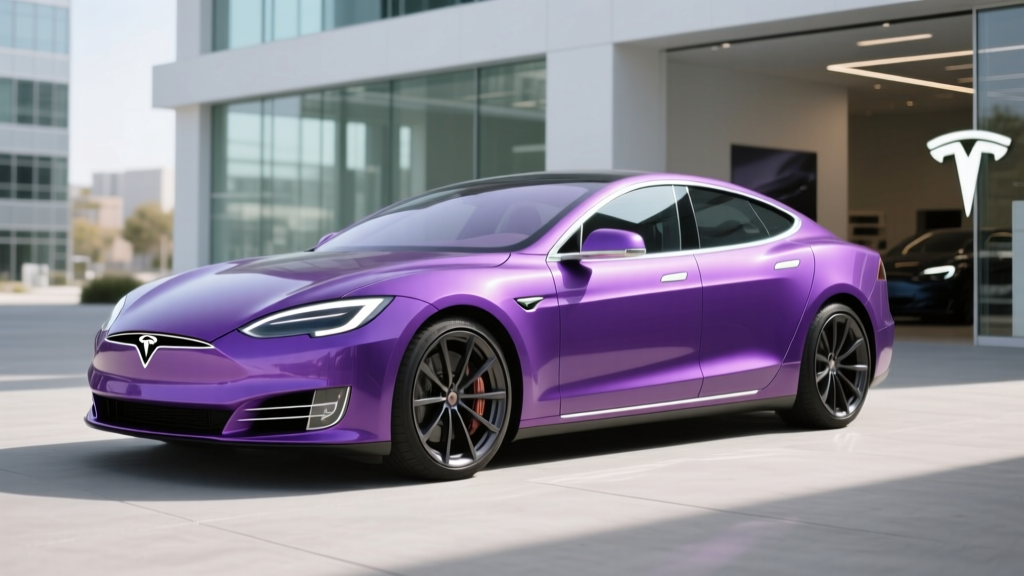
If you've been searching for Tesla purple, you're not alone — the query trends every year among buyers hoping Tesla has finally added a true violet or plum to its notoriously limited paint palette. As of the 2026 model year, Tesla does not offer a factory purple on any U.S.-market Model 3, Model Y, Model S, or Model X. The closest you'll get from the Fremont and Austin paint shops is Deep Blue Metallic ($1,000 upgrade on Model 3/Y, $1,500 on Model S/X), which in certain lighting — especially dawn, dusk, or overcast skies — reads as a dark indigo-purple.
That hasn't stopped owners from chasing the look. The aftermarket vinyl-wrap and PPF (paint protection film) industry has stepped in, with shops across the country wrapping Teslas in shades like Satin Chrome Purple, Metallic Violet, and Colorshift Plum. A full-body wrap typically runs $3,500–$5,500 depending on material and shop, and crucially, it's reversible — preserving resale value while giving you the one-of-a-kind spec Tesla refuses to build.
Below, we review the 2026 Tesla lineup through the lens of a buyer who wants something beyond white, black, and gray — covering real-world range, charging speeds, pricing after federal tax credits, and whether wrapping or waiting for a factory color makes more sense.
2026 Tesla Lineup: Specs, Range, and Efficiency
Whether you're wrapping a Model 3 purple or ordering a Model Y in Deep Blue Metallic and squinting, the engineering underneath is what you're actually buying. Here's the full 2026 U.S. spec breakdown for the core lineup.
| Spec | Model 3 Long Range AWD | Model Y Long Range AWD | Model S Long Range | Model X Long Range |
|---|---|---|---|---|
| EPA Range | 363 mi | 320 mi | 402 mi | 348 mi |
| Battery (usable) | ~79 kWh (NMC) | ~79 kWh (NMC) | ~95 kWh (NMC) | ~95 kWh (NMC) |
| Drivetrain | Dual-motor AWD | Dual-motor AWD | Dual-motor AWD | Dual-motor AWD |
| Horsepower | ~384 hp | ~384 hp | ~670 hp | ~670 hp |
| 0–60 mph | 4.2 sec | 4.8 sec | 3.1 sec | 3.8 sec |
| MPGe (combined) | 132 MPGe | 122 MPGe | 120 MPGe | 109 MPGe |
| Efficiency | 25 kWh/100mi | 27 kWh/100mi | 28 kWh/100mi | 31 kWh/100mi |
| Cargo (rear + frunk) | 23 + 3.1 cu ft | 72 + 4.1 cu ft | 28 + 3.1 cu ft | 88 + 6.6 cu ft |
| Rear Legroom | 35.2 in | 41.6 in | 35.4 in | 41.1 in |
Sources: fueleconomy.gov, Tesla.com 2026 order pages.
EPA stickers assume a mix of city and moderate-speed highway driving at ~70°F. In our experience and consistent with third-party testing, expect:
- Highway (75 mph sustained): subtract 10–15% from EPA. A Model 3 LR delivers ~310–325 real highway miles.
- Cold weather (below 32°F): subtract 20–30% without preconditioning. A Model Y LR may deliver ~220–250 miles on a sub-freezing commute.
- With heat pump + preconditioning: Tesla's standard heat pump recovers roughly half of the cold-weather loss compared to resistive heating. Preconditioning while plugged in is non-negotiable in winter.
Charging Speed: DC Fast, Level 2, and the Supercharger Advantage
Paint color won't affect your charging curve, but battery chemistry and thermal management will. All 2026 Long Range Teslas use NMC cells with active liquid cooling, which sustains peak DC charge rates longer than passively-cooled packs.
| Charging Level | Model 3 / Model Y LR | Model S / Model X LR |
|---|---|---|
| DC Fast Charge (peak) | 250 kW (V3 Supercharger) | 250 kW (V3 Supercharger) |
| 10–80% DC time | ~27–30 min | ~32–36 min |
| Level 2 home (48A / 11.5 kW) | ~44 mi/hr added | ~40 mi/hr added |
| Level 2 home (32A / 7.7 kW) | ~30 mi/hr added | ~27 mi/hr added |
| Level 1 (120V / 12A) | ~3 mi/hr added | ~3 mi/hr added |
Charging curve reality: The 250 kW peak on V3 Superchargers holds roughly from 10–30% State of Charge (SoC), then tapers progressively. From 50–80%, expect ~100–140 kW sustained. That's why the 10–80% time is a more honest metric than peak kW — and why Tesla's navigation-based battery preconditioning matters. Arriving at a Supercharger without preconditioning (e.g., navigating manually) can add 10–15 minutes to a session in cold weather.
The 2026 lineup ships with the NACS connector natively, meaning full access to Tesla's Supercharger network (20,000+ U.S. stalls) without adapters. Non-Tesla networks using CCS1 require the Tesla CCS adapter (~$175), which is worth keeping in the frunk for redundancy on road trips through charging deserts.
Pricing, Tax Credits, and the Cost of Going Purple
Here's what the 2026 lineup actually costs before and after the federal EV tax credit under IRS §30D. Remember: the credit is not automatic — it depends on your adjusted gross income, the vehicle's MSRP cap, and battery-critical-mineral sourcing requirements that tighten every year.
| Model / Trim | Base MSRP | As-Tested (Deep Blue + FSD) | §30D Credit Potential | Effective Price |
|---|---|---|---|---|
| Model 3 LR AWD | $47,740 | ~$56,240 | Up to $7,500* | ~$40,240–$48,740 |
| Model Y LR AWD | $49,630 | ~$58,130 | Up to $7,500* | ~$42,130–$50,630 |
| Model S LR | $79,990 | ~$89,490 | $0 (over MSRP cap) | $79,990–$89,490 |
| Model X LR | $84,990 | ~$94,490 | $0 (over MSRP cap) | $84,990–$94,490 |
* §30D eligibility requires buyer AGI ≤ $150k single / $300k joint, vehicle MSRP ≤ $55k sedans / $80k SUVs-trucks-vans, and compliance with critical-mineral + battery-component sourcing rules per IRS.gov. Point-of-sale transfer is available, reducing dealer price directly. Rules subject to change — confirm with a tax professional.
The purple premium: Adding a professional vinyl wrap in satin purple, metallic violet, or colorshift plum runs $3,500–$5,500. A high-end PPF in a purple tint (XPEL Stealth-color, SunTek Reaction) can push $6,000–$8,500 installed but adds rock-chip protection. Factor this into your as-tested budget.
Driver Assistance, Tech, and the Autopilot Reality
Every 2026 Tesla ships with Basic Autopilot (Traffic-Aware Cruise Control + Autosteer) as standard. The $8,000 Full Self-Driving (Supervised) package adds Navigate on Autopilot, Auto Lane Change, Smart Summon, and traffic-light/stop-sign recognition.
Tesla Autopilot and FSD (Supervised) are SAE Level 2 driver-assist systems. The driver must remain fully engaged, hands on or near the wheel, and eyes on the road at all times. Tesla's cabin camera actively monitors attention. True self-driving (SAE Level 4) currently exists only in geofenced robotaxi services like Waymo One. Do not treat any Tesla as autonomous — NHTSA continues to investigate Autopilot/FSD-involved incidents.
The 2026 infotainment stack remains Tesla's Linux-based 15.4-inch center display (Model 3/Y) or 17-inch tilt display (Model S/X), with no physical gauges or HUD. Wireless phone mirroring is absent — Tesla insists on its native apps for Spotify, Apple Music, YouTube, and Netflix (parked only). Rear-seat passengers in Model 3/Y get an 8-inch display for climate and media. Hardware 4 (AI4) powers the vision system across the fleet, replacing the older HW3 cameras and improving low-light object detection.
Pros and Cons: The Honest Take
- Class-leading Supercharger network access (native NACS)
- Top-tier efficiency (kWh/100mi) across the lineup
- Over-the-air updates continuously add features
- Strong resale value relative to most EVs
- Model Y cargo space (72 cu ft) rivals midsize SUVs
- No factory purple — or any truly distinctive color
- FSD ($8,000) remains Level 2 despite the name
- Minimalist interior isn't for everyone (no stalks on refreshed Model 3)
- Model S/X exceed MSRP caps — no §30D credit
- Ride quality on Model 3 can be firm over rough pavement
Who Should Buy (or Wrap) a Tesla in 2026?
Commuters with home Level 2: Model 3 LR is the efficiency and value sweet spot. At ~25 kWh/100mi and 363 EPA miles, a 48A home charger replenishes a full week of 40-mile round-trip commutes overnight. Wrap it purple for $4k and you've got a one-of-one daily driver under $50k effective.
Families needing cargo space: Model Y LR's 72 cu ft with seats folded and available 7-seat layout make it the default. Highway range drops to ~275 miles loaded with passengers and gear — plan Supercharger stops accordingly on 400+ mile road trips.
Road-trippers and towing: Model X offers 5,000-lb towing (3,500-lb on Model Y), but towing cuts range roughly in half. Budget Supercharger stops every 160–180 miles when towing.
Buyers chasing exclusivity: If a unique color is a top priority, wrapping a Tesla in purple is dramatically cheaper and faster than waiting for a factory option Tesla hasn't signaled. Consider the Rivian R1S or BMW iX if factory purple-adjacent colors (Rivian's Lilac, BMW's Tanzanite Blue) are deal-breakers.
Frequently Asked Questions
Does Tesla offer a factory purple paint in 2026?
No. Tesla's U.S. 2026 palette includes Pearl White, Solid Black, Midnight Silver, Deep Blue Metallic, Red Multi-Coat, Quicksilver, and Stealth Grey depending on model. Deep Blue Metallic is the closest to a purple read in certain lighting. True purple requires an aftermarket wrap or PPF.
How much does it cost to wrap a Tesla purple?
A high-quality satin or gloss vinyl wrap runs $3,500–$5,500 installed at a reputable shop. Colorshift or chameleon purples and tinted PPF options push the price to $6,000–$8,500. Wraps are reversible and protect the underlying paint, which helps resale.
Does a vinyl wrap affect Tesla's warranty or sensors?
A properly installed wrap does not void the vehicle or battery warranty. However, wraps must not cover camera lenses, ultrasonic sensor areas (if equipped), or the glass roof antenna zones. Use an installer experienced with Tesla sensor layouts.
What's the real-world range of a 2026 Model 3 Long Range?
EPA-rated at 363 miles, expect ~310–325 miles at sustained 75 mph highway speeds, and ~250–280 miles in sub-freezing winter conditions without aggressive preconditioning. With the heat pump and battery preconditioning while plugged in, winter losses can be reduced to ~15–20%.
Do Model 3 and Model Y qualify for the $7,500 federal tax credit?
They can — if your AGI is within IRS §30D limits ($150k single / $300k joint), the vehicle MSRP is under the cap ($55k sedans / $80k SUVs), and the battery meets critical-mineral and component-sourcing thresholds for the tax year. Point-of-sale transfer lets you apply the credit at purchase. Always verify current-year rules on IRS.gov or with a tax professional, as sourcing requirements tighten annually.
Is Tesla still worth buying vs. Hyundai Ioniq 5, Ford Mustang Mach-E, or Rivian?
For efficiency, Supercharger network access, and software, Tesla remains the benchmark. The Ioniq 5 charges faster (peak 350 kW on 800V architecture), the Mach-E offers a more traditional interior, and Rivian delivers genuine adventure-SUV capability with more distinctive factory colors. If paint uniqueness is a top-3 priority, cross-shop Rivian and BMW before committing to a wrap.