If you've scrolled through social media lately, you may have encountered alarming headlines suggesting that Tesla production is banned or will be halted imminently. These claims range from supposed government shutdowns to manufacturing recalls so severe they've stopped assembly lines cold. Before you cancel your order or panic-sell your shares, let's separate internet noise from verifiable fact — and then take a hard, data-driven look at the vehicle at the center of the storm: the 2026 Tesla Model Y, the best-selling EV in the United States and one of the most scrutinized vehicles on the road.
The short answer? No, Tesla production is not banned. Tesla's Fremont, Austin, Shanghai, and Berlin factories are all operational as of early 2026. The rumors appear to stem from a mix of misinterpreted regulatory filings, isolated NHTSA investigations, and clickbait amplification. We'll address the origin of these claims below. First, let's get into what actually matters for prospective buyers: whether the 2026 Model Y is worth your money.
The "Tesla Production Banned" Rumor: Origin and Reality
The phrase "Tesla production banned" appears to originate from a conflation of several unrelated events. In late 2025, the National Highway Traffic Safety Administration (NHTSA) opened an investigation into certain Autopilot-related incidents — a routine process that has occurred multiple times over the past several years and has never resulted in a production halt. Simultaneously, a misread European Union regulatory filing regarding updated pedestrian-safety standards was interpreted by some outlets as a "ban" on specific Tesla configurations in certain markets. In reality, Tesla issued an over-the-air software update to address compliance, as it routinely does.
As of 2026, Tesla's U.S. production lines remain active. The Austin Gigafactory continues to produce the Model Y, Model 3, and Cybertruck. Fremont still builds Model S and Model X. No federal, state, or international authority has issued a production ban on any Tesla vehicle. What has changed are updated IRS §30D tax credit sourcing requirements, tighter EU safety mandates, and evolving NHTSA oversight of driver-assist systems — all of which are relevant to buyers and which we'll cover in detail below.
2026 Tesla Model Y: Quick Verdict
The 2026 Model Y receives a meaningful refresh (internally dubbed "Juniper") that addresses the most common criticisms of the prior generation: ride quality, cabin noise, and rear-seat comfort. It retains the segment-leading efficiency and Supercharger network access that have made it the default EV crossover recommendation, while narrowing the gap in interior material quality with rivals like the Hyundai Ioniq 5 and BMW iX3.
With an EPA-estimated 320 miles of range on the Long Range AWD trim, 250 kW peak DC fast-charging, and a starting MSRP that keeps it within the federal tax credit MSRP cap, the 2026 Model Y remains the most practical all-around EV for American buyers who need crossover utility. Its main compromises are the touchscreen-centric interface (no physical buttons for climate or volume), a firm ride on the standard 19-inch wheels, and the ongoing requirement that drivers remain fully engaged when using Autopilot or FSD (Supervised).
Range, Battery, and Efficiency
| Spec | Long Range AWD | Performance AWD | RWD (Standard) |
|---|---|---|---|
| EPA Range | 320 mi | 295 mi | 270 mi |
| Battery (usable) | ~78 kWh (NMC) | ~78 kWh (NMC) | ~60 kWh (LFP) |
| Efficiency | 122 MPGe / 27 kWh/100mi | 115 MPGe / 29 kWh/100mi | 128 MPGe / 26 kWh/100mi |
| 0–60 mph | 4.8 sec | 3.5 sec | 6.6 sec |
| Horsepower | 384 hp | 456 hp | 295 hp |
| Drivetrain | Dual-Motor AWD | Dual-Motor AWD | RWD |
| Base MSRP | $47,990 | $52,490 | $39,990 |
Real-World Range Reality Check: The EPA's 320-mile estimate for the Long Range AWD is measured under controlled conditions. In real-world highway driving at 70–75 mph in moderate temperatures (60–80°F), expect approximately 270–290 miles before needing to charge. In cold weather (below 30°F), range can drop 20–30%, yielding 220–255 miles due to battery resistance and cabin heating demands. The LFP-equipped RWD model loses a smaller percentage in cold conditions but starts from a lower baseline. Tesla's heat pump, standard on all trims, helps mitigate winter losses compared to resistive heating systems.
The Long Range and Performance trims use nickel-manganese-cobalt (NMC) chemistry, which offers higher energy density — meaning more range in a lighter package. The RWD Standard trim uses lithium iron phosphate (LFP), which is heavier and less energy-dense but has significant advantages: longer cycle life, better tolerance for daily 100% charging, and no cobalt in the supply chain. If you're a commuter who can charge at home nightly, the LFP RWD is arguably the more durable long-term choice despite its shorter range.
Charging Speed: DC Fast, Level 2, and Level 1
| Charging Level | Power | Speed / Time | Connector |
|---|---|---|---|
| DC Fast Charge (peak) | 250 kW | 10–80% in ~22 min | NACS (native) |
| DC Fast Charge (sustained avg.) | ~170 kW | 10–80% avg. rate | NACS |
| Level 2 (Tesla Wall Connector) | 11.5 kW (48A) | ~44 mi/hr added | NACS |
| Level 2 (generic J1772 w/ adapter) | Up to 11.5 kW | ~44 mi/hr added | J1772 → NACS adapter |
| Level 1 (120V household) | ~1.4 kW | ~3–5 mi/hr added | NACS (mobile connector) |
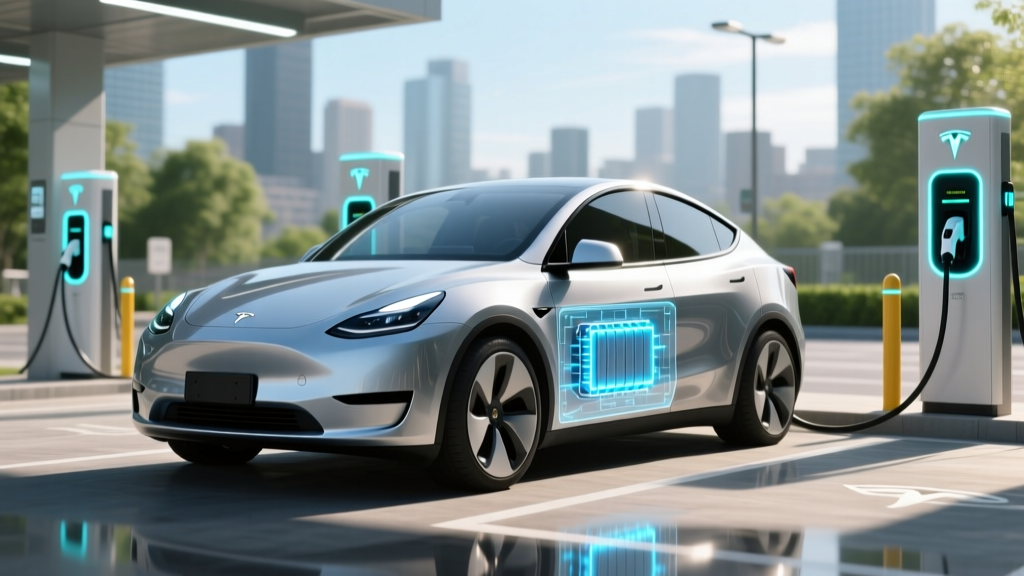
The 2026 Model Y uses the North American Charging Standard (NACS) connector natively — Tesla's proprietary plug that has now been adopted by Ford, GM, Rivian, Hyundai, and most other major automakers. This gives Model Y owners seamless access to the Supercharger network, which remains the most reliable and widely deployed DC fast-charging infrastructure in the U.S. with over 6,000 stations and 65,000+ connectors nationwide.
A critical nuance that spec sheets obscure: the 250 kW peak charge rate is not sustained across the entire session. The Model Y's charge curve peaks near 250 kW between roughly 10–30% state of charge, then tapers progressively. Between 50–80%, you'll see rates closer to 100–130 kW. This is why the 10–80% time of approximately 22 minutes is the more meaningful figure than peak kW alone. Preconditioning the battery (which the navigation system initiates automatically when you route to a Supercharger) is essential to hitting these numbers — arriving at a fast charger with a cold battery can double your charge time.
For home charging, Tesla's Wall Connector at 48 amps on a 240V/60A circuit delivers 11.5 kW, adding roughly 44 miles of range per hour. A full overnight charge from 20% to 100% takes about 7 hours on the Long Range model. Installation costs for a home Level 2 setup typically run $500–$2,500 depending on your electrical panel capacity and the distance from panel to garage. Homes with 100-amp service may need a panel upgrade ($1,500–$3,000) before adding a dedicated 60A EV circuit.
Performance and Driving Dynamics
The Performance trim's 3.5-second 0–60 mph time places it in sports-car territory, but what impresses more in daily driving is the instant torque delivery and the refined ride quality of the Juniper refresh. Tesla has retuned the suspension with new dampers and added acoustic laminated glass to the front and rear windows, reducing cabin noise noticeably at highway speeds compared to the pre-2025 Model Y.
All trims feature regenerative braking with a single-pedal driving mode that allows most drivers to avoid the friction brake pedal entirely in stop-and-go traffic. The blended braking system is smooth and predictable. The Performance trim adds larger brakes, 21-inch wheels, and a lowered sport suspension — choices that trade roughly 25 miles of range for sharper handling.
One persistent criticism: the steering feel remains artificially light and somewhat numb even in the sportiest settings. It's precise but lacks the feedback that enthusiasts appreciate. For commuting and family hauling, this is a non-issue; for canyon carving, competitors like the BMW iX3 feel more connected.
Interior, Cargo, and Technology
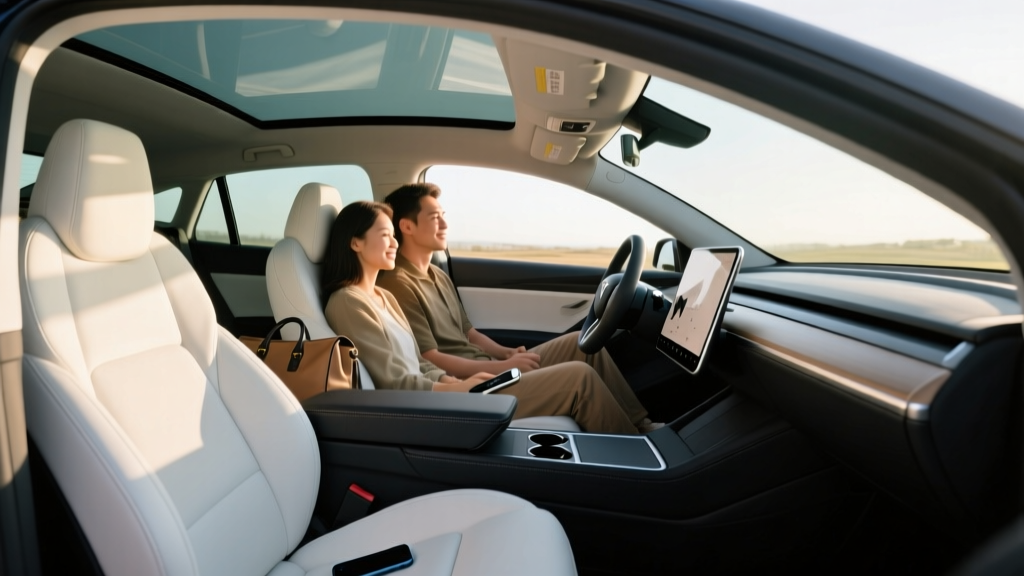
The Juniper interior refresh brings a more upscale feel: ventilated front seats (finally), ambient lighting, a rear-seat touchscreen for climate and entertainment control, and improved soft-touch materials on the dashboard and door panels. The minimalist ethos remains — there is still no instrument cluster, no physical climate controls, and no turn-signal stalk (signals are activated via steering-wheel buttons, a controversial choice carried over from the refreshed Model 3).
| Measurement | 2026 Model Y |
|---|---|
| Cargo (rear seats up) | 30.2 cu ft |
| Cargo (rear seats folded) | 72.1 cu ft |
| Frunk (front trunk) | 4.1 cu ft |
| Front legroom | 41.8 in |
| Rear legroom | 38.4 in |
| Seating capacity | 5 (optional 7-seat available) |
The 15.4-inch center touchscreen runs Tesla's proprietary infotainment system, which remains one of the most responsive in the industry. Wireless Apple CarPlay and Android Auto are not supported — Tesla insists on its native interface. Navigation, media, vehicle settings, and even glovebox release are all routed through the screen. The secondary rear touchscreen (8 inches) is a welcome addition for passengers but feels somewhat redundant given that front-seat climate controls are already on the main display.
On the driver-assistance front, the Model Y ships with Basic Autopilot (adaptive cruise control + lane centering), which is a competent SAE Level 2 system. Full Self-Driving (Supervised) is available as a $8,000 one-time purchase or $99/month subscription and adds automated lane changes, traffic light/stop sign recognition, and city-street navigation. However — and this cannot be overstated — FSD is not autonomous driving. It is a Level 2 system that requires continuous driver supervision. You must keep your hands on the wheel (or demonstrate attentiveness via the cabin camera) and be prepared to take over at any moment. Tesla's own documentation and NHTSA guidance make this clear, despite the aspirational branding.
SAE Automation Level Reminder: Tesla Autopilot and FSD (Supervised) are SAE Level 2 driver-assistance systems. The driver must remain fully engaged and responsible for the vehicle at all times. This is fundamentally different from Level 4 robotaxi services like Waymo, which operate without a human driver in geofenced areas. Never treat any current Tesla system as "self-driving."
Pricing, Trims, and Federal Tax Credit Eligibility
| Trim | Base MSRP | §30D Credit (est.) | Effective Price* |
|---|---|---|---|
| RWD (Standard) | $39,990 | Up to $7,500 | ~$32,490 |
| Long Range AWD | $47,990 | Up to $7,500 | ~$40,490 |
| Performance AWD | $52,490 | Up to $7,500 | ~$44,990 |
*Effective price assumes full §30D credit eligibility. As-tested prices with options (FSD, premium paint, 20" wheels) will be higher. Point-of-sale transfer available at participating dealers.
The federal EV tax credit under IRS §30D remains available for qualifying Tesla vehicles, but eligibility is not automatic. Here are the requirements you must meet:
- MSRP Cap: The vehicle's base MSRP must not exceed $80,000 for SUVs/trucks/vans. All 2026 Model Y trims clear this threshold comfortably.
- Buyer Income Cap: Modified adjusted gross income (MAGI) must not exceed $300,000 (joint filers), $225,000 (head of household), or $150,000 (single filers). This is based on the current or prior tax year — whichever is lower.
- Battery Sourcing: A percentage of critical minerals and battery components must be sourced from the U.S. or free-trade-agreement countries. Tesla's LFP batteries (RWD trim) have historically drawn from Chinese supply chains, which can reduce or eliminate the credit for that specific trim. The NMC Long Range and Performance trims, with more North American-sourced components, have consistently qualified for the full $7,500 — but sourcing rules tighten annually, and you should verify current-year eligibility on the IRS website or with your tax professional before purchasing.
- Point-of-Sale Transfer: As of 2024, you can transfer the credit to the dealer at purchase, reducing your out-of-pocket cost immediately rather than waiting to claim it on your tax return. Tesla participates in this program.
Critical caveat: Battery-sourcing requirements under §30D are updated annually, and the specific credit amount available for any given Tesla configuration can change mid-year. Always check fueleconomy.gov and consult a tax professional before relying on the credit for your budget.
Warranty and Long-Term Ownership
Tesla provides the following warranty coverage for the 2026 Model Y:
- Basic Vehicle: 4 years / 50,000 miles (bumper to bumper)
- Battery & Drive Unit: 8 years / 120,000 miles (Long Range & Performance, NMC); 8 years / 100,000 miles (RWD, LFP)
- Battery Capacity Retention Threshold: Tesla warrants that the battery will retain at least 70% of its original capacity during the warranty period. If degradation falls below this threshold, Tesla will repair or replace the battery at no cost.
In practice, Tesla NMC batteries have shown average degradation of approximately 10–12% over 100,000 miles based on fleet data aggregated by third-party sources, meaning most owners will retain 88–90% capacity well within the warranty window. LFP batteries tend to degrade even more slowly but may show slightly more variance in state-of-charge estimation accuracy over time. Neither chemistry is expected to require out-of-warranty replacement under normal use within the first 150,000–200,000 miles.
Pros, Cons, and Who Should Buy
Pros
- Segment-leading efficiency (122–128 MPGe depending on trim)
- Access to the Supercharger network — the most reliable U.S. DC fast-charging infrastructure
- Strong real-world range (270–290 mi highway on Long Range)
- Over-the-air updates continuously add features
- Spacious cargo area (72.1 cu ft with seats folded) and optional 7-seat config
- 250 kW peak DC charging with NACS native connector
- LFP option on RWD for maximum battery longevity
Cons
- No Apple CarPlay or Android Auto
- Turn-signal buttons on steering wheel take significant adaptation
- FSD (Supervised) is expensive ($8,000) and still requires full driver attention
- Rear-seat comfort improved but still trails Hyundai Ioniq 5 and Kia EV6
- Insurance premiums tend to be 15–25% above segment average
- RWD LFP trim may not qualify for full §30D credit due to battery sourcing
Who the 2026 Model Y Is For
Choose the Model Y Long Range AWD if: You need a family crossover with 300+ mile EPA range, regular road-trip capability via Superchargers, and all-weather AWD traction. It's the default recommendation for a reason.
Choose the RWD Standard if: You commute under 60 miles daily, charge at home, want the lowest purchase price, and value long-term LFP battery durability over maximum range.
Choose the Performance if: You want sports-car acceleration in a practical package and don't mind sacrificing 25 miles of range and a firmer ride.
Look at competitors (Ioniq 5, EV6, Equinox EV) if: You need physical buttons, prefer CarPlay/Android Auto, want a more traditional dealership experience, or find Tesla's minimalist interface alienating.
Frequently Asked Questions
Is Tesla production actually banned in 2026?
No. Tesla's U.S. and international factories are fully operational. The "production banned" rumor stems from misinterpreted NHTSA investigations and EU regulatory updates, neither of which halted manufacturing. No government authority has issued a production ban on any Tesla vehicle.
What is the real-world range of the 2026 Tesla Model Y?
The Long Range AWD has an EPA estimate of 320 miles. Real-world highway driving in moderate temperatures yields approximately 270–290 miles. In cold weather (below 30°F), expect 220–255 miles due to battery resistance and heating demands. The RWD Standard trim delivers roughly 230–245 real-world highway miles from its 270-mile EPA rating.
How fast does the Model Y charge at home and on the road?
On a DC fast charger, the Model Y peaks at 250 kW and charges from 10–80% in approximately 22 minutes (with battery preconditioning). At home on a Level 2 Tesla Wall Connector (11.5 kW / 48A), it adds roughly 44 miles of range per hour, fully recharging overnight. On a standard 120V household outlet (Level 1), expect only 3–5 miles per hour — suitable only for emergency top-ups.
Does the 2026 Model Y qualify for the $7,500 federal EV tax credit?
The Long Range AWD and Performance trims have consistently qualified for the full $7,500 credit under IRS §30D, subject to buyer income caps ($150K single / $300K joint) and the $80K SUV MSRP cap. The RWD trim's LFP battery sourcing has at times reduced its eligibility. Verify current-year status on fueleconomy.gov and consult a tax professional before purchasing.
Is the Model Y worth buying vs. the Hyundai Ioniq 5 or Kia EV6?
The Model Y wins on charging infrastructure (Supercharger access), efficiency, and cargo space. The Ioniq 5 and EV6 win on interior design, physical controls, CarPlay/Android Auto support, and 800V architecture (faster 10–80% charging at compatible stations, ~18 min at 350 kW chargers). If Supercharger access is your priority, the Model Y is the clear choice. If interior quality and traditional controls matter more, drive the Korean alternatives before deciding.
How long will the Model Y battery last before replacement?
Tesla warranties the battery for 8 years / 120,000 miles (Long Range/Performance) or 8 years / 100,000 miles (RWD) with a 70% capacity retention guarantee. Fleet data suggests NMC batteries lose roughly 10–12% capacity over 100,000 miles, and LFP batteries degrade even more slowly. Out-of-warranty replacement, if ever needed, currently costs approximately $12,000–$16,000 depending on the pack — but most batteries outlast 200,000 miles without requiring replacement.
Is Tesla's Full Self-Driving actually self-driving?
No. FSD (Supervised) is an SAE Level 2 driver-assistance system. Despite the name, it requires you to remain fully attentive, keep your hands on the steering wheel, and be prepared to take control instantly. It does not make the vehicle autonomous. Only Level 4 services like Waymo operate without a human driver, and those are limited to specific geofenced cities.
The "Tesla production banned" narrative is internet noise, not reality. The 2026 Model Y is in full production, widely available, and remains one of the most capable and efficient electric crossovers you can buy. Whether it's the right EV for you depends on your charging situation, your tolerance for touchscreen-only controls, and your budget after tax credits — not on unfounded rumors.