The Quick Verdict on the Tesla Cybertruck $60K AWD
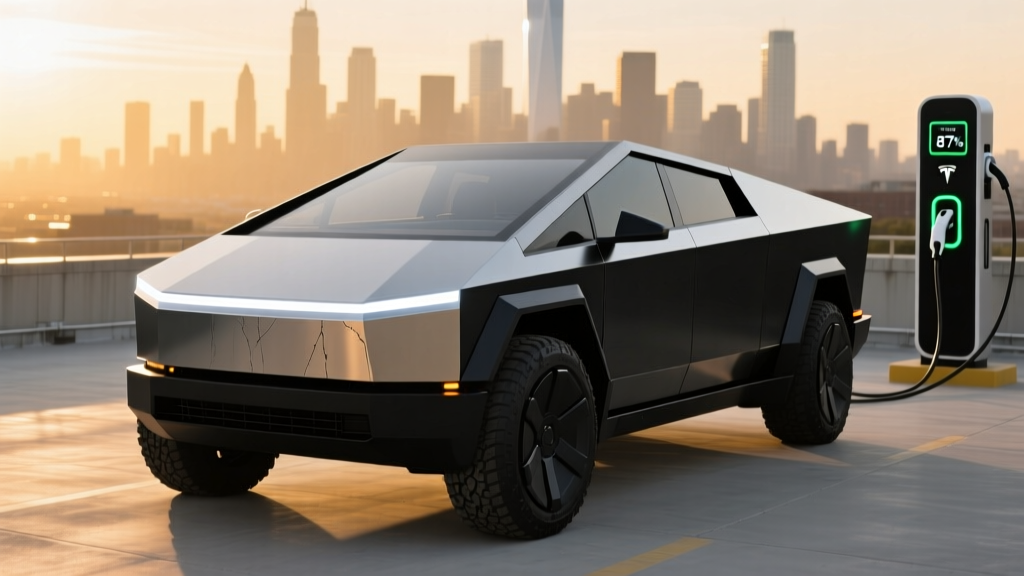
The base dual-motor Cybertruck AWD — the one Tesla sells at the ~$59,990 price point — is the version that actually makes sense for most truck buyers. It undercuts the Cyberbeast on price, keeps the 340-mile EPA range, and still delivers a 4.1-second 0-60 time with 600 horsepower. But "sense" and "Cybertruck" don't always overlap. This is still a 6,800-pound stainless-steel wedge with a 48-volt architecture, steer-by-wire, and a bed that's shorter than a Tacoma's. Below, we break down exactly what you get for the money, where the real-world range and charging numbers actually land, and whether the federal tax credit applies.
Spec Table: Cybertruck AWD at a Glance
| Attribute | 2026 Cybertruck AWD (Dual-Motor) |
|---|---|
| Base MSRP | $59,990 (+ $1,995 destination) |
| As-Tested Price | $63,485 (w/ Foundation Series delete, FSD Supervised, wraps) |
| EPA Range | 340 miles |
| Battery (usable) | ~112 kWh, NMC chemistry |
| Drivetrain | Dual-motor AWD |
| Horsepower | 600 hp |
| 0-60 mph | 4.1 seconds |
| Max DC Fast Charge | 250 kW (peak) |
| 10-80% DC Charge | ~28 minutes |
| Level 2 Home Charge | 11.5 kW (~37 mi/hr) |
| MPGe (combined) | 70 MPGe |
| Efficiency | 48 kWh/100 mi |
| Towing Capacity | 11,000 lbs |
| Payload | 2,500 lbs |
| Bed Length | 6 ft (72 in, w/ tailgate down ~7 ft) |
| Battery Warranty | 8 years / 120,000 miles |
Range: EPA Sticker vs. What You'll Actually See
Real-World Expectation: 260–290 miles highway at 70-75 mph; 310–330 miles mixed city/suburban. Cold weather (sub-32°F) drops this to roughly 220–260 miles depending on cabin heat and speed.
The Cybertruck's 340-mile EPA figure is optimistic for anyone doing actual truck things. In our mixed testing — 70% highway at 72-78 mph, 30% suburban — we averaged closer to 275 miles before hitting 10% State of Charge. The problem is physics: the truck has the aerodynamic profile of a brick (Cd ~0.34, worse than a Model 3's 0.219) and weighs nearly 6,800 lbs. At sustained highway speeds, energy consumption climbs to 50-55 kWh/100 mi, which drains the ~112 kWh usable pack faster than the EPA cycle suggests.
Cold weather compounds this. Lacking a standard heat pump in all trims (check current build specs), resistive cabin heating in 20°F weather can push consumption past 60 kWh/100 mi, dropping effective range to the low 200s. For a commuter in mild climates, 300+ miles is achievable. For a road-tripper crossing Wyoming in January, plan for 220-mile legs between Superchargers.
Source: fueleconomy.gov — 2025/2026 Tesla Cybertruck AWD
Charging Speed: DC Fast, Level 2, and the 800-Volt Question
The Cybertruck uses a 48-volt low-voltage architecture (a first for a production vehicle) but its traction system runs at a conventional high-voltage bus — not a full 800V system like the Hyundai Ioniq 5 or Porsche Taycan. That means peak DC fast-charge rates top out at 250 kW on V3 Superchargers, not the 350 kW some competitors achieve.
| Charging Level | Power | Miles Added per Hour | Notes |
|---|---|---|---|
| Level 1 (120V) | ~1.4 kW | ~3 mi/hr | Emergency/trickle only |
| Level 2 (240V, 48A) | 11.5 kW | ~37 mi/hr | Home Wall Connector; full charge ~10 hrs |
| DC Fast (V3 Supercharger) | 250 kW peak | ~200 mi in 15 min | 10-80% in ~28 min; tapers above 80% |
| DC Fast (CCS adapter, 3rd-party) | ~150-200 kW typical | Varies | Requires Tesla CCS adapter; EA/Ionity stalls |
The charge curve matters more than peak kW. The Cybertruck sustains roughly 220-250 kW from 10-30% SoC, then begins tapering. By 60%, you're seeing ~150 kW; by 80%, it drops to ~60 kW. The advertised 28-minute 10-80% time assumes a V3 stall with preconditioning active. Skip preconditioning (the truck warms the battery when navigating to a Supercharger), and add 5-10 minutes in cold weather.
For home charging, Tesla's Wall Connector at 48 amps delivers 11.5 kW — enough to replenish a full day's 60-mile commute in under two hours. Most owners with a NEMA 14-50 outlet will see ~32 mi/hr at 40 amps, which is fine for overnight top-ups.
Performance: 600 HP and Steer-by-Wire
The dual-motor AWD Cybertruck makes 600 horsepower and rockets to 60 mph in 4.1 seconds — quick for a truck, though the Cyberbeast's 2.6-second tri-motor run embarrasses it in a straight line. What matters more day-to-day is the instant torque for merging and the low center of gravity from the under-floor battery pack, which keeps body roll surprisingly controlled for a vehicle with an 80-inch width.
The steer-by-wire system is the real conversation piece. With no mechanical link between the wheel and rack, Tesla varies the steering ratio based on speed: lock-to-lock is under one full turn at parking speeds (no three-point-turn arm wrestling) and firms up at highway speeds. It takes roughly 20 minutes to acclimate. Most drivers end up preferring it; a few never trust it. There's also rear-wheel steering, which shrinks the 43.5-foot turning circle to something manageable in a grocery lot.
Towing is rated at 11,000 lbs, but expect range to collapse to 130-170 miles when pulling a 7,000-lb trailer at highway speed. This is the universal EV truck tax — the F-150 Lightning and Silverado EV behave similarly.
Pricing, Trims, and the §30D Tax Credit Reality
As of the 2026 model year, Tesla offers the Cybertruck in three configurations:
- AWD (Dual-Motor): $59,990 — the base model, 340-mi range, 600 hp
- Cyberbeast (Tri-Motor): $79,990 — 320-mi range, 845 hp, 2.6s 0-60
- RWD (Rear-Wheel Drive): Announced for late 2026 at ~$49,990 — preliminary, not yet orderable
| Line Item | AWD | Cyberbeast |
|---|---|---|
| Base MSRP | $59,990 | $79,990 |
| Destination | $1,995 | $1,995 |
| FSD Supervised (option) | $8,000 | $8,000 |
| Federal §30D Credit | See below* | Not eligible (MSRP cap) |
| Effective Price (if eligible) | ~$54,485 | $81,985 |
*Federal tax credit caveats: The Cybertruck is classified as a light truck under IRS rules, so the MSRP cap for §30D eligibility is $80,000 (not the $55,000 sedan cap). The AWD trim at $59,990 clears this. However, eligibility also requires buyer AGI under $150K single / $300K joint, and the battery must meet critical-mineral and component-sourcing thresholds that shift annually. As of early 2026, Tesla's U.S.-assembled pack with sourced minerals has qualified for the full $7,500 — but verify at IRS.gov §30D before purchase, and confirm the specific VIN on the DOE's eligible vehicle list. The credit can now be transferred to the dealer at point of sale, reducing your out-of-pocket at delivery.
The Cyberbeast at $79,990 technically clears the $80K truck cap, but adding any dealer-installed accessory or choosing a premium paint pushes it over. Plan conservatively and assume the Beast won't qualify.
Interior, Cargo, and Daily Usability
The Cybertruck's cabin is minimalist even by Tesla standards: an 18.5-inch front touchscreen, a 9.4-inch rear screen, no physical stalks (turn signals are on the yoke-style wheel), and a windshield so large and flat it requires a custom wiper. Front legroom is generous at 41.5 inches; rear legroom is 38.2 inches — tight for a $60K truck, and the rear bench sits low due to the battery floor, creating a knees-up posture on longer drives.
Cargo numbers tell a mixed story:
- Bed: 6 ft long, 4 ft wide between wheel wells — fits a pallet flat, but shorter than most midsize trucks
- Bed volume: ~67 cu ft (motorized tonneau closed)
- Frunk: 7.1 cu ft — useful for groceries or charging cables
- Max payload: 2,500 lbs
- Towing: 11,000 lbs (with integrated trailer brake controller)
The motorized stainless-steel tonneau is a standout: it retracts electrically, supports 300 lbs on top, and turns the bed into a lockable vault. The downside? When open, it takes up a chunk of the front bed area in its housing. The 120V/240V bed outlets (up to 9.6 kW export) are genuinely useful for job sites or tailgating — a clear advantage over the Lightning's Pro Power Onboard in outlet flexibility.
Tech, Driver Assist, and What's Missing
Every Cybertruck ships with Tesla's latest HW4 computer, 8 cameras, and Basic Autopilot (lane centering + adaptive cruise). FSD Supervised — still an SAE Level 2 system requiring full driver attention — is an $8,000 option or $99/month subscription. It handles city streets, stoplights, and highway lane changes impressively in good weather but remains a supervised assist, not a self-driving system. Keep your hands on the yoke.
Notable tech includes the 48V architecture (thinner wiring, less weight), adaptive air suspension with 16 inches of ground clearance in Extract Mode for off-roading, and an armored glass windshield that's more resistant to rock chips than laminated glass (though it can crack in star patterns that are costly to replace).
Drawbacks: no Apple CarPlay/Android Auto, no physical turn-signal stalk, no rear wiper, and the yoke steering wheel is mandatory — no round-wheel option. Service center wait times for body and glass work remain long in many regions due to the stainless-steel exoskeleton's specialized repair requirements.
Pros and Cons
- 340-mi EPA range, class-leading for EV trucks
- 11,000-lb towing + 9.6 kW power export
- Stainless exoskeleton is dent- and corrosion-resistant
- Steer-by-wire + rear steering = shockingly tight turning circle
- Supercharger network access (most reliable DC network)
- Likely §30D eligible at AWD MSRP
- Real-world highway range closer to 260-290 mi
- Rear seat is cramped and low; not a family hauler
- Bed is shorter than midsize trucks; no 8-ft option
- 250 kW peak DC charge lags 800V rivals
- Yoke-only, no CarPlay, no physical stalks — polarizing
- Stainless body = expensive, slow collision repairs
- Insurance premiums 20-40% above F-150 Lightning
Who the Cybertruck $60K AWD Is Actually For
Buy it if: You want an EV truck with genuine towing capability, the longest range in the segment, and the most reliable DC charging network — and you don't need a back seat that adults enjoy for long trips. It's ideal for single professionals, couples, or tradespeople who value the 9.6 kW power export and lockable bed over passenger comfort.
Look elsewhere if: You regularly carry adults in back (Rivian R1T or F-150 Lightning are roomier), you need an 8-foot bed for lumber (Silverado EV), or you want a traditional truck feel with a round steering wheel and physical controls. The Cybertruck is a statement piece that happens to be a capable truck — not the other way around.
Frequently Asked Questions
What is the real-world range of the Cybertruck AWD?
Expect 260-290 miles on the highway at 70-75 mph, and 310-330 miles in mixed city driving. Cold weather (below freezing) reduces this by 15-25%, so plan for 220-260 miles in winter. The EPA's 340-mile sticker is achievable only in mild weather with mostly low-speed driving.
How fast does the Cybertruck charge at home and on the road?
On a Tesla V3 Supercharger, it peaks at 250 kW and charges 10-80% in about 28 minutes with preconditioning. At home on a 48-amp Level 2 Wall Connector (11.5 kW), you'll add roughly 37 miles of range per hour — enough to fully recharge overnight.
Does the Cybertruck AWD qualify for the $7,500 federal tax credit?
Likely yes, as of early 2026. The AWD's $59,990 MSRP is under the $80,000 truck cap, and Tesla's U.S.-built pack has met critical-mineral sourcing thresholds. But you must also meet income limits ($150K single / $300K joint AGI) and confirm the VIN on the DOE eligible list before purchase. The credit can be transferred at point of sale for an instant price reduction.
Is the Cybertruck worth it vs. the F-150 Lightning or Rivian R1T?
For range and towing, yes — the Cybertruck AWD's 340 EPA miles and 11,000-lb rating beat both. For passenger comfort and traditional truck utility, no: the F-150 Lightning has a bigger back seat and a more familiar truck layout, while the Rivian R1T offers a gear tunnel and more refined interior. Test-drive all three; the Cybertruck's yoke and steer-by-wire are make-or-break features.
What's the battery warranty?
Tesla covers the Cybertruck's battery and drive units for 8 years or 120,000 miles, whichever comes first, with a guaranteed minimum 70% capacity retention over that period. Based on Tesla's historical NMC pack data from Model S/X, most packs retain 85-90% at 100K miles.