Tesla Premium Connectivity and WiFi: The Short Answer
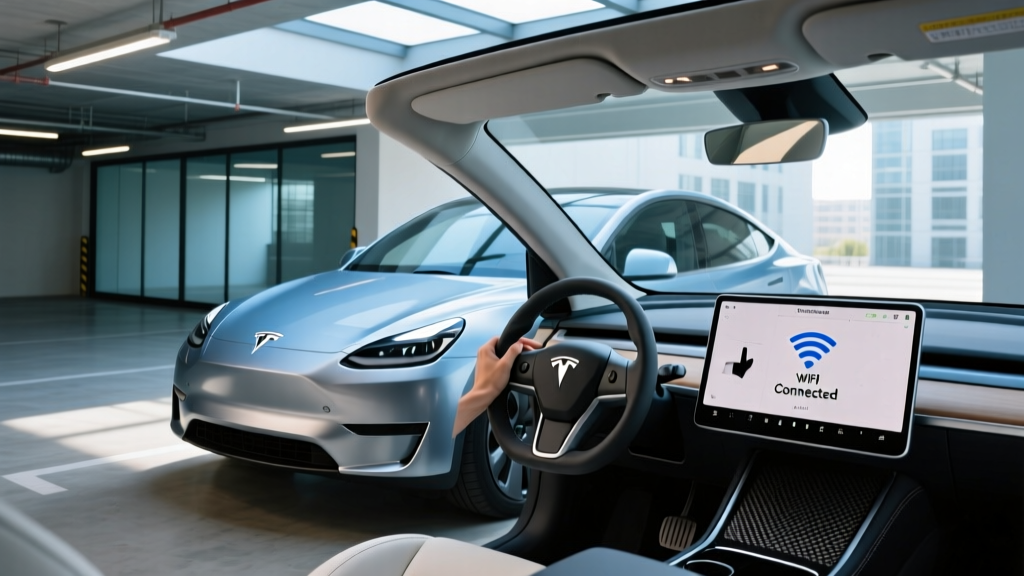
If you've been searching whether Tesla Premium Connectivity includes WiFi, the answer requires some nuance. Premium Connectivity does not turn your Tesla into a mobile WiFi hotspot for your personal devices. Instead, it provides enhanced cellular data features for the car's own systems — live traffic visualization, satellite maps, video streaming, music streaming, and the Car Wash Mode camera view — all routed through Tesla's built-in LTE/5G modem.
Your phone, laptop, and tablet cannot piggyback on Tesla's cellular connection via a hotspot feature. However, the vehicle can connect to your home WiFi network or a public hotspot for software updates, media downloads, and reduced cellular data consumption. This distinction trips up many new Tesla buyers, so let's clarify what you actually get — and then dive into whether the 2026 Tesla Model Y, Tesla's best-selling EV, earns your garage spot beyond the connectivity question.
- Standard Connectivity (free): Basic maps, navigation, Bluetooth, WiFi for updates
- Premium Connectivity ($9.99/mo or $99/yr): Satellite-view maps, live traffic, dashcam viewer, video/music streaming, web browser
- WiFi Hotspot for devices: Not available on any Tesla model as of 2026
Now that we've settled the connectivity question, here's the full owner's profile of the 2026 Tesla Model Y — the vehicle most Tesla-curious buyers are actually researching.
2026 Tesla Model Y at a Glance: Specs That Matter
| Spec | Long Range AWD | Performance |
|---|---|---|
| EPA Range | 320 miles | 295 miles |
| Battery (usable) | ~78 kWh, NMC | ~78 kWh, NMC |
| Drivetrain | Dual-motor AWD | Dual-motor AWD |
| Horsepower | 384 hp | 456 hp |
| 0–60 mph | 4.8 sec | 3.5 sec |
| Max DC Fast Charge | 250 kW (CCS/NACS) | 250 kW (CCS/NACS) |
| 10–80% DC Time | ~25 min | ~25 min |
| Level 2 Home Rate | 11.5 kW (~44 mi/hr) | 11.5 kW (~44 mi/hr) |
| MPGe (combined) | 122 MPGe | 111 MPGe |
| Efficiency | 28 kWh/100 mi | 30 kWh/100 mi |
| Cargo (rear seats up) | 30.2 cu ft | 30.2 cu ft |
| Cargo (seats folded) | 72.1 cu ft | 72.1 cu ft |
| Base MSRP | $44,990 | $51,490 |
| Battery Warranty | 8 yr / 120,000 mi | 8 yr / 120,000 mi |
Sources: EPA fueleconomy.gov, Tesla.com Model Y specs. Figures reflect 2026 model year Long Range and Performance trims.
Real-World Range: What the EPA Sticker Doesn't Tell You
EPA Sticker: 320 miles
Highway (70–75 mph, moderate climate): ~260–280 miles
City / suburban mixed driving: ~290–310 miles
Cold weather (below 32°F / 0°C): ~220–260 miles (20–30% reduction)
Hot weather with aggressive A/C: ~280–300 miles
The Model Y's heat pump helps mitigate winter losses compared to older EVs using resistive heating, but lithium-ion chemistry inherently loses efficiency in the cold. Preconditioning while plugged in recovers some of this range.
Efficiency in real-world testing hovers around 270–280 Wh/mi in mixed driving, which aligns with the EPA's 28 kWh/100 mi rating for the Long Range. The Performance trim's stickier tires and more aggressive powertrain tuning push consumption to roughly 30 kWh/100 mi.
For road trips, Tesla's navigation system factors in elevation, wind, temperature, and traffic to predict arrival State of Charge (SoC) with impressive accuracy — typically within 2–3 percentage points of actual. This trip planner integration is one of Tesla's strongest ownership advantages over competitors relying on third-party route planning.
Charging Speed: DC Fast, Level 2, and the Curve Reality
The 2026 Model Y supports up to 250 kW peak DC fast charging on V3 Superchargers and compatible CCS/NACS stations. However, as with all EVs, peak rate is not sustained rate. Here's the real-world charging picture:
| Charging Level | Power / Rate | Speed (mi/hr added) | Notes |
|---|---|---|---|
| Level 1 (120V) | ~1.4 kW | ~4 mi/hr | Emergency/trickle only |
| Level 2 (240V, 48A) | 11.5 kW | ~44 mi/hr | Full overnight charge in ~7–8 hrs |
| DC Fast (V3 Supercharger) | Peak 250 kW | ~1,000 mi/hr (peak) | 10–80% in ~25 min; tapers above 60% |
| DC Fast (V4 Supercharger) | Up to 250 kW* | Similar to V3 | *Vehicle-limited to 250 kW; V4 cabinet capable of more |
Charge curve reality check: The Model Y hits its 250 kW peak only between roughly 10–30% SoC. From 30–60%, the rate gradually drops to around 150 kW. Above 80%, it falls below 50 kW to protect battery longevity. This is why Tesla's navigation recommends charging to 80% at each stop on road trips — pushing to 100% at a Supercharger adds 20+ minutes for only ~60 extra miles.
At home, a Tesla Wall Connector on a 60-amp circuit delivers the full 11.5 kW (48 amps). Most owners report 0–100% in about 7.5 hours, meaning an overnight session from 20% to 80% takes roughly 4.5 hours. If your home electrical panel only supports a 40-amp circuit, you'll see about 9.6 kW (~37 mi/hr) — still perfectly adequate for daily use.
Pricing, Trims, and Federal Tax Credit Eligibility
The 2026 Model Y is available in two primary trims. Here's the pricing landscape including potential federal incentive impact:
| Trim | Base MSRP | As-Tested (typical options) | §30D Credit Eligible? |
|---|---|---|---|
| Long Range AWD | $44,990 | $47,000–$50,000 | Yes — up to $7,500 (if sourcing + income rules met) |
| Performance AWD | $51,490 | $53,000–$56,000 | Yes — up to $7,500 (if sourcing + income rules met) |
- MSRP cap: SUVs/vans/pickups ≤ $80,000 (Model Y qualifies as SUV)
- Buyer income cap: AGI ≤ $150,000 (single) / $225,000 (head of household) / $300,000 (joint)
- Battery sourcing: Must meet critical-minerals and battery-component requirements (phased thresholds increase annually through 2032)
- Point-of-sale transfer: Eligible buyers can apply the credit as an immediate purchase-price reduction at the dealer — no waiting until tax filing
- One credit per VIN, one vehicle per taxpayer per year
Both Model Y trims fall well under the $80,000 SUV MSRP cap. The critical variable is battery-sourcing compliance, which Tesla has historically met for US-built Model Y vehicles, but the specific mineral/component thresholds tighten each year. Always verify the exact VIN's eligibility through the dealer's point-of-sale system before finalizing the purchase.
Interior, Cargo, and Daily Livability
The refreshed Model Y interior continues Tesla's minimalist approach: a single 15.4-inch center touchscreen handles virtually every vehicle function, from climate to mirrors to glovebox release. The 2025–2026 refresh added ventilated front seats, ambient lighting, a rear-seat touchscreen, and improved sound insulation — addressing long-standing complaints about cabin noise and rear-seat comfort.
Passenger space:
- Front headroom: 40.3 inches
- Front legroom: 41.8 inches
- Rear headroom: 38.2 inches
- Rear legroom: 41.6 inches (improved in the refresh)
Cargo: 30.2 cu ft behind the rear seats, expanding to 72.1 cu ft with the 60/40 split folded. The front trunk (frunk) adds approximately 4.1 cu ft — useful for charging cables, a small bag, or groceries you want separated from the main cargo area.
The panoramic glass roof creates an airy cabin but does increase solar heat gain in summer. Tesla's ceramic-tint option or aftermarket tinting is a common owner upgrade in hot climates.
Driver Assistance: Autopilot, FSD, and What Level 2 Really Means
Tesla Autopilot and Full Self-Driving (Supervised) are SAE Level 2 driver-assistance systems. The driver must remain fully attentive, keep hands on the wheel (or provide steering-torque confirmation), and be prepared to take over at any moment. These systems are not self-driving. Only Level 4 services like Waymo's driverless robotaxis operate without a human driver in defined zones.
What's included standard (Basic Autopilot):
- Traffic-Aware Cruise Control (TACC)
- Autosteer (lane-centering on marked roads)
- Automatic Emergency Braking, collision warnings
FSD (Supervised) — $8,000 one-time or $99/month:
- All Basic Autopilot features
- Auto lane changes on highways
- Navigate on Autopilot (highway on/off-ramp routing)
- Autopark and Summon (low-speed parking lot maneuvers)
- Traffic light and stop sign recognition/response
- City street Autosteer (varies by region and driving profile)
Real-world FSD performance in 2026 has improved substantially for highway use, but city driving still requires frequent interventions in complex scenarios — unprotected left turns, construction zones, and ambiguous intersections remain weak points. Think of FSD as an advanced co-pilot, not a replacement driver.
Who Should Buy the 2026 Model Y — And Who Shouldn't
- Best-in-class Supercharger network access (20,000+ North American stations)
- Excellent efficiency: 28 kWh/100 mi beats most rival SUVs
- Over-the-air updates continuously add features
- Strong resale value relative to EV segment
- Spacious cargo area with flat load floor
- Heat pump standard for cold-climate efficiency
- No WiFi hotspot for personal devices
- Minimalist interior not for everyone (no physical buttons, no instrument cluster)
- 250 kW peak charge rate trails Hyundai Ioniq 5's 350 kW capability
- FSD remains Level 2 despite the "Full Self-Driving" name
- Ride quality firm on larger wheel options (20"/21")
- Panel gaps and paint quality inconsistent across delivery batches
Best for: Tech-forward commuters, small families needing versatile cargo space, and road-trip enthusiasts who value Tesla's Supercharger network reliability. The Model Y's efficiency and charging infrastructure access make it one of the most practical EVs for drivers who regularly travel 200+ miles from home.
Look elsewhere if: You prioritize a traditional luxury interior (consider the BMW iX or Genesis Electrified GV70), need 350 kW ultra-fast charging for minimal road-trip downtime (Hyundai Ioniq 5 or Kia EV6), or want a true 3-row family hauler (Kia EV9 or Rivian R1S).
Warranty and Long-Term Ownership
Tesla's warranty coverage for the 2026 Model Y:
- Basic vehicle: 4 years / 50,000 miles
- Battery & drive unit: 8 years / 120,000 miles (whichever comes first), with a minimum 70% capacity retention guarantee
The 70% retention threshold is the trigger for a warranty replacement or repair. In practice, Tesla's NMC batteries in the Model Y have shown degradation curves that plateau around 5–8% loss after the first 50,000 miles, with gradual linear decline afterward. Data aggregated from owner fleets suggests most Model Y batteries retain 85–90% capacity at 100,000 miles when charged primarily on Level 2 and kept between 20–80% SoC for daily use.
Insurance costs remain a consideration: the Model Y typically runs 15–30% higher premiums than comparable gas-powered compact SUVs due to repair costs and parts pricing. Get quotes from Tesla Insurance and at least two traditional carriers before purchase.
Frequently Asked Questions
Does Tesla Premium Connectivity include a WiFi hotspot for my phone?
No. Premium Connectivity provides enhanced data features for the car's built-in systems (satellite maps, live traffic, streaming media, web browser). It does not create a WiFi hotspot that your phone, laptop, or other devices can connect to for internet access. You would need to use your phone's own mobile hotspot or a dedicated mobile hotspot device for that.
Can my Tesla connect to my home WiFi?
Yes. All Tesla vehicles can connect to home or public WiFi networks. This is actually recommended, as software updates (which can be several gigabytes) download much faster over WiFi than over the car's cellular connection, and WiFi usage doesn't count against any data limitations.
What happens if I don't subscribe to Premium Connectivity?
You retain Standard Connectivity for free, which includes basic navigation, Bluetooth audio, and WiFi capability for updates. You lose satellite-view maps, live traffic overlays, in-car video streaming (Netflix, YouTube), music streaming (Spotify, Tidal via the car's connection), and the web browser. Navigation still works — it just shows simplified map tiles without satellite imagery.
Is the 2026 Model Y eligible for the $7,500 federal tax credit?
The Model Y qualifies under the MSRP cap (under $80,000 for SUVs). However, full $7,500 credit eligibility depends on battery-sourcing compliance (critical minerals and component manufacturing requirements), your adjusted gross income falling under IRS thresholds, and purchasing new (not leased — leases follow different §30D commercial credit rules). Verify with the dealer's point-of-sale system and consult IRS.gov for current-year rules.
How does the Model Y compare to the Hyundai Ioniq 5 on charging speed?
The Ioniq 5's 800V architecture supports up to 350 kW peak DC charging, achieving 10–80% in roughly 18 minutes on a compatible charger. The Model Y peaks at 250 kW with a 10–80% time of about 25 minutes. However, Tesla's proprietary Supercharger network offers far more reliable plug-and-charge availability in North America, which partially offsets the slower peak rate in real-world road-trip scenarios.
What's the real-world range of the Model Y Long Range in winter?
In sustained below-freezing temperatures, expect 220–260 miles from a full charge — a 20–30% reduction from the 320-mile EPA rating. The heat pump helps significantly compared to resistive-heater EVs, but cold still increases battery internal resistance and cabin heating demand. Preconditioning while plugged in and using seat/steering-wheel heaters instead of cabin air heating can recover 10–15 miles of range.