Quick Verdict: What the Powershare Home Backup Bundle Actually Does
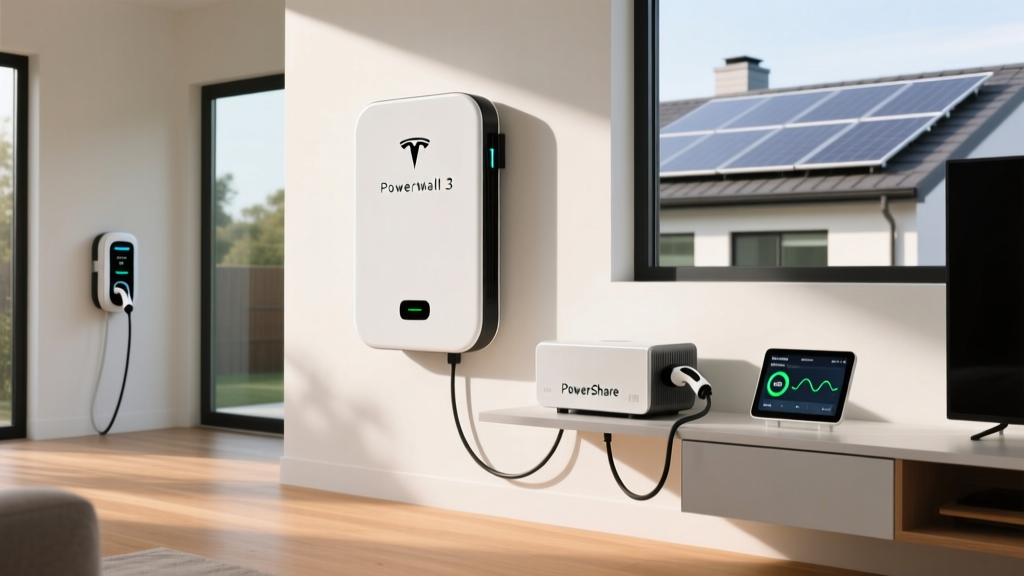
The Tesla Powershare Home Backup Bundle pairs a Tesla Powerwall 3 (or dual Powerwall 3 setup) with a Powershare Gateway to deliver whole-home backup during grid outages — and critically, it enables vehicle-to-home (V2H) bidirectional charging from compatible Tesla vehicles like the Cybertruck. For EV owners, this transforms a parked truck or SUV into a rolling battery that can power your house for days when the grid goes down.
As of early 2026, the bundle starts at $13,500 for a single Powerwall 3 configuration (before installation and incentives), scaling to roughly $25,000+ for dual-Powerwall setups with the Powershare Gateway and professional installation. The federal Residential Clean Energy Credit (§25D) covers 30% of the total cost — including battery and installation — through 2032, which can slash $4,000–$8,000 off your out-of-pocket expense.
This is not a vehicle review in the traditional sense. Instead, think of this as an owner's guide for EV drivers evaluating whether Tesla's home energy ecosystem justifies the investment — and how it integrates with the vehicles you're already charging in your garage.
Powerwall 3 Specs: Battery Capacity, Chemistry, and Power Output
The Powerwall 3 is Tesla's current-generation home battery, replacing the Powerwall 2 with meaningful upgrades in power density and integrated solar inverter functionality.
| Specification | Powerwall 3 (Single) | Dual Powerwall 3 |
|---|---|---|
| Usable Energy Capacity | 13.5 kWh | 27.0 kWh |
| Continuous Power Output | 11.5 kW | 23.0 kW |
| Peak Power Output | ~15 kW | ~30 kW |
| Battery Chemistry | NMC (Nickel Manganese Cobalt) | NMC |
| Integrated Solar Inverter | Yes (up to 11.5 kW DC) | Yes (per unit) |
| Round-Trip Efficiency | ~90% | ~90% |
| Weight | ~280 lbs (127 kg) | ~280 lbs each |
| Warranty | 10 years, unlimited cycles | 10 years, unlimited cycles |
Chemistry note: Tesla uses NMC (nickel manganese cobalt) chemistry in the Powerwall 3, optimized for energy density in a compact wall-mounted form factor. Unlike LFP (lithium iron phosphate) batteries — which offer longer cycle life but lower energy density and are common in stationary grid-scale storage — the NMC choice keeps the Powerwall 3 physically smaller. For home backup where you're cycling the battery infrequently (outages, not daily deep discharge), NMC's calendar-life trade-off is acceptable.
How Powershare and Vehicle-to-Home (V2H) Work
The Powershare Gateway is the intelligence layer that makes V2H possible. It sits between your main electrical panel, the Powerwall(s), your solar array (if present), and a compatible Tesla Wall Connector. When the grid drops, the Gateway:
- Detects the outage within milliseconds and isolates your home from the grid (islanding).
- Switches to battery power from the Powerwall 3 seamlessly — most homeowners notice only a brief flicker.
- Pulls energy from a plugged-in Tesla vehicle (currently Cybertruck with Powershare capability) if Powerwall reserves are depleted or if demand exceeds Powerwall output.
- Manages bidirectional flow — the Cybertruck can discharge up to 11.5 kW back through the Powershare Wall Connector to your home's backed-up circuits.
Compatible vehicles (as of 2026):
- Tesla Cybertruck — Powershare V2H capable (requires Powershare Wall Connector, included in some bundles or sold separately at ~$1,200)
- Future Tesla models — Tesla has signaled broader Powershare rollout, but as of early 2026, only the Cybertruck supports full V2H home backup. The refreshed Model Y and Model 3 do not currently support V2H discharge.
The Cybertruck's ~123 kWh (usable) battery pack means V2H can theoretically supply a managed home for 4–7 days depending on consumption. At 11.5 kW continuous discharge, you can run most household essentials simultaneously — though Tesla's app lets you set a minimum vehicle SoC (state of charge) floor, typically 20%, so you're never left with a dead truck when the grid returns.
Pricing, Installation Costs, and Tax Credits
Tesla's home energy pricing is more transparent than most competitors, but the final installed cost varies significantly based on your electrical panel, permitting, and local labor rates.
| Cost Component | Single Powerwall 3 | Dual Powerwall 3 |
|---|---|---|
| Battery hardware (MSRP) | $9,200 | $18,400 |
| Powershare Gateway | $2,200 | $2,200 |
| Powershare Wall Connector (V2H) | $1,200 | $1,200 |
| Installation (electrician + permit) | $2,500–$5,500 | $3,500–$7,500 |
| Electrical panel upgrade (if needed) | $1,500–$3,500 | $1,500–$3,500 |
| Total before incentives | $15,100–$21,600 | $25,300–$33,100 |
| 30% Federal Credit (§25D) | –$4,530 to –$6,480 | –$7,590 to –$9,930 |
| Net cost after federal credit | $10,570–$15,120 | $17,710–$23,170 |
Critical tax credit detail: The Powerwall 3 qualifies for the Residential Clean Energy Credit (IRS §25D), not the §30D vehicle credit. Section 25D covers 30% of qualified battery storage technology expenditures — including installation labor — with no annual dollar cap and no income cap. This is a key advantage over the EV purchase credit, which has strict MSRP and AGI limits. The 30% rate holds through 2032, then steps down to 26% in 2033 and 22% in 2034.
State incentives vary widely and can stack on top of the federal credit. California's SGIP (Self-Generation Incentive Program), for example, has historically offered additional rebates for battery storage. Check your state energy office or DSIRE (Database of State Incentives for Renewables & Efficiency) for current local programs.
Installation Requirements: What Your Electrician Needs to Know
Before ordering, understand the electrical infrastructure requirements. Tesla's certified installers (or your own licensed electrician) will assess:
- Main panel capacity: The Powerwall 3 connects to a dedicated breaker. Homes with 100A panels often need an upgrade to 200A to accommodate the battery, solar inverter pass-through, and existing loads. Budget $1,500–$3,500 for a panel upgrade if needed.
- Backup load panel: The Powershare Gateway requires a separate sub-panel (or a critical-loads panel) that routes only backed-up circuits. Whole-home backup is possible with dual Powerwalls on a 200A service, but selective backup is more common and cost-effective.
- Permitting: Most jurisdictions require an electrical permit and utility interconnection agreement (even for backup-only systems). Timelines range from 2–8 weeks depending on your municipality.
- Mounting: The Powerwall 3 mounts on an interior or exterior wall. It requires a flat surface, adequate clearance for ventilation, and proximity to your electrical panel to minimize conduit runs.
Installation timeline: From order to commissioning, expect 4–12 weeks in 2026. Hardware lead times have improved since 2023–2024 supply constraints, but Powershare Gateway availability can still add 2–4 weeks.
Pairing with Your EV: Charging and Backup Synergy
For EV owners, the Powershare bundle's real value is the interaction between your vehicle and home energy system. Here's how the pairing works in practice:
Solar + Powerwall + EV Charging: The Full Loop
If you have rooftop solar, the Powerwall 3's integrated inverter (up to 11.5 kW DC) eliminates the need for a separate solar inverter. During the day, solar charges the Powerwall and your EV simultaneously. At night or during outages, the Powerwall powers your home — and if V2H is active, your Cybertruck fills the gap.
EV Charging During Outages
A common question: Can I charge my EV during a grid outage? With the Powershare Gateway and sufficient Powerwall capacity, yes — but with caveats. Charging a vehicle draws 7–11 kW on a Level 2 circuit, which competes with household loads. In an outage scenario, Tesla's energy management software prioritizes critical home circuits. You can manually override to charge the vehicle, but this will deplete your Powerwall faster. The smarter play: use the Cybertruck's V2H to power the home, and recharge the truck from solar when the sun returns.
Time-of-Use (TOU) Arbitrage
Even without outages, the Powerwall 3 earns its keep through TOU rate management. Charge the battery from the grid at off-peak rates (overnight, ~$0.08–$0.12/kWh), then discharge during peak hours (4–9 PM, often $0.25–$0.50/kWh). In states like California with aggressive TOU pricing, this can save $80–$150/month — paying back the system in 7–10 years before considering backup value.
Competitor Comparison: Powerwall 3 vs. Alternatives
| Feature | Tesla Powerwall 3 | Enphase IQ 5P | FranklinWH aPower 2 |
|---|---|---|---|
| Usable Capacity | 13.5 kWh | 5 kWh (stackable to 20 kWh) | 13.6 kWh |
| Continuous Power | 11.5 kW | 1.92 kW per unit (3.84 kW stacked) | 10.4 kW |
| Integrated Inverter | Yes | Microinverter-based | Yes |
| V2H / Bidirectional EV | Yes (Cybertruck) | No | No |
| Whole-Home Backup | Yes (dual unit) | Limited by power output | Yes |
| Warranty | 10 years, unlimited cycles | 15 years | 12 years |
| Approximate Hardware Cost | $9,200 | ~$6,000–$8,000 (4-unit stack) | ~$9,500–$11,000 |
The Powerwall 3's defining advantage in 2026 remains V2H integration via Powershare. No competitor currently offers vehicle-to-home bidirectional charging within their ecosystem. If you own or plan to own a Cybertruck — and live in an area with frequent outages (Texas, California, Florida) — this integration is genuinely unique. If V2H isn't a priority and you simply need backup, the Enphase IQ 5P offers modularity and a longer 15-year warranty, while FranklinWH provides competitive capacity with a strong smart-panel management system.
Pros, Cons, and Who Should Buy
Pros
- Best-in-class V2H integration with Cybertruck
- Integrated solar inverter eliminates hardware redundancy
- 11.5 kW continuous output handles most homes on a single unit
- Seamless Tesla app management across vehicle + home
- 30% federal tax credit with no income or dollar cap (§25D)
- Unlimited cycle warranty for 10 years
Cons
- V2H limited to Cybertruck only (as of 2026)
- Longer lead times for Powershare Gateway
- Installation costs vary wildly; panel upgrades add $1,500–$3,500
- 10-year warranty trails Enphase's 15-year coverage
- NMC chemistry has shorter calendar life than LFP alternatives
- Requires Tesla Wall Connector ecosystem — not compatible with third-party chargers for V2H
Who This Bundle Suits Best
- Cybertruck owners in outage-prone regions (ERCOT/Texas, PG&E/SCE California, Florida hurricane zones) — V2H turns your truck into a 5+ day home generator.
- Solar homeowners looking to maximize self-consumption and eliminate a separate inverter.
- EV households wanting energy resilience — the Powerwall + EV pairing is the closest thing to true energy independence without going off-grid.
- TOU rate customers who can arbitrage peak/off-peak pricing for monthly savings.
Who should skip it: Apartment dwellers, homes without solar or outage risk, and EV owners who don't drive a Cybertruck (yet). If you just need basic backup, a portable generator or a single non-V2H battery may be more cost-effective.
Frequently Asked Questions
Does the Tesla Powershare Home Backup Bundle qualify for the federal EV tax credit?
No — it qualifies for a different federal credit. The Powerwall 3 and Powershare components fall under IRS §25D (Residential Clean Energy Credit), which covers 30% of battery storage costs including installation, with no income cap and no dollar cap. This is separate from the §30D new-vehicle credit that applies to EV purchases. Both credits can be claimed in the same tax year for different qualifying expenditures.
Can I use V2H with a Tesla Model Y or Model 3?
As of early 2026, only the Cybertruck supports Powershare V2H bidirectional charging to the home. The Model Y, Model 3, Model S, and Model X do not have V2H hardware capability. Tesla has indicated future vehicles may gain Powershare support, but no timeline has been confirmed.
How long will a Powerwall 3 last before needing replacement?
Tesla warranties the Powerwall 3 for 10 years with unlimited charge/discharge cycles, guaranteeing at least 70% capacity retention over that period. Real-world degradation data from Powerwall 2 units suggests 15–20+ year operational lifespans are realistic for backup-focused use (shallow, infrequent cycling). Daily deep-cycling for TOU arbitrage will accelerate degradation somewhat, but the NMC chemistry in a thermally managed enclosure holds up well.
What happens if my Cybertruck is unplugged during an outage?
The Powerwall 3 operates independently of your vehicle. If the Cybertruck isn't plugged in, the Powerwall(s) will still provide seamless backup from their own stored energy. V2H simply extends your backup duration when the vehicle is connected — it's not required for the system to function.
Can I add a second Powerwall 3 later?
Yes. The Powershare Gateway supports up to 10 Powerwall 3 units in a single system. Adding a second unit later requires an additional hardware purchase (~$9,200) plus electrician labor for the connection, typically $1,500–$3,000. Plan your conduit and sub-panel layout during initial installation to make future expansion simpler.
Is it worth buying vs. competitors like Enphase or FranklinWH?
If V2H integration matters to you — and you own or plan to own a Cybertruck — the Tesla Powershare bundle has no direct competitor in 2026. For pure home backup without vehicle integration, Enphase offers a longer warranty and modular scaling, while FranklinWH provides excellent smart-panel management at similar pricing. The Tesla ecosystem lock-in is real: Powershare works best when your solar, battery, charger, and vehicle are all Tesla products. If that's your setup, the integration quality is unmatched. If you mix brands, competitors may offer more flexibility.