Why Law Enforcement Is Switching to Tesla Police Cars
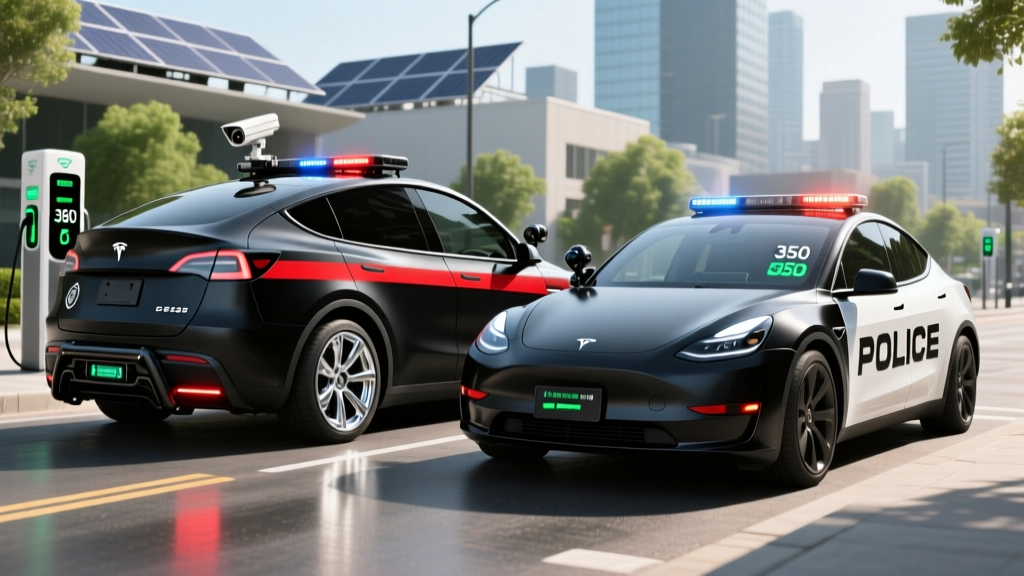
From Fremont to South Pasadena, agencies across the U.S. are adding Tesla police cars to their fleets. The math is compelling: the EPA rates the 2026 Model Y Long Range AWD at 119 MPGe combined, translating to roughly $0.04–$0.06 per mile in electricity versus $0.14–$0.18 per mile for a gas-powered Ford Explorer Interceptor. For a patrol vehicle logging 25,000 miles a year, that's a $2,000–$3,000 annual fuel savings per unit. But patrol work isn't a commute. Let's break down exactly what the 2026 Model Y Long Range AWD and Model 3 Long Range AWD deliver when spec'd for law-enforcement duty.
Spec Table: 2026 Tesla Model Y vs Model 3 Long Range AWD
| Specification | Model Y LR AWD | Model 3 LR AWD |
|---|---|---|
| EPA Range | 320 miles | 341 miles |
| Battery (usable) | ~78 kWh, NMC | ~79 kWh, NMC |
| Horsepower | 384 hp | 384 hp |
| 0–60 mph | 4.8 sec | 4.2 sec |
| Drivetrain | Dual-motor AWD | Dual-motor AWD |
| MPGe (combined) | 119 MPGe | 132 MPGe |
| Max DC Fast Charge | 250 kW | 250 kW |
| 10–80% DCFC Time | ~25 min | ~25 min |
| Level 2 Charge Rate | 11.5 kW (~44 mi/hr) | 11.5 kW (~48 mi/hr) |
| Cargo Volume | 76.2 cu ft (rear folded) | 23.0 cu ft (trunk) |
| Rear Legroom | 40.5 in | 35.2 in |
| Base MSRP | $44,990 | $42,490 |
| Battery/Drive Warranty | 8 yr / 120,000 mi | 8 yr / 120,000 mi |
Real-World Range: What Patrol Drivers Actually Get
Agencies that have deployed Tesla police cars report that most urban patrol shifts cover 80–120 miles per day, well within a single charge. The concern arises for rural or highway-patrol units covering 200+ miles with sustained high-speed driving. Tesla's thermal management system and heat pump (standard on 2026 models) help mitigate cold-weather losses, but physics is physics — battery chemistry loses efficiency in the cold, and cabin heating is a significant energy draw.
Charging Speed: DC Fast and Depot Level 2
Charging speed is make-or-break for fleet operations. Both the Model Y and Model 3 Long Range AWD peak at 250 kW on DC fast chargers (Tesla Superchargers or CCS-equipped stations with adapter). Here's what that means in practice:
| Charging Level | Max Power | Speed | Best Use Case |
|---|---|---|---|
| Level 1 (120V) | ~1.4 kW | 3–5 mi/hr | Emergency/backup only |
| Level 2 (240V, 48A) | 11.5 kW | 44–48 mi/hr | Overnight depot charging |
| DC Fast Charge | 250 kW peak | 10–80% in ~25 min | Mid-shift top-up, highway patrol |
Charging curve reality: The 250 kW peak is not sustained. The Model Y and Model 3 typically hold 200–250 kW from 10–40% State of Charge, then taper to ~100 kW by 60%, and drop below 50 kW above 80%. The 10–80% time of ~25 minutes assumes a preconditioned battery and a V3/V4 Supercharger or equivalent 250+ kW CCS station. Fleet depot planning should spec Level 2 chargers (Wall Connectors at 11.5 kW) for overnight replenishment — a full 0–100% charge takes roughly 7–8 hours.
Fleet Pricing and Federal Tax Credit Eligibility
Fleet procurement officers need to understand the actual acquisition cost. Here's the current 2026 pricing before any upfitting:
| Item | Model Y LR AWD | Model 3 LR AWD |
|---|---|---|
| Base MSRP | $44,990 | $42,490 |
| Destination Fee | $1,390 | $1,390 |
| Typical Upfit (lights, cage, console) | $15,000–$25,000 | $12,000–$20,000 |
| Estimated Total (before credits) | $61,380–$71,380 | $55,880–$63,880 |
Interior, Tech, and Patrol-Specific Considerations
Tesla's minimalist interior cuts both ways for police use. The 15.4-inch center touchscreen handles navigation, fleet telematics, and camera feeds — but there are no physical buttons for climate or wipers, which can frustrate gloved officers in high-stress situations.
Standout tech for law enforcement:
- Sentry Mode: Records 360° camera footage when the vehicle is parked and detects a threat — useful for evidence capture at scenes.
- Dashcam integration: Built-in cameras record front, rear, and side views continuously, reducing the need for aftermarket dashcam systems.
- Over-the-air updates: Software improvements deploy fleet-wide without shop visits.
- Frunk + cargo: Model Y offers 76.2 cu ft with rear seats folded — enough for evidence transport or equipment staging. Model 3's 23 cu ft trunk is tighter.
- Instant torque: Dual-motor AWD with 384 hp delivers 0–60 in under 5 seconds — competitive with pursuit-rated ICE vehicles off the line.
Notable drawbacks:
- No physical buttons or knobs — everything routes through the touchscreen.
- Low ground clearance (Model 3: 5.5 in; Model Y: 6.6 in) limits off-road or rough-terrain pursuit capability.
- Aftermarket upfitter ecosystem is still maturing compared to Ford's established police-interceptor program.
- High-speed sustained driving (100+ mph pursuit) drains the battery rapidly — agencies report 50–70 miles of range at pursuit speeds.
- Repair times can be longer than ICE equivalents due to parts supply chain and specialized body-shop requirements.
Pros and Cons: Tesla Police Cars at a Glance
✓ Pros
- Fuel cost savings of $2,000–$3,000/yr per vehicle
- Near-zero routine maintenance (no oil, filters, spark plugs)
- Instant torque for rapid response acceleration
- Integrated camera/Sentry Mode for evidence capture
- OTA updates reduce fleet shop visits
- Quiet operation advantageous for surveillance/stakeouts
- 8-year/120,000-mile battery warranty
✗ Cons
- Range drops significantly at pursuit speeds (50–70 mi)
- Cold-weather range loss of 15–30%
- Touchscreen-only controls impractical with gloves
- Low ground clearance vs. SUV-based interceptors
- Upfit ecosystem still developing
- Longer collision-repair timelines in some regions
- High-speed charging taper above 80% SoC
Who Should Buy — and Who Should Look Elsewhere
Choose Tesla police cars if: Your agency runs urban or suburban patrols with predictable daily mileage (under 150 miles/shift), has depot Level 2 charging infrastructure, and values low operating costs, integrated camera systems, and rapid acceleration for response calls. The Model Y is the better fit for most patrol roles due to its cargo capacity and crossover ride height.
Look at alternatives (Ford Explorer Interceptor, Chevy Tahoe PPV) if: Your agency covers rural routes with 250+ mile shifts, operates in extreme cold climates, requires sustained high-speed pursuit capability, needs off-road clearance, or lacks charging infrastructure at your station. Hybrids like the Ford Explorer Interceptor HEV offer a middle ground with no range compromise.
Frequently Asked Questions
What is the real-world range of a Tesla police car on patrol?
For a typical urban patrol shift with frequent stops, HVAC running, and light-bar draw, expect 200–260 miles from a full charge on the Model Y Long Range AWD in moderate weather. Highway patrol at sustained 70–80 mph yields roughly 260–280 miles. In sub-freezing temperatures, subtract 15–30%.
How fast do Tesla police cars charge at a depot vs. on the road?
On a depot Level 2 charger (11.5 kW), both models add roughly 44–48 miles of range per hour — a full overnight charge takes 7–8 hours. On a 250 kW DC fast charger (Supercharger), 10–80% takes approximately 25 minutes with a preconditioned battery. Above 80%, charging slows significantly to protect the NMC battery chemistry.
Do Tesla police cars qualify for the federal EV tax credit?
Under IRS §30D, the Model 3 qualifies for up to $7,500 (sedan MSRP cap: $55,000 — base MSRP is $42,490). The Model Y qualifies as an SUV (MSRP cap: $80,000 — base is $44,990). Both are assembled in U.S. plants. However, tax-exempt government entities must use the elective pay provision to receive a direct payment instead of a tax credit. Battery-sourcing and critical-mineral rules must also be met. Confirm current-year eligibility with your procurement office and the IRS.
Is a Tesla police car worth it vs. a Ford Explorer Interceptor?
It depends on use case. For urban patrol with depot charging, the Tesla Model Y saves $2,000–$3,000 annually in fuel and eliminates oil/filter maintenance. For rural, high-speed, or cold-climate patrol, the Explorer Interceptor HEV offers unlimited range, established upfitter support, and proven pursuit durability. Many agencies are running mixed fleets: Teslas for community patrol and ICE/hybrid units for highway and pursuit roles.
How long does the Tesla battery last in police service?
Tesla warrants the Model Y and Model 3 Long Range battery at 8 years or 120,000 miles, whichever comes first, with a minimum 70% capacity retention. Real-world fleet data from early adopters shows approximately 10–12% degradation at 100,000 miles. Heavy DC fast-charging and frequent 100% charges accelerate degradation slightly; agencies that charge to 80–90% daily and use DCFC sparingly report better long-term State of Health.
What upfitting is available for Tesla police cars?
Companies like EV Solutions, Setina, and Whelen offer light bars, prisoner transport cages, center consoles, and push bumpers designed for Tesla's unibody structure. Expect $12,000–$25,000 per vehicle depending on configuration. Note that Tesla's aluminum-intensive body requires certified repair shops for collision work — factor this into your fleet maintenance planning.