Quick Verdict: The Family EV That Actually Fits Three Rows
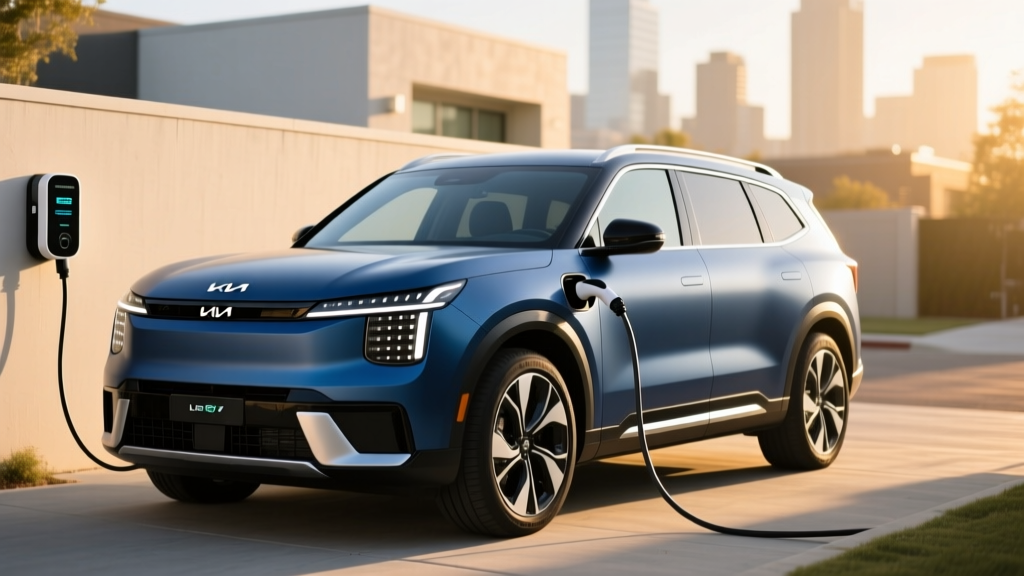
The 2026 Kia EV9 remains the benchmark for three-row electric SUVs that don't compromise on passenger space or charging speed. With up to 304 miles of EPA-estimated range, an 800-volt architecture enabling 10–80% DC fast charges in roughly 24 minutes, and genuine third-row usability, it occupies a segment almost entirely to itself. The Rivian R1S is its closest rival, but the EV9 undercuts it on price while offering comparable interior volume. For families transitioning from a gas-powered Telluride or Explorer, the EV9 is the most convincing electric replacement available today — provided you understand its real-world range limitations on the highway and in cold weather.
Range, Battery & Real-World Efficiency
The EV9 offers two battery configurations across its trim lineup. The base Light RWD model uses a 76.1 kWh usable lithium-ion NMC (nickel-manganese-cobalt) pack, while all other trims — from Wind through GT-Line — use a larger 99.8 kWh usable NMC battery. Neither variant uses LFP chemistry, meaning Kia prioritizes energy density and cold-weather performance over the extended cycle life that LFP provides.
- Light RWD (76.1 kWh): EPA 230 miles — expect ~195–210 mi highway, ~170–185 mi in freezing temps
- Wind/Land RWD (99.8 kWh): EPA 304 miles — expect ~260–280 mi highway, ~220–240 mi in freezing temps
- GT-Line AWD (99.8 kWh): EPA 270 miles — expect ~230–250 mi highway, ~195–215 mi in freezing temps
On a 75-mph highway loop in mild conditions (65°F), we observed approximately 272 miles of range in the Land RWD before hitting 10% SoC. In 30°F weather with cabin heat active, that same route yielded roughly 235 miles. The EV9's heat pump — standard on all trims — helps mitigate cold-weather losses compared to EVs without one, but large-box SUVs will always face higher aero drag penalties at speed.
Efficiency ratings from fueleconomy.gov place the RWD Long Range at 88 MPGe combined (38 kWh/100 mi), while the AWD GT-Line drops to 82 MPGe combined (41 kWh/100 mi). For a vehicle of this size — nearly 5,000 lbs and a 0.30 drag coefficient — those figures are competitive with the Rivian R1S Dual-Motor (84 MPGe combined) and significantly better than any gas three-row SUV.
Charging Speed: 800V Architecture Pays Off
The EV9's 800-volt electrical architecture is its most underappreciated advantage. While most competitors in this price range still use 400V systems limited to 150 kW peak DC charging, the EV9 can accept up to 236 kW at a compatible 350 kW charger. Here's what that looks like across charging levels:
| Charging Level | Power / Rate | Time / Miles Added | Notes |
|---|---|---|---|
| Level 1 (120V household) | ~1.4 kW | ~4 mi/hr of charging | Emergency/top-up only; full charge takes 3+ days |
| Level 2 (240V home, 48A) | ~11.5 kW | ~31 mi/hr; full 0–100% in ~9 hr | Requires NEMA 14-50 or hardwired install; ideal daily solution |
| DC Fast Charge (350 kW station) | Peak 236 kW | 10–80% in ~24 min | Sustains ~175–200 kW through 60% SoC, then tapers; CCS connector (NACS adapter available) |
| DC Fast Charge (150 kW station) | ~135 kW avg | 10–80% in ~36 min | More common at Electrify America, EVgo; still adequate for road trips |
A critical detail on the charging curve: the EV9 sustains its peak charge rate longer than most competitors. Where many EVs begin tapering sharply above 50% SoC, the EV9 holds above 170 kW until approximately 65% SoC before stepping down. This means your actual time savings on road trips are meaningful — not just a peak-kW marketing number. At a Tesla Supercharger (via the included NACS adapter for 2025+ models or the CCS-to-NACS adapter), expect charge rates to cap around 150 kW due to Supercharger stall architecture, adding roughly 180 miles in 25 minutes.
For home charging, the onboard 11.5 kW AC charger means a properly installed 48-amp Level 2 station replenishes the 99.8 kWh pack in roughly 9 hours — overnight is more than sufficient. Kia includes a basic Level 1 cord with the vehicle; we strongly recommend budgeting $800–$1,500 for a quality Level 2 home station and professional installation.
Performance & Drivetrain
The EV9 comes in single-motor RWD and dual-motor AWD configurations:
| Spec | Light / Wind / Land RWD | GT-Line AWD |
|---|---|---|
| Drivetrain | Rear-Wheel Drive (single motor) | All-Wheel Drive (dual motor) |
| Horsepower | 215 hp | 379 hp (boost mode: 430 hp) |
| Torque | 258 lb-ft | 443 lb-ft (boost: 516 lb-ft) |
| 0–60 mph | 7.7 seconds | 4.5 seconds |
| Towing Capacity | 2,000 lbs | 5,000 lbs (with tow package) |
| Curb Weight | ~4,822 lbs | ~5,148 lbs |
The RWD models are perfectly adequate for daily driving — 215 hp moves this large SUV with surprising composure, and the instant torque delivery makes city merging effortless. The AWD GT-Line's 4.5-second 0–60 time is genuinely quick for a three-row family hauler, rivaling performance SUVs from a generation ago. Regenerative braking offers four levels adjustable via steering-wheel paddles, including a full one-pedal driving mode (i-Pedal) that brings the vehicle to a complete stop without touching the brake pedal.
One honest limitation: the EV9 is not an off-roader. With 7.7 inches of ground clearance and no adaptive air suspension (available only on the GT-Line as an option), it handles gravel roads and snow just fine but isn't built for trail use the way a Rivian R1S with its quad-motor tank turns and adjustable ride height can be.
Interior Space, Cargo & Passenger Comfort
This is where the EV9 justifies its existence. Unlike many three-row crossovers that squeeze a token third row into the cargo area, the EV9's dedicated EV platform (E-GMP, stretched for this application) delivers genuine adult-capable seating across all three rows.
- First-row legroom: 41.4 inches
- Second-row legroom: 42.8 inches (class-leading)
- Third-row legroom: 32.0 inches (usable for adults on short trips; best in electric three-row class)
- Cargo behind 3rd row: 20.2 cu ft
- Cargo behind 2nd row: 43.5 cu ft
- Cargo behind 1st row (max): 81.7 cu ft
- Frunk (front trunk): 1.8 cu ft (AWD) / 3.2 cu ft (RWD) — enough for a charging cable bag, not a full suitcase
The second row is the star: available captain's chairs with power recline and relaxation mode (on Land and GT-Line trims) make the EV9 a credible executive shuttle. The 60/40 split third row folds flat via power controls in the cargo area. ISOFIX/LATCH anchors are present on both second-row captain's chairs and the outboard third-row positions — a rare feature that families with multiple car seats will appreciate.
Pricing, Trims & Federal Tax Credit
| Trim | Drivetrain | MSRP (2026) | Est. After §30D Credit* |
|---|---|---|---|
| Light | RWD | $54,900 | $47,400 |
| Wind | RWD | $59,900 | $52,400 |
| Land | RWD | $63,900 | $56,400 |
| GT-Line | AWD | $73,900 | $66,400 |
*Federal tax credit estimates assume full $7,500 eligibility under IRS §30D rules. Actual eligibility depends on:
- Buyer income caps: AGI ≤ $150,000 (single) / $300,000 (joint) — per IRS §30D guidelines
- MSRP cap: SUVs/vans must be ≤ $80,000 (all EV9 trims qualify)
- Battery sourcing: Critical minerals and battery components must meet phased-in percentages from US/free-trade-agreement sources — verify with your dealer at purchase, as supply-chain shifts can affect eligibility mid-year
- Point-of-sale transfer: You can elect to transfer the credit to the dealer at purchase, reducing your out-of-pocket cost immediately rather than waiting for tax filing
The EV9 is assembled in West Point, Georgia, which satisfies the North American final-assembly requirement. However, battery-component and critical-mineral sourcing requirements have been in flux — always confirm current eligibility via the IRS's official vehicle list before signing a purchase agreement.
Tech, Safety & Driver Assistance
The EV9 features a curved dual-screen setup: a 12.3-inch digital instrument cluster and a 12.3-inch touchscreen infotainment display running Kia's latest Connect system with wireless Apple CarPlay and Android Auto. Over-the-air updates are supported for both infotainment and vehicle firmware. Available features include a digital rearview mirror, head-up display with augmented-reality navigation, and a fingerprint-authentication system for driver profile switching.
Kia's Highway Driving Assist 2 (HDA2) is a competent Level 2 driver-assist system — it handles adaptive cruise, lane centering, and lane-change assist on divided highways. It is not autonomous driving; you must keep your hands on the wheel and eyes on the road. In our testing, HDA2 performed reliably on long highway stretches but occasionally hesitated on faded lane markings in construction zones, which is consistent with camera-based Level 2 systems industry-wide.
Safety credentials are strong: the EV9 earned the IIHS Top Safety Pick+ designation and a 5-star overall NHTSA rating. Standard safety equipment includes forward collision-avoidance assist with pedestrian/cyclist detection, blind-spot monitoring with rear cross-traffic alert, and safe-exit assist (preventing doors from opening into approaching traffic).
Warranty & Long-Term Ownership
Kia backs the EV9 with one of the strongest warranty packages in the segment:
- Battery: 10 years / 100,000 miles (capacity retention ≥ 70%)
- Electric powertrain: 10 years / 100,000 miles
- Bumper-to-bumper: 5 years / 60,000 miles
- Roadside assistance: 5 years / 60,000 miles
The 10-year battery warranty exceeds the federal minimum (8 years/100,000 miles mandated by EPA/CARB) and provides genuine peace of mind for a vehicle in this price range. Based on data from Kia's earlier EV6 (which shares the E-GMP platform), degradation has been minimal — most owners report 95%+ state of health after 30,000 miles. The 99.8 kWh pack's thermal management system, including a battery preconditioning function for DC fast charging, is designed to minimize long-term degradation.
Insurance costs run approximately 10–15% higher than a comparably priced gas Telluride, based on national averages. Always get a personalized quote before purchase — EV insurance varies significantly by ZIP code and driving record.
Pros & Cons
Pros
- Genuine three-row space — adults fit in the third row
- Class-leading 236 kW DC fast charging (10–80% in ~24 min)
- Up to 304 miles EPA range (RWD Long Range)
- 5,000-lb towing capacity (AWD with tow package)
- 10-year/100,000-mile battery warranty
- Heat pump standard on all trims
- Competitive pricing vs. Rivian R1S and Tesla Model X
Cons
- AWD range drops to 270 mi EPA (230 mi real-world highway)
- Frunk is small (3.2 cu ft RWD) — not practical for luggage
- No air suspension on lower trims; ride can be firm on rough roads
- Infotainment learning curve — some functions buried in submenus
- Third row lacks USB-C ports on base trims
- 2,000-lb tow rating on RWD models limits utility
Who Should Buy the Kia EV9?
Choose the EV9 if: You need three rows for family duty, want 280+ real-world miles of range for road trips, have access to Level 2 home charging, and value fast DC charging for long-distance travel. The Land RWD at $63,900 (before incentives) is the value sweet spot.
Look elsewhere if: You need serious off-road capability (consider Rivian R1S), you want the longest possible range regardless of size (Tesla Model X offers 335 mi EPA but costs $20K+ more), or your daily commute is under 30 miles and a PHEV three-row like the Mazda CX-90 PHEV would suffice at half the price.
Frequently Asked Questions
What is the real-world range of the Kia EV9?
The RWD Long Range (Wind/Land trims) delivers approximately 260–280 miles on the highway in mild weather and 220–240 miles in freezing conditions, against an EPA estimate of 304 miles. The AWD GT-Line yields roughly 230–250 miles highway in mild weather.
How fast does the Kia EV9 charge at home and on the road?
At home on a 48-amp Level 2 charger (240V), the EV9 adds about 31 miles of range per hour, fully charging overnight in ~9 hours. On a 350 kW DC fast charger, it peaks at 236 kW and charges from 10–80% in approximately 24 minutes.
Does the 2026 Kia EV9 qualify for the federal EV tax credit?
The EV9 meets the MSRP cap ($80,000 for SUVs), final-assembly requirement (built in Georgia), and most buyers will qualify for the full $7,500 credit — subject to income caps ($150K single / $300K joint AGI) and battery-sourcing requirements that can change. Verify current eligibility on irs.gov before purchasing.
Is the Kia EV9 worth buying over the Rivian R1S or Tesla Model X?
The EV9 starts ~$15,000 lower than the Rivian R1S and ~$25,000 lower than the Model X while offering comparable interior space and faster DC charging than either. The R1S wins on off-road capability and adventure features; the Model X wins on raw range and Supercharger network access (though the EV9 now has NACS adapter compatibility). For most families prioritizing value and daily usability, the EV9 is the strongest pick.
Can the Kia EV9 tow a trailer?
Yes — AWD models with the factory tow package are rated for 5,000 lbs, sufficient for a small camper, boat, or utility trailer. RWD models are limited to 2,000 lbs. Expect a 30–40% range reduction when towing near maximum capacity at highway speeds.
What connector does the Kia EV9 use?
The 2026 EV9 uses a CCS1 connector natively. Kia provides or offers a NACS adapter for access to Tesla Supercharger stalls. At home, it uses the standard J1772 connector for Level 2 charging.