Why Are People Searching for 'Tesla Planes'?
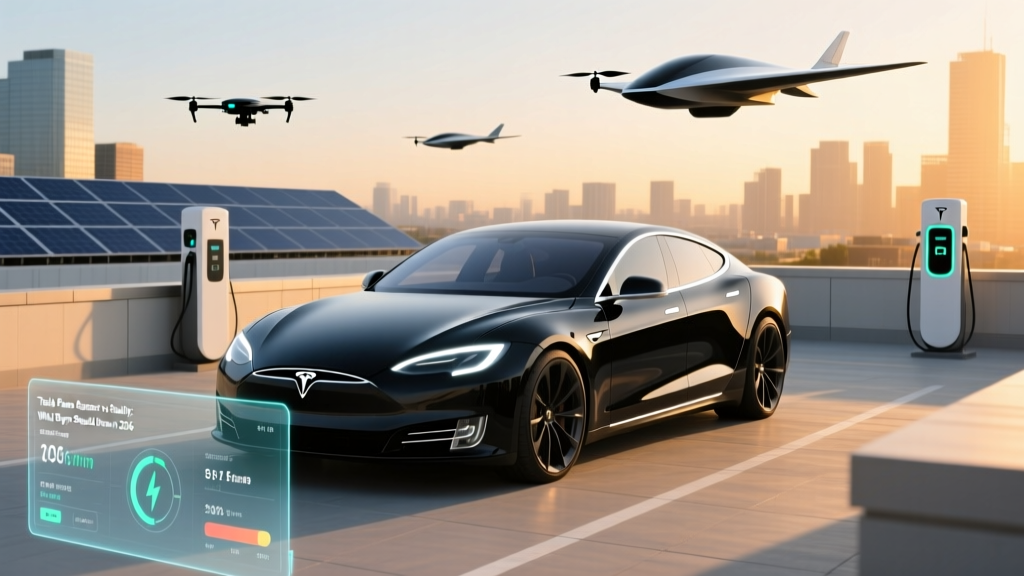
Every few months, search interest in "Tesla planes" spikes across Google. The queries stem from a mix of Elon Musk's offhand comments about electric aviation, fan-made render videos, and confusion with Tesla's actual product roadmap. Let's be direct: Tesla does not manufacture, sell, or have any announced program for aircraft. As of 2026, Tesla's production lineup consists of four consumer vehicles — the Model 3, Model Y, Model S, and Model X — plus the Cybertruck and the Semi commercial truck.
Musk has occasionally mentioned the theoretical possibility of an electric vertical takeoff and landing (eVTOL) aircraft, most notably in a 2019 podcast and scattered social media posts. But no prototype has been unveiled, no FAA certification has been filed, and no production timeline exists. Companies like Joby Aviation, Archer, and Beta Technologies are years ahead in the electric aviation space — and none of them are Tesla.
What is real is Tesla's 2026 vehicle lineup, which continues to dominate the EV market in efficiency and charging infrastructure. If you landed here curious about Tesla planes but are actually considering a Tesla EV, here's what the current fleet delivers in concrete, verifiable numbers.
The Real Tesla Lineup: 2026 Specs at a Glance
Below is the current production lineup with EPA-verified data sourced from fueleconomy.gov and Tesla's official specifications. Every figure here is a production reality — not a concept or rumor.
| Spec | Model 3 Long Range | Model Y Long Range | Model S | Model X | Cybertruck AWD |
|---|---|---|---|---|---|
| EPA Range | 363 mi | 320 mi | 402 mi | 348 mi | 340 mi |
| Battery (usable) | ~79 kWh NMC | ~79 kWh NMC | ~100 kWh NMC | ~100 kWh NMC | ~123 kWh NMC |
| 0–60 mph | 4.2 sec | 4.8 sec | 3.1 sec | 3.8 sec | 3.9 sec |
| Horsepower | 346 hp | 384 hp | 670 hp | 670 hp | 600 hp |
| Drivetrain | Dual-Motor AWD | Dual-Motor AWD | Dual-Motor AWD | Dual-Motor AWD | Dual-Motor AWD |
| Efficiency | 132 MPGe / 25 kWh/100mi | 120 MPGe / 28 kWh/100mi | 124 MPGe / 27 kWh/100mi | 111 MPGe / 30 kWh/100mi | 70 MPGe / 48 kWh/100mi |
| Base MSRP | $47,740 | $48,990 | $79,990 | $84,990 | $79,990 |
Real-World Range: What the EPA Sticker Doesn't Tell You
- Highway-only (70–80 mph): Subtract 10–15% from EPA range due to aerodynamic drag.
- Cold weather (below 32°F / 0°C): Subtract 20–30% due to battery resistance and cabin heating.
- Cold + highway combined: Subtract up to 35–40% in worst-case winter road-trip conditions.
Tesla's battery thermal management system is among the best in the industry. The vehicles precondition the battery automatically when you navigate to a Supercharger, which helps preserve range and optimize charging speed. Still, physics is physics — no EV battery performs identically across all temperatures, and Tesla's NMC chemistry is more sensitive to cold than the LFP packs found in some competitors' base trims.
The Model 3 remains Tesla's efficiency champion. At 25 kWh per 100 miles, it extracts more miles per kilowatt-hour than nearly any EV on the market. That efficiency advantage compounds on road trips, where you'll stop less often and charge for shorter durations.
Charging Speed: Supercharger Network and Home Charging
Charging is where Tesla maintains a decisive real-world advantage. The Supercharger network now exceeds 60,000 connectors globally, with V4 cabinets delivering up to 350 kW at the newest stations.
| Charging Level | Power | Model 3/Y Speed | Model S/X Speed | Cybertruck Speed |
|---|---|---|---|---|
| Level 1 (120V household) | ~1.4 kW | ~3 mi/hr | ~3 mi/hr | ~3 mi/hr |
| Level 2 (240V home) | 11.5 kW | ~44 mi/hr | ~34 mi/hr | ~34 mi/hr |
| DC Fast (V3 Supercharger) | Up to 250 kW | 10–80% in ~25 min | 10–80% in ~30 min | 10–80% in ~28 min |
| DC Fast (V4 Supercharger) | Up to 350 kW | 10–80% in ~18 min* | 10–80% in ~25 min | 10–80% in ~20 min* |
*V4 350 kW speeds require compatible hardware on 2025+ Model 3 Highland and refreshed Model Y. Peak rate is not sustained — the charge curve tapers significantly above 60% SoC, which is why 10–80% time is the meaningful metric, not peak kW.
For home charging, Tesla's Wall Connector ($420) delivers up to 11.5 kW on a 60-amp circuit (48-amp continuous). This translates to a full overnight charge for any Tesla model. Installation costs vary widely: expect $500–$1,500 for a straightforward install near your panel, or $2,000–$4,000+ if a panel upgrade (200-amp service) is required. Always get a quote from a licensed electrician before committing.
One important development: Tesla opened its Supercharger network to non-Tesla EVs (via NACS adapters and built-in NACS ports on newer vehicles from Ford, GM, Rivian, and others). This means the Supercharger advantage is no longer exclusive, but Tesla owners still benefit from seamless plug-and-charge integration with no adapters required.
Pricing, Trims, and Federal Tax Credit Eligibility
Tesla has adjusted pricing multiple times over the past two years. Here's where the lineup stands for the 2026 model year, along with federal tax credit context.
| Model / Trim | Base MSRP | §30D Credit Eligible? | Effective Price (if eligible) |
|---|---|---|---|
| Model 3 RWD | $38,990 | Yes — up to $7,500 | ~$31,490 |
| Model 3 Long Range AWD | $47,740 | Yes — up to $7,500 | ~$40,240 |
| Model 3 Performance | $54,990 | Yes — up to $7,500 | ~$47,490 |
| Model Y Long Range | $48,990 | Yes — up to $7,500 | ~$41,490 |
| Model Y Performance | $53,990 | Yes — up to $7,500 | ~$46,490 |
| Model S | $79,990 | No — exceeds MSRP cap | $79,990 |
| Model X | $84,990 | No — exceeds MSRP cap | $84,990 |
| Cybertruck AWD | $79,990 | No — exceeds MSRP cap | $79,990 |
Critical tax credit caveats (IRS §30D, 2026 rules):
- MSRP caps: Sedans (Model 3) must be ≤$55,000; SUVs/trucks (Model Y, Cybertruck) must be ≤$80,000.
- Buyer income limits: Modified AGI ≤$150,000 (single), ≤$225,000 (head of household), ≤$300,000 (joint).
- Battery sourcing: The full $7,500 requires meeting both critical-mineral and battery-component requirements. Tesla's US-built LFP Model 3 RWD has met the full credit; NMC trims vary by sourcing year. Check the latest IRS qualified vehicle list before purchasing.
- Point-of-sale transfer: Since 2024, eligible buyers can transfer the credit to the dealer at purchase, reducing the upfront price rather than waiting for a tax refund.
The Model S, Model X, and Cybertruck all exceed the $80,000 SUV/truck MSRP cap (or $55,000 sedan cap for the Model S) and therefore do not qualify for the §30D credit regardless of buyer income. This is a common point of confusion.
Tech, Interior, and Driver Assistance
Tesla's cabin remains minimalist by design — a single 15.4-inch center touchscreen handles virtually all vehicle controls, navigation, media, and climate. There is no traditional instrument cluster; speed and range information appears in the upper-left corner of the main display.
Standout tech features:
- Over-the-air updates: Tesla pushes meaningful software updates monthly, adding features and refining performance long after purchase.
- Autopilot (standard): Lane-centering and adaptive cruise control — a competent SAE Level 2 system requiring constant driver attention.
- FSD Supervised ($8,000 option or $99/month): Enhanced city-street and highway navigation. Still Level 2 — the driver must monitor the road and keep hands near the wheel at all times.
- Sentry Mode & Dashcam: Continuous exterior camera recording when parked or driving, stored on USB drive.
- Heat pump (all models): Significantly reduces cold-weather range loss compared to resistive heating systems.
Notable drawbacks:
- No physical buttons for climate, wipers, or glovebox — everything routes through the touchscreen.
- Rear visibility in Model 3 is limited; no rear wiper on Model Y (a common complaint).
- Build quality has improved substantially since 2023, but panel-gap inconsistencies still appear on some units.
- Insurance costs are above average for the segment due to high repair costs for collision damage.
Cargo, Passenger Space, and Practicality
| Model | Front Legroom | Rear Legroom | Cargo (rear seats up) | Cargo (rear seats folded) | Frunk |
|---|---|---|---|---|---|
| Model 3 | 42.7 in | 35.2 in | 23 cu ft | — | 3.1 cu ft |
| Model Y | 41.8 in | 41.6 in | 30 cu ft | 72 cu ft | 4.1 cu ft |
| Model S | 42.7 in | 35.4 in | 28 cu ft | — | 5.3 cu ft |
| Model X | 41.2 in | 41.1 in | 88 cu ft (behind 2nd row) | — | 6.7 cu ft |
| Cybertruck | 41.0 in | 39.0 in | Bed: 54.7 cu ft | — | — |
The Model Y remains Tesla's most practical offering for families, with genuine SUV cargo volume and available third-row seating (small, best suited for children). The Model 3 Highland refresh improved rear-seat comfort with a slightly longer wheelbase and revised cushion geometry, but it's still a midsize sedan at heart.
Warranty Coverage
Tesla's warranty structure is consistent across the lineup:
- Basic vehicle: 4 years / 50,000 miles
- Battery & drive unit (Model 3/Y RWD): 8 years / 100,000 miles
- Battery & drive unit (Model 3/Y Long Range, Performance; Model S/X; Cybertruck): 8 years / 120,000 miles
- Capacity retention threshold: Tesla warrants that the battery will retain at least 70% of original capacity during the warranty period.
The 70% retention threshold is industry-standard, matching Hyundai, Ford, and GM. Real-world degradation data from Tesla's fleet suggests most NMC packs retain 85–90% capacity at 100,000 miles under normal charging habits (avoiding frequent 100% charges and prolonged storage at very low SoC).
Who Should Buy a Tesla — and Who Shouldn't?
- You want access to the most reliable and extensive DC fast-charging network in North America.
- Efficiency matters — the Model 3 is one of the most energy-efficient EVs ever produced.
- You value over-the-air updates that meaningfully improve the vehicle post-purchase.
- You want a proven EV platform with extensive real-world ownership data available.
- You prefer physical controls and a traditional instrument cluster (consider Hyundai Ioniq 5 or BMW i4).
- Build quality and luxury materials are a priority at the $50K+ price point (consider Genesis GV60 or BMW iX).
- You need a long-range electric truck for towing beyond 5,000 lbs (the Rivian R1T or F-150 Lightning may suit better).
- You want LFP chemistry for maximum cycle life and daily 100% charging (the base Model 3 RWD uses LFP; Long Range trims use NMC).
Frequently Asked Questions
Does Tesla make planes or aircraft?
No. Tesla does not manufacture, design, or have any announced program for aircraft. Elon Musk has mentioned the concept of an electric VTOL aircraft in interviews, but no prototype, timeline, or FAA certification effort exists. Tesla's 2026 products are limited to electric vehicles (Model 3, Model Y, Model S, Model X, Cybertruck, Semi) and energy products (Powerwall, Megapack, solar).
What is the real-world range of the Tesla Model Y?
The 2026 Model Y Long Range carries an EPA rating of 320 miles. In real-world highway driving at 70–80 mph in moderate temperatures, expect approximately 270–290 miles. In cold weather (below freezing) on the highway, that drops to roughly 210–240 miles. Preconditioning and using seat heaters instead of cabin heat can help recover some of the cold-weather loss.
How fast does a Tesla charge at home and on the road?
At home on a Level 2 Tesla Wall Connector (11.5 kW), a Model 3 gains approximately 44 miles of range per hour — enough for a full overnight charge. On a V3 Supercharger (250 kW peak), the Model 3 charges 10–80% in about 25 minutes. At newer V4 Supercharger stations (350 kW capable), compatible 2025+ vehicles can achieve 10–80% in approximately 18 minutes, though the charge curve tapers significantly above 60% SoC.
Which Teslas qualify for the $7,500 federal tax credit?
As of 2026, the Model 3 (all trims under $55,000 MSRP) and Model Y (all trims under $80,000 MSRP) are eligible for up to $7,500 under IRS §30D, provided the buyer meets income limits ($150K single / $300K joint) and the vehicle meets battery-sourcing requirements. The Model S, Model X, and Cybertruck exceed MSRP caps and do not qualify. Always verify current eligibility on the IRS qualified vehicles page before purchasing.
Is Tesla still worth buying vs. competitors in 2026?
For efficiency and charging infrastructure, Tesla remains the benchmark. The Model 3 is the most energy-efficient EV in its class, and the Supercharger network is the most reliable DC fast-charging system available. However, competitors have closed the gap in interior quality (BMW i4, Hyundai Ioniq 6), value (Chevrolet Equinox EV), and three-row family hauling (Kia EV9). The right choice depends on your priorities — Tesla wins on efficiency and charging, but no longer dominates every category.
What's the difference between LFP and NMC batteries in Teslas?
Tesla uses two battery chemistries: LFP (lithium iron phosphate) in the Model 3 RWD and NMC (nickel manganese cobalt) in Long Range and Performance trims. LFP offers longer cycle life, better thermal stability, and can be charged to 100% daily without degradation concerns — but it has lower energy density (less range per pound) and worse cold-weather performance. NMC provides higher energy density and better cold-weather range but benefits from being charged to 80% for daily use. If you can charge at home every night and want maximum battery longevity, the LFP Model 3 RWD is an excellent choice.