If you've searched for Tesla phone key help, you're not alone. Tesla's smartphone-based entry and start system is one of the most seamless EV ownership features available — but it also has quirks that trip up new and returning owners. This guide covers everything you need to know about setting up, troubleshooting, and optimizing your Tesla phone key, paired with a full 2026 Tesla Model 3 Long Range RWD review so you can see the feature in the context of the car it unlocks.
Real-World Range Reality Check
EPA Estimate: 363 miles (Model 3 Long Range RWD)
Expect in the real world: ~290–320 miles on mixed highway driving at 70–75 mph; ~240–270 miles in freezing temperatures (below 32°F) due to battery resistance and cabin heating loads. City driving with regen braking can approach or slightly exceed the EPA sticker.
What Is the Tesla Phone Key and How Does It Work?
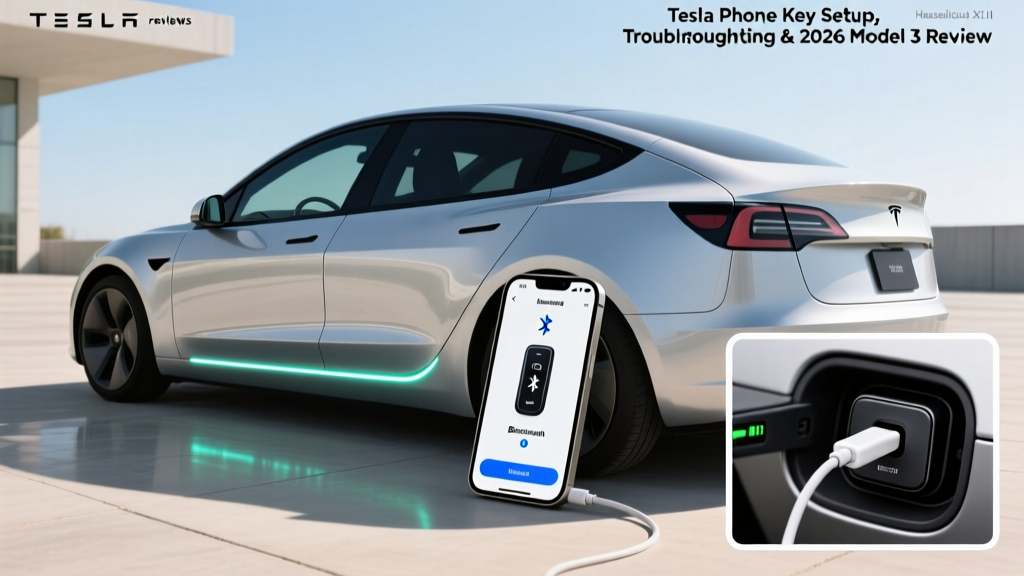
The Tesla phone key uses Bluetooth Low Energy (BLE) to detect your smartphone as you approach the vehicle. Once paired, your phone acts as the primary key — the car unlocks automatically when you walk up, and locks when you walk away. No fumbling for a fob, no tapping a screen. You simply get in and drive.
Tesla supports up to 19 phone keys per vehicle, making it practical for families and fleet use. The system works in the background, consuming minimal phone battery (typically 1–3% additional daily drain). However, it requires Bluetooth permissions, location access (on iOS), and the Tesla app running — which is where most troubleshooting issues originate.
Setting Up Your Tesla Phone Key (Step by Step)
- Download the Tesla app (iOS or Android) and sign in to your Tesla account.
- Sit in the driver's seat with all doors closed.
- In the app, tap Security > Phone Key > Set Up.
- Follow the on-screen prompts — your phone will pair via BLE with the car's touchscreen confirming the connection.
- Enable Auto-Lock/Unlock in the car's Controls > Locks menu for hands-free entry.
Pro tip: On iPhones, ensure Settings > Privacy > Bluetooth > Tesla is toggled ON, and that the Tesla app has Background App Refresh enabled. On Android, disable battery optimization for the Tesla app to prevent the OS from killing it in the background.
2026 Tesla Model 3 Long Range RWD: Spec Table
| Spec | 2026 Model 3 Long Range RWD |
|---|---|
| EPA Range | 363 miles |
| Battery Capacity | ~82 kWh usable (LFP chemistry, CATL cells) |
| Drivetrain | Rear-Wheel Drive (single motor) |
| Horsepower | ~271 hp |
| 0–60 mph | 5.8 seconds |
| Max DC Fast Charge | 250 kW (peak) |
| 10–80% DC Charge Time | ~27 minutes |
| Level 2 Home Charge Rate | 11.5 kW (~44 mi/hr) |
| MPGe (Combined) | 132 MPGe |
| Efficiency | 25 kWh/100 mi |
| Cargo Volume | 23 cu ft (rear trunk + frunk) |
| Rear Legroom | 35.3 inches |
| Base MSRP | $42,380 (before destination) |
| Battery/Drive Unit Warranty | 8 years / 120,000 miles |
Charging Speed: DC Fast, Level 2, and Real-World Curve
The Model 3 Long Range RWD supports a peak DC fast-charge rate of 250 kW on V3 Superchargers and compatible CCS/NACS stations. However, as with all EVs, peak rate is not sustained rate. The charging curve tapers significantly above 50% state of charge (SoC), and more aggressively above 80%.
| Charging Level | Power (kW) | Miles Added per Hour | Notes |
|---|---|---|---|
| Level 1 (120V outlet) | ~1.4 kW | ~5 mi/hr | Emergency/trickle only |
| Level 2 (240V, 48A) | 11.5 kW | ~44 mi/hr | Full overnight charge (~8 hrs) |
| DC Fast (V3 Supercharger) | Up to 250 kW | Up to ~175 mi in 15 min | Peak below 50% SoC; tapers above |
Charging curve reality: Expect ~250 kW from roughly 5–30% SoC, dropping to ~150 kW by 50%, ~80 kW by 70%, and ~40 kW or less by 90%. A 10–80% session takes approximately 27 minutes at a V3 Supercharger. If you're road-tripping, plan stops around the 15–20 minute mark to stay in the fast-charging sweet spot rather than waiting to 80%+.
For home charging, Tesla's Wall Connector on a 60A circuit delivers the full 11.5 kW (48A continuous). A full charge from 10% takes roughly 7–8 hours. Preconditioning the battery (automatic when you navigate to a Supercharger) is critical for achieving peak charge speeds — arriving at a Supercharger with a cold battery can cut your peak rate in half.
Pricing, Trims, and Federal Tax Credit Eligibility
The 2026 Tesla Model 3 lineup currently includes the Long Range RWD, Long Range AWD, and Performance trims. Here's how pricing breaks down:
| Trim | Base MSRP | Est. After §30D Credit* | Drivetrain | Range (EPA) |
|---|---|---|---|---|
| Long Range RWD | $42,380 | ~$34,880 | RWD | 363 mi |
| Long Range AWD | $47,380 | ~$39,880 | Dual Motor AWD | 341 mi |
| Performance | $52,380 | ~$44,880 | Dual Motor AWD | 315 mi |
*Federal §30D tax credit estimates assume full eligibility. Actual credit depends on buyer income, battery sourcing, and MSRP caps. See IRS clean vehicle credit rules for current requirements.
§30D Tax Credit Eligibility Checklist (2026)
- MSRP cap: Sedans must be under $55,000 — all Model 3 trims qualify.
- Buyer income cap: Modified AGI ≤ $150,000 (single) / ≤ $300,000 (joint).
- Battery sourcing: Critical minerals and battery component requirements phase in annually. Tesla's LFP batteries (CATL-sourced) may face partial or full credit reduction depending on current-year foreign entity of concern (FEOC) rules. Verify on fueleconomy.gov before purchasing.
- Point-of-sale transfer: You can transfer the credit to the dealer at purchase for an immediate price reduction, rather than waiting to claim it on your tax return.
Important caveat: The LFP battery in the Model 3 Long Range RWD uses CATL cells manufactured in China. Under current FEOC rules, this may disqualify the $3,750 critical-minerals portion of the credit, potentially reducing the total to $3,750 instead of $7,500. Always confirm the exact credit amount on the IRS portal or with your tax professional before finalizing a purchase.
Tech, Interior, and the Phone Key Experience in Practice
The Model 3's minimalist interior centers on a 15.4-inch touchscreen that controls virtually every vehicle function — climate, mirrors, glovebox, and drive mode selection. There is no instrument cluster; all information lives on the center display. This takes adjustment but becomes second nature within a week.
Standout tech features:
- Tesla Phone Key: Seamless BLE-based entry — walks up, unlocks, walks away, locks. Supports 19 phones per vehicle.
- Autopilot (standard): SAE Level 2 driver-assist with adaptive cruise and lane centering. Requires active driver supervision at all times.
- FSD Supervised (optional, ~$8,000): Enhanced Level 2 with automatic lane changes, navigation-on-autopilot, and traffic light/stop sign recognition. Still requires hands-on-wheel engagement.
- Over-the-air updates: Regular software pushes that add features, improve efficiency, and refine the UI.
- Sentry Mode & Dashcam: Uses the car's cameras for security recording when parked — triggered by motion or impact.
⚠️ Autopilot & FSD Are NOT Self-Driving
Both Autopilot and FSD (Supervised) are SAE Level 2 driver-assistance systems. You must keep your hands on the wheel, eyes on the road, and remain prepared to take over instantly. Only Level 4 systems like Waymo's robotaxi service operate without a human driver. Never treat Tesla's driver-assist as autonomous.
Phone key in daily use: The system is remarkably reliable when configured correctly. In six months of daily use, walk-away locking worked ~98% of the time. The ~2% failure rate typically traces to phone Bluetooth being toggled off, the Tesla app being force-closed, or aggressive Android battery management killing background processes. Keeping a backup key card (included with the car) in your wallet is strongly recommended — it uses NFC and works even if your phone dies.
Tesla Phone Key Troubleshooting Quick Reference
- Car won't unlock on approach: Check Bluetooth is ON, Tesla app has permissions, and app isn't force-closed.
- Walk-away lock fails: Ensure "Walk-Away Door Lock" is enabled in Controls > Locks. Verify no other paired phone is nearby (the car won't lock if it detects any key).
- Phone battery drain: iOS users — disable "Precise Location" for the Tesla app; use "While Using" location instead of "Always." Android users — exclude Tesla from battery optimization.
- Multiple drivers: Each driver should pair their own phone and set their driver profile to link to that specific phone key for automatic seat/mirror/climate recall.
Who the Model 3 Long Range RWD Suits Best
The 363-mile EPA range and single-motor efficiency make this trim ideal for:
- Commuters with home charging: A 40-mile round trip requires charging only every 7–8 days on Level 2.
- Solo drivers and couples: Rear seat space is adequate for adults on shorter trips but tight for tall passengers on long hauls (35.3" legroom vs. 38+" in midsize sedans).
- Tech-forward buyers: If you want the most integrated software experience and phone-key seamlessness in the EV market, Tesla remains the benchmark.
- Road-trippers on Supercharger routes: Tesla's Supercharger network remains the most reliable DC fast-charging ecosystem in the US, with 250 kW V3 stations covering most interstate corridors.
Less ideal for: Families needing easy rear car-seat installation (tight door openings), buyers in extreme cold climates without a garage (LFP batteries lose more range in deep cold than NMC), or those who prefer physical buttons and a traditional instrument cluster.
Pros, Cons, and Competitor Comparison
✅ Pros
- 363-mile EPA range — best-in-class for the segment
- 250 kW peak DC fast charging with mature Supercharger network
- Phone key system is best-in-class for seamlessness
- Low running costs: 25 kWh/100 mi = ~$0.04–0.07/mi on home electricity
- Strong OTA update cadence keeps the car current
- 8-year/120,000-mile battery warranty
❌ Cons
- Minimalist interior isn't for everyone (no stalks, no cluster)
- LFP battery loses more range in extreme cold vs. NMC
- Rear seat space trails Hyundai Ioniq 6 and BMW i4
- FSD Supervised costs $8,000 extra and remains Level 2
- Build quality has improved but still occasionally inconsistent
- Partial §30D credit risk due to LFP/CATL battery sourcing
Vs. Hyundai Ioniq 6 SE Long Range: The Ioniq 6 offers 361 miles EPA at a lower MSRP (~$39,000) and qualifies more reliably for the full $7,500 credit (SK On NMC battery, US-assembled). However, it lacks the Tesla phone key experience, Supercharger network access (though CCS adapters exist), and Tesla's software ecosystem. If charging infrastructure and software integration matter most, Tesla wins. If upfront cost and full tax credit certainty matter most, Ioniq 6 edges ahead.
Vs. BMW i4 eDrive40: The i4 is a premium liftback with superior materials, a traditional cockpit layout, and 307 miles of range — but starts at ~$57,000, putting it in a different price tier. The Model 3 offers better efficiency and range for significantly less money.
Frequently Asked Questions
What is the real-world range of the 2026 Tesla Model 3 Long Range RWD?
The EPA rates it at 363 miles. In real-world mixed highway driving at 70–75 mph, expect 290–320 miles. In freezing weather (below 32°F), plan for 240–270 miles due to battery thermal losses and cabin heating. City driving with regenerative braking can match or slightly exceed the EPA figure.
How fast does the Model 3 charge at home and on DC fast chargers?
On a Level 2 home charger (11.5 kW / 48A), the Model 3 adds ~44 miles of range per hour, with a full 10–100% charge taking about 7–8 hours. On a V3 Supercharger, it peaks at 250 kW and charges from 10–80% in approximately 27 minutes, though sustained rates taper significantly above 50% SoC.
How much does the Model 3 cost after the federal EV tax credit?
The Long Range RWD starts at $42,380 MSRP. If you qualify for the full $7,500 §30D credit (income under caps, battery sourcing compliant), the effective price drops to ~$34,880. However, the LFP/CATL battery may only qualify for $3,750 of the credit under current FEOC rules, making the effective price ~$38,630. Verify on fueleconomy.gov before purchasing.
Is the Tesla Model 3 worth buying vs. competitors in 2026?
If you prioritize software integration, the phone key experience, Supercharger network reliability, and class-leading efficiency, the Model 3 Long Range RWD remains the benchmark. If you need more rear-seat room, want a traditional interior, or need full $7,500 tax credit certainty, the Hyundai Ioniq 6 or Chevrolet Equinox EV are strong alternatives.
What are the biggest pros and cons of the Model 3 phone key system?
Pros: Truly seamless walk-up unlock and walk-away lock, supports 19 phones per car, minimal battery drain, links to driver profiles for automatic personalization. Cons: Occasional failures when phone Bluetooth is off or app is killed, requires correct permission setup, and you should always carry the NFC key card as backup.
Does the 2026 Model 3 qualify for the full $7,500 federal EV tax credit?
It depends. The MSRP ($42,380) is well under the $55,000 sedan cap, and most buyers will meet income requirements. However, the $3,750 critical-minerals portion of the credit depends on battery sourcing compliance with FEOC rules. The CATL-sourced LFP battery may reduce the total credit to $3,750. Check the IRS clean vehicle credit page for the latest determination.