Why Tesla's P/E Ratio Matters to EV Buyers
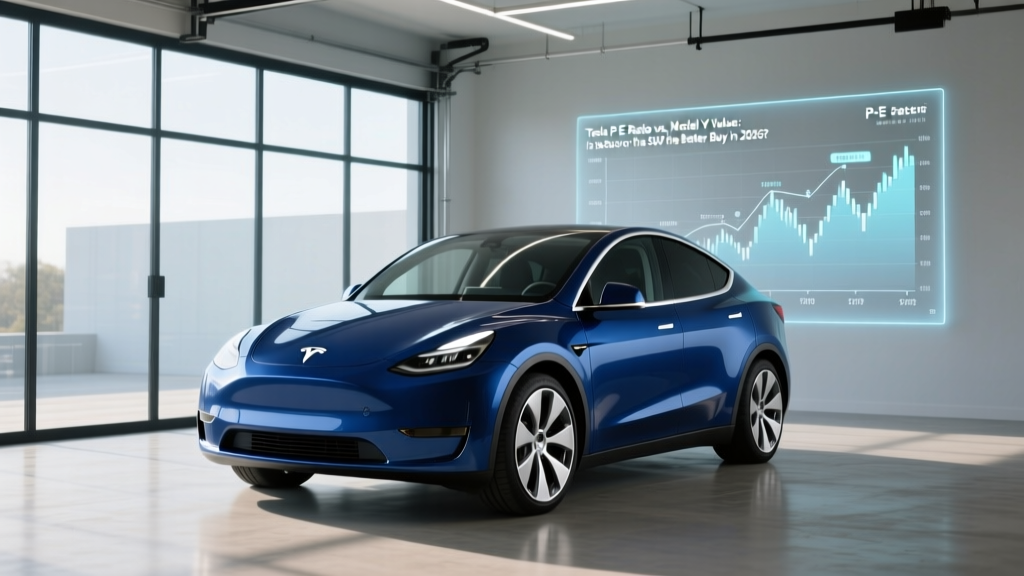
If you've searched "Tesla P/E ratio" recently, you're likely weighing two decisions at once: whether Tesla as a company justifies its market premium, and whether its core product — the refreshed 2026 Model Y — justifies its sticker price to an actual owner. The two questions are inseparable. A high price-to-earnings ratio signals that investors expect sustained growth, which in turn pressures Tesla to keep improving its vehicles while maintaining pricing power in an increasingly competitive EV market.
As of early 2026, Tesla's trailing P/E ratio has hovered in the mid-to-high 60s — well above legacy automakers like Ford and GM, which trade in the single digits to low teens. That premium prices in future revenue from energy storage, FSD licensing, and robotaxi ambitions. But for the person signing a purchase agreement today, the only P/E ratio that matters is price-to-EPA-range — what you actually pay per mile of advertised range, per kilowatt-hour of battery, and per year of reliable ownership.
This review tackles both angles. We'll contextualize the financial metric, then deliver a data-dense 2026 Tesla Model Y profile covering range, charging, pricing, tax-credit eligibility, and how it stacks up against the Hyundai Ioniq 5, Ford Mustang Mach-E, and Chevrolet Equinox EV.
2026 Tesla Model Y: Range, Battery, and Real-World Efficiency
The 2026 Model Y continues with two primary trims in the US market: the Long Range AWD and the Performance AWD. Both use a structural battery pack contributing to chassis rigidity, though Tesla has shifted some production to lithium iron phosphate (LFP) chemistry on rear-wheel-drive variants built for cost efficiency, while Long Range and Performance trims retain nickel-manganese-cobalt (NMC) cells for higher energy density.
| Spec | Long Range AWD | Performance AWD |
|---|---|---|
| EPA Range | 320 miles | 293 miles |
| Battery (usable) | ~75 kWh (NMC) | ~75 kWh (NMC) |
| Drivetrain | Dual-motor AWD | Dual-motor AWD |
| Horsepower | ~384 hp | ~456 hp |
| 0-60 mph | 4.8 sec | 3.5 sec |
| Efficiency (MPGe) | 111 MPGe combined | 102 MPGe combined |
| kWh/100 mi | 30 kWh/100 mi | 33 kWh/100 mi |
| Cargo (rear seats up) | 34.3 cu ft | 34.3 cu ft |
| Cargo (rear seats folded) | 72.1 cu ft | 72.1 cu ft |
| Base MSRP | $48,990 | $53,990 |
Efficiency remains a Tesla strong point. The Model Y Long Range at 30 kWh/100 miles is among the most efficient electric SUVs on the market, trailing only the slightly smaller Hyundai Ioniq 5 RWD. That efficiency translates directly to lower charging costs and more usable range per kilowatt-hour.
Charging Speed: DC Fast, Supercharger Network, and Home Level 2
Charging speed is often the deciding factor for road-trip-capable EVs, and the 2026 Model Y delivers competitive — though no longer class-leading — DC fast-charging performance. Tesla's V4 Superchargers now support higher peak rates, but the Model Y's pack architecture caps its intake.
| Charging Level | Power | Miles Added per Hour | Notes |
|---|---|---|---|
| Level 1 (120V) | ~1.4 kW | ~4–5 mi/hr | Emergency/top-up only |
| Level 2 (240V/48A) | 11.5 kW | ~37 mi/hr | Home Wall Connector |
| DC Fast (peak) | 250 kW | ~162 mi in 15 min | Sustained rate tapers above 50% SoC |
| 10–80% DC Fast | — | ~25 minutes | Optimal battery temp required |
The 250 kW peak figure requires a preconditioned battery — navigate to a Supercharger using the built-in route planner, and the car will warm the pack automatically. Without preconditioning, expect peak rates closer to 120–160 kW on a cold battery, extending 10–80% to 35+ minutes. The charge curve tapers significantly above 80% state of charge, so Tesla's recommendation to charge only to 80% for daily use is both a longevity and a time-saving strategy.
At home, a Tesla Wall Connector on a 60-amp circuit delivers the full 11.5 kW (48 amps), adding roughly 37 miles per hour of charging — enough to fully replenish overnight. Installation costs typically range from $800 to $2,000 depending on panel proximity and local permit requirements.
Pricing, Tax Credits, and the Real Cost of Ownership
Tesla's pricing has stabilized after years of volatility, but federal tax credit eligibility requires careful attention to IRS §30D rules. The credit is not a guaranteed $7,500 for every buyer — it depends on your income, the vehicle's MSRP, and battery component/critical mineral sourcing.
| Trim | Base MSRP | Destination | Est. Federal Credit* | Effective Price |
|---|---|---|---|---|
| Long Range AWD | $48,990 | $1,390 | $3,750–$7,500 | $42,880–$46,640 |
| Performance AWD | $53,990 | $1,390 | $3,750–$7,500 | $47,880–$51,640 |
*Federal credit amount depends on battery sourcing compliance under current IRS rules. Tesla has historically qualified for at least partial credit. Verify current eligibility at irs.gov before purchase. Income caps: $150K single / $225K head of household / $300K joint. MSRP cap for SUVs: $80,000.
- MSRP cap: Model Y qualifies (SUV cap is $80,000; all trims well under)
- Buyer income cap: MAGI must not exceed $150K (single), $225K (HOH), or $300K (joint filing)
- Battery sourcing: Credit splits into $3,750 for critical minerals + $3,750 for battery components — Tesla's sourcing has shifted over time; confirm at point of sale
- Point-of-sale transfer: Eligible buyers can transfer the credit to the dealer for an immediate price reduction rather than waiting for tax filing
Five-year total cost of ownership benefits from low electricity costs (roughly $0.13/kWh national average = ~$0.04/mile), minimal maintenance (no oil changes, reduced brake wear from regen), and strong resale value. However, Tesla insurance premiums run 15–30% higher than comparable EVs from legacy brands in many states — factor this into your budget.
Performance, Interior, and Daily Livability
The Model Y's performance credentials remain strong even as competitors close the gap. The Long Range's 4.8-second 0–60 time is brisk for a family SUV, while the Performance trim's 3.5 seconds rivals sports sedans. Dual-motor AWD provides confident traction in rain and light snow, though dedicated winter tires remain recommended for severe cold climates.
Interior quality saw meaningful improvement with the "Juniper" refresh: ventilated front seats, ambient lighting, a rear-seat touchscreen, and revised suspension tuning that reduces the harshness over sharp pavement imperfections. Legroom is generous — 41.8 inches front, 37.2 inches rear — and the 34.3 cu ft cargo area behind the second row expands to 72.1 cu ft with seats folded. The front trunk (frunk) adds approximately 4.1 cu ft for charging cables and small bags.
The minimalist cabin centers on a 15.4-inch touchscreen handling all vehicle functions, climate, navigation, and entertainment. Physical controls are sparse — no turn signal stalk (signals are on the steering wheel buttons), no gear lever (gear selection via screen or overhead console). This interface polarizes buyers: some love the clean aesthetic, others find it distracting while driving.
Driver Assistance: Autopilot, FSD Supervised, and SAE Level 2 Reality
Tesla Autopilot and Full Self-Driving (Supervised) are SAE Level 2 driver-assistance systems. The driver must remain fully engaged, hands on or near the wheel, eyes on the road, and ready to intervene at any moment. These systems do not make the Model Y a self-driving vehicle. Only Level 4 robotaxi services (Waymo, Zoox) operate without a human driver in defined zones.
Standard Autopilot includes adaptive cruise control and lane-centering on divided highways. The optional FSD (Supervised) package ($8,000 or $99/month) adds automatic lane changes, traffic-light and stop-sign recognition, and city-street navigation assistance. In practice, FSD handles most suburban and highway scenarios competently but still requires frequent driver takeovers in construction zones, faded lane markings, and complex unprotected left turns. Tesla's camera-only vision approach (no LiDAR or radar) occasionally struggles with stationary emergency vehicles and overhead shadows that trigger phantom braking.
- Drive without your supervision — you are the responsible operator
- Navigate unmapped or poorly marked roads reliably
- Handle severe weather (heavy rain, snow, fog) without increased intervention
- Replace attentive driving in school zones or dense urban pedestrian areas
How the Model Y Stacks Up Against Key Competitors
| Attribute | Tesla Model Y LR | Hyundai Ioniq 5 LR AWD | Ford Mach-E ER AWD | Chevy Equinox EV RS |
|---|---|---|---|---|
| EPA Range | 320 mi | 290 mi | 305 mi | 319 mi |
| DC Fast Peak | 250 kW | 238 kW | 150 kW | 190 kW |
| 10–80% Time | ~25 min | ~18 min | ~38 min | ~30 min |
| 0–60 mph | 4.8 sec | 5.1 sec | 5.6 sec | 6.3 sec |
| Base MSRP | $48,990 | $50,100 | $48,995 | $43,900 |
| Charging Network | Supercharger (native NACS) | NACS adapter / Supercharger | NACS adapter / Supercharger | NACS adapter / Supercharger |
The Ioniq 5's 800-volt architecture delivers faster 10–80% charging despite a slightly lower peak kW, making it the road-trip charging champion. The Mach-E offers a more traditional interior with physical controls and Apple CarPlay/Android Auto (which Tesla lacks). The Equinox EV undercuts on price significantly, though it charges more slowly and trails on performance. The Model Y wins on Supercharger network seamlessness, efficiency, and cargo space — but no longer dominates every category.
- Class-leading efficiency (30 kWh/100 mi)
- Native Supercharger access — most reliable public network
- Spacious cargo area (72.1 cu ft max)
- Strong over-the-air update cadence
- Competitive 0–60 performance across trims
- No Apple CarPlay or Android Auto
- Turn signals on steering wheel buttons (learning curve)
- FSD remains Level 2 despite the name and price
- Insurance premiums above segment average
- Rear visibility compromised by sloping roofline
Who Should Buy the 2026 Model Y?
- You road-trip frequently and want the lowest-friction Supercharger experience
- You need maximum cargo space for family gear or camping equipment
- You value efficiency and want the lowest cost-per-mile among electric SUVs
- You prefer minimal maintenance and OTA-delivered feature improvements
- You want sports-sedan acceleration in an SUV form factor
- You're willing to trade ~27 miles of range for 3.5-second 0–60 times
- Track Mode and adaptive dampers matter to your driving enjoyment
- You require Apple CarPlay/Android Auto for navigation or music
- You want physical buttons for climate and volume
- Your budget is under $40,000 — consider the Equinox EV or a used Model Y
- You need true Level 4 autonomy (not available from any consumer automaker as of 2026)
Warranty and Long-Term Battery Outlook
Tesla covers the 2026 Model Y with a 4-year/50,000-mile basic vehicle warranty and an 8-year/120,000-mile battery and drive unit warranty. The battery warranty guarantees retention of at least 70% of original capacity during the coverage period. Real-world data from Teslas with 100,000+ miles shows NMC packs typically retaining 85–90% capacity when charged primarily to 80% and not routinely exposed to extreme heat. LFP packs (on RWD trims) tolerate 100% daily charging and show excellent cycle life, though with slightly lower energy density.
Frequently Asked Questions
What is the real-world range of the 2026 Tesla Model Y?
The Long Range AWD carries an EPA rating of 320 miles, but sustained highway driving at 75 mph typically yields 265–285 miles. In sub-freezing temperatures, expect 220–255 miles. The Performance trim's 293-mile EPA rating drops proportionally.
How fast does the Model Y charge at home and on the road?
On a home Level 2 Tesla Wall Connector (11.5 kW), the Model Y adds about 37 miles of range per hour, fully recharging overnight. On a V3 or V4 Supercharger, it peaks at 250 kW, reaching 10–80% in approximately 25 minutes with a preconditioned battery.
How much does the Model Y cost after the federal tax credit?
The Long Range AWD starts at $48,990 plus $1,390 destination. Depending on current battery-sourcing compliance under IRS §30D, eligible buyers may receive $3,750 to $7,500 in federal credits, bringing the effective price to roughly $42,880–$46,640. Income caps apply ($150K single / $300K joint).
Does the 2026 Model Y qualify for the federal EV tax credit?
It qualifies on MSRP (under the $80,000 SUV cap). The credit amount depends on current critical-mineral and battery-component sourcing rules, which have shifted periodically. Verify your eligibility and the vehicle's current credit status at fueleconomy.gov and irs.gov before purchasing.
Is the Model Y worth buying vs. the Ioniq 5 or Mach-E?
The Model Y wins on efficiency, cargo space, and Supercharger seamlessness. The Ioniq 5 charges faster (10–80% in ~18 min) and offers CarPlay. The Mach-E provides a more conventional interior. All three are strong — the best choice depends on whether charging speed, interior ergonomics, or network access is your top priority.
What are the biggest drawbacks of the Model Y?
No smartphone integration (CarPlay/Android Auto), steering-wheel-button turn signals that require adjustment, higher-than-average insurance costs, and FSD's misleading name relative to its Level 2 capability. The Juniper refresh improved ride quality but didn't eliminate all road noise on coarse pavement.
How does Tesla's P/E ratio affect me as a buyer?
Indirectly. A high P/E ratio means Tesla must sustain growth to satisfy investors, which can drive aggressive pricing, rapid feature updates, and expansion of Supercharger infrastructure. It also means the company is investing heavily in future tech (robotaxi, Optimus, energy) that may or may not benefit current vehicle owners. As a buyer, focus on the product's concrete specs and your ownership costs rather than the stock's valuation multiple.