Quick Answer: Is a Subaru EV Right for You?
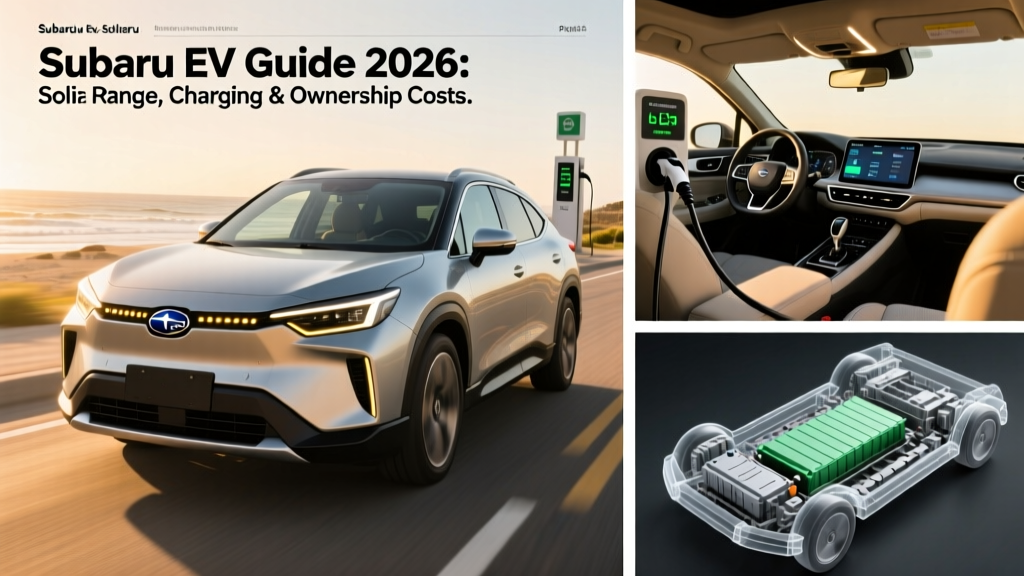
Subaru currently offers one battery-electric vehicle: the Solterra SUV, co-developed with Toyota (bZ4X). For 2026, the Solterra delivers an EPA-estimated 222 to 285 miles of range depending on trim, DC fast-charging up to ~100 kW (10-80% in roughly 30 minutes), and a starting MSRP around $44,995. It qualifies for a portion of the federal §30D tax credit (up to $7,500) depending on battery sourcing and buyer income. The Solterra is best suited for buyers who want standard AWD, Subaru's safety reputation, and moderate daily commutes — but it falls short of rivals like the Hyundai Ioniq 5 or Tesla Model Y on charging speed and highway range. If you need 300+ miles of range or ultra-fast 10-80% charging under 20 minutes, look elsewhere. If you want a practical AWD electric crossover for mixed suburban and light-off-road use, it's worth a close look.
The 2026 Subaru Solterra: What's Changed and What You Get
Subaru entered the EV market with the 2023 Solterra, built on the e-Subaru Global Platform shared with Toyota's bZ4X. The 2026 model year brings incremental updates — a slightly larger usable battery capacity, revised thermal management for better cold-weather performance, and expanded standard features across trims. Subaru has also improved the DC fast-charging curve, though the peak rate remains modest compared to 800V competitors.
Here's what the 2026 Solterra lineup looks like at a glance:
| Spec | Premium (Base) | Limited | Touring |
|---|---|---|---|
| EPA Range | ~285 mi | ~260 mi | ~222 mi |
| Battery (usable) | ~71.4 kWh (NMC lithium-ion) | ||
| Drivetrain | Dual-motor AWD (standard all trims) | ||
| Horsepower | 215 hp combined | ||
| 0-60 mph | ~6.5 seconds | ||
| Max DC Fast Charge | ~100 kW peak | ||
| 10-80% DC Charge Time | ~30 minutes (optimal conditions) | ||
| Level 2 Charge Rate | ~6.6 kW (onboard charger) | ||
| MPGe (combined) | ~111 MPGe | ~104 MPGe | ~97 MPGe |
| Base MSRP | ~$44,995 | ~$48,495 | ~$52,495 |
| Battery Warranty | 8 years / 100,000 miles | ||
Sources: EPA fueleconomy.gov, Subaru.com official specs. Real-world range and charging times vary with temperature, driving style, and battery preconditioning. Figures shown are estimates based on 2026 model-year data and may vary by final production specs.
Real-World Range: What the EPA Sticker Doesn't Tell You
The Solterra's EPA range varies significantly by trim because larger wheels, heavier curb weight, and additional equipment on higher trims reduce efficiency. But EPA estimates are tested under moderate conditions — real-world driving often tells a different story.
Range Reality Check
EPA sticker (Touring): 222 miles
Real-world highway (70-80 mph, moderate weather): ~180-195 miles
Real-world cold weather (below 30°F, mixed driving): ~150-170 miles
Real-world city/suburban (regenerative braking active): ~210-225 miles
The Solterra's NMC battery chemistry and thermal management handle cold better than early-generation EVs, but expect 20-30% range loss in deep winter. Highway driving at sustained speeds is the biggest efficiency killer for any EV, and the Solterra's boxy crossover shape doesn't help its drag coefficient.
For context, a Hyundai Ioniq 5 Long Range AWD delivers an EPA 290 miles and sustains closer to 240-250 real-world highway miles, while the Tesla Model Y Long Range AWD pushes 311 EPA and roughly 260-280 highway. The Solterra's range positions it as a commuter and weekend-trip vehicle, not a cross-country road-tripper without careful planning.
Charging the Subaru EV: Speeds, Connectors, and Home Setup
Charging speed is one of the Solterra's most debated attributes. Subaru uses the CCS1 connector (with NACS adapter access to Tesla Superchargers now available), and the DC fast-charging peak is approximately 100 kW. This is noticeably slower than 800V-platform rivals that peak at 200-350 kW.
| Charging Level | Power (kW) | Miles Added Per Hour | Typical Use Case |
|---|---|---|---|
| Level 1 (120V household) | ~1.2 kW | ~4-5 miles/hr | Overnight trickle, emergencies |
| Level 2 (240V home/public) | ~6.6 kW | ~22-25 miles/hr | Daily home charging, workplace |
| DC Fast Charge (CCS) | ~100 kW peak | ~150-180 miles in 30 min (10-80%) | Road trips, quick top-ups |
Understanding kW vs kWh: kW (kilowatts) is the rate of power flow — like water pressure from a hose. kWh (kilowatt-hours) is the total energy stored — like the size of the bucket. The Solterra's battery holds ~71.4 kWh of energy, and it can accept power at up to ~100 kW during DC fast charging.
The charging curve matters. The Solterra peaks near 100 kW at a low state of charge (around 10-20%), then tapers as the battery fills. From 60-80%, expect the rate to drop to roughly 50-60 kW. This is why the 10-80% time of ~30 minutes is achievable, but 10-100% could take 50+ minutes. Always precondition the battery (via the Subaru app or navigation routing to a charger) before DC fast-charging in cold weather — skipping this can cut your peak charge rate in half.
Home Charging Installation: What to Budget
Most Solterra owners will want a Level 2 home charger for daily convenience. Here's a realistic cost breakdown:
| Item | Cost Range |
|---|---|
| Level 2 charger (hardware, e.g., ChargePoint Home Flex, Wallbox) | $400 - $700 |
| Electrician labor (240V outlet or hardwire, 40-50A circuit) | $500 - $2,000 |
| Permit & inspection (varies by municipality) | $50 - $300 |
| Electrical panel upgrade (if needed, 200A service) | $1,500 - $3,500 |
| Total (typical, no panel upgrade) | $950 - $3,000 |
Subaru has partnered with charging networks to offer complimentary charging credits with new Solterra purchases — check current promotions, as these change annually. For public charging, expect to pay $0.30-$0.50/kWh at DC fast chargers (Electrify America, EVgo) and $0.15-$0.25/kWh at Level 2 public stations.
Solterra vs Gas vs Hybrid: The Cost Comparison That Matters
Buyers cross-shopping the Solterra are likely also considering Subaru's own gas and hybrid models — the Outback (gas) and the Crosstrek Hybrid (PHEV, if available in your market year). Here's how the numbers stack up over 5 years of ownership at 15,000 miles per year.
| Cost Category | Solterra (EV) | Outback 2.5i (Gas) | Crosstrek Hybrid (PHEV) |
|---|---|---|---|
| Purchase Price (MSRP, mid-trim) | $48,495 | $35,995 | $39,995 |
| Federal Tax Credit (§30D, estimated) | -$3,750 to -$7,500* | $0 | -$3,750* |
| Effective Purchase Price | $40,995 - $44,745 | $35,995 | $36,245 - $39,995 |
| Fuel / Energy (5 years) | $3,000 - $4,500** | $8,500 - $10,000 | $5,500 - $7,000 |
| Maintenance (5 years) | $1,200 - $1,800 | $3,500 - $4,500 | $3,000 - $4,000 |
| Insurance (5 years, avg) | $9,000 - $11,000 | $7,000 - $8,500 | $7,500 - $9,000 |
| Estimated 5-Year Total | $54,195 - $62,045 | $54,995 - $58,995 | $52,245 - $59,995 |
* Federal §30D credit eligibility depends on MSRP caps ($80,000 for SUVs), buyer income limits ($300K MFJ / $150K single), and battery critical-mineral/sourcing requirements. Credit may be taken as a point-of-sale rebate. Consult IRS.gov and a tax professional for your specific situation. Amounts shown are estimates.
** Solterra energy cost assumes 70% home charging at $0.14/kWh national average and 30% public DC charging at $0.40/kWh. Gas costs assume $3.50/gal and 28 MPG combined for the Outback.
Key takeaway: The Solterra's higher upfront price is partially offset by the tax credit and dramatically lower fuel and maintenance costs. Over 5 years, the total cost of ownership lands in a similar ballpark as the gas Outback — but you're driving a quieter, smoother, zero-tailpipe-emission vehicle with standard AWD. The crossover point where the Solterra becomes cheaper overall typically comes around year 6-7, depending on your electricity rates and annual mileage.
Federal Tax Credit: What the Solterra Actually Qualifies For
The §30D Clean Vehicle Credit is not a guaranteed $7,500 for every buyer. Here's the 2026 eligibility checklist:
- MSRP cap: Vehicle MSRP must be ≤ $80,000 for SUVs (Solterra qualifies at all trims)
- Buyer income cap: Modified AGI ≤ $300,000 (married filing jointly) or ≤ $150,000 (single)
- Battery sourcing: Critical minerals and battery components must meet phased-in percentage thresholds from US or FTA-partner countries — this determines whether you receive $3,750 or $7,500
- Point-of-sale transfer: As of 2024, you can transfer the credit to the dealer at purchase for an upfront price reduction, even if you owe less in taxes than the credit amount
- Final assembly: Vehicle must undergo final assembly in North America (the Solterra is assembled in Japan — this may affect eligibility; verify current status at fueleconomy.gov)
Critical note: Because the Solterra is built in Japan alongside the Toyota bZ4X, it has faced challenges meeting the North American final assembly requirement for the full §30D credit. Some buyers have qualified for partial credits under commercial-vehicle leasing provisions or state-level incentives. Always verify eligibility before purchasing — don't assume the credit applies.
Common Subaru EV Misconceptions — Separated From Fact
| Myth | Fact |
|---|---|
| "The Solterra has the same range as a Tesla Model Y." | The Model Y LR AWD is EPA-rated at 311 miles; the Solterra tops out at ~285 miles (Premium) and drops to ~222 on the Touring trim. That's a 26-89 mile gap. |
| "EV batteries need replacing every few years." | Subaru warranties the Solterra battery for 8 years/100,000 miles against degradation below 70% capacity. Industry data shows most NMC batteries retain 85-90% capacity after 100,000 miles. |
| "You can't take a Subaru EV off-road." | The Solterra includes 8.3 inches of ground clearance, X-MODE AWD management, and a dedicated Snow/Dirt drive mode. It handles light trails and snowy conditions capably — though it's not a lifted Wrangler. |
| "Charging an EV is always cheaper than gas." | Home charging is typically 50-70% cheaper per mile. But frequent public DC fast-charging at $0.40+/kWh can approach or exceed the per-mile cost of a fuel-efficient gas car. Your charging mix determines real savings. |
| "The Solterra charges as fast as other EVs." | At ~100 kW peak, the Solterra charges significantly slower than 800V rivals (Ioniq 5: ~230 kW; Porsche Taycan: ~270 kW). Plan for 30-minute stops, not 18-minute stops. |
Decision Framework: Should You Buy the Subaru Solterra?
Choose the Solterra If:
- You want standard AWD with legitimate light-off-road and snow capability
- Your daily commute is under 80 miles round-trip (comfortable range margin)
- You can install a Level 2 home charger and do 80%+ of charging at home
- You value Subaru's safety reputation (EyeSight driver-assist, top IIHS ratings) and dealer network
- You don't regularly take road trips exceeding 200 miles between charging stops
- You prefer a traditional crossover design over futuristic styling
Look Elsewhere If:
- You need 300+ miles of real-world range for frequent long-distance travel
- You rely exclusively on public DC fast-charging and want the shortest stops possible
- You want the fastest acceleration in the segment (the Solterra's 6.5-second 0-60 is adequate, not thrilling)
- You live in an area with limited CCS/NACS charging infrastructure and can't charge at home
- Maximum cargo space is a priority (the Solterra offers ~24 cu ft behind rear seats — less than an Outback)
First-Time EV Buyer Essentials: What to Know Before You Sign
If the Solterra is your first EV, here are the ownership realities no brochure mentions:
1. Home charging access is the single biggest ownership variable. If you can charge at home (garage, driveway, or dedicated parking spot with 240V access), EV ownership is seamless — you wake up "full" every morning. If you're 100% reliant on public charging, the Solterra's moderate charge speed and ~222-285 mile range will require more planning and patience than a longer-range, faster-charging rival.
2. Cold weather changes everything. Subaru buyers often live in snow-belt states. Expect 20-30% range reduction in sustained sub-freezing temperatures. A Solterra Touring with 222 miles of EPA range could realistically deliver 155-170 miles on a cold winter highway run. Preconditioning the battery while plugged in mitigates some of this loss.
3. Insurance costs more. EV insurance premiums run 15-25% higher than equivalent gas vehicles due to battery replacement costs and specialized repair requirements. Get a quote before committing — the difference could be $200-$400/year depending on your state and driving record.
4. Maintenance drops dramatically. No oil changes, no transmission fluid, no spark plugs, no exhaust system. The Solterra requires tire rotations, cabin air filter changes, brake fluid checks (regen braking extends pad life significantly), and wiper fluid. Budget roughly $300-$400/year in routine maintenance versus $700-$900 for a gas Outback.
5. The Solterra uses SAE Level 2 driver-assist. Subaru's EyeSight system with lane centering and adaptive cruise is a Level 2 driver-assistance feature — it is not self-driving. You must keep your hands on the wheel and eyes on the road at all times. It's excellent for reducing highway fatigue but requires full driver engagement.
SAE Automation Level Reminder: The Solterra's EyeSight and available driver-assist features are SAE Level 2 — partial automation with continuous driver supervision required. This is the same level as Tesla Autopilot, GM Super Cruise, and Ford BlueCruise. No production consumer vehicle sold today is "self-driving." Only Level 4 robotaxi services (Waymo, Zoox) operate without a human driver, and only in geofenced areas.
Frequently Asked Questions
Does the Subaru Solterra qualify for the $7,500 federal tax credit?
It depends. The Solterra's Japanese assembly location has complicated eligibility for the full §30D credit, which requires North American final assembly. Some buyers may qualify for partial credits ($3,750) based on battery sourcing, or may access credits through leasing provisions. Always check the latest eligibility list at fueleconomy.gov and consult a tax professional before purchasing.
How long does it take to charge the Solterra at home?
On a Level 2 (240V) home charger at 6.6 kW, a full charge from near-empty takes approximately 10-11 hours. In practice, most owners plug in nightly and add 50-80% of battery capacity overnight, which covers daily driving needs with range to spare.
Is the Solterra good in snow and winter conditions?
Yes — this is one of the Solterra's strongest suits. Standard dual-motor AWD, X-MODE traction management, 8.3 inches of ground clearance, and Subaru's winter-tuning heritage make it competitive with any AWD crossover in snow. The main winter trade-off is range reduction (20-30%), which is common to all EVs.
What happens if the Solterra battery degrades?
Subaru warranties the battery pack for 8 years or 100,000 miles against capacity loss below 70%. Based on industry NMC degradation data, most owners will see 5-10% capacity loss over the first 100,000 miles — meaning a 285-mile-range Solterra might deliver 257-270 miles after several years. Full battery replacement outside of warranty is expensive ($15,000-$22,000 estimated) but rarely needed in the vehicle's first decade.
Can the Solterra tow?
The 2026 Solterra has a maximum towing capacity of approximately 2,200 pounds when properly equipped — enough for a small utility trailer, a pair of dirt bikes, or a light pop-up camper. This is less than the gas Outback (2,700 lbs) and significantly less than truck-based EVs. Towing also reduces range by 30-50%, so plan charging stops accordingly.
How does the Solterra compare to the Toyota bZ4X?
They share the same platform, battery, and powertrain, so range and performance are nearly identical. The differences are in tuning, styling, and features: the Solterra has Subaru-tuned AWD with X-MODE, more ground clearance, and Subaru's EyeSight safety suite. The bZ4X is typically priced slightly lower. Choose based on brand loyalty, dealer proximity, and which feature set you prefer.
For the latest Subaru Solterra specifications, visit Subaru.com. For EPA range and efficiency data, search the model at fueleconomy.gov. Tax credit information current as of 2026; rules subject to change — verify at IRS.gov.