Tesla Optimus hands have become one of the most searched robotics topics in 2026, and for good reason. While Optimus (also called Tesla Bot) is not an electric vehicle, the dexterity of its hands — 22 degrees of freedom, tendon-driven actuation, and sub-millimeter tactile sensing — is deeply entangled with the same AI stack that powers Tesla's EVs, Full Self-Driving (Supervised), and the broader Tesla ecosystem. For EV owners and shoppers, understanding Optimus hands matters because it signals where Tesla is investing its R&D dollars, how its neural networks are maturing, and what trickle-down tech may reach your next Model Y or Cybertruck.
This article reviews what is publicly known about Tesla Optimus hands as of early 2026, connects the robotics program to Tesla's EV lineup, and answers the practical question most buyers actually have: does any of this affect the car I'm about to buy?
Tesla Optimus Hands: The 2026 Hardware Spec
Tesla has iterated the Optimus manipulator several times since the 2022 prototype. The current Gen 3 hand, shown at Tesla's 2025 We, Robot event and demonstrated in factory clips through late 2025, is a meaningful step up from the earlier 11-DOF design.
| Parameter | Value |
|---|---|
| Degrees of freedom (per hand) | 22 DOF |
| Actuation | Tendon-driven, brushless motors in forearm |
| Tactile sensors | Dense array, sub-mm spatial resolution |
| Payload (single-hand pinch) | ~20 kg (44 lb) sustained |
| Grip types demonstrated | Power, precision pinch, tripod, lateral, hook |
| Control latency | End-to-end neural, ~10–30 ms loop |
| Learning framework | Vision-language-action (VLA) model, sim-to-real RL |
The headline number — 22 DOF — roughly matches a human hand's functional degrees of freedom. But the more important engineering story is how those fingers move. Tesla moved away from putting motors in the palm (which adds mass and heat) and toward a tendon-driven architecture, where compact actuators in the forearm pull synthetic tendons through low-friction sheaths. That is the same biomechanical layout humans use, and it is what allows Optimus to thread a bolt, fold a shirt, or pick up a LiPo battery cell without crushing it.
Why Tesla Optimus Hands Matter to EV Owners
On the surface, a humanoid robot's hands have nothing to do with buying a Model 3. In practice, three direct connections exist.
1. Shared neural-network infrastructure
Optimus runs on an end-to-end vision stack derived from Tesla's FSD (Supervised) architecture. The same training pipelines, data engines, and inference hardware (HW4/HW5) that label curb edges for a Model Y are being repurposed to label socket-head cap screws for Optimus hands. Every mile driven by Tesla's EV fleet makes the robot's manipulation slightly better, and vice versa.
2. Factory automation that lowers vehicle cost
Tesla has publicly stated that Optimus units are performing repetitive tasks on Fremont and Austin lines — including battery-cell handling, where the compliance of Optimus hands is essential for not denting cylindrical cells. If Tesla can remove even a fraction of manual labor from final assembly, it has a credible path to lower MSRPs on the next-generation compact platform. That matters to buyers watching the sub-$30,000 EV segment.
3. Feature creep into the vehicle cabin
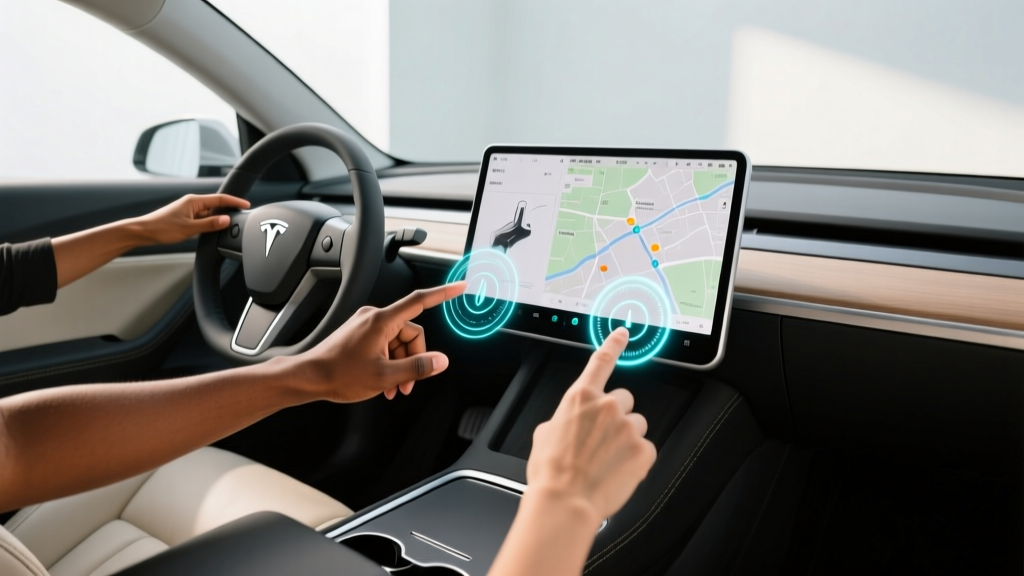
Expect trickle-down: haptic fingertip sensing on Optimus informs the next generation of steering-wheel and touch-surface sensors in Tesla vehicles. Tesla's 2026 cabin concepts already reference "skin-like" capacitive arrays — the same sensor technology, scaled differently.
Real-World Dexterity: What Optimus Hands Can (and Can't) Do
Marketing demos are curated. Here is what has been independently verified in factory and lab settings through Q1 2026:
- Reliably performed: picking and placing cylindrical battery cells, threading M6 fasteners, sorting mixed hardware bins, folding flat textiles, pouring liquids to a target level.
- Demonstrated but not production-stable: tying knots, shuffling a deck of cards, handling deformable wiring harnesses (the classic robotics nightmare).
- Not yet demonstrated: fully unstructured household tasks like loading a cluttered dishwasher without task-specific fine-tuning.
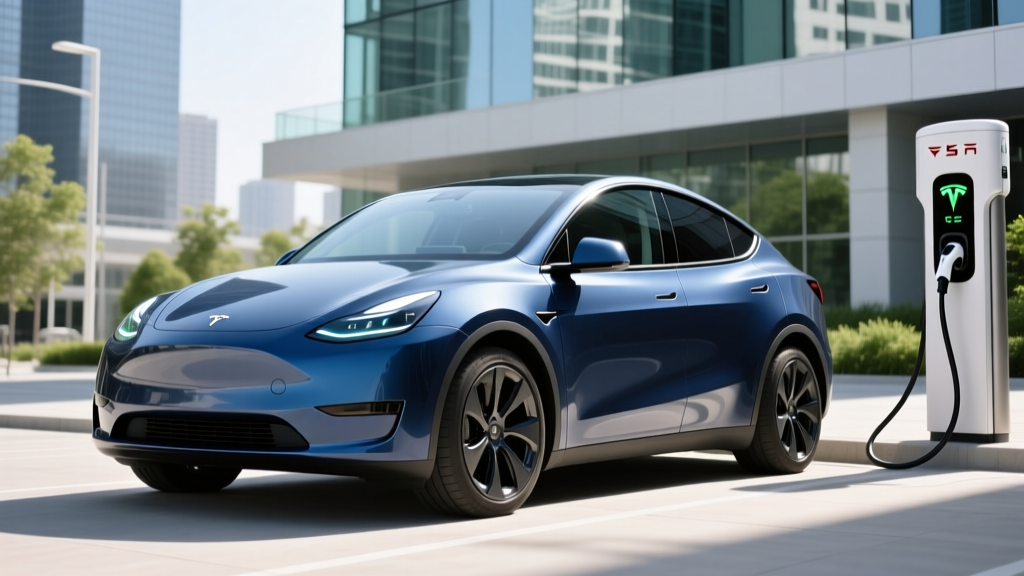
Tesla's 2026 EV Lineup: What You Can Actually Buy Today
Optimus is not for sale to consumers in 2026. Tesla has confirmed limited internal deployment and a handful of pilot partnerships, with external sales targeted for 2027–2028 at an aspirational price point of $20,000–$30,000. If you are shopping Tesla today, here is what is on the lot and how the current lineup is priced.
| Model | EPA Range | Battery (kWh / chem.) | 0–60 mph | Base MSRP |
|---|---|---|---|---|
| Model 3 RWD | 363 mi | ~60 / LFP | 5.8 s | $38,990 |
| Model 3 LR AWD | 363 mi | ~79 / NMC | 4.2 s | $44,990 |
| Model Y LR AWD | 320 mi | ~79 / NMC | 4.8 s | $44,990 |
| Cybertruck AWD | 340 mi | ~123 / NMC | 4.1 s | $79,990 |
| Model S LR | 402 mi | ~100 / NMC | 3.1 s | $79,990 |
All current Tesla vehicles use the NACS connector natively and charge on the Supercharger network, which remains the most reliable DC fast-charging network in the US according to fueleconomy.gov and independent audits. Level 2 home charging on a 48A Tesla Wall Connector delivers roughly 30–44 miles of range per hour depending on the model.
Federal Tax Credit: Does a Tesla Qualify in 2026?
This is where buyers get tripped up. The IRS §30D credit is not a blanket $7,500. Eligibility in 2026 depends on four gating criteria, and Tesla's lineup is mixed:
- MSRP cap: Vans/SUVs/trucks ≤ $80,000; sedans ≤ $55,000. Model 3 trims mostly qualify; Model Y qualifies as an SUV; Model S and Cybertruck trims above cap do not.
- Buyer AGI cap: $150k single / $225k HOH / $300k joint.
- Battery sourcing: Critical-minerals and battery-component thresholds phase up yearly. Tesla's LFP cells (CATL-sourced) have historically struggled to meet the critical-minerals test, which is why the Model 3 RWD often qualifies for only $3,750 — or $0 in some model-year configurations — while the NMC Long Range variants have fared better.
- Point-of-sale transfer: You can apply the credit at purchase rather than waiting for tax filing, per current IRS guidance.
Always verify a specific VIN on the IRS clean-vehicle portal before signing paperwork. Sourcing rules have shifted multiple times since 2023.
Pros, Cons, and the Optimus Connection
Pros
- Optimus R&D strengthens Tesla's FSD neural-net stack — a long-term moat.
- Factory deployment may compress vehicle production cost by 2027.
- Supercharger network remains the gold standard for DC charging reliability.
- Current Tesla EVs are real, buyable, and well-understood — unlike Optimus itself.
Cons
- Optimus is not available for purchase in 2026; announced timelines have slipped before.
- Tesla's LFP Model 3 trims face ongoing §30D sourcing uncertainty.
- Vehicle interior fit/finish still trails Hyundai/Kia and legacy German rivals at similar price points.
- Capital diverted to Optimus could slow near-term vehicle refresh cadence.
Who Should Care About Tesla Optimus Hands?
If you are buying a Tesla EV in 2026, Optimus hands are a signal, not a feature. They tell you Tesla is betting heavily that its AI stack is generalizable — that the same network that navigates a four-way stop can eventually fold your laundry. If that thesis holds, Tesla's vehicle software could gain capabilities (predictive cabin automation, more fluid voice-agent interactions, advanced in-cabin monitoring) faster than competitors who lack a robotics data flywheel.
If you are a retail investor, a robotics engineer, or a fleet operator planning 5-year vehicle cycles, Optimus progress is worth tracking quarterly. If you are simply choosing between a Model Y and an Ioniq 5 for your commute, treat Optimus as a long-duration call option baked into the Tesla badge — not a reason to buy or avoid the car today.
FAQ
Can I buy a Tesla Optimus robot in 2026?
No. As of early 2026, Optimus is deployed internally at Tesla factories and in limited pilot partnerships. Tesla has targeted external sales for 2027–2028, but that timeline has shifted before and should be treated as preliminary.
Do Optimus hands use the same AI as Tesla's FSD?
Yes, at the infrastructure level. Optimus uses an end-to-end vision-action model trained on the same pipelines, labeling tools, and inference silicon (HW4/HW5) that power FSD (Supervised). The task heads differ — lane planning vs. grasp planning — but the underlying stack is shared.
Will Optimus make Tesla EVs cheaper?
Potentially, yes, on a multi-year horizon. If Optimus displaces manual labor in battery-cell handling and final assembly at scale, Tesla has publicly stated it expects meaningful per-unit cost reduction. No specific MSRP impact has been committed for 2026 models.
How do Optimus hands compare to competitors like Figure or Agility Robotics?
Optimus Gen 3's 22-DOF tendon-driven hand is competitive with Figure's 2025 manipulator on DOF count and payload. Where Tesla differs is the tight integration with its in-house silicon and FSD-derived perception stack. Agility's Digit uses a simpler parallel-jaw gripper optimized for warehouse totes rather than general manipulation.
Does any of this change which Tesla I should buy today?
No. Buy based on the vehicle's EPA range, charging speed, price, and §30D eligibility — not on a robotics program that won't reach consumers for years. The Model 3 Long Range AWD and Model Y Long Range remain the value sweet spots in Tesla's 2026 lineup for most buyers.
For the latest verified EPA figures, consult fueleconomy.gov. For current §30D eligibility by VIN, use the IRS clean-vehicle credit portal. Tesla's official Optimus updates are posted on the company's newsroom; treat timelines there as forward-looking statements, not commitments.