Are There Tesla-Only Tunnels? The Short Answer
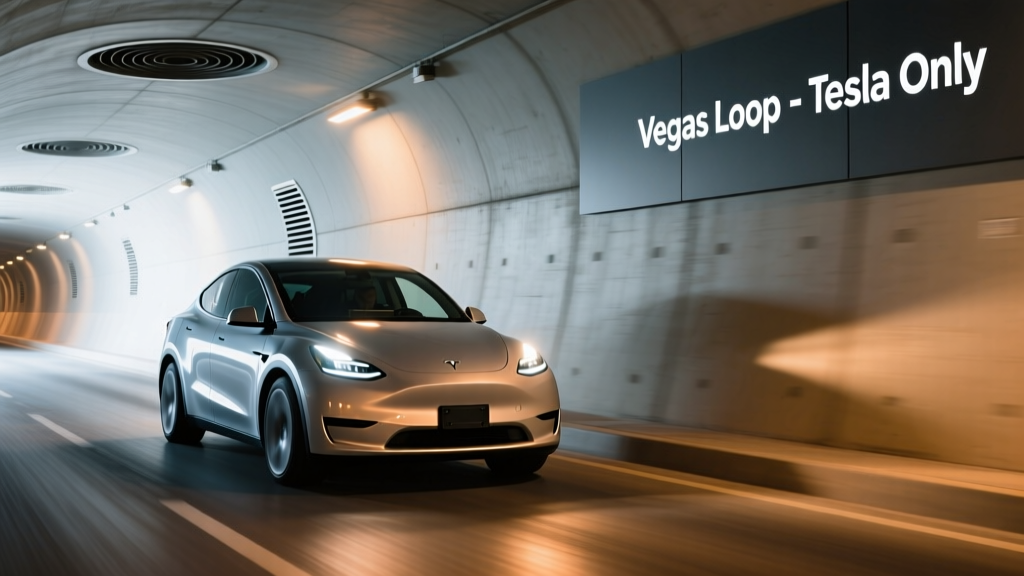
If you've been searching for whether are there Tesla only tunnels is a real thing, the answer is yes — but with important context. The Boring Company, Elon Musk's infrastructure venture, has built and is actively expanding the Vegas Loop, a network of underground tunnels beneath Las Vegas that currently operates exclusively with Tesla vehicles. As of early 2026, the system uses a fleet of Tesla Model Y and Model 3 vehicles to ferry passengers between stations connecting major resorts, the Las Vegas Convention Center (LVCC), and increasingly, the Strip's most-visited destinations.
However, calling them "Tesla-only tunnels" requires nuance. These tunnels aren't private roads restricted to Tesla owners driving their personal vehicles. They are a ride-hail-style transit system where passengers request rides through an app and are transported in Tesla vehicles operated by the Boring Company. You don't need to own a Tesla to ride — you just need a ticket.
SAE Automation Level: Level 2 with human drivers. Despite Tesla's Autopilot and FSD (Supervised) capabilities, Vegas Loop vehicles are currently driven by human operators. The system does not meet SAE Level 4 autonomy. Passengers are riders, not drivers.
What Is the Vegas Loop and How Does It Work?
The Vegas Loop is an underground point-to-point transit system built by The Boring Company. Unlike traditional subway systems with fixed routes and large trains, the Loop uses individual Tesla vehicles traveling through narrow, single-lane tunnels at speeds up to 35-40 mph. Passengers request a ride via a mobile app, descend to a station via elevators or escalators, and board a Tesla that takes them directly to their destination station.
The system launched in 2021 with a 1.7-mile loop beneath the Las Vegas Convention Center, initially using Tesla Model 3 vehicles. Since then, it has expanded significantly:
- LVCC Loop (2021): Connects the convention center's South, Central, and West halls
- Resorts World Station (2022): First Strip-connected station
- Encore/Wynn Station (2023): Extended reach north on the Strip
- Westgate & Riviera Stations (2024-2025): Further expansion east of the Strip
- University of Nevada, Las Vegas (UNLV) & Harry Reid International Airport: Announced/planned phases as of 2026
The Boring Company has stated a goal of building out a 65+ mile network across the Las Vegas valley, though construction timelines have historically been slower than initially projected.
Why Tesla Vehicles? The Technical Rationale
The choice to use Tesla vehicles exclusively in the Vegas Loop isn't arbitrary — it's driven by several technical and economic factors that make Teslas uniquely suited to this application:
Electric Powertrain Requirements
Underground tunnels require zero-emission vehicles. Internal combustion engines would produce carbon monoxide and particulate matter in enclosed spaces, requiring massive (and expensive) ventilation systems. Tesla's battery-electric powertrains eliminate this problem entirely.
Compact Dimensions for Narrow Tunnels
The Boring Company's tunnel-boring machines produce tunnels approximately 12 feet in diameter. This constrains the vehicles that can operate inside them. The Tesla Model Y and Model 3 are compact enough to navigate these tunnels comfortably while still seating up to five passengers (Model Y) or four (Model 3 in this configuration).
Over-the-Air Updates and Fleet Management
Operating a fleet of vehicles in a controlled environment benefits enormously from Tesla's OTA update infrastructure. Route optimization, speed limiting, climate control presets, and diagnostic monitoring can all be pushed to the entire fleet simultaneously.
Regenerative Braking Efficiency
Frequent stop-and-go operation between stations means regenerative braking recaptures significant energy, improving efficiency and reducing brake wear — a critical factor for high-utilization fleet vehicles.
The Tesla Vehicles Powering the Loop: Key Specs
Whether you're curious about the engineering or considering buying the same models for personal use, here's what powers the Vegas Loop fleet. The Model Y has increasingly become the primary vehicle due to its higher passenger and cargo capacity.
| Spec | Tesla Model Y (Long Range AWD) | Tesla Model 3 (Long Range AWD) |
|---|---|---|
| EPA Range | 311 miles | 341 miles |
| Battery Capacity | ~75 kWh usable (NMC) | ~75 kWh usable (NMC) |
| Drivetrain | Dual Motor AWD | Dual Motor AWD |
| Horsepower | 384 hp | 384 hp |
| 0-60 mph | 4.8 seconds | 4.2 seconds |
| Max DC Fast Charge | 250 kW (V3 Supercharger) | 250 kW (V3 Supercharger) |
| 10-80% DC Charge Time | ~27 minutes | ~25 minutes |
| Level 2 Home Charge Rate | 11.5 kW (~44 mi/hr) | 11.5 kW (~48 mi/hr) |
| MPGe (Combined) | 117 MPGe | 132 MPGe |
| Efficiency | 28 kWh/100 mi | 25 kWh/100 mi |
| Cargo Volume | 30.2 cu ft (rear seats up) / 72.0 cu ft (folded) | 23.0 cu ft (trunk) + 3.1 cu ft (frunk) |
| Rear Legroom | 41.6 inches | 35.3 inches |
| Base MSRP (2026) | $44,990 | $42,490 |
| Battery/Drive Unit Warranty | 8 years / 120,000 miles | 8 years / 120,000 miles |
Real-World Range Note: While the Model Y Long Range carries an EPA-estimated 311 miles, expect approximately 250-270 miles in sustained highway driving at 70+ mph, and significantly less — roughly 200-230 miles — in cold weather (below 32°F). In the Vegas Loop's controlled, low-speed tunnel environment with frequent regenerative braking, real-world range is likely closer to or exceeding EPA figures due to the absence of wind resistance at 35-40 mph tunnel speeds and constant climate-controlled ambient temperatures underground.
Could You Drive Your Own Tesla Through These Tunnels?
This is where the "Tesla-only tunnels" question gets interesting for EV owners. Currently, no — personal Tesla vehicles cannot access the Vegas Loop. The tunnels are a closed transit system operated exclusively by The Boring Company with its own fleet vehicles and trained drivers.
However, The Boring Company's long-stated vision includes the concept of allowing personal vehicles to enter tunnel networks at designated entry points, travel underground at high speeds, and exit near their destination. This concept, sometimes called "Loop" for public roads versus "transit" for ride-service, has not yet been implemented in Las Vegas or anywhere else as of 2026.
The Prufrock tunnel-boring machines The Boring Company has been developing are designed to reduce tunneling costs dramatically — Musk has targeted costs below $10 million per mile, compared to traditional subway construction that often exceeds $500 million per mile. If these cost targets are achievable at scale, the vision of personal EV-accessible tunnel networks becomes more plausible, though regulatory, safety, and liability hurdles remain substantial.
Expansion Beyond Las Vegas: Where Else Are Tesla Tunnels Planned?
Las Vegas is the only city with an operational Boring Company tunnel system carrying passengers as of 2026, but other projects have been announced or explored:
Fort Lauderdale, Florida (Proposed)
The Boring Company proposed a tunnel connecting downtown Fort Lauderdale to Fort Lauderdale-Hollywood International Airport. As of 2026, this project remains in planning stages with no confirmed construction start date.
San Antonio, Texas (Proposed)
A tunnel connecting San Antonio International Airport to downtown was explored, but the project has faced community pushback and regulatory delays. Status remains uncertain.
Austin, Texas (Bastrop — PHL Testing)
The Boring Company has built a short test tunnel near Bastrop, Texas (approximately 30 miles from Austin) primarily for technology development and testing of its Prufrock boring machines. This is not a public transit system.
Chicago & Washington D.C. (Abandoned/Inactive)
Earlier proposals for Chicago (O'Hare Express) and a Washington D.C.-Baltimore loop were announced but never built and are no longer actively pursued.
Reality Check: The Boring Company's announced tunnel projects have a history of significant delays or cancellations. While the Vegas Loop is real and expanding, treat other city proposals as preliminary until construction is actively underway. Regulatory approval, environmental review, and community opposition are major variables.
How the Vegas Loop Compares to Traditional Transit and Robotaxis
Understanding where Tesla-only tunnels fit in the broader EV and autonomous transport landscape requires comparing them to alternatives:
| Feature | Vegas Loop (Boring Co.) | Waymo Robotaxi | Traditional Light Rail/Subway | |
|---|---|---|---|---|
| SAE Automation Level | Level 2 (human driver) | Level 4 (driverless) | Fixed-guideway automated | |
| Vehicle Type | Tesla Model Y/3 | Jaguar I-PACE (custom) | Rail cars | |
| Infrastructure Cost | ~$10-50M/mile (target) | Surface roads (existing) | $200-900M/mile | |
| Operating Cities (2026) | Las Vegas only | Phoenix, SF, LA, Austin | Hundreds worldwide | |
| Ride Cost | Free (convention center) / ~$5-12 (resort) | Comparable to Uber/Lyft | $1-5 per ride | |
| Capacity per Hour | ~1,000-4,000 pax (est.) | Variable, surface-limited | 10,000-50,000+ pax | |
| Weather Disruption | None (underground) | Moderate (heavy rain/snow) | Minimal (underground) |
The Vegas Loop occupies a unique niche: it's too small-scale to replace traditional mass transit, but it offers a premium, weather-proof, point-to-point experience that surface robotaxis can't match in extreme heat — a meaningful advantage in Las Vegas summers where surface temperatures regularly exceed 110°F.
What This Means for Tesla Buyers and EV Owners
If you're researching Tesla-only tunnels because you're considering buying a Tesla and wondering about tunnel access, here's the practical reality:
- Owning a Tesla does not grant you tunnel access. The Vegas Loop is a closed fleet system.
- The same Tesla models used in the Loop are available for purchase. The Model Y Long Range AWD starts at $44,990 for 2026.
- Federal tax credit eligibility varies. Under current IRS §30D rules, the Model Y may qualify for up to $7,500, but eligibility depends on battery component sourcing, critical mineral requirements, buyer income caps ($150K single / $300K joint), and the vehicle's MSRP staying under the $55,000 sedan / $80,000 SUV cap. The point-of-sale transfer option allows qualifying buyers to apply the credit at purchase. Always verify current eligibility on IRS.gov and confirm with a tax professional.
- Future tunnel networks could theoretically open to personal EVs, but this is speculative and years away from implementation anywhere.
Buy a Model Y if: You want the same vehicle used in the Vegas Loop, need 311 miles of EPA range, value Supercharger network access, and prioritize cargo space (30.2 cu ft behind the rear seats).
Buy a Model 3 if: You prefer a lower starting price ($42,490), better efficiency (132 MPGe combined), and don't need SUV cargo capacity.
Neither if: Your primary interest in Tesla-only tunnels is personal underground driving access — that capability doesn't exist yet and has no confirmed timeline.
Frequently Asked Questions
Are there Tesla-only tunnels open to the public right now?
Yes, the Vegas Loop in Las Vegas is open to the public, but as a ride-service — not a road you can drive your personal Tesla through. You request a ride via an app and are transported in a Tesla vehicle operated by a Boring Company driver.
How much does it cost to ride the Vegas Loop?
Rides within the Las Vegas Convention Center loop are typically free for convention attendees. Rides connecting to Strip resorts generally cost between $5 and $12 per person, depending on the route and time. Pricing is set by The Boring Company and subject to change.
Will the Vegas Loop eventually allow personal Tesla vehicles?
The Boring Company's long-term vision includes personal vehicle access to tunnel networks, but as of 2026, no timeline has been announced for this capability in Las Vegas or elsewhere. Regulatory, insurance, and safety certification for mixed fleet/personal vehicle operation in tunnels would be substantial hurdles.
Does the Tesla Model Y qualify for the federal EV tax credit in 2026?
The Model Y may qualify for up to $7,500 under IRS §30D, but eligibility depends on multiple factors: the buyer's modified adjusted gross income must not exceed $150,000 (single) or $300,000 (joint), the vehicle MSRP must be under $80,000 (SUV classification), and the battery must meet critical mineral and component sourcing requirements that change annually. Check current status on IRS.gov and consult a tax professional before relying on credit eligibility in your purchase decision.
What is the real-world range of the Tesla Model Y in the Vegas Loop?
In the tunnel environment — low speeds (35-40 mph), no wind resistance, controlled temperature, and frequent regenerative braking — the Model Y likely achieves range at or slightly above its EPA estimate of 311 miles. For personal owners driving on highways, expect 250-270 miles in fair weather and 200-230 miles in freezing conditions. According to fueleconomy.gov, the Model Y Long Range AWD achieves 117 MPGe combined.
How fast do vehicles travel in the Vegas Loop tunnels?
Vehicles travel at approximately 35-40 mph in the tunnels. While The Boring Company initially envisioned much higher speeds (up to 150 mph), the current implementation uses standard surface-vehicle speeds due to station spacing, vehicle capabilities, and safety considerations in a single-lane tunnel environment.
Are there plans for Tesla-only tunnels in other cities?
Proposals have been made for Fort Lauderdale, San Antonio, and other cities, but Las Vegas remains the only operational passenger system as of 2026. Other proposals face regulatory, environmental, and funding challenges. Treat any non-Vegas tunnel project as preliminary until active construction is confirmed.