If you've typed "Tesla oil filter" into a search bar, you're not alone. Thousands of new EV owners and curious shoppers search for this exact term every month — usually for one of two reasons: they're either converting their mental maintenance checklist from a gas car to an electric vehicle, or they've heard conflicting information about what servicing a Tesla actually involves.
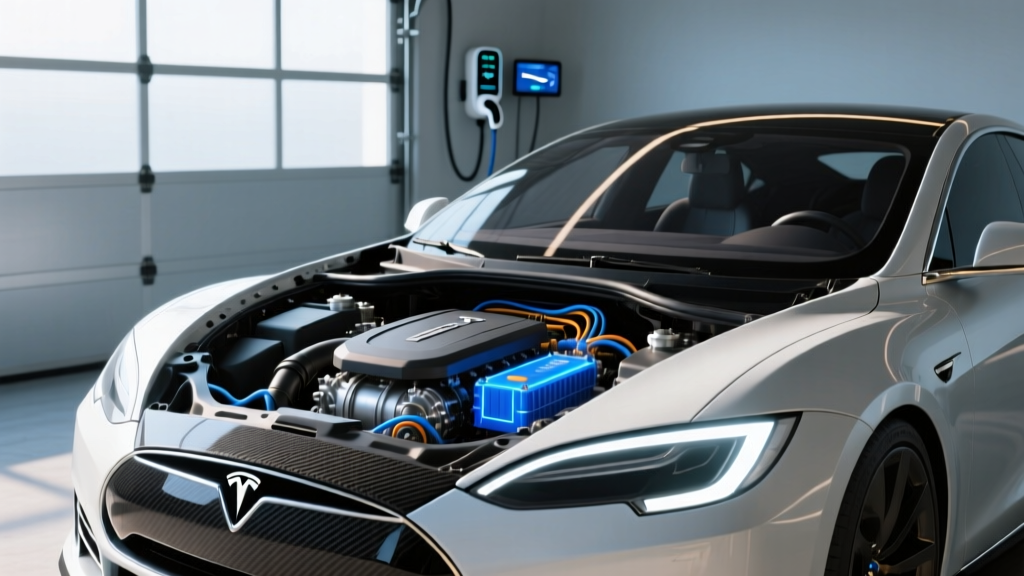
The short answer: Teslas do not have oil filters because they don't have internal combustion engines. There's no engine oil to circulate, no oil pump, no oil pan, and no oil filter to replace. But that doesn't mean a Tesla is maintenance-free. Understanding what does require attention — cabin air filters, brake fluid, coolant loops, drive unit fluid, and the 12V battery — is critical for budgeting ownership correctly.
This guide breaks down exactly what maintenance a 2026 Tesla Model Y (the brand's best-selling vehicle) requires, how much it costs, and how that compares to the gas-car maintenance you're leaving behind. We'll also cover the Model Y's full ownership picture: range, charging, pricing, and whether it still earns its spot against rising competition.
Why There's No Tesla Oil Filter — and What Replaces It
A conventional gas engine contains hundreds of moving parts lubricated by motor oil that circulates through an oil filter to trap metallic particles and sludge. That filter typically gets replaced every 5,000–10,000 miles at a cost of $40–$80 per visit.
A Tesla's electric drivetrain eliminates all of that. Each Model Y uses one or two permanent-magnet synchronous reluctance motors with far fewer moving parts. The drive units do contain a small amount of lubricating fluid (roughly 1.5–2.5 liters of gear oil inside the drive unit housing), but this fluid is designed to last the life of the vehicle under normal conditions. Tesla does not publish a scheduled replacement interval for drive unit fluid on the Model Y, and there is no user-serviceable filter for it.
Here's what does require periodic replacement on a 2026 Tesla Model Y:
| Maintenance Item | Interval | Typical Cost (Parts + Labor) |
|---|---|---|
| Cabin air filter (HEPA/standard) | Every 2–3 years | $35–$90 (DIY) / $80–$150 (service center) |
| Brake fluid check/test | Every 2 years (replace as needed) | $80–$140 |
| Tire rotation | Every 6,250 miles | $30–$60 |
| Windshield washer fluid | As needed | $5–$15 |
| A/C desiccant bag | Every 6 years | $50–$90 |
| 12V lithium auxiliary battery | ~6–8 years (as needed) | $100–$200 (replacement) |
| Coolant (battery thermal loop) | No scheduled interval | N/A under normal use |
The cabin air filter is the closest analog to what gas-car owners think of as a "filter change." Tesla recommends replacing the standard particulate cabin filter every 2 years and the HEPA filter (if equipped) every 3 years. Many owners do this themselves — the filter housing is accessible behind the glovebox area, and aftermarket filters cost $20–$40 on sites like Amazon or directly from Tesla's parts catalog.
2026 Tesla Model Y: Range, Battery, and Efficiency
Real-World Expectation: Expect 260–290 miles on highway-heavy trips at 70–75 mph. In freezing temperatures (below 32°F), range can drop 20–30%, yielding roughly 220–255 miles. City driving with regenerative braking recovers energy and can exceed the EPA estimate.
Source: fueleconomy.gov
The 2026 Tesla Model Y Long Range AWD carries an EPA-estimated 320 miles of range. This is a modest improvement over the pre-refresh Long Range, thanks to the updated "Juniper" platform's improved aerodynamics (a claimed 0.22 drag coefficient) and slightly revised battery management.
The battery pack is an NMC (nickel-manganese-cobalt) lithium-ion configuration with approximately 75 kWh of usable capacity. Tesla does not officially publish usable kWh figures, but independent teardown and telemetry data from third-party sources consistently place the Long Range pack in the 74–76 kWh usable window, with a gross capacity closer to 82 kWh including the buffer.
The base Model Y (RWD) uses an LFP (lithium iron phosphate) battery with roughly 57–60 kWh usable. LFP chemistry trades energy density for longevity — Tesla recommends charging LFP packs to 100% regularly, whereas NMC packs are best kept between 20–80% for daily use to minimize degradation. If you plan to keep the vehicle 8+ years, the LFP pack's superior cycle life is a genuine advantage.
| Spec | Model Y (Base RWD) | Model Y Long Range AWD | Model Y Performance AWD |
|---|---|---|---|
| EPA Range | 283 mi | 320 mi | 295 mi |
| Battery Chemistry | LFP | NMC | NMC |
| Usable Capacity (est.) | ~58 kWh | ~75 kWh | ~75 kWh |
| Efficiency | 133 MPGe / 25 kWh/100mi | 122 MPGe / 28 kWh/100mi | 115 MPGe / 30 kWh/100mi |
| Drivetrain | RWD (single motor) | AWD (dual motor) | AWD (dual motor) |
| Horsepower | ~295 hp | ~384 hp | ~456 hp |
| 0–60 mph | 5.8 sec | 4.8 sec | 3.5 sec |
| Base MSRP | $44,990 | $48,990 | $53,490 |
Charging Speed: DC Fast Charging and Home Level 2
Charging speed remains one of Tesla's strongest competitive advantages, largely due to the Supercharger network's reliability and the vehicle's thermal management system, which preconditions the battery for optimal charge acceptance.
| Charging Level | Power | Speed / Time | Notes |
|---|---|---|---|
| Level 1 (120V household) | ~1.4 kW | ~3–4 mi/hr | Emergency/trickle only; 80+ hours for full charge |
| Level 2 (240V home, 48A) | ~11.5 kW | ~36–44 mi/hr | Full charge overnight (~8–9 hours for Long Range) |
| DC Fast Charge (V3 Supercharger) | Peak 250 kW | 10–80% in ~25 min | Peak rate sustained to ~50% SoC, then tapers |
| DC Fast Charge (V4 Supercharger) | Peak 250 kW (vehicle-limited) | 10–80% in ~23 min | V4 posts can deliver 350+ kW, but 2026 Model Y architecture caps at ~250 kW |
The critical nuance that spec sheets obscure: peak kW is not sustained kW. A Model Y Long Range will hit ~250 kW only when the battery is preconditioned, at a low state of charge (below 20%), and at a V3 or V4 Supercharger. The charge curve tapers significantly above 50% SoC, dropping to ~100 kW by 65% and ~40 kW by 85%. That's why the 10–80% metric is the most honest measure — and at roughly 25 minutes, the Model Y remains competitive but no longer class-leading. The Hyundai Ioniq 5 and Kia EV6, with their 800V architectures, achieve 10–80% in approximately 18 minutes at a 350 kW charger.
For home charging, Tesla's Wall Connector ($475) delivers up to 44 miles of range per hour at 48 amps on a 60-amp circuit. A typical professional installation runs $800–$2,000 depending on panel proximity and whether a panel upgrade (200A service) is needed. Factor in a potential $1,500–$3,000 panel upgrade if your home still has 100-amp service.
Pricing, Tax Credits, and Total Cost of Ownership
The 2026 Tesla Model Y lineup starts at $44,990 for the base RWD and climbs to $53,490 for the Performance trim. All trims fall under the IRS §30D MSRP cap of $80,000 for SUVs, which is the first eligibility gate for the federal tax credit.
However, qualifying for the full $7,500 federal tax credit is not automatic. Under current IRS §30D rules, eligibility depends on:
- Buyer income caps: Modified AGI must not exceed $150,000 (single), $225,000 (head of household), or $300,000 (joint filers)
- Battery component sourcing: A percentage of battery components must be manufactured or assembled in North America (threshold increases annually)
- Critical minerals: A percentage of critical minerals must be sourced from the U.S. or FTA partners (threshold also increases annually)
- Point-of-sale transfer: As of 2024, buyers can transfer the credit to the dealer at purchase, reducing the upfront price rather than waiting for a tax refund
Tesla's U.S.-built Model Y has historically qualified for the full credit, but battery-sourcing rules tighten each year. Always verify current eligibility on fueleconomy.gov before purchasing, and consult a tax professional for your specific situation.
| Trim | MSRP | Est. Price After $7,500 Credit | Destination |
|---|---|---|---|
| Base RWD | $44,990 | ~$37,490* | Included |
| Long Range AWD | $48,990 | ~$41,490* | Included |
| Performance AWD | $53,490 | ~$45,990* | Included |
*Assumes full $7,500 §30D credit eligibility. Verify current sourcing rules and income caps before purchase.
On total cost of ownership, a Model Y Long Range driven 12,000 miles/year at the U.S. average electricity rate of $0.17/kWh costs roughly $570/year in energy. A comparable gas SUV averaging 25 MPG at $3.40/gallon costs about $1,630/year in fuel. That's a ~$1,060/year energy savings, or ~$5,300 over five years — before factoring in the eliminated oil changes, transmission fluid, spark plugs, and timing belt replacements.
Interior, Cargo, and Technology
The 2026 "Juniper" refresh brought meaningful interior improvements to the Model Y, addressing longstanding complaints about cabin noise and ride harshness. Acoustic glass, revised suspension tuning, and ventilated front seats are now standard across trims.
Cargo volume: 30.2 cubic feet behind the second row, expanding to 72.1 cubic feet with the rear seats folded. The front trunk (frunk) adds 4.1 cubic feet — enough for a charging cable kit and a small bag. Total usable cargo space trails the Hyundai Ioniq 5 (behind-rear-seat space is similar, but the Ioniq 5's boxier shape offers more vertical clearance).
Passenger space: Front legroom is generous at 41.8 inches; rear legroom measures 37.3 inches — adequate for adults on shorter trips but tighter than a RAV4 or Ioniq 5 for tall passengers on long hauls.
Infotainment: Everything routes through a 15.4-inch center touchscreen. There is no traditional instrument cluster; speed and navigation appear on the main display. The Juniper refresh added a rear 8-inch touchscreen for climate and media control. Tesla's software ecosystem remains the most polished in the industry — over-the-air updates, trip planning with automatic battery preconditioning, Sentry Mode dashcam recording, and a built-in app suite. Wireless Apple CarPlay and Android Auto are still not natively supported, which remains a friction point for many buyers.
Driver assistance: Basic Autopilot (Traffic-Aware Cruise Control and Autosteer) is standard. Full Self-Driving (Supervised) is a $8,000 option or $99/month subscription. FSD remains an SAE Level 2 system — the driver must remain fully attentive, keep hands on the wheel, and is legally responsible for all vehicle operation. It is not autonomous driving.
Warranty Coverage
Tesla's warranty structure is straightforward:
- Basic Vehicle Limited Warranty: 4 years / 50,000 miles, whichever comes first
- Battery and Drive Unit Warranty (Long Range/Performance): 8 years / 120,000 miles, with a minimum 70% capacity retention threshold
- Battery and Drive Unit Warranty (Base RWD with LFP): 8 years / 100,000 miles, with a minimum 70% capacity retention threshold
The 70% retention threshold is standard across the industry. In practice, Tesla NMC packs have shown roughly 10–12% degradation at 100,000 miles based on aggregated fleet data from owner communities, meaning most packs will retain well above the warranty threshold. LFP packs tend to degrade even more slowly, though they are newer to the U.S. market and long-term data is still accumulating.
Maintenance Cost Comparison: Tesla Model Y vs. Gas SUV
Here's what five years / 60,000 miles of scheduled maintenance looks like when comparing a Model Y Long Range to a similarly priced gas compact SUV (e.g., Toyota RAV4 AWD):
| Service Item | Model Y (5yr / 60k mi) | Gas SUV (5yr / 60k mi) |
|---|---|---|
| Oil changes + oil filter | $0 (no engine oil) | $450–$720 |
| Cabin air filter | $70–$180 (2 replacements) | $80–$200 |
| Tire rotation | $200–$400 | $200–$400 |
| Brake pads | $0–$200 (regen extends life significantly) | $300–$600 |
| Brake fluid | $80–$140 (test/replace at yr 4) | $80–$150 |
| Transmission fluid | $0 (no scheduled change) | $150–$300 |
| Engine air filter | $0 (no engine air filter) | $50–$100 |
| Coolant flush | $0 (no scheduled interval) | $100–$200 |
| Total Estimated | $350–$920 | $1,410–$2,670 |
The savings are real but not dramatic in absolute terms — roughly $1,000–$1,750 over five years. The bigger financial story is the fuel savings (~$5,300 over five years as calculated above) and the federal tax credit, which together dwarf the maintenance difference.
Pros and Cons of the 2026 Tesla Model Y
✅ Pros
- Supercharger network remains the most reliable DC fast-charging ecosystem in the U.S.
- Best-in-class software, OTA updates, and trip planning with battery preconditioning
- Excellent efficiency (25–30 kWh/100mi) translates to lower charging costs
- No oil changes, no engine air filter, minimal brake wear
- Strong cargo capacity (72.1 cu ft max) with practical frunk
- Qualifies for $7,500 federal tax credit (verify current eligibility)
- Juniper refresh fixed ride quality and cabin noise complaints
❌ Cons
- DC fast-charge speed (250 kW peak, ~25 min 10–80%) trails 800V competitors
- No native Apple CarPlay or Android Auto
- Rear seat legroom (37.3 in) is tight for tall adults on long trips
- FSD (Supervised) costs $8,000 and remains Level 2 — not autonomous
- Service center wait times can stretch weeks in less-populated areas
- Insurance premiums run 15–25% higher than comparable gas SUVs
- All-screen interface lacks physical buttons for climate and volume
Who Should Buy the 2026 Tesla Model Y?
Choose the Model Y if:
- You have home charging access (Level 2) and want the lowest daily operating cost
- You road-trip regularly and value the Supercharger network's reliability
- You want strong acceleration (3.5–5.8 sec 0–60) with practical cargo space
- You prioritize software features, OTA updates, and integrated trip planning
- You qualify for the $7,500 federal tax credit and want to reduce the effective purchase price
Look elsewhere if:
- You need the fastest possible DC charging (consider Ioniq 5/EV6 with 800V)
- You rely on Apple CarPlay/Android Auto and won't compromise
- You frequently carry tall rear-seat passengers (consider the Ioniq 5 or Kia EV9)
- You live in an area with limited Tesla service center coverage
- You want a traditional instrument cluster and physical controls
Frequently Asked Questions
Does a Tesla have an oil filter?
No. Teslas are fully electric vehicles with no internal combustion engine. There is no engine oil, no oil pump, no oil pan, and no oil filter. The drive unit contains sealed gear lubricant that does not require scheduled replacement.
What is the real-world range of the 2026 Tesla Model Y?
The EPA rates the Long Range AWD at 320 miles. In real-world highway driving at 70–75 mph, expect 260–290 miles. In cold weather (below 32°F), range can drop to 220–255 miles due to battery resistance and cabin heating demand. City driving with regenerative braking often matches or slightly exceeds the EPA estimate.
How fast does the Model Y charge at home and on the road?
At home on a Level 2 (240V, 48A) Tesla Wall Connector, the Model Y gains approximately 36–44 miles of range per hour, fully charging overnight in 8–9 hours. On a V3 Supercharger at peak rate (250 kW), it charges from 10–80% in approximately 25 minutes. Charging slows significantly above 80% SoC to protect battery health.
Does the 2026 Tesla Model Y qualify for the federal EV tax credit?
The Model Y is assembled in the U.S. and has historically qualified for the full $7,500 §30D credit. However, eligibility depends on the buyer's income (AGI caps apply), battery component sourcing requirements (which tighten annually), and the vehicle's MSRP (must be under $80,000 for SUVs). Always verify current eligibility on fueleconomy.gov and consult a tax professional.
How much does it cost to maintain a Tesla vs. a gas car?
Over five years and 60,000 miles, a Model Y costs roughly $350–$920 in scheduled maintenance (cabin filters, tire rotation, brake fluid). A comparable gas SUV costs $1,410–$2,670 over the same period, largely due to oil changes, transmission fluid, engine air filters, and more frequent brake pad replacements. Combined with fuel savings (~$5,300 over five years), the total operating cost advantage is substantial.
Is the Tesla Model Y worth buying over competitors in 2026?
The Model Y remains the default recommendation for buyers who prioritize charging infrastructure, software integration, and efficiency. However, the Hyundai Ioniq 5 offers faster DC charging (800V architecture), more rear-seat space, and CarPlay/Android Auto. The Ford Mustang Mach-E provides a more engaging driving experience. The Model Y wins on Supercharger access, energy efficiency, and cargo versatility — but the gap has narrowed considerably since 2022.