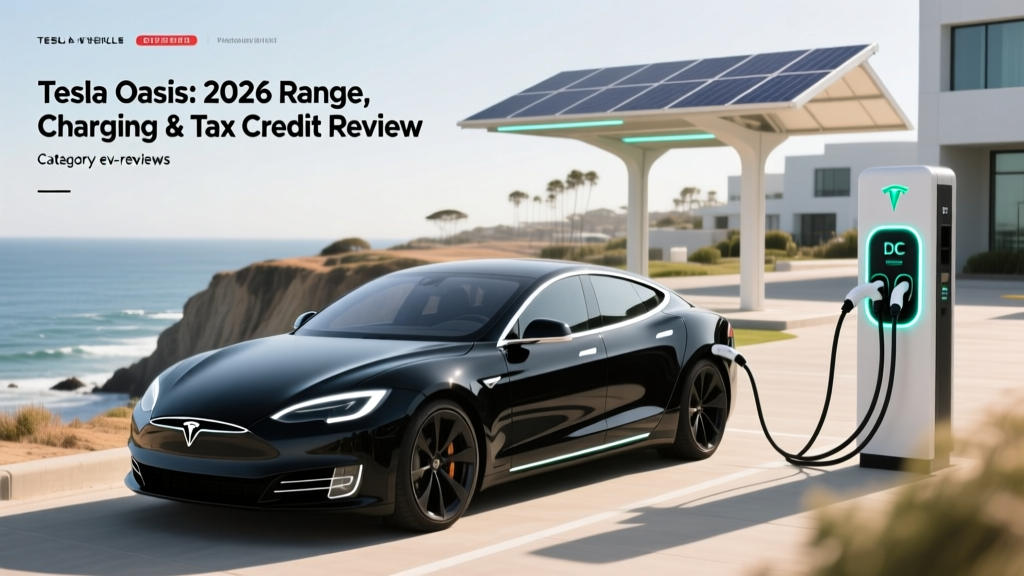
If you've been searching for the Tesla Oasis, you've likely encountered a tangle of rumors, speculative renders, and forum speculation. Here is the definitive reality check for 2026: the Tesla Oasis does not currently exist as a production or officially announced vehicle in Tesla's lineup. Tesla's publicly available models as of early 2026 remain the Model 3, Model Y, Model S, Model X, Cybertruck, and the next-generation Roadster (still listed as upcoming). No press release, SEC filing, or configuration page on Tesla.com references an "Oasis" nameplate.
So why is "Tesla Oasis" drawing search interest? The name has circulated in enthusiast communities as a speculative codename for a future compact crossover or a potential refresh of the Model Y. Some early 2025 concept renders used the name, but none originated from Tesla. This review addresses what buyers actually need to know, what the rumor points toward, and which existing Tesla models deliver the specs the Oasis is rumored to target.
Is the Tesla Oasis a Real, Buyable EV?
| Attribute | Status |
|---|---|
| Official Announcement | None from Tesla |
| Production Status | Not in production |
| Configuration Page | Not available on Tesla.com |
| EPA Certification | No filing on fueleconomy.gov |
| Estimated Segment Target (Rumor) | Compact/midsize crossover (Model Y class) |
Until Tesla officially unveils a vehicle by this name and submits it for EPA testing, any range, battery, or pricing figures attributed to the "Oasis" are speculative. Buyers researching the nameplate should pivot to evaluating the existing models that occupy the segment the Oasis is rumored to target.
What the Rumored Tesla Oasis Would Need to Compete
The crossover EV segment in 2026 is the most competitive in the industry. If Tesla introduces a new model under the Oasis name, it would need to match or exceed the following benchmarks established by the current Model Y and its key rivals:
| Spec | Tesla Model Y (Long Range AWD) | Hyundai Ioniq 5 (Long Range AWD) | Ford Mustang Mach-E (Extended Range AWD) |
|---|---|---|---|
| EPA Range | ~320 mi | ~305 mi | ~312 mi |
| Battery (usable kWh) | ~75 kWh (NMC) | ~77.4 kWh (NMC) | ~91 kWh (NMC) |
| Peak DC Charge Rate | ~250 kW | ~240 kW (800V) | ~150 kW |
| 10–80% DC Time | ~27 min | ~18 min | ~45 min |
| 0–60 mph | 4.8 sec | 5.1 sec | 5.5 sec |
| Base MSRP (est.) | ~$48,000 | ~$49,000 | ~$47,000 |
| EPA MPGe (combined) | ~122 MPGe | ~114 MPGe | ~101 MPGe |
Any new Tesla entry would also face the 2026 competitive pressure from the Chevrolet Equinox EV (starting under $35,000 with over 300 miles of range), the Kia EV6, and the Volkswagen ID.4. The Oasis would need a compelling differentiator—whether that is pricing, a structural battery pack, an updated FSD hardware suite, or a new LFP chemistry option—to justify entering an already crowded field.
Real-World Range and Efficiency: What to Expect from a Tesla Crossover
Because no EPA data exists for an Oasis, let's anchor expectations to the Model Y Long Range AWD, which is the closest proxy for what an Oasis might deliver. The EPA rates the 2026 Model Y Long Range AWD at approximately 320 miles. Real-world results consistently fall below that figure under common driving conditions.
Real-World Range Reality Check (Model Y Proxy)
EPA Sticker: ~320 miles
Highway (70–75 mph, moderate weather): ~265–285 miles
Cold Weather (below 32°F, cabin heat): ~220–260 miles
Best Case (city, 55 mph, mild temps): ~310–330 miles
Efficiency: ~122 MPGe combined / ~27 kWh per 100 miles. Cold-weather range loss of 20–30% is typical for all NMC lithium-ion packs without consistent preconditioning.
Tesla's thermal management system, including the heat pump introduced across the lineup, mitigates some cold-weather losses compared to rivals without heat pumps. However, physics still govern: cabin heating, battery warming, and increased rolling resistance in winter reduce range materially. Drivers in northern climates should plan around a 20–25% winter reduction, not the EPA sticker.
Charging Speed: DC Fast, Level 2, and the Supercharger Advantage
Tesla's charging ecosystem remains a primary purchase driver. Using the Model Y as a stand-in, here is what a similarly positioned Tesla crossover delivers in 2026:
| Charging Level | Power | Miles Added per Hour | Notes |
|---|---|---|---|
| Level 1 (120V household) | ~1.4 kW | ~3–5 mi/hr | Emergency/trickle only |
| Level 2 (240V home, 48A) | ~11.5 kW | ~37–44 mi/hr | Full charge in ~7–8 hours |
| DC Fast (Supercharger V3) | Peak ~250 kW | Up to ~170 mi in 15 min | 10–80% in ~27 min; tapers above 80% |
| DC Fast (Supercharger V4) | Peak ~350 kW (capable) | Model Y may not accept full rate | Vehicle-side charge acceptance is the bottleneck |
A critical nuance many buyers miss: kW is power (charge rate), kWh is energy (battery capacity). A 250 kW peak rate is not sustained across the entire session. The charge curve tapers significantly above 50–60% state of charge to protect battery longevity. Expect the final 20% (80–100%) to take nearly as long as the 10–80% portion. Tesla's navigation system automatically preconditions the battery when routing to a Supercharger, which is essential for achieving peak charge rates—arriving cold can cut peak kW in half.
The 2026 Supercharger network, now open to NACS-equipped vehicles from Ford, GM, Rivian, and others, has grown denser but also busier. Tesla owners still benefit from seamless plug-and-charge integration and generally higher uptime than third-party networks, but wait times at popular corridor stations during peak travel are a growing reality.
Pricing, Trims, and Federal Tax Credit Eligibility
Since the Oasis is not a listed product, there is no MSRP to evaluate. For reference, Tesla's 2026 crossover pricing structure (Model Y) provides the likely template:
| Trim | Est. MSRP | §30D Federal Credit | Effective Price (if eligible) |
|---|---|---|---|
| Long Range AWD | ~$48,000 | Up to $7,500 (point-of-sale) | ~$40,500 |
| Performance | ~$53,000 | Up to $7,500 (point-of-sale) | ~$45,500 |
Federal tax credit eligibility under IRS §30D is not automatic. Buyers must satisfy all of the following for the 2026 tax year:
- MSRP Cap: SUVs/crossovers/vans must not exceed $80,000; sedans must not exceed $55,000.
- Buyer Income Cap: Modified adjusted gross income must not exceed $150,000 (single), $225,000 (head of household), or $300,000 (joint).
- Battery Sourcing: A percentage of critical minerals and battery components must be sourced from the US or free-trade-agreement partners. These percentages increase annually and can disqualify otherwise eligible vehicles mid-year.
- Point-of-Sale Transfer: As of 2024, buyers can transfer the credit to the dealer at purchase, reducing the upfront price rather than waiting for a tax refund.
- VIN Registration: The vehicle must be registered in the buyer's name and primarily used in the US.
Tesla's battery sourcing has historically qualified for the full credit on US-built models, but supply-chain shifts can change eligibility quarter to quarter. Always verify current status on the IRS clean vehicle credits page before committing to a purchase.
Performance, Interior, and Technology
Based on the Model Y platform, a Tesla crossover in this class delivers:
- Powertrain: Dual-motor AWD; Long Range produces ~384 hp; Performance variant ~510 hp.
- 0–60 mph: 4.8 seconds (Long Range); 3.5 seconds (Performance).
- Cargo Volume: ~30 cu ft behind the second row; ~72 cu ft with seats folded. Front trunk (frunk) adds ~4 cu ft.
- Passenger Space: ~41.8 inches front legroom; ~38.4 inches rear legroom.
- Infotainment: 15-inch center touchscreen; no Apple CarPlay/Android Auto (Tesla-native OS only); rear-seat entertainment screen on newer builds.
- Driver Assistance: Standard Autopilot (SAE Level 2); optional FSD (Supervised), also Level 2—driver must remain fully engaged at all times.
SAE Automation Level Reminder
Tesla Autopilot and FSD (Supervised) are SAE Level 2 driver-assistance systems. They do not make the vehicle self-driving. The driver is legally and operationally responsible for all vehicle actions at all times. Only Level 4 services like Waymo operate without a human driver in defined geographic zones.
Notable drawbacks of the current Tesla crossover platform include panel-gap inconsistency (improved but still variable), a firm ride on larger wheel options, the lack of Apple CarPlay/Android Auto (a dealbreaker for some buyers), and reliance on touchscreen controls for functions like mirror adjustment and glovebox release that competitors handle with physical controls.
Warranty and Long-Term Ownership
| Component | Coverage |
|---|---|
| Basic Vehicle | 4 years / 50,000 miles |
| Battery & Drive Unit (Long Range/Performance) | 8 years / 120,000 miles (min 70% retention) |
| Roadside Assistance | 4 years / 50,000 miles |
Tesla's battery warranty guarantees at least 70% capacity retention over the warranty period. Real-world degradation data from high-mileage Tesla owners suggests most NMC packs retain 85–92% capacity at 100,000 miles when charged primarily to 80–90% daily and not repeatedly DC fast-charged to 100%. LFP-equipped variants (where offered) tolerate regular 100% charges and may show lower long-term degradation, though with a modest range and energy-density trade-off.
Who Should Wait for an Oasis—and Who Should Buy Now
Decision Framework
Wait for an official Oasis announcement if: You are not under time pressure, you want to see if Tesla introduces a next-generation platform with structural battery pack improvements, 800V architecture, or a more affordable entry price below the Model Y.
Buy a Model Y (or competitor) now if: You need a vehicle within 6 months, you want proven EPA range data, established Supercharger access, known tax credit eligibility, and a documented service network. Waiting for an unannounced vehicle carries the risk that it never materializes or arrives at a higher price than expected.
Pros (of the Rumored Segment Target)
- Tesla's Supercharger network and plug-and-charge integration
- Industry-leading energy efficiency (kWh/100mi)
- Over-the-air updates that add features post-purchase
- Strong resale value relative to non-Tesla EVs
- Access to FSD (Supervised) feature set, if valued
Cons (of the Rumored Segment Target)
- No confirmed specs, pricing, or timeline—pure speculation
- Tesla's service center capacity has not scaled with fleet size
- No Apple CarPlay/Android Auto support
- Insurance premiums for Teslas remain above segment average
- Increasing competition from lower-priced crossovers (Equinox EV, Ioniq 5)
Tesla Oasis FAQ
Is the Tesla Oasis a real car I can order in 2026?
No. As of early 2026, Tesla has not announced, unveiled, or listed a vehicle called the Oasis. It is not available for order on Tesla.com and has no EPA certification. All specifications attributed to it online are speculative.
What is the real-world range of Tesla's current crossover (Model Y)?
The EPA rates the Model Y Long Range AWD at approximately 320 miles. Real-world highway driving at 70–75 mph yields roughly 265–285 miles. In cold weather (below 32°F), expect 220–260 miles depending on cabin heat usage and preconditioning habits.
How fast does a Tesla crossover charge on DC fast charging?
The Model Y Long Range AWD peaks at approximately 250 kW on a V3 Supercharger, achieving a 10–80% charge in about 27 minutes. The charge rate tapers significantly above 80% to protect battery health. Battery preconditioning via navigation routing is essential to achieve peak rates.
Does the Tesla Model Y qualify for the $7,500 federal tax credit in 2026?
The Model Y has generally qualified for the full $7,500 credit under IRS §30D, but eligibility depends on the buyer's income (must not exceed $150,000 single / $300,000 joint), the vehicle's MSRP (must not exceed $80,000 for SUVs), and battery-sourcing requirements that change annually. The credit can be transferred at the point of sale. Verify current eligibility on the IRS website before purchasing.
Is the Tesla Model Y worth buying vs. the Hyundai Ioniq 5 or Ford Mach-E?
The Model Y leads in energy efficiency (MPGe), Supercharger network access, and cargo volume. The Ioniq 5 charges faster (10–80% in ~18 minutes vs. ~27) thanks to its 800V architecture and offers Apple CarPlay. The Mach-E provides a more traditional driving feel and physical controls. The best choice depends on whether you prioritize charging speed (Ioniq 5), ecosystem integration (Model Y), or driving dynamics (Mach-E).
What are the biggest pros and cons of Tesla's crossover platform?
Pros: class-leading efficiency, Supercharger access, OTA updates, strong resale value, spacious interior. Cons: no CarPlay/Android Auto, firm ride on larger wheels, variable panel gaps, above-average insurance costs, service center wait times in some regions, and the requirement to use Tesla's proprietary (though now NACS-standard) ecosystem for optimal charging.
If Tesla announces the Oasis, when could it realistically arrive?
Tesla's historical pattern from announcement to first deliveries ranges from 6 months (Cybertruck was an extreme outlier at 4+ years) to about 18 months. If an official announcement occurs in 2026, the earliest realistic delivery window would be late 2027. This is speculative and should not be relied upon for purchase planning.