Why So Many People Search for a "Tesla Nikola Car"
If you've typed "Tesla Nikola car" into a search engine, you're not alone — it's a persistent query that blends two names synonymous with electric vehicles. But here's the straightforward answer: there is no Tesla Nikola car. Nikola Tesla, the inventor and electrical engineer, died in 1943 — nearly 60 years before Elon Musk, Martin Eberhard, and Marc Tarpenning founded Tesla Motors in 2003. The company was named in his honor, but Nikola Tesla never designed, engineered, or endorsed any automobile.
Meanwhile, Nikola Corporation (founded 2016, named after the same inventor) is a separate, publicly traded company focused on hydrogen fuel-cell and battery-electric commercial trucks — not consumer cars. Its products like the Nikola Tre BEV are Class 8 semi-trucks aimed at fleet operators, not individual buyers.
So if you're shopping for an EV and landed here searching for a "Tesla Nikola car," what you're really looking for is a 2026 Tesla. Let's break down what's actually available, with exact specs, real-world range, charging data, and tax-credit details to help you decide.
The Actual 2026 Tesla Lineup: Specs at a Glance
Tesla's 2026 consumer lineup consists of four core models. Here's the essential data buyers need:
| Spec | Model 3 | Model Y | Model S | Model X |
|---|---|---|---|---|
| Body Style | Sedan | Crossover SUV | Luxury Sedan | Luxury SUV |
| EPA Range (max) | 363 mi | 320 mi | 402 mi | 335 mi |
| Battery (usable, est.) | ~60 kWh (LFP) / ~79 kWh (NMC) | ~60 kWh (LFP) / ~79 kWh (NMC) | ~100 kWh (NMC) | ~100 kWh (NMC) |
| Peak DC Charge | 170 kW (LFP) / 250 kW (LR/AWD) | 170 kW (LFP) / 250 kW (LR/AWD) | 250 kW | 250 kW |
| 10–80% DC Time | ~25–30 min | ~25–30 min | ~30 min | ~32 min |
| Level 2 Rate | 11.5 kW (~44 mi/hr) | 11.5 kW (~44 mi/hr) | 11.5 kW (~44 mi/hr) | 11.5 kW (~44 mi/hr) |
| 0–60 mph (quickest) | 3.1s (Performance) | 3.5s (Performance) | 1.99s (Plaid) | 2.5s (Plaid) |
| Drivetrain | RWD / AWD | RWD / AWD | AWD / Tri-Motor | AWD / Tri-Motor |
| Starting MSRP | $38,990 | $44,990 | $79,990 | $84,990 |
Sources: fueleconomy.gov, Tesla.com. Specs reflect 2026 model year; verify trim-specific figures before purchase.
Real-World Range: What the EPA Sticker Doesn't Tell You
The EPA estimates above assume a mix of city and highway driving at moderate temperatures. In practice:
- Highway driving at 75+ mph: Expect 10–15% less than EPA. A Model 3 Long Range rated at 363 mi may deliver ~310–325 mi on an interstate road trip.
- Cold weather (below 32°F / 0°C): Range loss of 20–30% is common. The same Model 3 could drop to ~250–290 mi in freezing conditions, even with Tesla's heat pump and battery preconditioning.
- City/regenerative driving: You may match or slightly exceed EPA ratings thanks to regen braking recapturing energy in stop-and-go traffic.
Tesla's navigation system is notably good at predicting remaining range by factoring in elevation, temperature, and traffic — a genuine advantage for road-trip planning over competitors whose range estimators rely on simpler algorithms.
Charging Speed: DC Fast Charging and Home Level 2
Charging speed is where Tesla maintains a significant practical advantage in 2026, thanks to the Supercharger network — now open to other brands via NACS adapters, but still most seamless for Tesla owners.
DC Fast Charging (Supercharger / CCS)
Tesla's V3 Superchargers deliver up to 250 kW peak. However, peak kW is not sustained kW. The charge curve tapers significantly above 50–60% state of charge (SoC) to protect battery health. Here's what that means in practice:
- 10–50% SoC: Near-peak power; a Model 3 Long Range can add ~150 miles in ~12 minutes.
- 50–80% SoC: Charge rate drops progressively; the final 30% takes roughly as long as the first 50%.
- Above 80%: Charging slows dramatically. Plan your road-trip stops to charge to 80% and move on — sitting to 100% wastes time.
Tesla's V4 Supercharger cabinets (rolling out through 2025–2026) promise sustained higher power for longer, but real-world throughput still depends on battery temperature, SoC, and station load.
Home Level 2 Charging
All 2026 Teslas accept up to 11.5 kW on Level 2 (48 amps on a 60-amp circuit). That translates to roughly 44 miles of range per hour of charging — enough to fully replenish any Tesla overnight on a standard home Wall Connector install.
Home installation costs typically range from $500–$2,500 depending on panel proximity and whether your electrical panel needs upgrading from 100A to 200A service. Always get a quote from a licensed electrician before committing.
Pricing, Trims, and Federal Tax Credit Eligibility
Understanding what you'll actually pay requires navigating trim levels, options, and the IRS §30D federal tax credit — which has strict rules that disqualify many buyers and some configurations.
2026 Tesla Pricing by Model and Trim
| Model / Trim | MSRP | Est. After §30D Credit |
|---|---|---|
| Model 3 RWD | $38,990 | ~$31,490* |
| Model 3 Long Range AWD | $45,490 | ~$37,990* |
| Model 3 Performance | $52,990 | ~$45,490* |
| Model Y RWD | $44,990 | ~$37,490* |
| Model Y Long Range AWD | $49,990 | ~$42,490* |
| Model Y Performance | $52,490 | ~$44,990* |
| Model S Long Range | $79,990 | Not eligible (MSRP cap) |
| Model X Long Range | $84,990 | Not eligible (MSRP cap) |
*Tax credit estimates assume full $7,500 eligibility. Actual credit depends on buyer income, battery sourcing, and point-of-sale transfer. Verify at IRS.gov and with a tax professional.
§30D Federal Tax Credit Rules (2026)
- MSRP Cap: Sedans (Model 3) must be under $55,000; SUVs/pickups/vans (Model Y) under $80,000.
- Buyer Income Cap: Modified AGI ≤ $150,000 (single), $225,000 (head of household), $300,000 (joint).
- Battery Sourcing: Critical minerals and battery components must meet escalating domestic/free-trade-partner thresholds. Tesla's LFP batteries (sourced from CATL in China) have faced scrutiny — verify current-year compliance on the specific trim you're ordering.
- Point-of-Sale Transfer: As of 2024+, eligible buyers can transfer the credit to the dealer at purchase, reducing the upfront price rather than waiting for a tax refund.
Critical note: The Model 3 RWD and Model Y RWD use LFP (lithium iron phosphate) batteries, which have historically raised questions about critical-mineral sourcing compliance under §30D. Tesla has worked to qualify these trims, but eligibility can shift with IRS guidance updates. Always confirm on fueleconomy.gov's credit lookup tool before purchasing.
Efficiency, Cargo, and Interior Practicality
Efficiency (MPGe and kWh/100 mi)
Tesla's efficiency remains a benchmark. Per fueleconomy.gov:
- Model 3 RWD: 132 MPGe combined / 25 kWh per 100 miles
- Model 3 Long Range AWD: 134 MPGe combined / 25 kWh per 100 miles
- Model Y Long Range AWD: 122 MPGe combined / 28 kWh per 100 miles
- Model S Long Range: 120 MPGe combined / 28 kWh per 100 miles
Lower kWh/100mi means lower charging costs. At the US average electricity rate of ~$0.17/kWh, a Model 3 costs roughly $4.25 per 100 miles to charge at home — compared to $12–15 per 100 miles in a comparable gas sedan at $3.50/gallon.
Cargo and Passenger Space
- Model 3: 23 cu ft trunk + frunk; rear legroom 35.2 in. Adequate for a family of four, tight for tall rear passengers on long trips.
- Model Y: 30 cu ft behind rear seats (76 cu ft folded) + frunk; rear legroom 40.5 in. The practicality winner — genuine SUV cargo volume with a sedan-like footprint.
- Model S: 28 cu ft trunk + frunk; rear legroom 35.4 in. Luxurious but cargo space lags the Model Y.
- Model X: Up to 88 cu ft (seats folded, 5-seat config); optional third row. Falcon-wing doors are striking but add weight and maintenance complexity.
Tech, Driver Assistance, and Warranty
Infotainment and Software
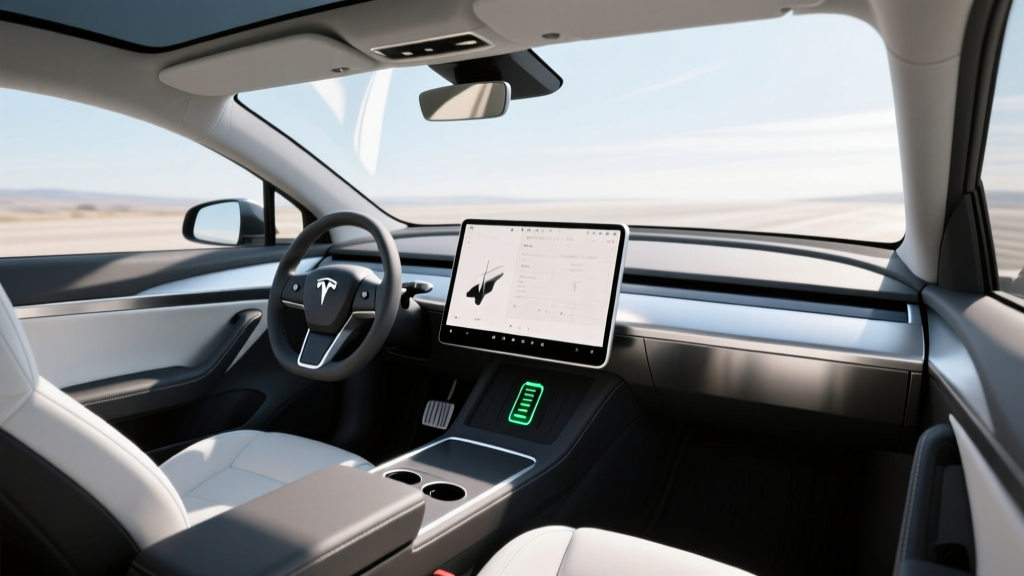
Tesla's minimalist interior centers on a 15.4-inch touchscreen (17-inch in Model S/X) running Tesla's proprietary OS. Strengths include over-the-air updates that add features post-purchase, integrated trip planning with Supercharger routing, and a robust app ecosystem. The absence of physical buttons for climate, mirrors, and glovebox frustrates some buyers — everything runs through the screen or voice commands.
Driver Assistance: Autopilot and FSD (Supervised)
Tesla's Autopilot (standard) and Full Self-Driving Supervised ($8,000 option or $99/mo subscription) are SAE Level 2 driver-assistance systems. The driver must remain fully attentive, keep hands available, and be prepared to take over at any moment. FSD Supervised handles more complex scenarios (city streets, stop signs, lane changes) but still requires constant supervision. This is not Level 4 autonomy like Waymo's driverless robotaxis. Overreliance on Level 2 systems has contributed to NHTSA-investigated crashes — always drive attentively.
Warranty Coverage
- Basic Vehicle: 4 years / 50,000 miles
- Battery & Drive Unit: 8 years / 100,000 miles (Model 3 RWD); 8 years / 120,000 miles (Long Range, Performance, Model S/X)
- Battery Capacity Guarantee: Tesla warrants minimum 70% retention over the warranty period. In practice, Tesla's battery degradation data shows most packs retain ~90% capacity at 100,000 miles — among the best in the industry.
Pros, Cons, and Who Should Buy a Tesla in 2026
Pros
- Class-leading Supercharger network (20,000+ stalls in North America)
- Industry-best energy efficiency (low kWh/100mi = lower charging cost)
- Over-the-air updates continuously improve the vehicle
- Strong resale value relative to most EV competitors
- Model Y offers best-in-class cargo/passenger practicality for its footprint
- Heat pump standard on all trims (better cold-weather range retention)
Cons
- No physical buttons — screen-dependent controls frustrate some drivers
- Build quality inconsistency (panel gaps, paint) improving but still lags legacy luxury brands
- FSD Supervised remains a Level 2 system despite its name and $8,000 price tag
- LFP battery trims face uncertain §30D tax-credit eligibility due to sourcing rules
- Insurance costs are above average for the class (Tesla-specific repair costs)
- Service center availability varies by region — mobile service helps but can't cover everything
Best For
- Commuters: Model 3 RWD or Model Y RWD — low running costs, home charging convenience.
- Families: Model Y Long Range AWD — space, range, and safety ratings make it the default family EV.
- Road trippers: Any Long Range trim — Supercharger network makes cross-country travel genuinely practical.
- Performance seekers: Model S Plaid or Model 3 Performance — supercar acceleration at a fraction of the price.
Look Elsewhere If
- You want physical buttons and a traditional interior layout (consider Hyundai Ioniq 5 or BMW i4).
- You need a truck bed (look at Ford F-150 Lightning or Rivian R1T).
- You want guaranteed §30D eligibility without sourcing uncertainty (check the Hyundai Ioniq 5 or Chevy Equinox EV).
Frequently Asked Questions
Is there a car called the Tesla Nikola?
No. Tesla and Nikola are separate companies. Tesla makes consumer EVs (Model 3, Y, S, X, Cybertruck). Nikola Corporation makes commercial hydrogen and battery-electric semi-trucks. Both are named after inventor Nikola Tesla, but they have no corporate connection.
What is the real-world range of a 2026 Tesla Model 3?
The EPA rates the Model 3 Long Range AWD at 363 miles. In real-world highway driving at 75 mph, expect roughly 310–325 miles. In freezing temperatures, plan for 250–290 miles. The Model 3 RWD (LFP battery) is rated at 272 miles EPA, with similar proportional real-world reductions.
How fast does a Tesla charge at home and on the road?
On DC fast charging (Tesla V3 Supercharger), a Model 3 or Model Y charges at up to 250 kW peak, reaching 10–80% in approximately 25–30 minutes. At home on a Level 2 Wall Connector (11.5 kW / 48A), you'll add about 44 miles of range per hour, fully recharging overnight.
Does the Tesla Model 3 or Model Y qualify for the $7,500 federal tax credit?
Potentially — but eligibility depends on the specific trim's battery sourcing, your income (AGI caps apply), and the vehicle's MSRP (under $55,000 for sedans, $80,000 for SUVs). The Model Y generally qualifies across trims. The Model 3's LFP battery trims have faced sourcing-related eligibility questions. Always verify on fueleconomy.gov and consult a tax professional before relying on the credit.
Is a Tesla worth buying over competitors like the Hyundai Ioniq 5 or Ford Mustang Mach-E?
Tesla's advantages are the Supercharger network, efficiency, and software ecosystem. The Ioniq 5 offers faster 800V charging architecture (10–80% in ~18 min at a 350 kW charger), a more conventional interior with physical buttons, and clearer tax-credit eligibility. The Mach-E offers strong driving dynamics. If Supercharger access and software integration are your priorities, Tesla wins. If interior ergonomics, charging speed on non-Tesla networks, or guaranteed credit eligibility matter more, test-drive the competition.
How long do Tesla batteries last?
Tesla warrants its batteries for 8 years / 100,000–120,000 miles (depending on trim), guaranteeing at least 70% capacity retention. Tesla's own impact report shows average degradation of roughly 10% at 100,000 miles across its fleet, with the degradation curve flattening significantly after the first 20,000–30,000 miles. Many Tesla batteries are projected to outlast 200,000 miles before reaching the 70% threshold. Replacement cost, if needed out of warranty, ranges from $12,000–$20,000 depending on the model.
What does FSD (Full Self-Driving) actually do?
FSD Supervised is a Level 2 driver-assist system that adds automatic lane changes, traffic light and stop sign recognition, and city-street navigation to the standard Autopilot package. Despite its name, it does not make the car self-driving. The driver must monitor the road at all times and be ready to intervene immediately. It costs $8,000 upfront or $99/month as a subscription. Whether it's worth the premium depends on your commute complexity and tolerance for supervision requirements.