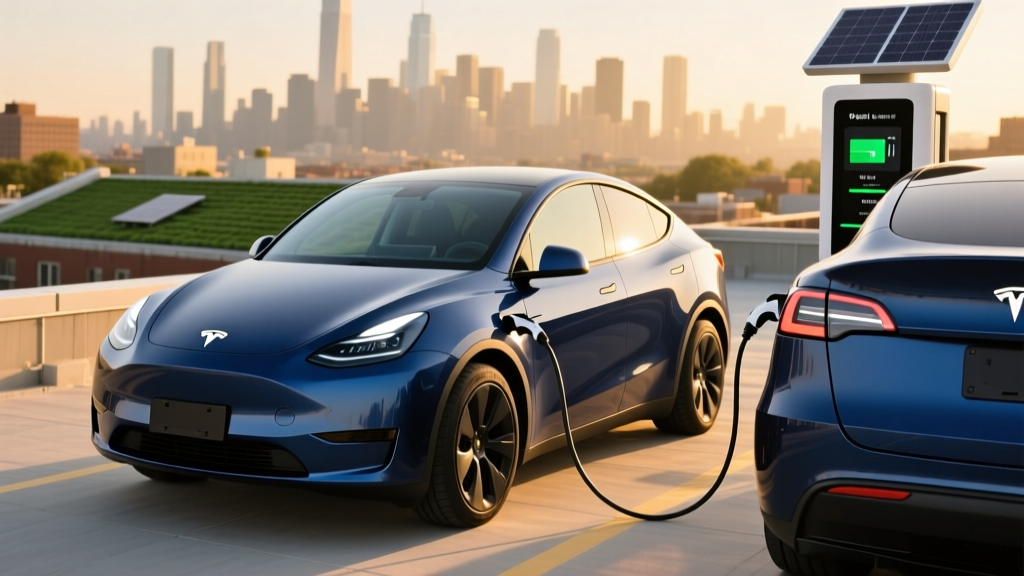
Tesla doesn't win on build quality awards or interior luxury rankings. What it does win on — consistently, stubbornly, and with compounding advantage — is a tightly integrated stack of engineering competencies that no legacy automaker has fully replicated. In 2026, those Tesla motors core competencies are best understood not through press releases but through the vehicle that sells more units globally than any other EV: the Tesla Model Y Long Range AWD.
This review uses the current 2026 Model Y (Juniper refresh) as a lens to dissect what Tesla actually does better than the competition — and where the gaps are narrowing or have closed entirely. We'll cover range, charging, efficiency, software, manufacturing, and ownership economics with the exact numbers buyers need.
2026 Tesla Model Y Long Range: The Spec Sheet That Defines Tesla's Edge
| Attribute | 2026 Model Y Long Range AWD |
|---|---|
| EPA Range | 320 miles |
| Real-World Range (highway, 70 mph) | ~270–290 miles |
| Real-World Range (cold, 20°F) | ~230–260 miles |
| Battery Capacity | ~78 kWh usable (NMC chemistry) |
| Efficiency | 122 MPGe combined / 27 kWh/100 mi |
| Peak DC Fast Charge | 250 kW |
| 10–80% DC Fast Charge | ~24 minutes |
| Level 2 Home Charge Rate | 11.5 kW (~44 mi/hr) |
| 0–60 mph | 4.8 seconds |
| Horsepower | 384 hp (dual motor) |
| Drivetrain | Dual-motor AWD |
| Cargo Volume | 76.2 cu ft (rear seats folded) |
| Rear Legroom | 41.6 inches |
| Battery Warranty | 8 years / 120,000 miles (70% retention) |
| Base MSRP | $48,990 |
What Are Tesla Motors' Actual Core Competencies?
The phrase "core competencies" gets thrown around in investor decks and auto-media think pieces. Let's define what's real and measurable in 2026, using the Model Y as evidence.
1. Powertrain and Thermal Efficiency
Tesla's permanent-magnet reluctance motor design, silicon-carbide inverter, and integrated heat pump deliver class-leading efficiency. At 27 kWh per 100 miles, the Model Y Long Range uses less energy per mile than the Hyundai Ioniq 5 (29 kWh/100 mi) and the Ford Mustang Mach-E (31 kWh/100 mi) in equivalent AWD configurations. That efficiency gap compounds: over 15,000 annual miles, the Model Y uses roughly 300–600 fewer kWh, saving $45–$90 per year at average US electricity rates. Over a decade, that's real money — and it also means you need fewer kWh of battery for the same EPA range, reducing vehicle weight and cost.
2. Supercharger Network Integration
Tesla's Supercharger network remains the most reliable DC fast-charging ecosystem in North America. While CCS networks like Electrify America and EVgo have improved, fueleconomy.gov and third-party reliability surveys consistently show Tesla Superchargers with 97%+ uptime versus 70–85% for many CCS providers. The Model Y's native NACS connector means no adapter is needed at any of the 30,000+ Supercharger stalls in North America. This isn't just a charging spec — it's an infrastructure moat.
3. Software-Defined Vehicle Architecture
Over-the-air updates on a Tesla aren't just infotainment patches. Tesla routinely updates battery management algorithms, regenerative braking profiles, heat pump logic, and Autopilot perception models. A 2024 Model Y that received the 2025.44 software update gained measurable improvements in cold-weather range estimation accuracy and Supercharger preconditioning timing. No legacy OEM pushes powertrain-level OTA updates at this cadence.
4. Vertical Integration and Manufacturing Cost
Tesla's gigacastings (single-piece rear and front underbody castings) reduce part count by hundreds of components versus stamped-and-welded body structures. This translates to lower manufacturing cost, which funds aggressive pricing. The Model Y at $48,990 undercuts comparably equipped rivals by $5,000–$12,000 while maintaining margins that legacy automakers have struggled to match on their EV programs.
Charging: Where Tesla's Ecosystem Advantage Lives
| Charging Level | Power | Miles Added per Hour | Typical Use Case |
|---|---|---|---|
| Level 1 (120V outlet) | ~1.4 kW | ~4 mi/hr | Emergency / trickle |
| Level 2 (240V, 48A Wall Connector) | 11.5 kW | ~44 mi/hr | Daily home charging |
| DC Fast (Supercharger V3) | 250 kW peak | ~180 mi in 15 min | Road trips |
| DC Fast (Supercharger V4) | 250 kW (current Y cap) | ~180 mi in 15 min | Future-capable stalls |
The Model Y's charge curve peaks at 250 kW from roughly 10–30% SoC, then tapers progressively: ~175 kW through 50%, ~110 kW at 70%, and ~50 kW above 85%. The published 10–80% time of ~24 minutes is accurate under optimal conditions (battery preconditioned via navigation to a Supercharger). Without preconditioning — say, pulling into a charger with a cold battery — that time can stretch to 30–35 minutes. Always navigate to your Supercharger stop using the car's built-in routing; it triggers battery preconditioning automatically.
Home charging with the Tesla Wall Connector on a 60A circuit delivers 11.5 kW, adding roughly 44 miles of range per hour. A full charge from 10% takes about 7 hours — plug in at night, wake up full. Installation typically runs $800–$2,000 depending on panel proximity and whether a 200A service upgrade is needed.
Performance, Interior, and Tech: The Honest Assessment
The dual-motor AWD Model Y hits 60 mph in 4.8 seconds — quick enough for any real-world merge or pass, but not the 3.5-second territory of the Performance variant. Ride quality has improved with the Juniper refresh: revised damper tuning and acoustic glass reduce highway noise noticeably versus the 2024 model. The cabin is minimal by design — a 15.4-inch touchscreen handles everything from climate to glovebox release. Some buyers love this; others find it distracting.
Cargo capacity at 76.2 cubic feet (rear seats folded) beats the Ioniq 5 (59.3 cu ft) and matches the Mach-E (59.7 cu ft with the frunk combined). The Model Y's frunk adds 4.1 cu ft of secure storage. Rear legroom of 41.6 inches is generous for a crossover in this class.
On the tech front, Tesla's infotainment remains the fastest and most responsive in the EV segment. Wireless Apple CarPlay and Android Auto are still not supported — Tesla insists on its native interface. Autopilot (standard) handles highway lane centering and adaptive cruise well; Full Self-Driving (Supervised), a $8,000 add-on, is an SAE Level 2 system that requires constant driver attention. It is not autonomous driving.
Pricing, Trims, and Federal Tax Credit Eligibility
| Trim | MSRP | Est. After §30D Credit | Notes |
|---|---|---|---|
| Long Range AWD | $48,990 | $41,490* | Eligible for up to $7,500 if sourcing rules met |
| Performance AWD | $54,990 | $47,490* | Same credit eligibility |
| RWD (Standard Range) | $44,990 | $37,490* | LFP battery; lower range |
*Tax credit caveats: The IRS §30D credit is not automatic. Eligibility requires:
- Buyer income caps: AGI ≤ $150,000 (single) / $300,000 (joint) / $225,000 (head of household)
- MSRP cap: Vehicle MSRP must not exceed $80,000 (SUVs/vans — Model Y qualifies as SUV)
- Battery sourcing: Increasing percentages of critical minerals and battery components must be sourced from the US or FTA partners — this requirement tightens annually and can disqualify otherwise eligible vehicles mid-year
- Point-of-sale transfer: As of 2024+, the credit can be transferred to the dealer at purchase, reducing the purchase price directly
- VIN verification: Confirm eligibility at fueleconomy.gov before purchasing — battery sourcing compliance changes frequently
As of early 2026, the Model Y Long Range qualifies for the full $7,500 credit for most buyers, but Tesla's battery sourcing compliance should be verified at the time of purchase. Rules shift, sometimes mid-year.
How the Model Y Stacks Up Against Key Rivals
| Spec | 2026 Tesla Model Y LR | 2026 Hyundai Ioniq 5 Limited AWD | 2026 Ford Mach-E Premium AWD |
|---|---|---|---|
| EPA Range | 320 mi | 290 mi | 300 mi |
| Battery (usable) | 78 kWh (NMC) | 77.4 kWh (NMC) | 91 kWh (NMC) |
| Peak DC Charge | 250 kW | 240 kW | 150 kW |
| 10–80% Time | ~24 min | ~18 min | ~38 min |
| Efficiency | 27 kWh/100mi | 29 kWh/100mi | 31 kWh/100mi |
| 0–60 mph | 4.8 sec | 5.1 sec | 5.0 sec |
| Cargo (max) | 76.2 cu ft | 59.3 cu ft | 59.7 cu ft |
| Base MSRP | $48,990 | $52,500 | $50,995 |
| NACS Native? | Yes | Yes (2025+) | Yes (2025+) |
The Ioniq 5 charges faster (18 minutes 10–80% on a 350 kW charger thanks to its 800V architecture) and offers a more conventional interior with physical climate controls. The Mach-E has the largest battery but the slowest charging. The Model Y wins on efficiency, cargo space, Supercharger access reliability, and price — but not on every axis.
Pros
- Best-in-class efficiency (27 kWh/100 mi)
- Supercharger network reliability (97%+ uptime)
- Class-leading cargo volume (76.2 cu ft)
- Continuous OTA improvements to powertrain and safety
- Strong resale value relative to EV peers
- Competitive pricing after tax credit
Cons
- No wireless Apple CarPlay / Android Auto
- Minimalist interior polarizes buyers
- DC charge speed (250 kW) lags Ioniq 5's 800V architecture
- Panel gaps and paint quality still inconsistent
- FSD (Supervised) remains expensive and Level 2 only
- Service center wait times in some markets
Who Should Buy the 2026 Model Y — And Who Shouldn't
- You road-trip frequently and want the most reliable DC charging network
- You need maximum cargo space in a mid-size electric crossover
- You value efficiency (lower charging costs over ownership)
- You want OTA updates that meaningfully improve the vehicle over time
- Your household has a 240V circuit available for Level 2 home charging
- You demand physical buttons and a conventional dashboard layout (try Ioniq 5 or Mach-E)
- You want the absolute fastest DC charging available (Ioniq 5 / Kia EV6 at 800V)
- You need three rows of seating (consider the Kia EV9 or wait for refreshed Model X pricing)
- You prefer a dealership service experience with loaner cars
Warranty and Long-Term Battery Outlook
Tesla covers the Model Y battery and drive units for 8 years or 120,000 miles, whichever comes first, with a guaranteed minimum 70% capacity retention. This is competitive with Hyundai's 10-year/100,000-mile battery warranty and Ford's 8-year/100,000-mile coverage. Real-world data from high-mileage Tesla owners and fleet operators shows NMC batteries in the Model Y typically retaining 88–92% capacity at 100,000 miles when charged primarily on Level 2 and kept between 20–80% SoC for daily use. Tesla's battery management system is conservative — it buffers the top and bottom of the pack, which aids longevity but slightly reduces usable capacity.
For buyers concerned about out-of-warranty battery replacement, current estimates for a Model Y pack replacement range from $12,000–$16,000 at Tesla service centers, though third-party refurbishment options are emerging at lower cost. This is a consideration for second owners or those planning to keep the vehicle past 150,000 miles.
Frequently Asked Questions
What is the real-world range of the 2026 Tesla Model Y?
The EPA rates it at 320 miles. In real-world mixed driving (highway and suburban), expect 285–295 miles. In cold weather below 30°F, plan for 230–260 miles. These numbers assume moderate climate use and no extreme terrain.
How fast does the Model Y charge at home and on the road?
On a Tesla Wall Connector (Level 2, 11.5 kW), you gain about 44 miles of range per hour — a full overnight charge is routine. On a V3 Supercharger (250 kW DC), the 10–80% charge takes about 24 minutes with battery preconditioning active. Without preconditioning, add 6–10 minutes.
Does the 2026 Model Y qualify for the $7,500 federal EV tax credit?
It can, but eligibility depends on your income (≤$300K joint / ≤$150K single), the vehicle's MSRP (under $80K — the Model Y qualifies as an SUV), and Tesla's current battery-sourcing compliance with IRS §30D rules. Always verify on fueleconomy.gov before purchasing, as sourcing requirements tighten annually.
Is the Model Y worth buying versus the Ioniq 5 or Mach-E?
If Supercharger reliability, cargo space, and efficiency are your top priorities, yes. If you prefer faster DC charging (Ioniq 5), a more traditional interior with physical controls, or a larger battery for less efficiency penalty (Mach-E), those are valid alternatives. Test-drive all three.
Is Tesla Autopilot or FSD actually self-driving?
No. Both are SAE Level 2 driver-assist systems. You must keep your hands on the wheel and eyes on the road at all times. FSD (Supervised) handles more complex scenarios like city intersections, but it is not autonomous — the driver remains legally and practically responsible.
What are the biggest drawbacks of owning a Model Y?
No Apple CarPlay or Android Auto, a polarizing minimalist interior, occasional panel-gap inconsistencies, and service center wait times that can stretch to several weeks in underserved markets. The 250 kW peak charge rate, while adequate, is no longer class-leading.
The Tesla Model Y in 2026 isn't the most luxurious, the fastest-charging, or the most conventionally styled electric crossover. But it remains the vehicle that best demonstrates what Tesla's core competencies — powertrain efficiency, charging infrastructure, software iteration, and manufacturing cost — actually produce for a buyer. For the majority of EV shoppers who want a practical, efficient, well-supported electric family vehicle, it's still the benchmark to beat. Just go in with eyes open about what it isn't.