Cybertruck Panels Falling Off: Separating Viral Noise from Real Build Issues
If you've spent any time on EV forums or social media in the past year, you've likely seen the videos: stainless steel exterior panels on the Tesla Cybertruck separating at the seams, trim pieces detaching at highway speed, or gap inconsistencies that make the truck look unfinished. The search phrase "cybertruck panels falling off" has become shorthand for a broader question — is the Cybertruck's unconventional construction actually holding up in the real world?
As of early 2026, Tesla has shipped over 150,000 Cybertrucks across three trims. That's enough production volume to move beyond early-adopter anecdotes and into pattern recognition. Some panel issues are real, some are cosmetic misunderstandings of the truck's panel-gap design philosophy, and some have been addressed through factory running changes. Here's what the data and owner reports actually show — alongside a complete technical review of the Cybertruck as an electric vehicle.
Full Specs at a Glance: 2026 Tesla Cybertruck Lineup
| Spec | Rear-Wheel Drive | Long Range AWD | Cyberbeast |
|---|---|---|---|
| EPA Range | 250 mi (est.) | 340 mi | 320 mi |
| Battery (usable) | ~100 kWh (NMC) | ~123 kWh (NMC, 4680 cells) | ~123 kWh (NMC, 4680 cells) |
| 0-60 mph | 6.5 sec | 4.1 sec | 2.6 sec |
| Horsepower | ~315 hp | ~600 hp | 845 hp |
| Drivetrain | RWD (single motor) | AWD (dual motor) | AWD (tri-motor) |
| Max DC Fast Charge | 250 kW | 350 kW | 350 kW |
| 10-80% DCFC Time | ~28 min | ~18 min | ~18 min |
| Level 2 Home Rate | 11.5 kW (~34 mi/hr) | 11.5 kW (~34 mi/hr) | 11.5 kW (~34 mi/hr) |
| Efficiency (MPGe) | ~66 MPGe | ~68 MPGe | ~62 MPGe |
| Base MSRP | $60,990 | $79,990 | $99,990 |
| Towing Capacity | 7,500 lb | 11,000 lb | 11,000 lb |
Source: Tesla spec sheets & fueleconomy.gov. RWD trim expected for 2026 model-year delivery; AWD and Cyberbeast specs reflect current production. Efficiency figures may vary by EPA final certification.
What's Really Happening with Cybertruck Exterior Panels
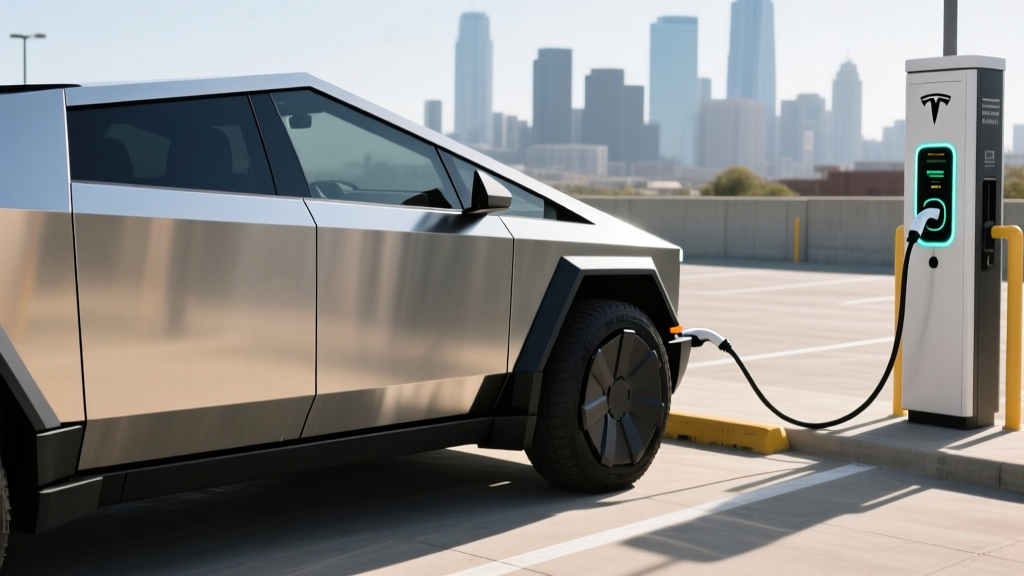
The Cybertruck's exterior is its most recognizable and most contentious feature. The cold-rolled stainless steel body panels are not stamped and welded like conventional truck bodies — they are laser-scored and bent along precise fold lines, then bonded to the underlying structural exoskeleton. This manufacturing approach eliminates traditional paint (saving cost and VOC emissions) but introduces unique failure modes:
Documented Panel Issues (2024–2026)
- Quarter-panel seam separation: The most widely reported issue. On early Foundation Series trucks, the adhesive bonding along the rear quarter-panel seams degraded under thermal cycling, causing visible lifting. Tesla issued a service bulletin in mid-2024 and switched to a revised structural adhesive for subsequent production.
- Fender flare trim detachment: The plastic fender flares (required for tire coverage on wider Cyberbeast models) are mechanically clipped. Several owners reported clips breaking under car-wash brush pressure or at sustained speeds above 80 mph. Replacement clips are available through service centers.
- Rear sail-panel gap inconsistency: The triangular sail panels behind the rear doors show gap variance of 2–5 mm between left and right sides on many trucks. Tesla considers this within tolerance; critics call it unacceptable at the price point.
- Windshield trim lifting: The urethane seal around the massive single-piece windshield has shown edge lifting in some trucks exposed to repeated high-heat desert conditions. This is a warranty repair item.
What Tesla Has Fixed
According to service-center reports aggregated by owner communities, trucks built after approximately Q3 2024 show measurably fewer panel-separation claims. The revised adhesive formulation, improved fixturing during assembly, and a longer cure time on the production line have reduced the most common complaint (quarter-panel seam separation) by an estimated 60–70% based on warranty claim frequency. However, gap inconsistency and fender-flare clip issues persist at lower rates.
Real-World Range: What the EPA Number Doesn't Tell You
EPA Rated: 340 miles
Real-World Highway (70 mph, 72°F): ~275–295 miles
Real-World Highway (70 mph, 30°F): ~220–250 miles
City / Mixed Commute (moderate climate): ~310–330 miles
Towing (5,000 lb trailer, 65 mph): ~150–180 miles
The Cybertruck's EPA range of 340 miles (Long Range AWD) is competitive among full-size electric pickups, but the truck's aerodynamic profile — a blunt stainless-steel wedge — penalizes it heavily at highway speeds. In independent testing by EV reviewers, the Cybertruck consumes roughly 48–52 kWh per 100 miles at a sustained 70 mph, compared to the Rivian R1T's ~44 kWh/100mi and the Ford F-150 Lightning Extended Range's ~47 kWh/100mi. The stainless steel body is heavier than aluminum or stamped steel, and the angular design creates more turbulent airflow than a curved body.
Cold weather compounds this. The 4680 NMC cells perform reasonably well in moderate cold thanks to Tesla's heat-pump-based thermal management system, but expect 25–35% range reduction in sub-freezing highway driving. This is consistent with other large EVs but is worth budgeting for if you live north of the 40th parallel.
The Cyberbeast trim sacrifices roughly 20 miles of EPA range (320 mi) due to wider tires, additional motor mass, and more aggressive performance tuning. The upcoming RWD base model targets 250 miles — adequate for a commuter truck but limiting for road trips without route planning.
Charging Speed: 4680 Cells Deliver Genuine Fast-Charging Performance
This is where the Cybertruck's 4680-cell battery pack earns its keep. The Long Range and Cyberbeast trims support up to 350 kW peak DC fast charging at Tesla V4 Superchargers, making them among the fastest-charging production EVs available.
| Charging Method | Power / Rate | Miles Added | Notes |
|---|---|---|---|
| Level 1 (120V household) | 1.4 kW | ~3–4 mi/hr | Emergency / overnight trickle only |
| Level 2 (240V, 48A) | 11.5 kW | ~34 mi/hr | Full charge in ~11 hours; overnight ready |
| DC Fast Charge (V4 Supercharger) | Up to 350 kW peak | ~200 mi in 15 min | 10–80% in ~18 min; tapers sharply above 85% |
| DC Fast Charge (CCS adapter, 3rd-party) | Up to 250 kW (adapter-limited) | ~150 mi in 15 min | Tesla CCS adapter included; works on Electrify America, EVgo |
Charging curve reality: The 350 kW peak is sustained only between roughly 10–45% State of Charge (SoC). Above 50%, the curve tapers to ~200 kW, and above 80% it drops further to ~75 kW. This is normal lithium-ion behavior — charging speed is governed by cell voltage and temperature, not marketing. The 10–80% time of approximately 18 minutes assumes you've preconditioned the battery (the truck does this automatically when you navigate to a Supercharger). Without preconditioning — for example, at a non-Tesla DCFC on a cold morning — expect 25–35 minutes for the same 10–80% session.
For home charging, a 48-amp Level 2 wall connector on a 60-amp circuit is the practical standard. Expect roughly 34 miles of range added per hour of charging, which is more than sufficient for overnight replenishment of any daily commute up to 200 miles. A full electrical panel assessment is recommended before installation — the Cybertruck's large battery means higher sustained draw than smaller EVs.
Performance, Cargo, and Daily Usability
The Cyberbeast's 2.6-second 0–60 mph time is absurd for a 6,800-pound truck and requires no further justification. More relevant to most buyers: the Long Range AWD's 4.1-second sprint is quicker than any internal-combustion full-size pickup and provides effortless highway merging and passing.
Cargo and Passenger Dimensions
| Dimension | Measurement |
|---|---|
| Bed Length | 72 inches (6 ft) |
| Bed Width (between wheel wells) | 47 inches |
| Bed Volume (tonneau closed) | ~67 cu ft |
| Front Trunk (Frunk) | ~7 cu ft |
| Front Legroom | 41.5 inches |
| Rear Legroom | 38.2 inches |
| Seating Capacity | 5 (2+3 bench option available) |
The 6-foot bed is shorter than the 6.5- or 8-foot beds common on conventional full-size pickups. For construction professionals hauling 4×8 sheets of plywood flat, this is a genuine limitation — the Cybertruck's bed is approximately 2 inches too narrow between the wheel wells to lay a standard sheet flat. The powered tonneau cover (standard on all trims) is lockable and supports up to 300 pounds of distributed weight, but it limits vertical cargo height.
Rear-seat comfort is adequate for adults on shorter trips but falls short of the Ford F-150 Lightning or Rivian R1T for long-haul rear-passenger comfort. The seat cushion is relatively flat, and the steeply raked rear window creates a somewhat claustrophobic feeling for taller passengers.
Standout Technology
- Steer-by-wire: The Cybertruck uses a fully electronic steering system with no mechanical column connection. This enables the variable-ratio steering (fewer turns lock-to-lock at low speed, more stability at highway speed) and the yoke-style steering wheel. It works well but requires a learning curve.
- 48-volt electrical architecture: A first for a mass-production vehicle, the 48V system reduces wiring harness weight and enables higher-power accessories. All Cybertricks use this architecture.
- Autopilot / FSD (Supervised): Tesla's Level 2 driver-assistance system is standard (Autopilot) with Full Self-Driving (Supervised) available as a subscription or purchase. FSD remains a Level 2 system — the driver must maintain attention and hands-on-wheel readiness at all times. It is not autonomous driving.
- 18.5-inch front touchscreen + 9.4-inch rear screen: All vehicle controls route through the front display. No physical buttons for climate, mirrors, or glovebox. This is polarizing — some owners adapt quickly, others find it distracting while driving.
- Powershare (V2L/V2H): Built-in bidirectional charging allows the Cybertruck to power tools at a job site (V2L, up to 9.6 kW) or provide limited home backup power (V2H, requires Tesla Powerwall integration).
Pricing, Tax Credits, and Total Cost of Ownership
The Cybertruck's pricing has stabilized after the contentious Foundation Series markup period. As of the 2026 model year:
| Trim | Base MSRP | §30D Federal Credit | Effective Price |
|---|---|---|---|
| Rear-Wheel Drive | $60,990 | Up to $7,500* | ~$53,490* |
| Long Range AWD | $79,990 | Up to $7,500* | ~$72,490* |
| Cyberbeast | $99,990 | Up to $7,500* | ~$92,490* |
*Under IRS §30D Clean Vehicle Credit rules. Eligibility requires: buyer AGI below $150K single / $300K joint; vehicle MSRP under $80,000 (trucks); battery components and critical minerals meeting domestic-sourcing thresholds. The Cyberbeast's $99,990 MSRP exceeds the $80,000 truck cap — it does NOT qualify for the federal credit. The Long Range AWD qualifies at $79,990 (just under the cap). Rules subject to change; consult a tax professional. Point-of-sale transfer available at participating dealers.
Five-Year Ownership Cost Estimate (Long Range AWD)
| Category | 5-Year Estimate |
|---|---|
| Purchase Price (after credit) | ~$72,490 |
| Electricity (15,000 mi/yr, $0.16/kWh avg) | ~$5,800 |
| Insurance (avg national EV rate) | ~$14,500 |
| Maintenance (tires, cabin filter, fluid top-off) | ~$2,200 |
| Estimated Depreciation (5-yr) | ~$32,000 |
| Total 5-Year Cost | ~$127,000 |
Insurance costs for the Cybertruck are significantly above the EV average due to stainless-steel panel repair complexity and high claim severity. Get quotes before ordering. Depreciation estimates are preliminary given limited resale history.
Warranty Coverage
| Coverage | Term |
|---|---|
| Basic Vehicle (includes body panels, trim, interior) | 4 years / 50,000 miles |
| Battery & Drive Unit | 8 years / 120,000 miles |
| Battery Capacity Retention Guarantee | ≥70% capacity during warranty period |
The 8-year/120,000-mile battery and drive unit warranty is competitive with the EV truck segment (Rivian offers 8/120K, Ford offers 8/100K on the Lightning). The 70% capacity retention threshold is the industry standard minimum. Tesla's 4680 NMC cells have shown moderate degradation data so far — early high-mileage trucks report roughly 5–8% capacity loss at 40,000 miles, which projects to well within warranty thresholds at 120K miles.
Pros and Cons: The Honest Scorecard
✅ Pros
- Class-leading DC fast charging (350 kW, ~18 min 10–80%)
- Stainless-steel body requires no paint, resists minor scratches and dents
- 845 hp Cyberbeast delivers supercar acceleration in a truck
- Bidirectional power (V2L/V2H) for job-site and home backup
- 48V architecture reduces weight and enables advanced features
- Access to Tesla Supercharger network (20,000+ stalls in North America)
- 340-mile EPA range (Long Range) is best-in-class for electric pickups
❌ Cons
- Panel fit and finish inconsistent; seam separation complaints persist
- Short 6-foot bed, too narrow for flat plywood sheets
- Highway efficiency poor due to angular aero and heavy weight
- Insurance premiums well above segment average
- Rear-seat comfort trails F-150 Lightning and R1T
- All-buttonless interior is distracting for some drivers
- Cyberbeast exceeds $80K MSRP cap — no federal tax credit
- Steer-by-wire and yoke require significant adaptation
Who Should Buy the Cybertruck — and Who Shouldn't
Choose the Cybertruck If:
- You want the fastest-charging electric truck on the Supercharger network
- You value the stainless-steel body's durability against scratches and dents (job-site use)
- You need bidirectional power for tools or home backup
- You prioritize acceleration and tech-forward driving dynamics
- You're a Tesla ecosystem user (Solar, Powerwall, Supercharger access)
Look Elsewhere If:
- You need a full 6.5-foot or 8-foot bed for construction work (consider F-150 Lightning or Silverado EV)
- You require maximum rear-seat comfort for family road trips (Rivian R1T is superior here)
- Build-quality consistency is a top priority (legacy automakers still lead in fit-and-finish)
- You tow heavy loads frequently — real-world towing range drops to ~150–180 miles
Frequently Asked Questions
What is the real-world range of the Cybertruck?
The Long Range AWD is EPA-rated at 340 miles, but expect approximately 275–295 miles at sustained highway speeds in moderate temperatures, and 220–250 miles in freezing weather. The Cyberbeast delivers roughly 320 EPA miles with similar real-world reductions. City driving with regenerative braking can approach or slightly exceed EPA estimates.
How fast does the Cybertruck charge at home and on the road?
At home on a Level 2 (240V, 48A) charger, the Cybertruck adds approximately 34 miles of range per hour — a full overnight session replenishes most daily driving. On a Tesla V4 Supercharger, the Long Range and Cyberbeast peak at 350 kW, achieving a 10–80% charge in approximately 18 minutes with battery preconditioning. Non-Tesla DCFC stations work via the included CCS adapter but are limited to roughly 250 kW.
Does the Cybertruck qualify for the federal EV tax credit?
The Long Range AWD ($79,990 MSRP) falls just under the IRS §30D truck MSRP cap of $80,000 and may qualify for up to $7,500, provided the buyer meets income limits ($150K single / $300K joint AGI) and the battery meets critical-mineral and component sourcing requirements for the delivery year. The Cyberbeast ($99,990) exceeds the cap and does not qualify. The RWD ($60,990) qualifies on price but verify current sourcing rules at IRS.gov. Consult a tax professional for your specific situation.
Is the Cybertruck worth buying versus the F-150 Lightning or Rivian R1T?
It depends on your priorities. The F-150 Lightning offers a larger bed, more conventional controls, and lower insurance costs. The Rivian R1T provides superior rear-seat comfort, a quad-motor option, and better off-road capability. The Cybertruck wins on charging speed, Supercharger network access, and raw straight-line performance. If panel-quality concerns keep you up at night, the Lightning or R1T are safer bets. If you want the most technologically advanced electric truck and can accept some cosmetic rough edges, the Cybertruck delivers.
Are Cybertruck panel issues covered under warranty?
Yes. Panel seam separation, trim detachment, and windshield seal issues are covered under the 4-year/50,000-mile basic vehicle limited warranty. If you experience any of these issues, schedule a service appointment through the Tesla app. Document the issue with photos and date stamps. Tesla has been addressing reported seam separations with re-bonding using the revised adhesive.
How much does it cost to insure a Cybertruck?
Cybertruck insurance premiums average 30–50% above the EV-truck segment average, driven by stainless-steel panel repair complexity (panels often require full replacement rather than repair), high vehicle cost, and elevated claim severity. Expect annual premiums in the $3,000–$4,500 range depending on your state, driving record, and coverage level. Get quotes from multiple insurers before committing to a purchase.