How Tesla's Electric Motors Actually Work
If you've ever wondered how a Tesla motor works, the answer starts with a fundamental difference from internal combustion: instead of controlled explosions pushing pistons, a Tesla uses electromagnetic force to spin a rotor that drives the wheels directly. There are no gears to shift (beyond a single-speed reduction gear), no spark plugs, and no exhaust. The result is instant torque from 0 RPM and an efficiency rate that converts roughly 90% of electrical energy into motion, compared to about 20-30% for a gasoline engine.
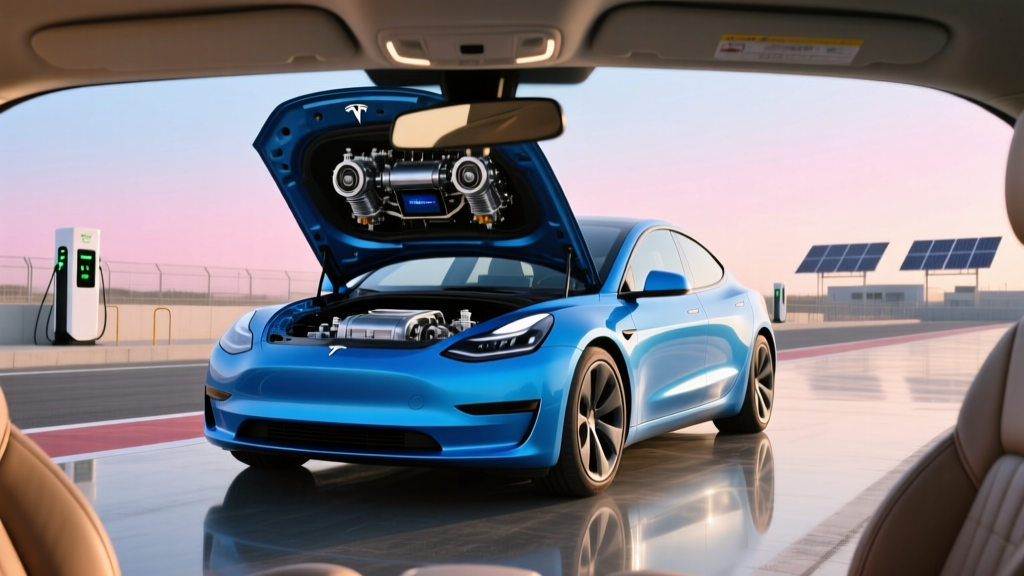
The 2026 Tesla Model 3 uses what's called a permanent magnet synchronous reluctance motor (PMSRM) on the rear axle. This design combines two motor principles in one unit: a permanent magnet rotor for high efficiency at cruising speeds, and reluctance torque (the tendency of a ferromagnetic rotor to align with the stator's magnetic field) for strong low-speed acceleration. The front motor in dual-motor variants is typically an induction motor, which can be completely de-energized when not needed, reducing drag and improving highway efficiency.
The inverter — a shoebox-sized unit bolted directly to the motor — converts the battery's DC current into precisely timed AC waveforms. Tesla's use of silicon carbide (SiC) MOSFETs in the inverter reduces switching losses, which is a key reason the Model 3 consistently tops EPA efficiency charts. The entire drive unit (motor + inverter + gearbox) weighs roughly 90 lbs and fits between the rear wheels.
2026 Tesla Model 3: Full Spec Breakdown
To ground the engineering in real purchase decisions, here's the complete spec profile for the current-generation Model 3 lineup.
| Spec | Long Range RWD | Long Range AWD | Performance |
|---|---|---|---|
| EPA Range | 363 mi | 346 mi | 330 mi |
| Battery (usable) | ~75 kWh (LFP) | ~75 kWh (NMC) | ~75 kWh (NMC) |
| Drivetrain | RWD (single motor) | Dual-motor AWD | Dual-motor AWD |
| Horsepower | 271 hp | 382 hp | 510 hp |
| 0-60 mph | 5.8 sec | 4.2 sec | 2.9 sec |
| Top Speed | 125 mph | 125 mph | 163 mph |
| MPGe (combined) | 132 MPGe | 121 MPGe | 113 MPGe |
| Efficiency | 25 kWh/100 mi | 28 kWh/100 mi | 30 kWh/100 mi |
| Max DC Fast Charge | 250 kW | 250 kW | 250 kW |
| 10-80% DCFC Time | ~25 min | ~25 min | ~25 min |
| Level 2 Home Charge | 11.5 kW (~44 mi/hr) | 11.5 kW (~44 mi/hr) | 11.5 kW (~44 mi/hr) |
| Cargo Volume | 23 cu ft (trunk + frunk) | 23 cu ft | 23 cu ft |
| Rear Legroom | 35.3 in | 35.3 in | 35.3 in |
| Base MSRP | $38,990 | $43,990 | $52,990 |
| Battery/Drive Unit Warranty | 8 yr / 120,000 mi | 8 yr / 120,000 mi | 8 yr / 120,000 mi |
Real-World Range: What the EPA Sticker Doesn't Tell You
- EPA sticker: 363 miles
- Highway driving (70-75 mph, 70°F): Expect ~290-310 miles
- City/suburban mixed: Expect ~340-360 miles (regen braking recovers energy)
- Cold weather (below 32°F, highway): Expect ~230-270 miles (15-30% loss depending on cabin heat usage and battery preconditioning)
- Worst-case scenario (cold + highway + no preconditioning): ~210-240 miles
The Model 3's heat pump (standard since 2021) significantly reduces cold-weather range loss compared to resistive heating systems in older EVs, but physics still applies — battery chemistry slows in the cold, and cabin heating draws energy regardless of the method.
The 363-mile EPA figure for the Long Range RWD is among the highest of any EV under $45,000, and in real-world mixed driving during moderate temperatures, most owners report achieving 90-98% of that figure. Highway efficiency drops because aerodynamic drag increases with the square of speed — at 75 mph, the Model 3 is pushing significantly more air than at 55 mph. The Long Range AWD's 346-mile rating reflects the added weight and mechanical drag of the front induction motor.
According to EPA data on fueleconomy.gov, the Long Range RWD achieves 132 MPGe combined, which translates to roughly 25 kWh per 100 miles — one of the most efficient sedans of any powertrain on the market.
Charging Speed: DC Fast, Level 2, and the Charge Curve Reality
| Charging Method | Max Power | Speed (miles added) | Typical Use Case |
|---|---|---|---|
| Level 1 (120V household) | ~1.4 kW | ~3-5 mi/hr | Emergency / overnight trickle |
| Level 2 (240V home, 48A) | 11.5 kW | ~44 mi/hr | Daily home charging |
| DC Fast Charge (Supercharger V3/V4) | 250 kW peak | ~180 mi in 15 min | Road trips |
The Model 3 can peak at 250 kW on a V3 or V4 Supercharger, but that peak only holds between roughly 10-20% State of Charge (SoC). By 50% SoC, the rate tapers to ~150 kW, and above 80%, it drops sharply to protect battery longevity. A 10-80% session takes approximately 25 minutes in ideal conditions (warm battery, V3+ station). In cold weather without preconditioning, expect 35-45 minutes for the same session.
Preconditioning matters. When you navigate to a Supercharger using the car's built-in nav, the Model 3 automatically warms the battery to optimal charging temperature before you arrive. Skipping this (for instance, by navigating with a phone app and plugging in at a non-Tesla station) can cut peak charge rates by 30-50% in cold conditions.
At home on a Level 2 wall connector (48-amp, 240V circuit), the Model 3 accepts up to 11.5 kW, adding roughly 44 miles of range per hour. A full overnight charge from 20% to 80% takes about 4 hours — more than enough for any daily commute.
Pricing, Tax Credits, and Total Cost
| Trim | MSRP | Federal §30D Credit | Effective Price |
|---|---|---|---|
| Long Range RWD | $38,990 | Up to $7,500 (if eligible) | ~$31,490 |
| Long Range AWD | $43,990 | Up to $7,500 (if eligible) | ~$36,490 |
| Performance | $52,990 | Up to $7,500 (if eligible) | ~$45,490 |
The IRS §30D federal EV tax credit offers up to $7,500, but eligibility is not automatic. Key requirements for 2026:
- MSRP cap: Sedans must be under $55,000. All Model 3 trims qualify.
- Income cap: Modified AGI must not exceed $150,000 (single), $225,000 (head of household), or $300,000 (joint).
- Battery sourcing: A percentage of critical minerals and battery components must be sourced from the U.S. or FTA partners. Tesla has progressively shifted supply chains, but exact credit amounts ($3,750 vs. $7,500) depend on current-year sourcing thresholds — check the fueleconomy.gov credit lookup for the specific VIN.
- Point-of-sale transfer: Since 2024, buyers can transfer the credit to the dealer for an immediate price reduction rather than waiting for tax filing.
Tax credit rules change frequently. Consult a tax professional and verify your specific vehicle's eligibility before purchase.
Technology, Driver Assistance, and Interior
The Model 3's interior remains minimalist by design — a 15.4-inch center touchscreen handles all vehicle controls, navigation, and media, with no physical instrument cluster. A rear 8-inch screen serves back-seat passengers. The 2024+ "Highland" refresh added ventilated front seats, ambient lighting, improved sound insulation, and a rear diffuser for better aerodynamics.
Autopilot (standard) includes adaptive cruise control, lane-keeping, and automatic emergency braking. Full Self-Driving (Supervised), a $8,000 option or $99/month subscription, adds automated lane changes, traffic light/stop sign recognition, and city-street navigation. Important clarity: both Autopilot and FSD are SAE Level 2 driver-assist systems. The driver must remain attentive, hands on the wheel (or providing torque input), and eyes on the road at all times. This is not autonomous driving — it is an advanced cruise-and-steering assist.
Tesla's over-the-air (OTA) update system is a genuine differentiator. The Model 3 receives firmware updates that have added features like battery preconditioning improvements, new UI options, and even performance boosts years after purchase — something legacy automakers are still working to match.
How the Model 3 Stacks Up Against Competitors
- Class-leading efficiency (25 kWh/100 mi on Long Range RWD)
- Access to the Supercharger network — the most reliable DC fast-charging network in North America
- Strong OTA update track record; vehicle improves over time
- 363-mile EPA range on Long Range RWD is top-tier for the price
- Low center of gravity and responsive handling from the skateboard platform
- No physical controls — everything through the touchscreen, including climate and mirror adjustments
- Rear seat legroom (35.3 in) is tighter than a Hyundai Ioniq 6 or BMW i4
- Panel gaps and paint quality have improved but still draw criticism vs. legacy luxury brands
- Repair costs and insurance premiums are above segment average
- FSD (Supervised) remains Level 2 despite the name — buyers expecting autonomy will be disappointed
Against the Hyundai Ioniq 6 (EPA 361 mi, $38,650), the Model 3 trades nearly identical range for a more mature charging network and stronger software ecosystem. The BMW i4 eDrive40 (EPA 301 mi, $52,200) offers a more premium interior but less range and higher cost. The Polestar 2 (EPA 320 mi, $49,900) is a compelling design alternative but trails on efficiency and charging speed. For pure value-per-mile-of-range, the Model 3 Long Range RWD remains the benchmark.
Who Should Buy the 2026 Model 3?
- Choose the Long Range RWD if: You commute 30-80 miles daily, want maximum range per dollar, and don't need AWD. This is the sweet-spot trim.
- Choose the Long Range AWD if: You live in a snowy climate, frequently drive mountain passes, or want the security of dual-motor traction. The 17-mile range penalty is modest.
- Choose the Performance if: You prioritize 2.9-second 0-60 acceleration and track-day capability. You'll sacrifice range and pay a premium, but few sedans at any price match this performance.
- Look elsewhere if: You need a large back seat for adult passengers, prefer physical buttons, or want a traditional luxury-badge experience.
The Model 3 works best for tech-forward commuters and small families who charge at home and take 2-4 road trips per year. With the Supercharger network and 363-mile range, range anxiety is manageable for the vast majority of American driving patterns. The car is less ideal for those who regularly carry four adults or who lack reliable home charging access.
Frequently Asked Questions
How does a Tesla motor differ from a traditional car engine?
A Tesla motor uses electromagnetic force to spin a rotor directly connected to the wheels through a single-speed reduction gear. There are no pistons, no combustion, no multi-speed transmission, and no exhaust system. The motor has roughly 20 moving parts compared to hundreds in an internal combustion engine, which is why EVs require far less mechanical maintenance — no oil changes, no timing belts, no spark plugs.
What is the real-world range of the 2026 Model 3?
The EPA rates the Long Range RWD at 363 miles. In real-world highway driving at 70-75 mph in moderate temperatures, expect 290-310 miles. In city driving with regenerative braking, expect 340-360 miles. In cold weather below freezing, expect 230-270 miles on the highway, depending on preconditioning and cabin heat usage.
How fast does the Model 3 charge at home and on road trips?
At home on a Level 2 (240V, 48A) charger, the Model 3 charges at up to 11.5 kW, adding roughly 44 miles of range per hour — a full overnight session covers any daily commute. On a Supercharger (DC fast charge), it peaks at 250 kW and can add ~180 miles in 15 minutes, with a 10-80% session taking about 25 minutes under ideal conditions.
Does the 2026 Model 3 qualify for the $7,500 federal tax credit?
It can, but eligibility depends on your income (under $150K single / $300K joint), the vehicle's MSRP (all trims are under the $55K sedan cap), and battery-sourcing requirements that change yearly. Some Model 3 configurations may qualify for the full $7,500, while others may qualify for $3,750 or nothing, depending on critical-mineral sourcing thresholds. Verify your specific vehicle on fueleconomy.gov and consult a tax professional.
Is the Model 3 worth buying over the Hyundai Ioniq 6 or BMW i4?
The Model 3 Long Range RWD wins on efficiency (132 MPGe vs. Ioniq 6's 140 MPGe but with less range), Supercharger network access, and OTA software updates. The Ioniq 6 offers a more spacious rear seat and physical buttons. The BMW i4 delivers a more premium cabin and traditional dealership service experience. If charging network reliability and software are your priorities, the Model 3 is the strongest pick. If interior space or physical controls matter more, test-drive the Ioniq 6.
What's the battery warranty, and how long will the battery last?
Tesla covers the Model 3 battery and drive unit for 8 years or 120,000 miles (whichever comes first), with a minimum 70% capacity retention guarantee. Real-world data from high-mileage Model 3 owners suggests NMC batteries lose roughly 10-12% capacity over the first 100,000 miles, with degradation slowing significantly after the initial break-in period. LFP batteries (used in the RWD Standard Range) tolerate 100% daily charging better and may show even less degradation over time.
Is Tesla's Full Self-Driving actually self-driving?
No. FSD (Supervised) is an SAE Level 2 driver-assistance system. It can navigate city streets, handle traffic lights, and change lanes automatically, but the driver must remain fully attentive and ready to take over at any moment. Level 4 autonomous driving (no driver required) is currently only available in limited robotaxi services like Waymo in specific geofenced areas. Tesla's FSD is an assist feature, not a replacement for an engaged driver.