Tesla's Electric Motor: The Engineering Behind the Acceleration
If you've ever wondered how a Tesla motor works, the answer lies in a fundamental shift away from internal combustion. Instead of pistons, spark plugs, and a multi-speed transmission, Tesla uses electric motors that convert electrical energy from a lithium-ion battery pack directly into rotational force. The result is instant torque, near-silent operation, and fewer moving parts than any gas engine ever built.
But Tesla doesn't use just one type of motor. Across its 2026 lineup — the Model 3, Model Y, Model S, Model X, and Cybertruck — the company deploys two primary motor architectures: permanent magnet synchronous reluctance motors (PMSRM) on the rear axle and AC induction motors on the front axle of dual-motor vehicles. Understanding these designs explains why Teslas feel the way they do on the road and how the company achieves its efficiency numbers.
This guide breaks down the engineering, then grounds it in the real-world specs buyers actually care about: range, charging speed, pricing, and ownership costs. We'll use the 2026 Tesla Model 3 Long Range AWD as our primary reference vehicle, since it represents the highest-volume Tesla and the most common entry point into the brand.
The Two Motor Types Tesla Uses (And Why)
Permanent Magnet Synchronous Reluctance Motor (Rear Axle)
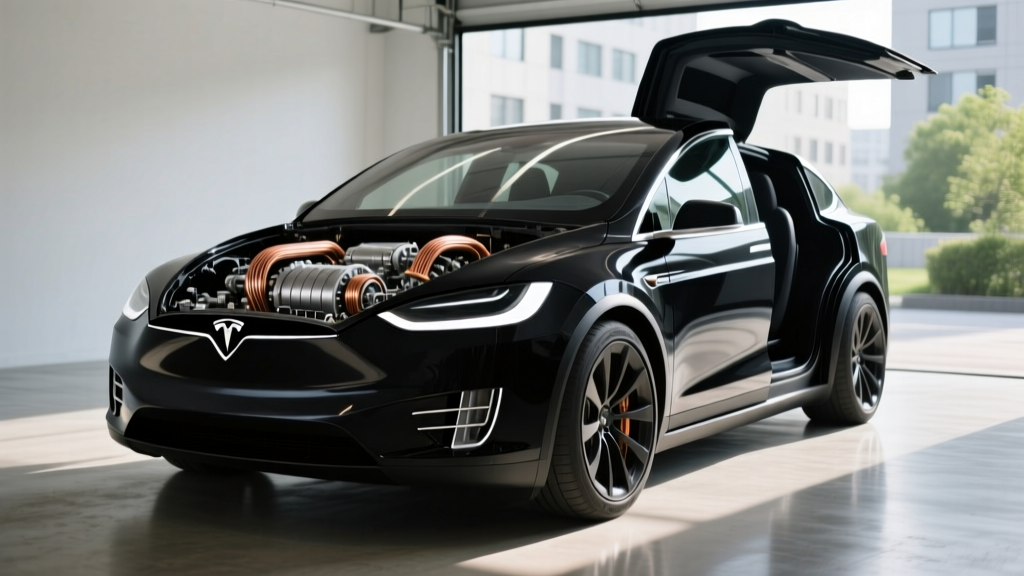
The rear motor in most dual-motor Teslas is a permanent magnet synchronous reluctance motor. Here's how it works: a rotor embedded with rare-earth magnets (typically neodymium-iron-boron) sits inside a stator wound with copper coils. When the inverter sends alternating current through the stator, it creates a rotating magnetic field. The permanent magnets on the rotor lock into this field and spin in sync — hence "synchronous."
The "reluctance" component is key. The rotor is designed with intentional asymmetry in its magnetic reluctance (resistance to magnetic flux). This means the rotor is pulled into alignment with the stator's field not just by the magnets, but by the geometry of the iron core itself. The combined effect produces exceptional torque density, especially at low speeds — which is why a Tesla launches so aggressively from a stop.
Why Tesla uses it on the rear axle: The PMSRM is extremely efficient at converting battery energy into motion, particularly during steady-state cruising and partial-load driving (the majority of real-world commuting). It's also compact and lightweight relative to its output. The trade-off is reliance on rare-earth materials, which carry supply-chain and cost implications.
AC Induction Motor (Front Axle on Dual-Motor Models)
The front motor in Tesla's dual-motor vehicles is typically an AC induction motor — the same basic design Nikola Tesla patented in the 1880s. In this design, the rotor contains no permanent magnets. Instead, it's a "squirrel cage" of aluminum or copper bars. When the stator's rotating magnetic field cuts across these bars, it induces a current in them, which in turn creates a secondary magnetic field. The interaction between the two fields causes the rotor to spin.
The critical advantage of the induction motor: it can be completely disengaged. When the front axle isn't needed (light-load cruising, for instance), Tesla's power electronics simply stop sending current to the stator. With no permanent magnets, the rotor freewheels with minimal drag — no cogging torque. This eliminates parasitic losses and improves highway efficiency.
Why Tesla uses it on the front axle: Induction motors handle high-RPM operation well, don't suffer from permanent-magnet demagnetization at extreme temperatures, and add all-wheel-drive traction without a range penalty during efficient driving. They're also cheaper to produce since they use no rare-earth materials.
The Inverter: The Brain Behind the Motor
No electric motor works without an inverter. Tesla's inverter converts the battery's direct current (DC) into the alternating current (AC) the motors need. Tesla was an early adopter of silicon carbide (SiC) MOSFETs in its inverters, which switch faster and lose less energy as heat compared to traditional silicon IGBTs. This improves overall drivetrain efficiency by roughly 5-8%, a meaningful gain that translates directly to additional range.
The inverter also controls motor speed and torque by varying the frequency and amplitude of the AC signal. Press the accelerator, and the inverter instantly increases current flow — no turbo lag, no gear hunting, no delay. That's why even a base Model 3 RWD (0-60 in 5.8 seconds) feels responsive in city traffic.
2026 Tesla Model 3 Long Range AWD: Full Specs
Here's how the engineering translates into numbers for the most popular Tesla sedan:
| Spec | Value |
|---|---|
| EPA Estimated Range | 341 miles |
| Battery Capacity (Usable) | ~75 kWh, NMC (nickel manganese cobalt) |
| Drivetrain | Dual-motor AWD (rear PMSRM + front induction) |
| Horsepower | ~384 hp combined |
| 0-60 mph | 4.2 seconds |
| Top Speed | 125 mph |
| Max DC Fast Charge Rate | 250 kW (peak) |
| 10-80% DC Fast Charge | ~27 minutes |
| Level 2 Home Charging | 11.5 kW (~44 miles/hr) |
| MPGe (Combined) | 134 MPGe |
| Efficiency | 25 kWh/100 mi |
| Cargo Volume | 23 cu ft (trunk) + 3.1 cu ft (frunk) |
| Rear Legroom | 34.7 inches |
| Battery & Drive Unit Warranty | 8 years / 120,000 miles |
| Base MSRP | $47,740 (before incentives) |
Charging: How Fast Can You Refill the Battery?
Tesla's charging ecosystem remains one of its strongest advantages. The Supercharger network now includes over 6,500 stalls in North America, and with the industry's shift to NACS (North American Charging Standard), non-Tesla EVs are increasingly joining the network — but Tesla owners still benefit from native integration and automatic plug-and-charge.
| Charging Level | Power | Speed (Approx.) | Typical Use Case |
|---|---|---|---|
| Level 1 (120V household) | 1.4 kW | ~5 miles/hour | Emergency top-up, overnight for low-mileage drivers |
| Level 2 (240V home wall connector) | 11.5 kW | ~44 miles/hour | Daily home charging; full charge in ~7 hours |
| DC Fast Charge (Supercharger V3/V4) | Up to 250 kW peak | Up to 175 miles in 15 min | Road trips; 10-80% in ~27 minutes |
Charging curve reality: The 250 kW peak rate only applies at low states of charge (roughly 10-30%). As the battery fills, the rate tapers to protect cell longevity. Expect sustained rates around 150-180 kW through 60%, then a gradual decline to roughly 50-70 kW above 80%. This is normal for NMC lithium-ion chemistry and is managed by Tesla's thermal management system, which preconditions the battery when you navigate to a Supercharger.
Home charging cost: At the US average residential electricity rate of ~$0.17/kWh, fully charging the Model 3 Long Range's 75 kWh battery costs roughly $12.75 — about $0.037 per mile. Compare that to $0.12-$0.15 per mile for a 30-MPG gas car at $3.50/gallon.
Pricing, Tax Credits, and Ownership Cost
Tesla's pricing has shifted multiple times, but as of early 2026, here's where the Model 3 lineup stands:
| Trim | MSRP | Est. Price After §30D Credit | Drivetrain | EPA Range |
|---|---|---|---|---|
| Model 3 RWD | $38,990 | $31,490* | Rear-wheel drive | 272 mi |
| Model 3 Long Range AWD | $47,740 | $40,240* | Dual-motor AWD | 341 mi |
| Model 3 Performance | $54,990 | $47,490* | Dual-motor AWD | 315 mi |
*Price after federal tax credit assumes full §30D eligibility. Actual credit depends on your tax liability, income, and vehicle sourcing compliance.
- Income caps: Modified AGI must not exceed $150,000 (single), $225,000 (head of household), or $300,000 (joint filers).
- MSRP cap: Sedans must be $55,000 or less. (The Model 3 Performance at $54,990 just clears this.)
- Battery sourcing: Critical minerals and battery components must meet phased-in domestic/free-trade-agreement sourcing thresholds that tighten each year. Tesla's US-built batteries have generally complied, but verify at irs.gov before purchasing.
- Point-of-sale transfer: As of 2024+, you can transfer the credit to the dealer at purchase, reducing your out-of-pocket cost immediately rather than waiting for tax filing.
- One vehicle per VIN, one credit per taxpayer per year.
Performance and Driving Dynamics
The dual-motor setup isn't just about efficiency — it enables precise torque vectoring. Tesla's power electronics independently control torque to the front and rear axles in real time. During hard acceleration, more torque shifts rearward (where weight transfers under load). During cornering, the system can brake the inside wheels and overdrive the outside wheels, mimicking a limited-slip differential without the mechanical complexity.
The Model 3 Performance takes this further with a new front induction motor and rear PMSRM producing 510 hp and a 3.0-second 0-60 time. Tesla also added adaptive dampers and a track-oriented stability control mode for this trim.
For everyday driving, the Long Range AWD's 4.2-second 0-60 is more than adequate for highway merging and passing. The single-speed transmission means there's no shift shock — just a continuous, linear pull from 0 to top speed. Regenerative braking (adjustable from standard to low) enables near one-pedal driving in most conditions, reducing brake wear significantly.
Technology, Safety, and Driver Assistance
Tesla's 15.4-inch center touchscreen handles nearly all vehicle controls — there are no physical buttons for climate, mirrors, or glovebox. The infotainment system supports streaming, gaming (while parked), and over-the-air updates that regularly add features.
Autopilot and Full Self-Driving (Supervised): Every Tesla ships with basic Autopilot (traffic-aware cruise control and lane centering). The optional FSD Supervised package ($8,000 or $99/month) adds automatic lane changes, traffic light/stop sign recognition, and city-street navigation.
Safety ratings: The 2026 Model 3 earned a 5-star overall rating from NHTSA and Top Safety Pick+ from IIHS. Standard features include automatic emergency braking, blind-spot monitoring, lane departure warning, and eight cameras providing 360-degree visibility.
Who Should Buy the Tesla Model 3 (And Who Shouldn't)
- You want access to the Supercharger network for road trips
- You value OTA updates that improve the car over time
- You commute 30-80 miles daily and can charge at home
- You want sedan efficiency with sports-sedan acceleration
- You prioritize a minimalist interior and touchscreen-first controls
- You need SUV cargo space or 3rd-row seating (consider Model Y or a competitor)
- You prefer physical buttons and traditional controls
- You frequently tow heavy loads (Model 3 is not rated for towing)
- You lack reliable home or workplace charging access
- You want a dealership experience with in-person service (Tesla uses mobile rangers and service centers with variable wait times)
How the Model 3 Compares to Key Rivals
The Model 3 Long Range AWD competes directly with the Hyundai Ioniq 6 Long Range AWD (320 mi EPA, ~$49,000), the BMW i4 xDrive40 (282 mi, ~$57,000), and the Polestar 2 Long Range Dual Motor (276 mi, ~$53,000). The Model 3 leads in efficiency (134 MPGe vs. 117-130 for rivals), charging speed (250 kW vs. 150-205 kW), and Supercharger access. The Ioniq 6 offers a more traditional interior with physical controls. The BMW i4 delivers superior build quality and dealer service. The Polestar 2 provides a Scandinavian design ethos but trails on range and charging.
Frequently Asked Questions
How does a Tesla motor differ from a gas engine?
A Tesla motor converts electrical energy directly into rotational force using magnetic fields — no combustion, no pistons, no multi-speed transmission. An internal combustion engine burns fuel to drive pistons, which turn a crankshaft through a gearbox. Tesla's approach has far fewer moving parts (roughly 20 in the drivetrain vs. 2,000+ in a gas powertrain), requires no oil changes, and delivers maximum torque from 0 RPM.
Does Tesla use the same motor in every model?
No. Tesla uses a combination of permanent magnet synchronous reluctance motors (rear axle) and AC induction motors (front axle on dual-motor vehicles). The Cybertruck uses a different motor architecture with a carbon-fiber-wrapped rotor for higher RPM capability. The Model S Plaid uses three motors (one rear PMSRM, two front) with carbon-sleeved rotors for its 1,020-hp output.
Do Tesla motors require maintenance?
Minimal. There are no oil changes, spark plugs, timing belts, or exhaust systems. Tesla recommends cabin air filter replacement every 2-3 years, brake fluid checks every 2 years, and tire rotations every 6,250 miles. The motors themselves are essentially sealed units with no scheduled maintenance. The drive unit warranty covers 8 years/120,000 miles on the Model 3 Long Range.
What happens if a Tesla motor fails?
Motor failures are rare but not unheard of. Under warranty, Tesla replaces the drive unit at no cost. Out of warranty, a drive unit replacement typically costs $5,000-$8,000 depending on the model. Third-party EV shops are increasingly offering refurbished drive units at lower cost. Because the motor has so few moving parts, failures are usually related to inverter electronics or bearing wear rather than catastrophic mechanical breakdown.
Does the Tesla Model 3 qualify for the full $7,500 federal tax credit?
As of 2026, the Model 3 RWD and Long Range AWD generally qualify for the full $7,500 §30D credit, provided the buyer meets income caps and the vehicle's battery sourcing complies with current-year critical mineral and component requirements. The Model 3 Performance at $54,990 clears the $55,000 sedan MSRP cap. Always verify current eligibility on irs.gov before purchasing, as sourcing rules tighten annually.
How long does a Tesla battery last?
Tesla's NMC battery packs are designed for long life. Tesla reports that Model 3/Y batteries retain approximately 85% capacity after 200,000 miles. The warranty guarantees at least 70% retention over 8 years/120,000 miles (Long Range) or 8 years/100,000 miles (RWD). Real-world data from fleet operators and owner surveys generally confirms 10-15% degradation over the first 100,000 miles, with the curve flattening significantly afterward.