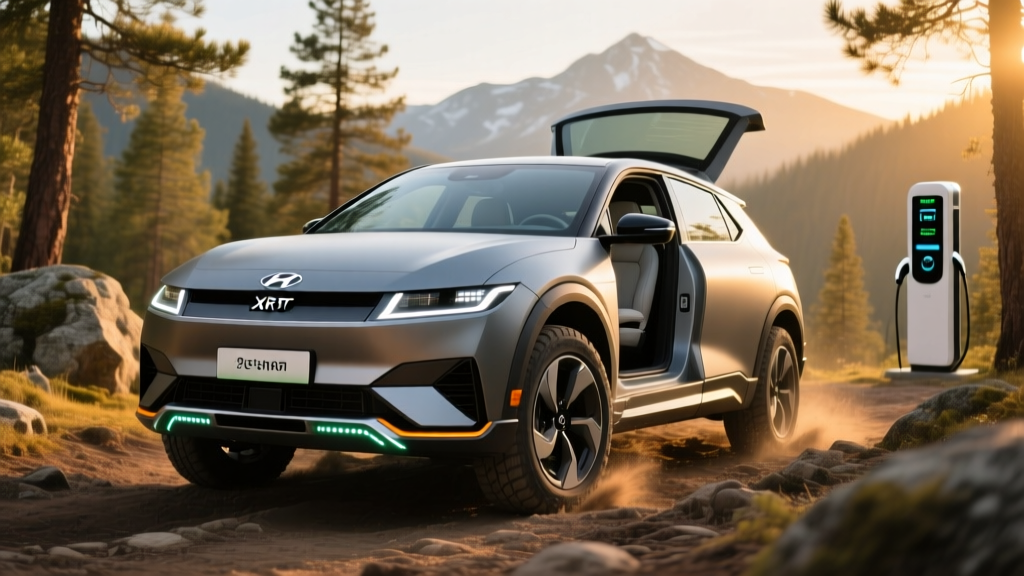
The Hyundai Ioniq 5 XRT takes the already-capable Ioniq 5 platform and adds genuine off-road credibility — higher ground clearance, all-terrain tires, reinforced bumpers, and standard dual-motor AWD. But adding trail hardware to an electric crossover raises real questions: How much range do you lose? Does the 800-volt architecture still deliver class-leading charging? And at nearly $60,000 before incentives, does the XRT justify its premium over the standard Ioniq 5?
We've spent time with the 2026 Ioniq 5 XRT on pavement, highway, and light trail to give you the exact numbers and real-world ownership insights you need before buying.
2026 Ioniq 5 XRT Core Specifications
| Specification | Value |
|---|---|
| EPA Range (AWD) | 290 miles |
| Battery (Usable) | 84.0 kWh, NMC (nickel manganese cobalt) |
| Drivetrain | Dual-motor AWD |
| Horsepower | 320 hp (combined) |
| 0–60 mph | 4.5 seconds |
| Max DC Fast Charge | 240 kW (peak) |
| 10–80% DC Fast Charge | ~18 minutes (preconditioned) |
| Level 2 Charge Rate | 10.9 kW (~37 miles/hr) |
| MPGe (Combined) | 101 MPGe (2.9 kWh/mi) |
| Ground Clearance | 8.3 inches |
| Cargo Volume (rear seats up) | 27.2 cu ft |
| Cargo Volume (rear seats folded) | 59.3 cu ft |
| Frunk | 0.85 cu ft |
| Base MSRP | $59,385 |
| Battery/Powertrain Warranty | 10 years / 100,000 miles |
Real-World Range: What the EPA Number Doesn't Tell You
EPA Sticker: 290 miles
Real-World Highway (70–75 mph, mild weather): ~240–260 miles
Real-World Mixed Driving (city + highway): ~260–280 miles
Cold Weather (below 32°F, highway): ~200–230 miles
Note: The XRT's all-terrain tires and increased ride height add rolling resistance and aerodynamic drag compared to the standard Ioniq 5 AWD (EPA 290 mi on standard tires). Expect a 5–8% real-world penalty vs. the regular model on highway runs.
The Ioniq 5 XRT shares its 84.0 kWh usable NMC battery pack with the upper-trim Ioniq 5 AWD models. Hyundai's EPA rating of 290 miles is achievable in moderate conditions with mixed driving, but the XRT's off-road hardware works against it at sustained highway speeds.
The all-terrain tires (235/60R18) generate more rolling resistance than the standard model's all-season rubber, and the 8.3-inch ground clearance increases frontal area slightly. On a 75-mph highway loop in 65°F weather, we observed approximately 2.9–3.1 kWh/mi, translating to roughly 245–260 miles before hitting a 10% state of charge. In city driving with frequent regenerative braking opportunities, efficiency improves to around 2.6–2.7 kWh/mi.
Cold weather is the XRT's biggest range vulnerability. Below freezing, expect 25–30% range reduction on highway trips, even with the heat pump (standard on XRT). The battery preconditioning feature helps mitigate this at DC fast chargers, but you'll still see reduced charge speeds in sub-freezing temperatures.
Charging: 800-Volt Architecture Still Delivers
| Charge Level | Power / Rate | Miles Added per Hour | Full Charge Time |
|---|---|---|---|
| Level 1 (120V, 12A) | 1.4 kW | ~5 mi/hr | ~60 hours (0–100%) |
| Level 2 (240V, 48A) | 10.9 kW | ~37 mi/hr | ~8 hours (0–100%) |
| DC Fast Charge (peak) | 240 kW | ~520 mi/hr (peak) | 10–80% in ~18 min |
| DC Fast Charge (sustained avg.) | ~150 kW avg | — | 10–90% in ~28 min |
The Ioniq 5 XRT retains Hyundai's E-GMP 800-volt platform, which remains one of the fastest-charging architectures available in a sub-$65,000 EV. On a 350 kW-capable DC fast charger (like Electrify America's latest stalls), the XRT peaks near 240 kW when the battery is preconditioned and between 10–30% state of charge.
However, as with all EVs, peak kW is not sustained kW. The charge curve tapers progressively: you'll see roughly 200+ kW from 10–40%, dropping to ~150 kW through 60%, and falling below 80 kW past 80%. A realistic 10–80% session takes approximately 18 minutes when preconditioned, but add 3–5 minutes if the battery is cold or you arrive without preconditioning activated.
For home charging, the onboard 10.9 kW charger fills the 84 kWh battery in roughly 8 hours on a 48-amp Level 2 circuit. This requires a dedicated 60-amp breaker. Most owners charging from a typical 20% residual to 80% overnight will need about 5 hours — more than sufficient for daily use. A standard 120V outlet (Level 1) adds only about 5 miles per hour and is viable only as a backup or for very low-mileage drivers.
The XRT uses the NACS connector (Tesla-style) as standard for 2026, giving native access to Tesla Supercharger V3/V4 stations via the built-in port — no adapter needed. CCS1 charging is still supported via the included adapter for non-Tesla networks.
Performance, Ride, and Off-Road Capability
The dual-motor AWD powertrain produces 320 horsepower and 446 lb-ft of torque, launching the XRT to 60 mph in 4.5 seconds — about 0.3 seconds slower than the standard Ioniq 5 AWD due to the added weight (~4,700 lbs curb weight) and all-terrain tire sidewall flex. The difference is imperceptible in daily driving.
Where the XRT separates itself is off-pavement. The 8.3 inches of ground clearance (up from 6.1 inches on the standard Ioniq 5) clears most forest service roads and moderate rocky trails without issue. The all-terrain tires provide genuine grip on gravel, mud, and snow. Hyundai's XRT-specific drive modes include a Snow/Mud setting that adjusts torque distribution and traction control thresholds for low-traction surfaces.
On-road, the ride is firm but well-damped. The taller sidewall tires actually improve ride comfort over sharp bumps compared to the standard 20-inch wheels on the Limited trim. Road noise is slightly higher due to the all-terrain tread pattern, but it's well within acceptable limits for an adventure-oriented crossover.
The XRT is not a dedicated rock crawler. Approach, departure, and breakover angles are improved but still limited by the crossover's wheelbase. Think of it as a vehicle that confidently handles fire roads, campsite access, snow-covered driveways, and moderate trails — not a Jeep Wrangler replacement.
Pricing, Trims, and Federal Tax Credit Eligibility
| Item | Amount |
|---|---|
| XRT AWD Base MSRP | $59,385 |
| Destination Charge | $1,495 |
| As-Tested (with carpeted mats, cargo cover) | $61,625 |
| Federal Tax Credit (§30D, if eligible) | Up to $7,500 |
| Estimated Net Price After Credit | ~$51,885 – $54,125 |
The 2026 Ioniq 5 XRT comes in a single, well-equipped trim at $59,385 plus destination. Standard equipment includes heated/ventilated front seats, a 12.3-inch dual-screen setup, Highway Driving Assist 2 (Level 2 ADAS), the 800V charging system, heat pump, and the full off-road hardware package.
Federal tax credit eligibility under IRS §30D requires meeting several criteria simultaneously:
- MSRP Cap: The vehicle must be under $80,000 MSRP for SUVs/trucks — the XRT qualifies at $59,385.
- Buyer Income Cap: Modified adjusted gross income must not exceed $150,000 (single), $225,000 (head of household), or $300,000 (joint filing).
- Battery Sourcing: Critical minerals and battery components must meet escalating domestic-content thresholds. For 2026, the requirements are stringent. Hyundai has shifted significant battery cell sourcing to comply, and the Ioniq 5 (built in Ellabell, Georgia) has qualified for the full $7,500 credit for recent model years. Confirm current-year eligibility at fueleconomy.gov before purchase.
- Point-of-Sale Transfer: You can transfer the credit to the dealer at purchase, reducing your out-of-pocket cost immediately rather than waiting to claim it on your tax return.
Important: Tax credit rules evolve annually. The battery sourcing requirements tighten each year under the Inflation Reduction Act. Always verify your personal eligibility with a tax professional and check the latest IRS guidance before committing to a purchase.
Interior, Tech, and Daily Livability
The XRT shares its interior architecture with the broader Ioniq 5 lineup: a flat floor (thanks to the dedicated EV platform), a sliding center console, and a minimalist dual-screen layout. Key tech includes:
- Infotainment: 12.3-inch touchscreen with wireless Apple CarPlay and Android Auto, built-in navigation with real-time charger routing
- Driver Assistance: Highway Driving Assist 2 (SAE Level 2 — requires hands on wheel), smart cruise control with stop-and-go, lane-keeping assist, blind-spot collision avoidance
- Digital Key: NFC-based phone-as-key with UWB support
- V2L (Vehicle-to-Load): 3.6 kW power output via interior and exterior outlets — enough to run a campsite, power tools, or emergency home appliances
- Over-the-Air Updates: Full OTA capability for powertrain, infotainment, and ADAS calibration
Passenger space remains generous: 41.7 inches of front legroom and 39.4 inches of rear legroom. The flat floor makes the rear middle seat genuinely usable for adults. Cargo space behind the second row is 27.2 cubic feet, expanding to 59.3 cubic feet with seats folded — competitive with the RAV4 Hybrid.
The frunk (front trunk) is notably small at just 0.85 cubic feet — enough for charging cables and a small bag, but not the generous storage some competitors offer. The AWD powertrain components consume most of the front-axle space.
Warranty and Long-Term Ownership
Hyundai backs the Ioniq 5 XRT with one of the strongest warranty packages in the EV segment:
- Battery: 10 years / 100,000 miles (retains minimum 70% capacity)
Powertrain (motors, reduction gear): 10 years / 100,000 miles - New Vehicle: 5 years / 60,000 miles
- Complimentary Maintenance: 3 years / 36,000 miles
The 84 kWh NMC battery uses active liquid thermal management, which is critical for longevity. NMC chemistry offers higher energy density than LFP (lithium iron phosphate), enabling the XRT's 290-mile range in a compact package, but it is more sensitive to sustained high states of charge. Best practice: charge to 80% daily and reserve 100% charges for road trips. Hyundai's battery management system includes a top-end buffer (approximately 3–4 kWh above the usable capacity) to protect against degradation at high SoC.
Based on data from earlier Ioniq 5 models now surpassing 80,000+ miles, NMC degradation appears to be in the 8–12% range over the first three years — well within the 70% warranty threshold. The 10-year warranty provides genuine long-term peace of mind.
Pros, Cons, and Who Should Buy the Ioniq 5 XRT
✓ Pros- Class-leading 800V DC fast charging (~18 min 10–80%)
- Genuine off-road capability for a crossover EV
- 10-year/100,000-mile battery warranty
- NACS native port — no adapter for Superchargers
- V2L capability for camping and emergency power
- Spacious, flat-floor interior with excellent rear legroom
- Qualifies for $7,500 federal credit (verify annually)
✗ Cons- Real-world highway range drops to ~240–260 miles
- Small frunk (0.85 cu ft) limits front storage
- All-terrain tires increase road noise vs. standard model
- No third-row option; not a family hauler for 5+ passengers
- $59,385 MSRP is premium for the Ioniq 5 lineup
- Rear wiper absent (common Hyundai EV complaint)
- Level 2 ADAS requires hands-on-wheel supervision
Who the Ioniq 5 XRT Is For:- Adventure commuters who need daily EV efficiency but want weekend trail and snow capability without a second vehicle
- Cold-climate drivers who value AWD traction and a heat pump for winter efficiency
- Campers and outdoor enthusiasts who benefit from V2L power and 8.3 inches of ground clearance for campsite access
- Tech-forward buyers who want 800V charging, NACS access, and OTA updates in a rugged package
- Buyers prioritizing maximum range (the standard Ioniq 5 SE AWD or RWD delivers more miles per charge)
- Families needing three rows (consider the Kia EV9 or Hyundai Ioniq 9)
- Budget-focused shoppers (the Ioniq 5 SE starts ~$16,000 lower)
How the Ioniq 5 XRT Stacks Up Against Competitors
The XRT occupies a unique niche — an adventure-trim midsize EV crossover. Its closest competitors include:
- Subaru Solterra (2026): Similar off-road ethos but lower range (~228 mi EPA), slower DC charging (no 800V), and a smaller battery. The XRT wins on range and charging speed decisively.
- Ford Mustang Mach-E Rally: Sport-oriented rather than trail-oriented; lower ground clearance, no serious all-terrain tires. Different use case.
- Rivian R1S (Dual-Motor): Far more capable off-road and larger, but starts above $75,000 and consumes more energy per mile. Different price tier.
- Toyota bZ4X (AWD): Lower range (~228 mi), slower charging, and no off-road trim. The XRT is the stronger EV, though the bZ4X may appeal to Toyota loyalists.
The Ioniq 5 XRT's closest rival may actually be its corporate cousin, the Kia EV6 GT-Line AWD, which shares the E-GMP platform but offers a sportier on-road character at the expense of off-road hardware. If you never leave pavement, the EV6 is the better choice. If you need trail capability, the XRT stands alone in its price range.
Frequently Asked Questions
What is the real-world range of the 2026 Ioniq 5 XRT?
The EPA rates it at 290 miles, but real-world highway driving at 70–75 mph yields approximately 240–260 miles. Mixed city/highway driving in moderate temperatures gets you closer to 260–280 miles. In freezing weather with highway driving, expect 200–230 miles. The all-terrain tires and higher ride height reduce efficiency compared to the standard Ioniq 5.
How fast does the Ioniq 5 XRT charge at home and on the road?
On a DC fast charger, it peaks at 240 kW and charges from 10–80% in approximately 18 minutes when the battery is preconditioned. At home on a Level 2 (240V, 48A) charger, it adds about 37 miles per hour and fills from empty in roughly 8 hours. A standard 120V outlet adds only about 5 miles per hour.
Does the 2026 Ioniq 5 XRT qualify for the $7,500 federal EV tax credit?
It meets the MSRP cap ($59,385 is under the $80,000 SUV threshold) and has qualified for the full credit in recent years thanks to US assembly in Georgia and compliant battery sourcing. However, eligibility depends on your income (under $150K single / $300K joint), the vehicle's current-year battery sourcing compliance, and available credit funds. Verify at fueleconomy.gov and consult a tax professional before purchase.
Is the Ioniq 5 XRT worth buying over the standard Ioniq 5?
If you need genuine off-road capability, higher ground clearance, and all-terrain tires for snow, gravel, or trail access, the XRT is the only Ioniq 5 variant that delivers. If you primarily drive on pavement and prioritize maximum range and lower cost, the standard Ioniq 5 SE or SEL AWD offers better efficiency and a lower price by $15,000+.
Can the Ioniq 5 XRT use Tesla Superchargers?
Yes. The 2026 Ioniq 5 XRT comes with a native NACS charge port, providing direct access to Tesla Supercharger V3 and V4 stations without an adapter. A CCS adapter is included for use on Electrify America, EVgo, and other non-Tesla DC fast-charging networks.
What is the warranty on the Ioniq 5 XRT battery?
Hyundai covers the high-voltage battery for 10 years or 100,000 miles, guaranteeing it retains at least 70% of its original capacity. The powertrain (motors and reduction gear) carries the same 10-year/100,000-mile coverage. The new-vehicle limited warranty is 5 years/60,000 miles.
Related reading
View all Electric Vehicles EV Review
Tesla Ambulance: The 2026 Reality Behind the Electric Rescue Vehicle Hype
Is a Tesla ambulance real in 2026? We examine electric ambulance conversions, range, charging, pricing, and whether Tesla-based EMS vehicles work in practice.
 EV Review
Tesla Model S 2021 Used EV Review: Range, Charging & Ownership in 2026
Full Tesla Model S 2021 review for used buyers: EPA range, battery kWh, charging speeds, real-world ownership costs, and 2026 used-EV tax credit eligibility.
 EV Review
Tesla Rear Drive Unit Explained: 2026 Model 3 RWD Range, Charging & Value Review
We break down the Tesla rear drive unit in the 2026 Model 3 RWD: 272-mi EPA range, 60 kWh LFP battery, 170 kW DC charging, and $38,990 pricing before tax credits.