The 2026 Tesla Lineup at a Glance
Tesla's 2026 portfolio spans five consumer vehicles: the refreshed Model 3 sedan, the Juniper-updated Model Y crossover, the flagship Model S and Model X, and the polarizing Cybertruck. Each targets a different buyer, but they share common DNA — over-the-air updates, the Tesla Supercharger network, and a minimalist interior philosophy. Below, we break down every current model with the exact numbers buyers need: EPA range, battery chemistry, DC fast-charge curves, real-world efficiency, and current federal tax credit eligibility under IRS §30D rules.
| Model | Body Style | EPA Range | Battery (kWh) | 0-60 mph | Base MSRP |
|---|---|---|---|---|---|
| Model 3 RWD | Sedan | 272 mi | ~60 (LFP) | 5.8 s | $38,990 |
| Model 3 Long Range AWD | Sedan | 341 mi | ~79 (NMC) | 4.2 s | $45,990 |
| Model 3 Performance | Sedan | 315 mi | ~79 (NMC) | 2.9 s | $52,990 |
| Model Y Long Range AWD | Crossover | 320 mi | ~79 (NMC) | 4.8 s | $46,990 |
| Model Y Performance | Crossover | 298 mi | ~79 (NMC) | 3.5 s | $51,490 |
| Model S Long Range | Luxury Sedan | 402 mi | ~100 (NMC) | 3.1 s | $79,990 |
| Model S Plaid | Luxury Sedan | 359 mi | ~100 (NMC) | 1.99 s | $94,990 |
| Model X Long Range | Luxury SUV | 335 mi | ~100 (NMC) | 3.8 s | $84,990 |
| Cybertruck AWD | Pickup | 340 mi | ~123 (NMC) | 4.1 s | $79,990 |
Sources: fueleconomy.gov, Tesla spec sheets. MSRP excludes destination fee. Specs reflect 2025/2026 model year data.
Model 3: The Entry Point
The refreshed Model 3 (internally called "Highland") remains Tesla's most accessible vehicle. The base RWD trim uses a lithium iron phosphate (LFP) battery — roughly 60 kWh usable. LFP chemistry trades energy density for longevity and cost: Tesla recommends charging LFP packs to 100% regularly, which simplifies daily ownership. The Long Range AWD and Performance trims switch to nickel-manganese-cobalt (NMC) packs at ~79 kWh usable, offering more range and power but requiring an 80% daily charge limit for optimal battery health.
EPA sticker: 341 miles. Expect ~280–300 miles on sustained highway driving at 70+ mph. In freezing temperatures (below 32°F), range can drop 20–30%, yielding roughly 240–270 miles. The LFP RWD model (EPA 272 mi) typically delivers 220–240 miles in mixed real-world driving.
Charging Speeds
Model 3 Long Range peaks at approximately 250 kW on a V3 Supercharger, reaching 10–80% in about 25 minutes. The LFP RWD model peaks lower, around 170 kW, with a 10–80% time closer to 30 minutes. Both trims accept 11.5 kW on Level 2 (48A), adding roughly 44 miles of range per hour of charging at home.
Efficiency & Practicality
The Long Range AWD achieves approximately 132 MPGe combined (25 kWh/100 mi), making it one of the most efficient EVs in its class. Cargo volume is 23 cu ft (trunk + frunk combined), with 42.2 inches of front legroom. The rear seat is tighter at 35.3 inches — adequate for adults on short trips, cramped on long hauls.
Tax Credit Eligibility
Under current IRS §30D rules, the Model 3 Long Range AWD and Performance trims qualify for up to $7,500 in federal tax credits when battery sourcing and critical-mineral requirements are met — and the buyer's modified adjusted gross income falls within caps ($150K single / $300K joint). The base RWD model at $38,990 also qualifies, subject to the same income and sourcing rules. The credit can be transferred at point of sale as a purchase-price reduction. Tesla's website lists current credit eligibility per trim; this changes periodically as supply-chain sourcing shifts.
Model Y: The Volume Seller
The Juniper-refreshed Model Y is the best-selling EV in the U.S. for good reason: crossover practicality with sedan-like efficiency. The Long Range AWD (EPA 320 mi) and Performance (EPA 298 mi) both use ~79 kWh NMC packs. The key upgrade over the pre-refresh model is a more compliant ride, a ventilated-seat option, and a rear touchscreen for passengers.
EPA sticker: 320 miles. Highway cruising at 75 mph yields approximately 265–285 miles. Cold-weather (sub-freezing) range: ~230–260 miles. The larger frontal area and weight of the crossover body reduce efficiency compared to the Model 3 on the same battery platform.
Charging & Efficiency
Model Y Long Range peaks at ~250 kW DC fast charging, with a 10–80% session taking roughly 25 minutes. Level 2 home charging at 11.5 kW (48A) adds about 42 miles per hour. Efficiency is rated at approximately 122 MPGe combined (28 kWh/100 mi).
Space & Utility
Cargo volume behind the second row is 30.2 cu ft, expanding to 72.1 cu ft with seats folded. An optional third row adds two small seats (best for children under 5'4"). Front legroom is 41.8 inches; rear is 37.3 inches — noticeably more generous than the Model 3. The Model Y also offers a powered liftgate and a flat load floor, making it the practical choice for families and gear-heavy road trips.
Pricing & Credit
At $46,990 base (Long Range AWD), the Model Y falls under the §30D MSRP cap of $80,000 for SUVs. Full $7,500 credit eligibility depends on battery-sourcing compliance and buyer income. After the maximum credit, the effective price drops to approximately $39,490 — competitive with gas-powered compact SUVs when fuel savings are factored in.
Model S and Model X: The Flagships
The Model S sedan and Model X SUV occupy Tesla's premium tier, sharing a ~100 kWh NMC battery pack and dual-motor AWD architecture. The Model S Long Range claims an EPA-estimated 402 miles — the longest range of any current Tesla. The Model S Plaid sacrifices some range (359 mi EPA) for a tri-motor, 1,020-hp powertrain that hits 60 mph in 1.99 seconds.
The Model X Long Range delivers 335 miles EPA with seating for up to seven. Its signature falcon-wing rear doors provide wide opening access but add mechanical complexity. Both vehicles peak at 250 kW on DC fast charging (10–80% in ~28 minutes) and charge at 11.5 kW on Level 2.
EPA sticker: 402 miles. Sustained highway driving at 75 mph typically yields 330–360 miles. Cold-weather impact is partially mitigated by the heat pump (standard on all current Teslas), but expect 280–320 miles in sub-freezing conditions. The Model X, heavier and less aerodynamic, delivers roughly 280–300 miles highway in mild weather.
Who Should Consider the Flagships?
These vehicles suit buyers who prioritize range (Model S), performance prestige (Plaid), or three-row EV seating (Model X). However, at $79,990+ MSRP, neither qualifies for the federal §30D credit — the MSRP cap is $55,000 for sedans and $80,000 for SUVs, and the Model X starts above that threshold. State-level incentives may still apply; check your jurisdiction's rules.
Cybertruck: The Outlier
The stainless-steel Cybertruck AWD carries a ~123 kWh NMC battery pack, delivering an EPA-estimated 340 miles. The 48-volt electrical architecture and steer-by-wire system make it technologically distinct from the rest of the Tesla fleet. Towing capacity is rated at 11,000 lbs, though towing at max capacity cuts range by roughly 50%.
DC fast charging peaks at approximately 250 kW (10–80% in ~30 minutes, slower than the sedans due to the larger pack). Level 2 charging at 11.5 kW adds roughly 30 miles per hour. At $79,990 base, the Cybertruck exceeds the §30D truck MSRP cap of $80,000 only barely — but Tesla has priced the AWD trim at the threshold, and credit eligibility depends on current sourcing compliance.
Charging Infrastructure: The Tesla Advantage
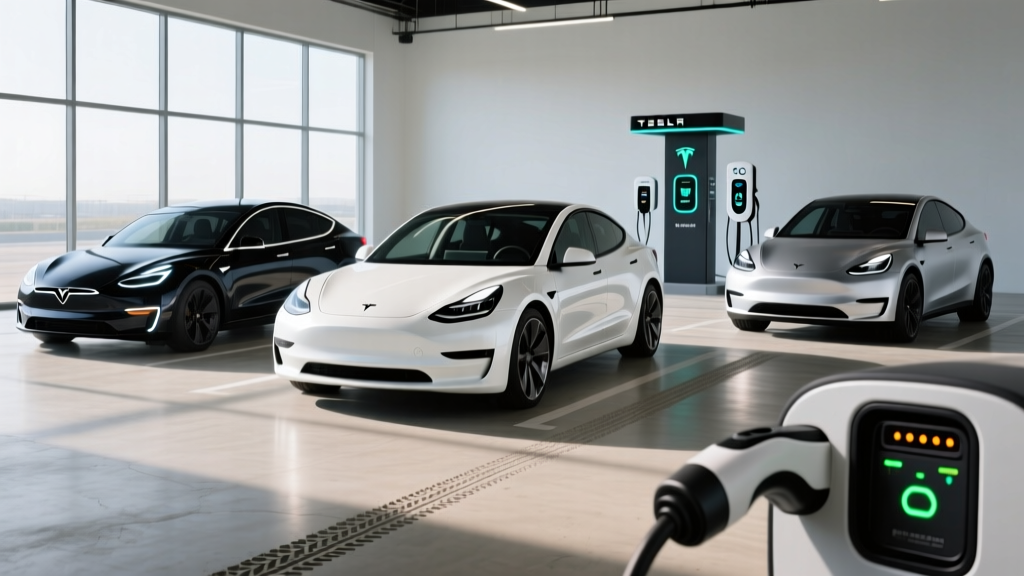
All 2026 Teslas use the North American Charging Standard (NACS) connector natively. Tesla's Supercharger network now exceeds 6,500 U.S. stations with over 30,000 stalls, including an expanding number of open-access chargers for non-Tesla EVs. For Tesla owners, this means the most reliable DC fast-charging network in North America — a significant ownership advantage that competitors are only beginning to match via NACS adoption.
| Charge Type | Power | Model 3 LR | Model Y LR | Model S LR | Cybertruck |
|---|---|---|---|---|---|
| Level 1 (120V) | 1.4 kW | ~5 mi/hr | ~5 mi/hr | ~4 mi/hr | ~4 mi/hr |
| Level 2 (240V, 48A) | 11.5 kW | ~44 mi/hr | ~42 mi/hr | ~38 mi/hr | ~30 mi/hr |
| DC Fast (Peak) | 250 kW | ~25 min 10-80% | ~25 min 10-80% | ~28 min 10-80% | ~30 min 10-80% |
Note: DC fast-charge times assume optimal battery preconditioning and a V3/V4 Supercharger stall. Charge rate tapers significantly above 80% SoC.
Autopilot and FSD: What You're Actually Getting
Every 2026 Tesla ships with Basic Autopilot (lane-centering and adaptive cruise control). The optional Full Self-Driving (Supervised) package — currently $8,000 or $99/month — adds automated lane changes, traffic-light recognition, and city-street navigation.
Both Autopilot and FSD (Supervised) are SAE Level 2 driver-assistance systems. The driver must remain fully engaged, hands on the wheel, eyes on the road. Tesla's "Supervised" branding is deliberate: the system does not replace the driver. Only Level 4 services like Waymo operate without a human driver in defined zones.
Warranty Coverage
Tesla provides a 4-year/50,000-mile basic vehicle warranty across all models. Battery and drive-unit coverage varies:
- Model 3 RWD (LFP): 8 years / 100,000 miles, minimum 70% capacity retention
- Model 3 Long Range / Performance, Model Y: 8 years / 120,000 miles, minimum 70% retention
- Model S / Model X: 8 years / 150,000 miles, minimum 70% retention
- Cybertruck: 8 years / 120,000 miles, minimum 70% retention
The 70% retention threshold is standard across the industry. In practice, Tesla battery degradation data from fleet analytics shows most packs retaining 85–90% capacity at 100,000 miles, with LFP packs showing slightly better longevity due to their chemistry tolerance for full-charge cycles.
Pricing, Tax Credits, and Total Cost
| Model | Base MSRP | §30D Credit | Effective Price |
|---|---|---|---|
| Model 3 RWD | $38,990 | Up to $7,500* | ~$31,490 |
| Model 3 Long Range AWD | $45,990 | Up to $7,500* | ~$38,490 |
| Model Y Long Range AWD | $46,990 | Up to $7,500* | ~$39,490 |
| Model S Long Range | $79,990 | $0 (MSRP cap) | $79,990 |
| Model X Long Range | $84,990 | $0 (MSRP cap) | $84,990 |
| Cybertruck AWD | $79,990 | Varies* | Varies |
*Eligibility for the full $7,500 credit requires: buyer MAGI within limits ($150K single / $225K HOH / $300K joint), vehicle MSRP within caps ($55K sedans / $80K SUVs & trucks), and battery-sourcing/critical-mineral compliance per IRS §30D. Credit can be applied at point of sale. Verify current eligibility on Tesla's configurator and with a tax professional.
Who Should Buy Which Tesla?
- Choose Model 3 RWD if you want the lowest entry price, commute under 40 miles daily, and can charge at home. The LFP battery rewards daily 100% charging.
- Choose Model 3 Long Range if you take regular road trips and want 300+ real-world miles between stops.
- Choose Model Y Long Range if you need family cargo space, child-seat room, or occasional light off-pavement use.
- Choose Model S Long Range if maximum range is your priority and budget is flexible (no federal credit applies).
- Choose Cybertruck if you need a truck bed and towing capacity, and you accept the size and polarizing design.
- Look elsewhere if you want a traditional interior with physical controls, Apple CarPlay/Android Auto, or an affordable three-row EV (consider the Kia EV9 or Rivian R1S).
- Supercharger network — the most reliable DC fast-charging ecosystem in North America
- Class-leading efficiency (Model 3 Long Range: 132 MPGe)
- Over-the-air updates continuously add features
- LFP option on Model 3 RWD simplifies daily charging habits
- Strong resale value relative to most EV competitors
- No Apple CarPlay or Android Auto — Tesla's proprietary infotainment only
- Minimalist interior lacks physical controls for climate, mirrors, and glovebox
- FSD (Supervised) is expensive and remains Level 2 — not autonomous
- Build quality inconsistencies still reported (panel gaps, paint)
- Model S/X pricing excludes them from federal tax credits
Frequently Asked Questions
What is the real-world range of the most popular Tesla?
The Model Y Long Range AWD (EPA 320 mi) typically delivers 265–285 miles in highway driving and 230–260 miles in cold weather. The Model 3 Long Range (EPA 341 mi) achieves 280–300 miles highway in mild conditions. Real-world range depends heavily on speed, temperature, terrain, and HVAC use.
How fast do Teslas charge at home and on the road?
At home on a 240V Level 2 charger (48A/11.5 kW), Teslas add 30–44 miles of range per hour depending on the model. On a Tesla V3 Supercharger (250 kW peak), most models reach 10–80% in 25–30 minutes. Charge rate tapers substantially above 80% — plan to unplug at 80% on road trips for time efficiency.
Do all Teslas qualify for the $7,500 federal tax credit?
No. Under IRS §30D, eligibility requires meeting MSRP caps ($55K for sedans, $80K for SUVs/trucks), buyer income limits ($150K single / $300K joint), and battery-sourcing requirements. The Model S and Model X exceed MSRP caps and do not qualify. The Model 3 and Model Y may qualify for the full credit depending on current battery-sourcing compliance — always verify on Tesla's site and consult a tax professional.
Is a Tesla worth buying over competitors like Hyundai, BMW, or Ford?
Tesla's advantages are efficiency, the Supercharger network, and over-the-air feature updates. Competitors like the Hyundai Ioniq 5 offer faster 800V charging (10–80% in ~18 min), more traditional interiors, and Apple CarPlay. The BMW i4 provides a more refined ride. The Ford Mustang Mach-E offers competitive range at a lower price point. If Supercharger access and software are your priorities, Tesla wins. If you want physical buttons, faster peak charging, or a more traditional luxury feel, test-drive the competition.
What is LFP vs. NMC battery chemistry, and does it matter?
LFP (lithium iron phosphate) batteries, used in the Model 3 RWD, are heavier and less energy-dense but tolerate daily 100% charging and show slower degradation. NMC (nickel-manganese-cobalt) packs, used in Long Range and Performance trims, offer more range and power but should be charged to 80% daily for longevity. For a commuter who charges nightly at home, LFP is simpler. For road-trippers, NMC's higher energy density matters more.
Does Tesla's warranty cover battery replacement?
Tesla's battery warranty guarantees minimum 70% capacity retention for 8 years / 100,000–150,000 miles depending on the model. If capacity drops below 70% within that period, Tesla will repair or replace the pack. Out-of-warranty replacement costs range from approximately $12,000–$20,000 depending on the model, though most packs are lasting well beyond warranty limits based on fleet data.
Editorial note: Specs and pricing reflect 2025/2026 model-year data as of publication. Tesla adjusts pricing and credit eligibility frequently. Always confirm current figures on tesla.com and verify tax-credit eligibility with a qualified tax professional before purchasing.