Tesla's 2024 Lineup: A Data-Driven Breakdown for Real Buyers
If you've searched for Tesla models 2024 pricing, range, or charging specs, you've likely found marketing copy light on the numbers that actually matter. This guide cuts through the noise with exact EPA figures, real-world range expectations, sustained DC fast-charge rates (not just peak kW), and updated 2026 pricing context for every current Tesla model. Whether you're cross-shopping the Model 3 against a Hyundai Ioniq 6 or weighing a Cybertruck against an F-150 Lightning, the data below tells you exactly what each Tesla delivers—and where it falls short.
Tesla prices and incentives shift frequently. The figures below reflect the latest available data as of early 2026, including current IRS §30D federal tax credit eligibility. Always confirm final pricing with Tesla directly and consult a tax professional before claiming credits.
Quick Spec Comparison: Every 2024 Tesla Model at a Glance
| Spec | Model 3 | Model Y | Model S | Model X | Cybertruck |
|---|---|---|---|---|---|
| EPA Range (max) | 363 mi | 320 mi | 402 mi | 335 mi | 340 mi |
| Battery (usable, kWh) | ~60 (LFP) / ~79 (NMC) | ~60 (LFP) / ~75 (NMC) | ~95 (NMC) | ~95 (NMC) | ~123 (NMC) |
| Max DC Fast Charge | 170 kW (LFP) / 250 kW (LR) | 170 kW (LFP) / 250 kW (LR) | 250 kW | 250 kW | 350 kW (est.) |
| 10–80% DCFC Time | ~25–30 min | ~25–30 min | ~27 min | ~30 min | ~20–25 min |
| 0–60 mph (quickest) | 3.1s (Perf) | 3.7s (Perf) | 1.99s (Plaid) | 2.5s (Plaid) | 2.6s (Cyberbeast) |
| Base MSRP (2024) | $38,990 | $44,990 | $74,990 | $79,990 | $79,990 |
| Federal Tax Credit | $7,500 (RWD/LR) | $7,500 (most trims) | Not eligible | Not eligible | Not eligible (MSRP cap) |
| Battery Warranty | 8 yr / 100k–120k mi | 8 yr / 100k–120k mi | 8 yr / 150k mi | 8 yr / 150k mi | 8 yr / 120k mi |
Tesla Model 3 (2024): The Refreshed Benchmark Sedan
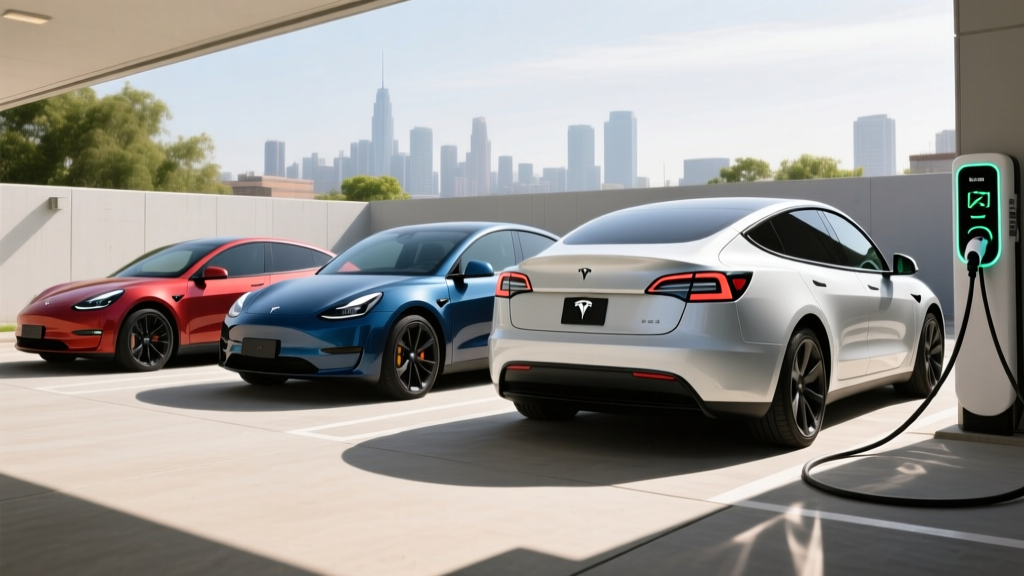
The 2024 Model 3 "Highland" refresh brought a quieter cabin, ventilated seats, a rear touchscreen, and subtle suspension tuning. It remains Tesla's most affordable vehicle and one of the most efficient EVs on the market. The base RWD trim uses an LFP (lithium iron phosphate) battery, while the Long Range and Performance trims use NMC chemistry for greater energy density and range.
Charging the Model 3 RWD (LFP) peaks at roughly 170 kW on a DC fast charger, with a 10–80% session taking about 25–30 minutes. The Long Range model with NMC can sustain up to 250 kW at peak, though real-world charge curves taper significantly above 60% SoC. Expect 10–80% in roughly 25 minutes at a V3 Supercharger. At home on a Level 2 (11.5 kW / 48A) connection, the Model 3 adds approximately 44 miles of range per hour of charging.
The Model 3 RWD qualifies for the full $7,500 federal EV tax credit under §30D, assuming the buyer meets income caps ($150,000 single / $300,000 joint). The Long Range also qualifies. Tesla offers a point-of-sale transfer at checkout, reducing the purchase price directly—effectively bringing the RWD to around $31,490 before destination fees for eligible buyers.
Performance trim buyers should note: the $52,990 MSRP exceeds the $55,000 sedan MSRP cap for the credit, but as of the latest IRS guidance, it remains just under the threshold. Verify current eligibility at fueleconomy.gov.
Tesla Model Y (2024): America's Best-Selling EV
The Model Y needs no introduction—it was the best-selling vehicle globally in 2023 and remains Tesla's volume leader. The 2024 model year carried over largely unchanged ahead of the "Juniper" refresh expected for 2025–2026. It offers crossover practicality with a usable 30.2 cu ft of cargo space behind the second row (72.1 cu ft with seats folded) and an optional third row for very small children.
The Long Range AWD model delivers an EPA-estimated 320 miles and achieves 122 MPGe combined (EPA data). Efficiency sits at roughly 28 kWh per 100 miles—one of the best figures in the crossover segment. The RWD Standard Range (LFP) variant comes in at 260 miles EPA and is the credit-eligible volume play.
| Charge Level | Power / Rate | Model Y Range Added | Full Session Time |
|---|---|---|---|
| Level 1 (120V) | ~1.4 kW | ~4 mi/hr | Days for full charge |
| Level 2 (240V, 48A) | 11.5 kW | ~37 mi/hr | ~8–9 hours (0–100%) |
| DC Fast (V3 Supercharger) | Peak 250 kW | ~200+ mi in 15 min | 10–80% in ~27 min |
| DC Fast (50 kW public) | 50 kW | ~18 mi/hr | 10–80% in ~75 min |
The Model Y Long Range starts at $44,990 and qualifies for the $7,500 credit, bringing the effective price to $37,490 for eligible buyers. This positions it against the Ford Mustang Mach-E Extended Range ($42,995 before credit) and the Hyundai Ioniq 5 ($41,800 before credit). The Model Y's Supercharger network access remains a tangible advantage for road-trippers, though NACS adoption by other automakers is narrowing that gap through 2026.
Tesla Model S and Model X (2024): Flagship Performance, Premium Price
The Model S and Model X occupy a niche: six-figure performance sedans and SUVs with class-leading range and acceleration. The Model S Plaid's 1,020 horsepower and 1.99-second 0–60 time remain staggering. The Model S Long Range achieves an EPA-estimated 402 miles—the highest range of any Tesla—and its 95 kWh (usable) NMC battery pack sustains 250 kW peak DC charging.
However, the $74,990 starting price for the Model S (and $79,990 for the Model X) places both above the $55,000 sedan / $80,000 SUV MSRP cap set by the IRS for §30D credit eligibility. Neither model qualifies for the federal tax credit. For buyers in this price range, the decision typically comes down to performance priorities versus luxury competition from the Lucid Air (up to 516 mi EPA), BMW i7, or Mercedes EQS.
The Model X offers up to 335 miles of range, falcon-wing rear doors, and 88.1 cu ft of cargo space with seats folded. It can tow up to 5,000 pounds—one of the few EV SUVs with meaningful towing capability. Both models include Tesla's full suite of driver-assist features, though it's critical to understand that Autopilot and FSD (Supervised) are SAE Level 2 systems, meaning the driver must remain fully engaged at all times.
Tesla Cybertruck (2024): First-Year Realities
The Cybertruck began deliveries in late 2023, making the 2024 model year its first full production year. Available in AWD ($79,990) and Cyberbeast ($99,990) trims—with a base RWD variant announced for a later date—the Cybertruck delivers up to an estimated 340 miles of range with the optional Range Extender battery pack (sold separately, adding ~130+ miles to the bed-mounted generator-style pack).
The AWD dual-motor produces 600 horsepower and hits 0–60 in 4.1 seconds; the tri-motor Cyberbeast makes 845 horsepower and does 0–60 in 2.6 seconds. The 48-volt electrical architecture and steer-by-wire system represent genuine engineering departures from the rest of the industry.
DC fast charging peaks at an estimated 350 kW (800-volt architecture), with Tesla claiming a 10–80% charge in roughly 20–25 minutes at a V4 Supercharger. However, V4 infrastructure remains limited as of early 2026. The Cybertruck's MSRP exceeds the $80,000 truck/SUV cap, so it does not qualify for the $7,500 federal tax credit. Early production quality has been inconsistent—panel gaps, software bugs, and recall campaigns (notably the accelerator pedal recall in mid-2024) are documented on NHTSA's recall database.
Tax Credits, Pricing, and Total Cost of Ownership
Understanding the real purchase price requires navigating the IRS §30D rules. Here's what applies to Tesla's 2024 lineup as of 2026:
| Model / Trim | Base MSRP | Federal Credit | Effective Price* | Notes |
|---|---|---|---|---|
| Model 3 RWD | $38,990 | $7,500 | ~$31,490 | LFP battery; credit eligible |
| Model 3 Long Range | $42,490 | $7,500 | ~$34,990 | AWD, 363 mi EPA |
| Model 3 Performance | $52,990 | $7,500 | ~$45,490 | Under $55k sedan cap |
| Model Y RWD | $44,990 | $7,500 | ~$37,490 | LFP battery; credit eligible |
| Model Y Long Range | $48,990 | $7,500 | ~$41,490 | AWD, 320 mi EPA |
| Model S Long Range | $74,990 | $0 | $74,990 | Exceeds $55k sedan cap |
| Model X Long Range | $79,990 | $0 | $79,990 | At $80k SUV cap limit |
| Cybertruck AWD | $79,990 | $0 | $79,990 | Exceeds $80k truck cap |
*Effective price assumes full §30D eligibility. Buyer must meet income caps ($150,000 single / $225,000 HOH / $300,000 joint), and the vehicle must meet battery-sourcing and critical-mineral requirements. Tesla's point-of-sale transfer option applies the credit as a direct price reduction at delivery. Verify current rules at irs.gov before purchasing.
Five-year total cost of ownership favors the Model 3 RWD and Model Y RWD heavily, thanks to low electricity costs (roughly $0.04–0.05 per mile on home charging vs. $0.12–0.15 for a comparable gas sedan at $3.50/gal), minimal maintenance, and strong resale values. Insurance premiums for Teslas tend to run 15–25% higher than segment averages—factor this into your budget.
Who Should Buy Which Tesla Model?
Choose the Model 3 RWD if: You want the lowest entry price, primarily commute under 50 miles daily, have home charging, and value efficiency over cargo space. At ~$31,490 after the credit, it's the best value in Tesla's lineup.
Choose the Model 3 Long Range if: You take regular road trips, live in a cold climate (the NMC battery handles range loss better), and want AWD traction. The 363-mile EPA range provides a comfortable buffer.
Choose the Model Y Long Range if: You need family-friendly cargo space (30.2 cu ft rear, 72.1 cu ft flat), occasional third-row seating, and road-trip versatility. It's the default choice for households with kids.
Choose the Model S if: You prioritize range above all else (402 mi EPA), want executive-sedan comfort, and the $75K+ price tag is within budget. Compare carefully against the Lucid Air Pure, which offers similar range at a lower price point.
Choose the Cybertruck if: You need a truck bed, tow occasionally (11,000-lb max towing), and accept first-year production risk. It's not the most efficient or practical truck—but it's unlike anything else on the road.
Pros Across the 2024 Lineup
- Supercharger network access (the most reliable DCFC network in North America)
- Class-leading efficiency and real-world range retention
- Over-the-air updates continuously add features
- Strong resale value relative to most EV competitors
- $7,500 tax credit eligibility on Model 3 and Model Y
- Minimal maintenance costs (no oil, filters, spark plugs)
Cons Across the 2024 Lineup
- FSD (Supervised) remains Level 2—driver must stay fully engaged
- Insurance premiums run 15–25% above segment average
- Model S/X/Cybertruck excluded from federal tax credit
- Minimalist interior lacks physical controls (no turn signal stalk on Model 3 Highland)
- Panel gap and build-quality inconsistency persists on some units
- No Apple CarPlay or Android Auto support
Frequently Asked Questions
What is the real-world range of the 2024 Tesla Model 3 Long Range?
The EPA rates it at 363 miles. In real-world highway driving at 70 mph, expect 290–310 miles. In sub-freezing weather, plan for 220–260 miles. Preconditioning the battery while navigating to a Supercharger helps recover some efficiency.
How fast does the Model Y charge on a DC fast charger?
The Long Range AWD peaks at 250 kW on a V3 Supercharger, reaching 10–80% in about 27 minutes. The RWD LFP variant peaks around 170 kW, taking roughly 28–32 minutes for the same session. Charging slows significantly above 80% SoC to protect the battery.
Does the 2024 Tesla Cybertruck qualify for the $7,500 federal tax credit?
No. The Cybertruck's $79,990+ MSRP exceeds the $80,000 truck/SUV cap under §30D, and the AWD trim's pricing pushes it over. It also must meet battery-sourcing and critical-mineral requirements. Consult the IRS for the latest eligibility guidance.
Is Tesla's FSD actually self-driving?
No. Full Self-Driving (Supervised) is an SAE Level 2 driver-assistance system. It can handle highway lane changes, navigate on-ramps, and manage some city streets, but the driver must remain fully attentive and ready to take over instantly. It is not autonomous. Only Level 4 services like Waymo operate without a human driver in geofenced areas.
Is a 2024 Tesla still worth buying in 2026?
Yes, particularly the Model 3 and Model Y, which continue to offer competitive range, charging speed, and pricing against newer rivals. Used 2024 models may offer strong value on the pre-owned market (eligible for the $4,000 used-EV credit under separate §25E rules). The Supercharger network remains a key ownership advantage, though NACS adoption by Ford, GM, and others is expanding non-Tesla access through 2026.
What is the battery warranty on a 2024 Tesla?
The Model 3 and Model Y carry an 8-year / 100,000–120,000-mile battery warranty (120k for Long Range/Performance, 100k for RWD). The Model S and Model X extend to 8 years / 150,000 miles. The warranty covers defects and capacity loss below 70% of original capacity. Battery replacement out of warranty costs $12,000–$20,000+ depending on the model.