Quick Verdict: Does the 3-Row Model Y Deliver?
The Tesla Model Y XL (sometimes called the Model Y 7-seat variant) stretches the standard Model Y platform to squeeze in a third row, targeting families who want electric efficiency without stepping up to the Model X price tag. For 2026, Tesla has refined the Juniper refresh with improved thermal management, a slightly larger battery pack, and the continuation of the NACS (North American Charging Standard) connector that now works natively across most major public DC fast-charging networks.
But adding a third row to a compact crossover creates trade-offs. The XL's EPA range dips compared to the 5-seat Long Range AWD, cargo space behind the third row is tight, and the rearmost seats are best suited for children. This review breaks down every number that matters — from real-world highway range to 10-80% charging minutes — so you can decide if the Model Y XL fits your family's needs.
| Spec | Value |
|---|---|
| EPA Estimated Range | 300 miles |
| Battery Capacity (usable) | ~79 kWh (NMC chemistry) |
| Drivetrain | Dual-Motor AWD |
| Horsepower | 384 hp (combined) |
| 0-60 mph | 4.8 seconds |
| Max DC Fast Charge Rate | 250 kW (peak) |
| 10-80% DC Charge Time | ~27 minutes |
| Level 2 Home Charge Rate | 11.5 kW (~37 mi/hr) |
| MPGe (combined) | 117 MPGe |
| Efficiency | 29 kWh/100 mi |
| Cargo (behind 3rd row) | 12.0 cu ft |
| Cargo (3rd row folded) | 34.0 cu ft |
| Cargo (max, all rear folded) | 72.0 cu ft |
| 3rd Row Legroom | 26.5 inches |
| Battery Warranty | 8 years / 120,000 miles |
| Base MSRP (Long Range AWD XL) | $49,990 |
Real-World Range: What the EPA Sticker Doesn't Tell You
EPA Estimated Range: 300 miles
Real-World Expectation: 250-275 miles on highway road trips (70-80 mph); 220-250 miles in freezing weather (below 32°F); 280-300 miles in mixed city/suburban driving with moderate regen.
The 300-mile EPA figure is achievable under ideal conditions: moderate temperatures, mixed city-highway driving at lower speeds, and liberal use of regenerative braking. On a 75-mph interstate run in 85°F heat with A/C running, expect roughly 260-275 miles before the battery indicator hits zero. In winter conditions — say a January drive through Colorado at 20°F — range can drop to 220-240 miles due to battery heating demands and cabin climate draw, even with Tesla's heat pump standard on the 2026 model.
The 79 kWh usable battery uses NMC (nickel manganese cobalt) chemistry, which offers higher energy density than LFP (lithium iron phosphate) but benefits from not being routinely charged to 100%. Tesla's onboard battery management recommends a daily charge limit of 80-90% for NMC packs, reserving 100% for road-trip days. This means your everyday usable range is closer to 240-270 miles at a 90% state of charge — still plenty for most commutes, but worth planning around on longer drives.
Compared to the 5-seat Model Y Long Range AWD (EPA 320 miles for 2026), the XL sacrifices roughly 20 miles of range due to the added weight of the third-row structure, heavier rear HVAC ducting, and slightly higher rolling resistance from the load-leveling rear suspension. Per fueleconomy.gov, the efficiency penalty shows up as 29 kWh/100 mi versus the standard Long Range's 27 kWh/100 mi.
Charging Speed: DC Fast, Level 2, and the Charging Curve Reality
| Charging Level | Power (kW) | Miles Added per Hour | Notes |
|---|---|---|---|
| Level 1 (120V household) | ~1.4 kW | ~4-5 mi/hr | Emergency/trickle only; overnight adds ~50 miles |
| Level 2 (240V, 48A) | 11.5 kW | ~37 mi/hr | Full charge in ~7.5 hours; ideal home setup |
| DC Fast Charge (peak) | 250 kW | ~1,000 mi/hr (at peak) | Sustained only briefly; curve tapers sharply above 60% SoC |
| DC Fast 10-80% | — | — | ~27 minutes at a V3/V4 Supercharger |
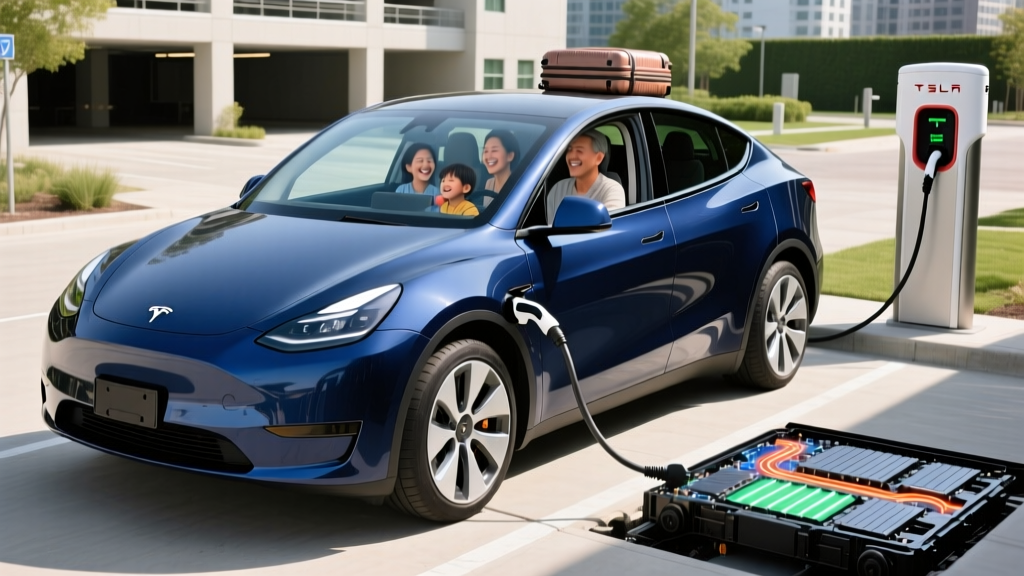
The Model Y XL uses the NACS connector natively, meaning it plugs directly into Tesla Superchargers and, increasingly, Electrify America, EVgo, and ChargePoint stations that have added NACS cables. This is a significant advantage in 2026: the NACS ecosystem has matured well beyond Tesla's own network.
At a V3 or V4 Supercharger (250-350 kW capable), the Model Y XL peaks at 250 kW but only sustains that rate between roughly 10-30% state of charge. By 50% SoC, the rate drops to approximately 150 kW, and above 80% it tapers to under 60 kW. This is the charging curve reality that spec sheets obscure: the 250 kW peak is real, but the average rate across a 10-80% session is closer to 130-140 kW, yielding the ~27-minute 10-80% time.
For home charging, Tesla's Wall Connector at 48 amps on a 60-amp circuit delivers 11.5 kW — enough to add roughly 37 miles of range per hour, or a full 0-100% charge in about 7.5 hours. If your home has a 200-amp electrical panel with spare capacity, installation typically runs $800-$2,000 for the electrician work plus the $475 Wall Connector unit. Homes needing a panel upgrade to 200A should budget an additional $1,500-$3,000.
Performance, Drivetrain, and the Juniper Ride Quality
The 2026 Model Y XL carries over the Juniper generation's dual-motor AWD setup: a permanent-magnet synchronous motor on the rear axle and an induction motor up front, combining for 384 hp and an estimated 360 lb-ft of torque. The 0-60 mph sprint clocks in at 4.8 seconds — quick for a 7-seat family hauler, though 0.3 seconds slower than the 5-seat Long Range AWD due to the XL's roughly 150-lb weight penalty.
Ride quality on the Juniper platform is notably improved over the pre-2025 Model Y. Tesla retuned the suspension with softer damper settings and added acoustic laminated glass to the front and rear windows, cutting cabin noise at highway speed. The XL shares these improvements. However, with the third row occupied and cargo loaded, the rear suspension can feel firm over sharp bumps — a consequence of the load-leveling setup prioritizing stability over plushness.
Regenerative braking remains strong, with Tesla's one-pedal driving mode capable of bringing the car to a complete stop without touching the brake pedal in most traffic scenarios. The blended braking feel is among the best in the EV segment.
Pricing, Trims, and Federal Tax Credit Eligibility
| Trim / Config | Base MSRP | Est. After §30D Credit* |
|---|---|---|
| Long Range AWD XL (7-seat) | $49,990 | $42,490 (if eligible for full $7,500) |
| Long Range AWD XL + FSD (Supervised) | $57,990 | $50,490 |
*Federal tax credit eligibility depends on multiple factors. See details below.
The Model Y XL is offered exclusively in the Long Range AWD configuration for 2026 — there is no base RWD or Performance trim for the 7-seat variant. The $49,990 base MSRP (before destination) positions it against the Kia EV9, Hyundai Ioniq 9, and the upper trims of the Volkswagen ID.4 with third-row packages.
Federal §30D Tax Credit: Do You Qualify?
- MSRP Cap: The Model Y XL at $49,990 falls under the $80,000 SUV/van cap for §30D. ✓
- Buyer Income Cap: Modified AGI must not exceed $150,000 (single), $225,000 (head of household), or $300,000 (joint filers). Verify via IRS.gov §30D guidelines.
- Battery Sourcing: The $7,500 credit splits into two halves — $3,750 for critical minerals and $3,750 for battery component sourcing. As of 2026, Tesla sources an increasing share of battery materials domestically and from FTA partners, but exact eligibility can shift with supply chain changes. Confirm current-year status on the IRS qualified vehicles list before purchasing.
- Point-of-Sale Transfer: Under current rules, you can transfer the credit to the dealer at purchase, reducing your out-of-pocket cost immediately rather than waiting for tax filing. Tesla supports this at checkout.
- Foreign Entity of Concern (FEOC): Battery components or critical minerals from FEOC sources (certain Chinese, Russian, North Korean, or Iranian entities) can disqualify part or all of the credit. Tesla's vertically integrated supply chain has largely avoided this, but verify the current model year's status.
Bottom line: Most buyers who meet the income thresholds and purchase a new Model Y XL will likely qualify for the full $7,500 credit in 2026, bringing the effective price to roughly $42,490. However, always confirm eligibility with a tax professional and the latest IRS guidance before committing.
Interior, Cargo, and Third-Row Practicality
The Model Y XL's defining feature is its third row, but buyers should go in with realistic expectations. The 26.5 inches of third-row legroom is tight — comfortable for children up to about 12 years old, or for adults on short trips under 30 minutes. Compare that to the Kia EV9's 32.0 inches of third-row legroom, and the Model Y XL clearly prioritizes cargo flexibility over adult third-row comfort.
Behind the third row, you get 12.0 cubic feet of cargo space — enough for a couple of grocery bags or a compact stroller, but not much more. Fold the third row flat (a 50/50 split) and cargo volume jumps to 34.0 cu ft, competitive with midsize SUVs. Fold both rear rows and the XL opens up to 72.0 cu ft, which handles furniture-store runs and camping gear with ease.
The Juniper-generation interior carries over: a 15.4-inch center touchscreen running Tesla's latest software, ventilated front seats, heated second-row seats (third-row heating is not standard), a panoramic glass roof with improved UV-blocking tint for 2026, and a front trunk (frunk) offering roughly 4.1 cu ft of additional storage. Build quality has improved noticeably since the Fremont-built pre-2025 models, with tighter panel gaps and higher-grade soft-touch materials on the dash and door panels.
Tech, Autopilot, and Driver-Assistance Features
Every 2026 Model Y XL comes standard with Tesla's Basic Autopilot, which includes Traffic-Aware Cruise Control and Autosteer (lane-centering) on divided highways. This is a SAE Level 2 driver-assistance system — meaning the driver must remain fully attentive, keep hands on the wheel (or demonstrate engagement via Tesla's camera-based monitoring), and be prepared to take over instantly.
SAE Automation Level: Level 2 (Partial Automation)
Tesla Autopilot and FSD (Supervised) are Level 2 systems. They do NOT make the vehicle self-driving. The driver is legally and operationally responsible for all vehicle control at all times. Level 4 driverless capability (no human needed) currently exists only in geofenced robotaxi services like Waymo — not in any consumer vehicle you can buy.
The optional Full Self-Driving (Supervised) package ($8,000 in 2026) adds automatic lane changes, Navigate on Autopilot (highway on/off-ramp handling), Autopark, Smart Summon (low-speed parking lot navigation), and traffic light/stop sign recognition. FSD (Supervised) has improved substantially with Tesla's v13 neural-network architecture, but it still requires active supervision and can make unexpected decisions in construction zones, unmapped areas, or complex intersections. It is not a substitute for an attentive driver.
The infotainment system remains one of the best in the industry: fast, responsive, with Netflix/YouTube streaming while parked, a built-in trip planner that factors in charging stops and battery preconditioning, and over-the-air updates that regularly add features. Wireless phone mirroring is notably absent — Tesla uses its own native ecosystem rather than Apple CarPlay or Android Auto.
What Autopilot and FSD (Supervised) Do NOT Do:
- Drive the car without a licensed, attentive driver in the seat
- Handle all weather conditions (heavy rain, snow, fog degrade camera performance)
- Navigate unmapped roads or complex construction zones reliably
- Replace the driver's legal responsibility for the vehicle
Pros, Cons, and How It Stacks Up Against Competitors
Pros
- Access to the mature Supercharger network via native NACS connector
- Best-in-class efficiency for a 3-row EV SUV (29 kWh/100 mi)
- Strong 0-60 performance (4.8s) for the segment
- Over-the-air updates continuously improve the vehicle
- Competitive pricing after federal tax credit (~$42,490 effective)
- Excellent trip-planning software with battery preconditioning
- Improved Juniper ride quality and cabin noise levels
Cons
- Third-row legroom (26.5 in) is tightest in the 3-row EV SUV class
- Only 12 cu ft of cargo behind the third row
- No Apple CarPlay or Android Auto support
- FSD (Supervised) is expensive and still requires full driver attention
- No Performance or RWD trim option for the XL
- NMC battery requires 80-90% daily charge limit for longevity
- Insurance premiums tend to run 15-25% above segment average
Model Y XL vs. Key Competitors
The most direct rivals in the 3-row electric SUV space for 2026 include:
- Kia EV9 (Long Range AWD): EPA 280 mi, ~$56,000 base, far more third-row room (32.0 in), slower DC charging (peak ~210 kW), CCS connector (with NACS adapter needed for Superchargers).
- Hyundai Ioniq 9 (announced/preliminary): Expected EPA 300+ mi, competitive pricing, larger third row, NACS native for 2026. Still early in market availability.
- Volkswagen ID.4 (with optional 3rd row): EPA ~260 mi, significantly lower starting price (~$42,000), much slower charging and smaller battery, CCS connector.
Choose the Tesla Model Y XL if:
- Your third-row passengers are primarily children
- You prioritize Supercharger network access and charging speed
- You want the lowest energy cost per mile in the segment
- Tesla's software ecosystem and OTA updates matter to you
Choose a competitor (Kia EV9, etc.) if:
- Adults will regularly ride in the third row
- You need maximum cargo space behind all three rows
- You prefer traditional dealership service and CarPlay/Android Auto
Warranty and Long-Term Battery Outlook
Tesla covers the 2026 Model Y XL's battery and drive unit for 8 years or 120,000 miles, whichever comes first, with a minimum 70% capacity retention threshold. If the battery degrades below 70% of its original capacity within that window, Tesla will repair or replace it at no cost.
The vehicle's limited warranty covers 4 years / 50,000 miles for the basic vehicle. This is on par with BMW and Mercedes-Benz but falls short of Hyundai/Kia's 5-year/60,000-mile basic and 10-year/100,000-mile powertrain coverage.
On NMC battery longevity: real-world data from Tesla's fleet suggests NMC packs retain approximately 88-92% capacity after 100,000 miles when charged primarily to 80-90% and avoiding prolonged 100% states of charge. The Model Y XL's thermal management system (liquid-cooled with the heat pump integrated) is among the most effective in the industry for mitigating degradation, particularly in hot climates.
Frequently Asked Questions
What is the real-world range of the Tesla Model Y XL?
The EPA rates the 2026 Model Y XL at 300 miles. In real-world highway driving at 70-80 mph, expect 250-275 miles. In freezing weather, plan for 220-250 miles. Daily driving at a 90% charge limit yields roughly 240-270 usable miles.
How fast does the Model Y XL charge at home and on the road?
At home on a Level 2 (240V, 48A) Tesla Wall Connector, it charges at 11.5 kW, adding about 37 miles per hour — a full charge takes roughly 7.5 hours. On a DC fast charger (V3/V4 Supercharger), it peaks at 250 kW and charges from 10-80% in approximately 27 minutes, though the charging curve tapers significantly above 60% SoC.
How much does the Model Y XL cost after federal tax credits?
The base MSRP is $49,990. If you qualify for the full $7,500 federal §30D tax credit (meeting income caps, MSRP limits, and battery sourcing requirements), the effective price drops to approximately $42,490. Confirm eligibility at IRS.gov and with a tax professional before purchasing.
Does the Tesla Model Y XL qualify for the $7,500 federal EV tax credit?
As of 2026, the Model Y XL is expected to qualify for the full $7,500 credit for buyers meeting the income thresholds ($300,000 joint / $150,000 single AGI cap). The MSRP of $49,990 is well under the $80,000 SUV cap. Battery sourcing compliance with FEOC rules has been strong for Tesla, but always verify the current model year's status on the IRS qualified vehicle list.
Is the Model Y XL worth buying versus the Kia EV9 or other 3-row EVs?
If your priority is charging infrastructure, energy efficiency, and software, the Model Y XL is the strongest choice. If third-row adult comfort and maximum cargo are paramount, the Kia EV9 is more practical. The Model Y XL's ~$42,490 effective price (after tax credit) undercuts most competitors, but the trade-off is a tighter third row and limited behind-third-row cargo.
Can the Model Y XL tow?
Tesla rates the 2026 Model Y XL at 3,500 lbs of towing capacity when equipped with the factory tow package. Towing significantly reduces range — expect a 30-50% range reduction depending on trailer weight, aerodynamics, and terrain. Plan charging stops accordingly.
Is the third row safe for child car seats?
The third row includes LATCH anchors on both outboard positions. However, the tight legroom means rear-facing car seats may press against the second-row seatbacks. Forward-facing seats fit more comfortably. Always verify fit with your specific car seat model before purchase. Check NHTSA's car seat guidelines for proper installation standards.