The Quick Answer: Does Tesla Have a Hotspot?
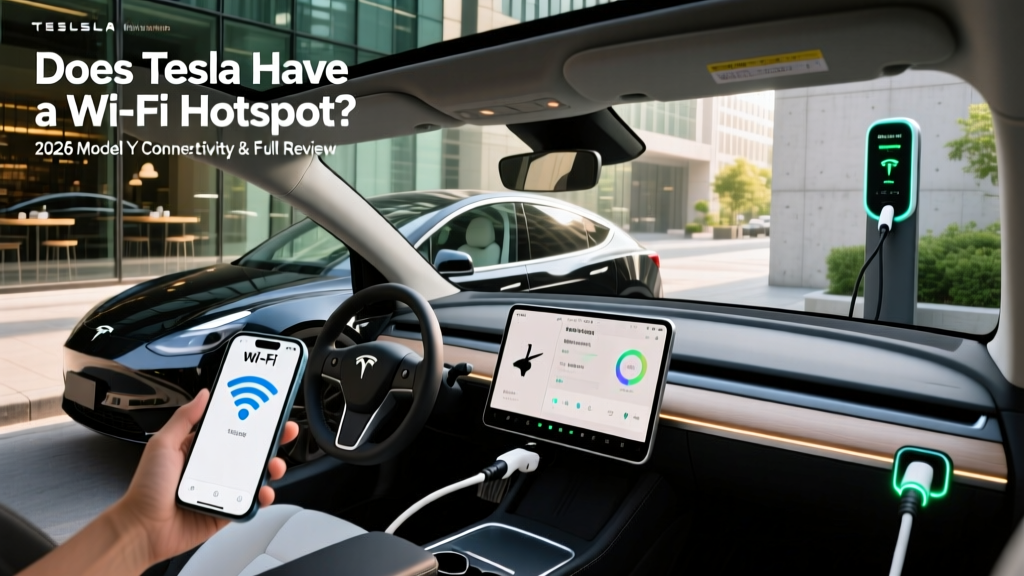
Yes — every current Tesla vehicle, including the 2026 Model Y, functions as a Wi-Fi hotspot through Tesla's Premium Connectivity subscription. The car's built-in LTE/5G modem shares its cellular connection with up to five devices simultaneously, turning your Tesla into a rolling workspace. However, this isn't a free perk: it requires the $9.99/month (or $99/year) Premium Connectivity add-on, and streaming throughput is modest compared to a dedicated mobile hotspot device.
With Standard Connectivity (included free), your Tesla still streams navigation, music, and software updates over cellular — but the in-car Wi-Fi hotspot feature, live traffic visualization, satellite maps, and video streaming are locked behind the Premium tier. For buyers evaluating the Model Y, connectivity is just one piece of the puzzle. Let's break down the full ownership picture.
2026 Tesla Model Y: Spec Sheet at a Glance
| Specification | Value |
|---|---|
| EPA Estimated Range | 320 miles |
| Real-World Highway Range | ~265–285 mi (75 mph, moderate temps) |
| Battery Capacity (usable) | ~75 kWh (NMC chemistry) |
| Max DC Fast Charge Rate | 250 kW (peak) |
| 10–80% DC Fast Charge Time | ~25 minutes |
| Level 2 Home Charge Rate | 11.5 kW (~44 mi/hr) |
| 0–60 mph | 4.8 seconds |
| Horsepower | 384 hp (dual motor) |
| Drivetrain | Dual Motor AWD |
| Efficiency | 122 MPGe combined / 27 kWh/100 mi |
| Cargo Volume (rear seats up) | 30.2 cu ft |
| Cargo Volume (rear seats folded) | 72.0 cu ft |
| Front Legroom | 41.8 in |
| Rear Legroom | 39.5 in (Juniper refresh) |
| Base MSRP (Long Range AWD) | $44,990 |
| Performance Trim MSRP | $51,490 |
| Battery & Drive Unit Warranty | 8 years / 120,000 miles |
| Basic Vehicle Warranty | 4 years / 50,000 miles |
Source: fueleconomy.gov and Tesla's official specifications.
Real-World Range: What to Actually Expect
The Juniper-refreshed Model Y benefits from improved aerodynamics and thermal management compared to the pre-2025 generation. Tesla's heat pump system scavenges waste heat from the drive unit and battery to warm the cabin, reducing the winter range penalty that plagues older EVs without this technology. Still, physics is physics: cold electrolyte moves ions more slowly, and dense cold air increases drag. Plan charging stops accordingly on sub-freezing road trips.
For city-dominant commuting with regular regenerative braking, you'll land closer to the EPA sticker — sometimes even exceeding it in stop-and-go traffic where regen recovers kinetic energy. Highway driving at sustained 80+ mph is where the Model Y (and every EV) loses the most ground against its sticker range.
Charging Speed: DC Fast, Level 2, and the Charge Curve
Understanding the Model Y's charging behavior requires distinguishing between kW (power — the rate of charging) and kWh (energy — the battery's capacity). Think of kW as how fast water flows from a hose, and kWh as the size of the bucket.
| Charge Level | Power (kW) | Miles Added per Hour | Typical Use Case |
|---|---|---|---|
| Level 1 (120V household) | ~1.4 kW | ~4–5 mi/hr | Emergency / overnight trickle |
| Level 2 (240V, Wall Connector) | 11.5 kW | ~44 mi/hr | Home daily charging |
| DC Fast (Supercharger V3) | 250 kW peak | ~200 mi in 15 min | Road trips |
The charge curve matters. The 250 kW peak rate applies only in a narrow state-of-charge (SoC) window — roughly 10% to 35%. Above 50% SoC, the rate tapers significantly. By 80%, you're typically pulling 60–90 kW. This is why Tesla (and every automaker) quotes 10–80% times rather than 0–100%: the final 20% is deliberately slow to protect battery longevity. A full 10–80% session at a V3 Supercharger takes approximately 25 minutes under ideal battery preconditioning conditions.
Preconditioning is critical. When you navigate to a Supercharger using the car's built-in navigation, the Model Y pre-warms the battery to optimal temperature before you arrive. Without preconditioning — for example, pulling into a charger with a cold-soaked battery in winter — your peak charge rate may be cut by 40–60% for the first several minutes. Always route through the nav system to maximize charging speed.
At home, the Tesla Wall Connector on a 60-amp circuit delivers 11.5 kW (48 amps continuous, per NEC 80% rule). This adds roughly 44 miles of range per hour, meaning a depleted battery fully replenishes in about 7–8 hours overnight. Most owners who charge nightly at home rarely visit a public charger except on road trips.
Premium Connectivity and the Wi-Fi Hotspot Explained
Returning to the core question: the Tesla Wi-Fi hotspot is a software-defined feature enabled through Premium Connectivity. Here's what each tier includes:
- Standard Connectivity (free): Basic navigation, Bluetooth audio streaming, over-the-air (OTA) software updates via Wi-Fi or cellular, Tesla app remote access.
- Premium Connectivity ($9.99/mo or $99/yr): Wi-Fi hotspot for passenger devices, live traffic visualization on the map, satellite-view maps, video streaming (Netflix, YouTube, etc. while parked), Caraoke, and internet browser.
The hotspot shares the vehicle's AT&T or similar cellular connection. Speeds are generally adequate for email, web browsing, and video calls on one or two devices, but don't expect fiber-like throughput when multiple passengers stream 4K video. For heavy data use — large file downloads, competitive gaming — a dedicated phone hotspot or mobile Wi-Fi device will outperform it. Tesla does not publish an official data cap, but heavy sustained usage may trigger throttling per the carrier's fair-use policy.
Worth noting: the Model Y also connects to your home Wi-Fi network when parked in range, which is the preferred method for downloading large OTA updates (they can exceed 1 GB). This doesn't require Premium Connectivity.
Pricing, Tax Credits, and True Cost
| Trim | MSRP | Est. Federal Credit (§30D) | Effective Price |
|---|---|---|---|
| Long Range AWD | $44,990 | Up to $7,500* | ~$37,490* |
| Performance AWD | $51,490 | Up to $7,500* | ~$43,990* |
*Federal EV tax credit eligibility under IRS §30D depends on multiple factors that change periodically. Key requirements include:
- MSRP cap: SUVs/vans must be at or below $80,000 (Model Y qualifies).
- Buyer income cap: Modified AGI must not exceed $150,000 (single), $225,000 (head of household), or $300,000 (joint).
- Battery sourcing: A percentage of critical minerals and battery components must be sourced from the US or free-trade-agreement countries — these thresholds tighten annually. Tesla's US-built LFP and NMC packs have largely met requirements, but verify current-year eligibility at fueleconomy.gov before purchasing.
- Point-of-sale transfer: As of 2024, eligible buyers can transfer the credit to the dealer at purchase, receiving the discount upfront rather than waiting to claim it on their tax return. Tesla participates in this program.
Always confirm eligibility with a tax professional. State and local incentives (California's CVRP, Colorado's innovative motor vehicle credit, utility rebates) stack on top and can reduce the effective price further, but vary widely by jurisdiction.
Autopilot, FSD, and Driver-Assist Technology
The 2026 Model Y comes standard with Basic Autopilot: adaptive cruise control and lane-centering assist on marked highways. The $6,000 FSD (Supervised) upgrade adds automatic lane changes, Navigate on Autopilot (highway on-ramp to off-ramp), traffic light and stop sign recognition, and Autopark. Tesla's vision-only approach (no LiDAR or radar in current models) relies on neural networks processing camera feeds — impressive in many scenarios but occasionally hesitant at unprotected left turns or construction zones.
Competing systems like GM's Super Cruise and Ford's BlueCruise offer hands-free driving on pre-mapped divided highways, which some drivers find less fatiguing than Tesla's torque-sensing wheel requirement. Neither system is "self-driving" — all require supervision.
Pros and Cons
- Supercharger network: 6,000+ US stations, unmatched reliability
- Class-leading efficiency (122 MPGe combined)
- Over-the-air updates continuously add features
- Spacious cargo area (72 cu ft max) with flat load floor
- Strong resale value relative to EV segment
- Heat pump standard for better winter range
- No Apple CarPlay or Android Auto — Tesla OS only
- Wi-Fi hotspot requires $9.99/mo Premium Connectivity
- Ride quality firm on 20-inch wheels
- Turn-signal stalk removed (steering-wheel buttons)
- Rear visibility compromised by sloping roofline
- FSD (Supervised) at $6,000 remains Level 2 — not autonomous
Who Should Buy the 2026 Tesla Model Y?
Best for: Tech-forward commuters and small families who want a single-vehicle solution for daily driving and road trips. The Supercharger network makes long-distance travel genuinely practical, and the 30+ cu ft cargo area handles weekly groceries, strollers, or camping gear with ease. If you work remotely from your car (video calls, email) and value the built-in Wi-Fi hotspot, the Model Y with Premium Connectivity is a legitimate mobile office.
Consider alternatives if: You need three-row seating (look at the Kia EV9 or Rivian R1S), you want Apple CarPlay integration (Hyundai Ioniq 5, Ford Mustang Mach-E), or you prioritize ride comfort over sporty handling (the refreshed Model Y is firmer than the Hyundai Ioniq 5's adaptive setup).
Frequently Asked Questions
Does Tesla have a Wi-Fi hotspot in every model?
Yes. Every current Tesla (Model 3, Model Y, Model S, Model X, Cybertruck) can function as a Wi-Fi hotspot, but the feature requires the Premium Connectivity subscription at $9.99/month or $99/year. Without it, the car still uses cellular for its own navigation and streaming, but cannot share that connection with passenger devices.
How many devices can connect to the Tesla hotspot?
Tesla supports up to five simultaneous device connections. Throughput is shared across all connected devices and depends on local cellular signal strength. In urban areas with strong 5G coverage, expect usable speeds for video calls and streaming; in rural areas, speeds may drop to basic browsing levels.
What is the real-world range of the 2026 Model Y?
The EPA rates the Long Range AWD at 320 miles. Real-world highway driving at 70–75 mph in moderate temperatures yields approximately 265–285 miles. In freezing conditions, expect 220–250 miles. City driving with regenerative braking can approach or match the EPA figure.
Does the 2026 Tesla Model Y qualify for the $7,500 federal tax credit?
The Model Y has historically qualified for the full $7,500 §30D credit, but eligibility depends on current-year battery sourcing requirements, your income level, and the vehicle's MSRP (must be ≤$80,000 for SUVs). The point-of-sale transfer option lets you apply the credit as an upfront discount. Verify current status at fueleconomy.gov and consult a tax professional.
Is the Tesla Model Y worth buying over the Hyundai Ioniq 5 or Ford Mach-E?
The Model Y wins on charging infrastructure (Supercharger network), efficiency, and cargo space. The Ioniq 5 offers faster 10–80% charging (18 min on 350 kW chargers), Apple CarPlay, and a more comfortable ride. The Mach-E provides a more traditional crossover feel with competitive range. Your priority — infrastructure vs. comfort vs. ecosystem — determines the best fit.
How much does home charging installation cost?
A Tesla Wall Connector installation on an existing 60-amp circuit typically runs $500–$1,500 (equipment + electrician). If your electrical panel needs a service upgrade to 200 amps, expect $2,000–$4,000 additional. Always get a quote from a licensed electrician before committing to a purchase.