What Does "Tesla Home for Sale" Actually Mean in 2026?
Search real estate platforms long enough and you'll encounter listings marketed as a "Tesla home for sale" — properties that come pre-equipped with Tesla Wall Connectors, Powerwall battery backups, solar arrays, or even bundled Tesla vehicles. For EV buyers, these listings can represent a genuine shortcut: skip the electrician, skip the permitting, and plug in on day one. But the value of a Tesla-ready home depends entirely on the underlying hardware, electrical panel capacity, and whether the installed equipment matches the vehicles you actually plan to own.
This guide breaks down what to inspect in a Tesla-equipped home, pairs it with the current specs for Tesla's two most popular vehicles — the 2026 Model 3 and Model Y — and explains the charging, tax-credit, and ownership math you need before making an offer.
2026 Tesla Model 3 & Model Y: Spec Snapshot
| Spec | Model 3 Long Range AWD | Model Y Long Range AWD |
|---|---|---|
| EPA Range | 341 miles | 320 miles |
| Battery (usable) | ~75 kWh (NMC) | ~75 kWh (NMC) |
| Peak DC Fast Charge | 250 kW | 250 kW |
| 10–80% DCFC Time | ~25 min | ~27 min |
| Level 2 Charge Rate | 11.5 kW (~44 mi/hr) | 11.5 kW (~44 mi/hr) |
| 0–60 mph | 4.2 sec | 4.8 sec |
| Horsepower | ~384 hp (dual motor) | ~384 hp (dual motor) |
| Drivetrain | AWD (dual motor) | AWD (dual motor) |
| Efficiency | 132 MPGe / 25 kWh/100mi | 122 MPGe / 28 kWh/100mi |
| Cargo Volume | 23 cu ft (rear trunk + frunk) | 76 cu ft (rear seats folded) |
| Rear Legroom | 35.2 in | 41.6 in |
| Base MSRP | $47,740 | $48,630 |
| Battery Warranty | 8 yr / 120,000 mi | 8 yr / 120,000 mi |
Both vehicles use the NACS (North American Charging Standard) connector natively. This is the same connector used by Tesla Superchargers and, as of 2025–2026, increasingly adopted by Ford, GM, Rivian, Volvo, and other manufacturers at third-party DC fast-charging networks.
EPA estimates assume a mix of city and highway driving at moderate temperatures. In practice:
- Highway-only at 75 mph: Expect ~280–300 miles (Model 3) and ~260–280 miles (Model Y) — aerodynamic drag cuts efficiency roughly 15–18% vs. the EPA combined cycle.
- Cold weather (below 32°F): Range can drop 20–30% due to battery resistance and cabin heating. A Model 3 Long Range might deliver ~240 miles on a cold highway trip.
- City/stop-and-go: Regenerative braking helps you approach or occasionally exceed EPA numbers in mild conditions.
Inspecting a Tesla-Equipped Home: What to Check
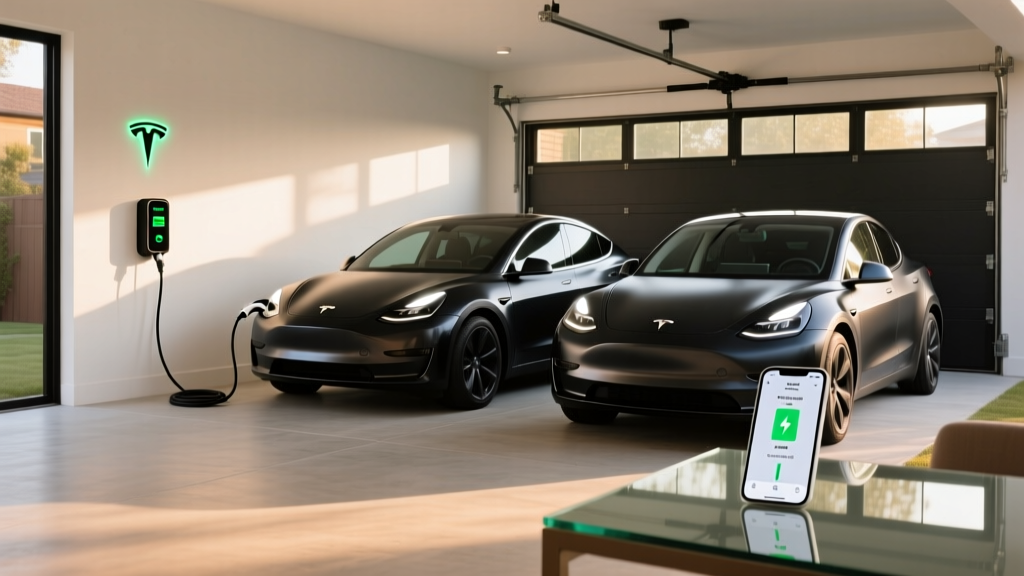
A home listed as "Tesla-ready" or "Tesla-equipped" typically includes one or more of the following: a Tesla Wall Connector (Gen 3 or Gen 4), a 240V NEMA 14-50 outlet, a Powerwall home battery, and/or rooftop solar panels. Here's what to verify before you assume the setup is move-in ready.
The Wall Connector and Electrical Panel
The Tesla Wall Connector Gen 3 delivers up to 11.5 kW on a 60-amp circuit, which adds roughly 44 miles of range per hour to a Model 3 or Model Y. That's enough to fully recharge overnight from any realistic daily driving distance. But confirm:
- Circuit breaker size: A 60A breaker requires 6-gauge wire and a panel with sufficient spare capacity. A 48A breaker (common in older installs) delivers ~9.6 kW / ~37 mi/hr — still excellent.
- Panel capacity: Most homes need a 200-amp service panel to comfortably support a 60A EV circuit alongside electric ranges, dryers, and HVAC. Homes with 100A panels may need a costly upgrade ($2,000–$5,000+).
- Connector type: Gen 3 Wall Connectors use NACS natively. If the home has a J1772 charger instead, you'll need a NACS adapter (included with Tesla vehicles for Level 2 charging).
Powerwall and Solar Pairing
A Tesla Powerwall 3 (13.5 kWh usable capacity, continuous 11.5 kW output) can serve as a backup power source and, when paired with solar, can offset your EV charging costs. A typical two-Powerwall setup can keep a refrigerator, lights, and a Level 2 charger running during an outage — though charging an EV from battery alone will deplete the Powerwall quickly (roughly one partial charge).
Charging Speed Breakdown: Home vs. Supercharger
| Charging Level | Power (kW) | Miles Added per Hour | Full Charge Time (10–80%) |
|---|---|---|---|
| Level 1 (120V household) | ~1.2 kW | ~3–5 mi/hr | Not practical for daily use |
| Level 2 (NEMA 14-50, 32A) | ~7.7 kW | ~30 mi/hr | ~6.5 hours |
| Level 2 (Wall Connector, 48A) | ~11.5 kW | ~44 mi/hr | ~4.5 hours |
| DC Fast (Supercharger V3) | Peak 250 kW | ~1,000+ mi/hr (peak) | ~25–27 min (10–80%) |
Charging curve reality: The 250 kW peak at a V3 Supercharger only sustains at low state-of-charge (roughly 10–30%). Above 50% SoC, the rate tapers significantly — by 80% you're typically pulling 60–80 kW. This is normal lithium-ion behavior, not a defect. Tesla's navigation system preconditions the battery when you route to a Supercharger, warming it to optimal temperature so you hit peak rates on arrival. Without preconditioning (e.g., arriving at a charger with a cold battery), expect slower initial charge rates, especially in winter.
Pricing, Tax Credits, and Total Cost
As of early 2026, Tesla's lineup qualifies for the federal §30D EV tax credit, but eligibility depends on several buyer-specific and vehicle-specific factors that shift with IRS guidance and battery-sourcing rules.
- Vehicle MSRP cap: Vans/SUVs/pickups ≤ $80,000; sedans ≤ $55,000. The Model 3 ($47,740 base) qualifies on price. The Model Y ($48,630 base, classified as SUV) qualifies on price.
- Buyer income cap: AGI ≤ $150,000 (single), $225,000 (head of household), $300,000 (married filing jointly).
- Battery sourcing: Critical minerals and battery components must meet phased-in domestic/free-trade-partner thresholds that tighten annually. Check the latest IRS qualified vehicle list before purchase.
- Point-of-sale transfer: As of 2024+, you can transfer the credit to the dealer at purchase for an immediate price reduction, rather than waiting to claim it on your tax return.
- Credit amount: Up to $7,500, split between critical-mineral ($3,750) and battery-component ($3,750) requirements. Many Tesla vehicles currently qualify for the full $7,500, but verify at purchase.
| Trim | Base MSRP | Max §30D Credit | Effective Price* |
|---|---|---|---|
| Model 3 Long Range AWD | $47,740 | $7,500 | ~$40,240 |
| Model 3 Performance | $54,990 | $0 (sedan MSRP cap) | $54,990 |
| Model Y Long Range AWD | $48,630 | $7,500 | ~$41,130 |
| Model Y Performance | $52,490 | $7,500 | ~$44,990 |
*Effective price assumes full §30D eligibility. The Model 3 Performance exceeds the $55,000 sedan MSRP cap and does not qualify. Always confirm current-year rules with a tax professional and the IRS clean vehicle credit page.
Tech, Driver Assistance, and Interior
Tesla's infotainment runs on a 15.4-inch center touchscreen with no physical instrument cluster. The system handles navigation, media, climate, and vehicle settings — all software-driven. Over-the-air updates add features regularly, and the interface remains among the most responsive in the EV market.
Tesla's Autopilot (included) and optional Full Self-Driving (Supervised) are both classified as SAE Level 2 driver-assist systems. The driver must remain attentive, keep hands on the wheel (or demonstrate engagement via cabin monitoring), and be prepared to take over at any moment. FSD Supervised can navigate city streets, stop lights, and highway interchanges, but it makes errors and requires active supervision. It is not autonomous driving (Level 4). Only fully driverless services like Waymo operate at Level 4 in limited geofenced areas.
Notable interior observations:
- Ventilated front seats were added to the refreshed Model 3 (Highland) and carry into 2026.
- Rear-seat entertainment screen (8-inch) is standard on Long Range and Performance trims.
- No turn signal stalks: The refreshed Model 3 uses steering-wheel-mounted buttons for turn signals — a polarizing choice that takes weeks to build muscle memory for.
- Build quality has improved significantly post-Fremont and Austin production ramp, though panel-gap variation still surfaces in some deliveries.
Pros and Cons at a Glance
- Access to the Tesla Supercharger network — the most reliable and extensive DC fast-charging network in North America (50,000+ global connectors)
- Class-leading efficiency: 25 kWh/100mi (Model 3) means lower electricity cost per mile than nearly any competitor
- Over-the-air updates continuously improve the vehicle post-purchase
- NACS connector now the industry standard — future-proof for resale and cross-brand charging
- Strong resale value relative to most EV competitors
- Service center wait times can stretch weeks in high-demand metro areas
- No Apple CarPlay or Android Auto — Tesla's native system only
- Turn-signal buttons on the steering wheel frustrate some drivers
- FSD Supervised costs $8,000 (or $99/month) and still requires full driver attention
- Insurance premiums run 15–30% higher than comparable gas sedans in many states
Who Should Buy — and Who Should Look Elsewhere?
- You commute 30–80 miles daily and want the lowest cost-per-mile EV sedan available
- You prioritize driving dynamics — the Model 3 handles more like a sport sedan than a crossover
- You don't regularly carry more than two rear-seat passengers or bulky cargo
- You need family cargo space (76 cu ft with seats folded accommodates strollers, bikes, and road-trip gear)
- You want the higher seating position and easier ingress/egress of a crossover
- You plan to tow (Model Y tow rating: 3,500 lbs — adequate for a light trailer or small boat)
- You need 3-row seating (consider the Rivian R1S or Kia EV9)
- You want Apple CarPlay integration (consider Hyundai Ioniq 5 or BMW i4)
- Your daily commute exceeds 250 miles one-way without mid-route charging access
Frequently Asked Questions
What is the real-world range of the 2026 Tesla Model 3 and Model Y?
The Model 3 Long Range carries an EPA rating of 341 miles, but real-world highway driving at 75 mph typically yields 280–300 miles. In cold weather (below freezing), expect 240–270 miles on the highway. The Model Y Long Range is EPA-rated at 320 miles, with real-world highway range around 260–280 miles and cold-weather highway range of roughly 220–250 miles.
How fast does a Tesla charge at home and on the road?
At home on a Tesla Wall Connector (48A/11.5 kW), both vehicles gain approximately 44 miles of range per hour — a full overnight charge covers any daily driving. At a V3 Supercharger, peak rate is 250 kW, with a 10–80% session taking roughly 25–27 minutes. Remember that charge speed tapers significantly above 80% SoC.
How much does a Tesla cost after the federal tax credit?
The Model 3 Long Range AWD starts at $47,740 MSRP and may qualify for the full $7,500 §30D credit, bringing the effective price to approximately $40,240 — assuming you meet income caps and the vehicle meets battery-sourcing requirements. The Model Y Long Range starts at $48,630 and similarly may reach ~$41,130 after credit. The Model 3 Performance ($54,990) exceeds the $55,000 sedan cap and does not qualify. Verify current eligibility on the IRS qualified vehicles list.
Does a Tesla qualify for the federal EV tax credit in 2026?
Most Model 3 and Model Y trims qualify for up to $7,500 under §30D, subject to buyer income limits ($150K single / $300K joint), vehicle MSRP caps, and battery critical-mineral and component sourcing thresholds. The credit can be transferred to the dealer at point of sale for an immediate price reduction. Rules tighten annually — always check IRS.gov before purchasing.
Is a "Tesla home for sale" worth the premium?
It depends on the installed equipment. A home with a professionally installed Tesla Wall Connector on a 60A circuit, a 200A electrical panel, and proper permitting saves you $1,000–$2,500 in installation costs and weeks of waiting. A Powerwall adds $10,000–$15,000 in value (installed) if you live in an area with frequent outages or time-of-use electricity rates. Always request permits and inspection records — an unpermitted charger install is a liability, not an asset.
Is the Tesla Model 3 or Model Y worth buying vs. competitors?
Against the Hyundai Ioniq 6 (EPA 361 mi, ~$42,000), the Model 3 sacrifices some range but wins on charging infrastructure (Supercharger network), software, and resale value. Against the Ford Mustang Mach-E (EPA ~312 mi, ~$45,000), the Model Y offers slightly better efficiency and faster DC charging. Tesla's key differentiator in 2026 remains the integrated Supercharger ecosystem and software maturity — if those matter to you, the premium (where it exists) is justified.