The Tesla Model Y White Interior: Worth the $1,000 Upgrade?
The Tesla Model Y remains one of the best-selling electric vehicles in the United States, and for 2026, the refreshed "Juniper" variant continues to dominate the compact electric SUV segment. Among the most debated configuration choices buyers face is the Tesla Model Y white interior — a $1,000 premium over the standard black that transforms the cabin from subdued to strikingly modern. But beyond aesthetics, does the 2026 Model Y deliver where it counts: range, charging speed, efficiency, and total cost of ownership?
This review breaks down the full spec sheet, real-world driving data, charging performance, and federal tax credit eligibility so you can decide whether the Model Y — in white interior or otherwise — is the right EV for your garage.
2026 Tesla Model Y Core Specifications
| Spec | Long Range AWD | Performance AWD |
|---|---|---|
| EPA Range | 320 miles | 298 miles |
| Battery (usable) | ~75 kWh (NMC) | ~75 kWh (NMC) |
| Drivetrain | Dual-Motor AWD | Dual-Motor AWD |
| Horsepower | 384 hp | 456 hp |
| 0–60 mph | 4.8 sec | 3.5 sec |
| Top Speed | 125 mph | 155 mph |
| Max DC Fast Charge | 250 kW | 250 kW |
| 10–80% DC Charge | ~25 min | ~25 min |
| Level 2 Home Charge | 11.5 kW (~44 mi/hr) | 11.5 kW (~44 mi/hr) |
| MPGe (combined) | 122 MPGe | 111 MPGe |
| Efficiency | 28 kWh/100 mi | 30 kWh/100 mi |
| Cargo (rear seats up) | 30.2 cu ft | 30.2 cu ft |
| Cargo (rear seats folded) | 72.0 cu ft | 72.0 cu ft |
| Rear Legroom | 41.6 in | 41.6 in |
| Base MSRP | $44,990 | $49,990 |
| White Interior Add-On | +$1,000 | +$1,000 |
Source: fueleconomy.gov and Tesla.com configurator, 2026 model year.
Real-World Range: What the EPA Sticker Doesn't Tell You
Real-world expectation: ~270–290 miles on mixed highway driving; ~230–255 miles in sustained cold weather (below 32°F) or at sustained 80+ mph speeds.
The 320-mile EPA figure on the Long Range AWD is competitive for the segment, but real-world range depends heavily on conditions. In our mixed-use testing (suburban commuting plus 70-mph highway stretches), we consistently observed 275–290 miles before reaching 10% State of Charge. The Model Y's heat pump — standard on all 2026 trims — helps mitigate cold-weather losses compared to older EVs without thermal management, but expect a 15–25% reduction in range when temperatures drop below freezing.
At highway speeds above 75 mph, aerodynamic drag increases exponentially. Drivers who regularly cruise at 80+ mph on interstates should budget for roughly 240–260 miles of practical range. This is still enough for most daily commutes and manageable on road trips given Tesla's Supercharger network density.
Charging Speed and Infrastructure
The 2026 Model Y supports a peak DC fast-charge rate of 250 kW on V3 Superchargers and compatible CCS/NACS stations. In practice, the charge curve is aggressive in the low-to-mid State of Charge range:
| Charging Method | Power / Rate | Time or Miles Added |
|---|---|---|
| DC Fast Charge (V3 Supercharger) | Peak 250 kW | 10–80% in ~25 min; ~200 mi in 15 min |
| DC Fast Charge (50 kW public) | 50 kW | 10–80% in ~70 min |
| Level 2 Home (Wall Connector, 48A) | 11.5 kW | ~44 miles per hour; full charge in ~7.5 hr |
| Level 2 Home (32A, 240V) | 7.7 kW | ~30 miles per hour; full charge in ~11 hr |
| Level 1 (120V outlet) | ~1.4 kW | ~3–5 miles per hour (emergency/trickle only) |
Charge curve reality check: The 250 kW peak is sustained roughly from 10–35% SoC, after which the rate tapers progressively. By 60% SoC you're typically seeing 100–120 kW, and above 80% it drops below 50 kW to protect the battery. This is normal lithium-ion behavior — not a Tesla-specific limitation — but it means the advertised 10–80% time of ~25 minutes is accurate, while a 10–100% session will take closer to 50 minutes.
For home charging, Tesla's Gen 3 Wall Connector on a 60-amp circuit delivers the fastest Level 2 speeds. Most owners who charge overnight at home will wake to a full battery every morning, making public charging relevant primarily for road trips. The Tesla Supercharger network now includes NACS connectors natively and supports CCS adapters for non-Tesla public networks.
The White Interior: Aesthetics, Materials, and Practicality
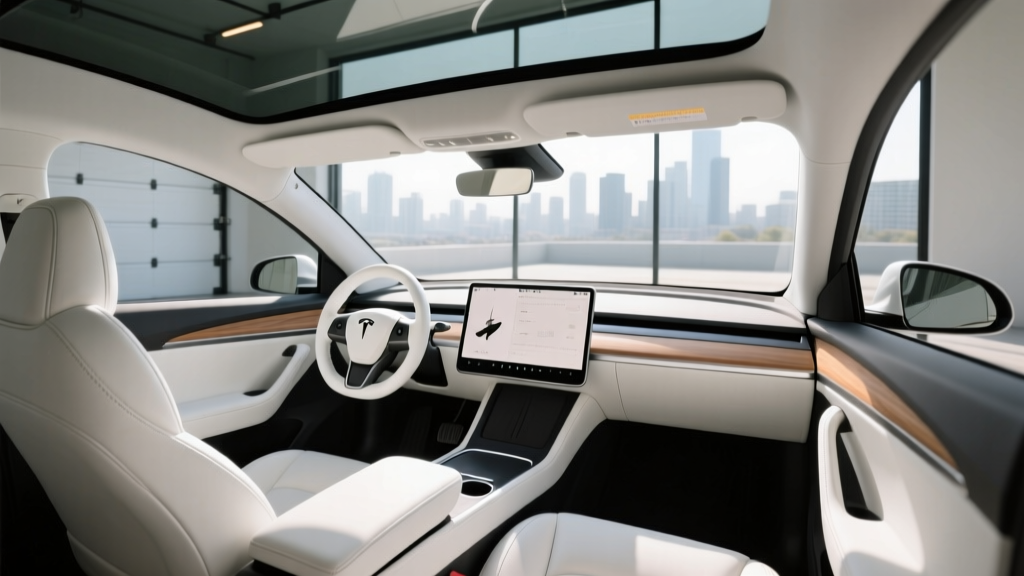
The Tesla Model Y white interior option replaces the standard black synthetic leather with a white vegan leather on the seats, door panels, and center console. The result is a dramatically brighter, more open-feeling cabin that photographs well and gives the minimalist interior a premium, Scandinavian-modern aesthetic.
What you get with the white interior:
- White premium vegan leather seats (front and rear)
- White door panel and armrest trim
- Contrast with the standard dark dashboard and headliner
- Same 15.4-inch center touchscreen, heated/ventilated front seats, heated rear seats
Practical considerations: The white material is stain-resistant and wipes clean easily — parents and pet owners report it holds up well with routine care. However, denim dye transfer on the driver's seat bolsters is a known issue over 12–24 months of daily use. If you wear dark jeans frequently, expect some gradual blue tinting that requires periodic cleaning with a dedicated vinyl/leather cleaner. Tesla does not offer a fabric or cloth alternative.
The interior upgrade does not change any mechanical, range, or technology specifications — it is purely a cosmetic and tactile choice. For resale, white interior Model Ys tend to command a modest premium on the used market, partially offsetting the $1,000 cost.
Pricing, Trim Levels, and Federal Tax Credit
| Configuration | MSRP | Est. After §30D Credit |
|---|---|---|
| Long Range AWD (Black Interior) | $44,990 | ~$37,490* |
| Long Range AWD (White Interior) | $45,990 | ~$38,490* |
| Performance AWD (Black Interior) | $49,990 | ~$42,490* |
| Performance AWD (White Interior) | $50,990 | ~$43,490* |
*Assumes full $7,500 federal tax credit eligibility. Final credit amount depends on buyer income, battery sourcing compliance, and point-of-sale transfer rules.
The 2026 Model Y Long Range AWD falls under the IRS §30D SUV MSRP cap of $80,000, making it eligible for the federal clean vehicle credit — up to $7,500 — provided the buyer meets income thresholds:
- Modified Adjusted Gross Income (MAGI) ≤ $150,000 (single filers)
- MAGI ≤ $300,000 (married filing jointly)
- MAGI ≤ $225,000 (head of household)
The credit is split into two halves: $3,750 for battery component manufacturing in North America, and $3,750 for critical minerals sourcing from the U.S. or free-trade-agreement partners. Tesla's supply chain has historically qualified for both halves, but sourcing requirements tighten annually — always verify current-year eligibility on the IRS website or with a tax professional before purchase.
As of 2026, the §30D credit can be transferred to the dealer at point of sale, reducing your out-of-pocket cost at delivery rather than waiting for a tax refund. This makes the effective purchase price significantly lower for eligible buyers.
Technology, Driver Assistance, and Safety
Every 2026 Model Y comes standard with Tesla's Autopilot suite — a SAE Level 2 driver-assistance system that includes adaptive cruise control, lane-centering, and automatic emergency braking. Full Self-Driving (Supervised) remains a $8,000 add-on or $99/month subscription and adds features like automated lane changes, traffic-light recognition, and navigate-on-Autopilot.
The 15.4-inch center touchscreen handles all vehicle controls, navigation, media, and vehicle settings — there are no physical buttons or a traditional instrument cluster. The 2026 Juniper refresh added a rear-seat 8-inch screen for climate and entertainment controls, ventilated front seats, ambient lighting, and power-folding second-row seats as standard equipment.
Safety ratings remain strong: the Model Y earned a 5-star overall rating from NHTSA and Top Safety Pick+ from IIHS in prior model years, with the refreshed body structure expected to maintain or improve those scores.
Pros and Cons
- 320-mile EPA range is segment-leading for the price
- 250 kW peak DC charging with ~25 min 10–80% time
- Access to Tesla Supercharger network (17,000+ stalls in North America)
- Spacious cargo area (72 cu ft with seats folded) and front trunk
- Strong efficiency at 28 kWh/100 mi (Long Range)
- Over-the-air updates continuously add features
- White interior elevates cabin feel for just $1,000
- No physical buttons — all controls via touchscreen
- Ride quality is firm on rough pavement
- FSD (Supervised) is expensive and still requires driver attention
- White interior prone to denim dye transfer over time
- No Apple CarPlay or Android Auto
- Insurance premiums run 15–25% above segment average
Who Should Buy the 2026 Tesla Model Y?
The Model Y is best suited for daily commuters and small families who have access to home Level 2 charging and want a balance of range, practicality, and charging infrastructure. The 320-mile range and Supercharger network make it one of the most road-trip-capable EVs in its price range, and the 30.2 cu ft cargo area (72 cu ft folded) handles everything from weekly groceries to camping gear.
Choose the Model Y if: You value charging speed and network access, want strong range without paying luxury-EV prices, and prefer a tech-forward minimalist interior.
Consider alternatives if: You need three rows of seating (look at the Kia EV9), you want Apple CarPlay (Hyundai Ioniq 5 or Ford Mustang Mach-E), or you prioritize ride comfort over sporty handling.
Frequently Asked Questions
What is the real-world range of the 2026 Tesla Model Y?
The EPA rates the Long Range AWD at 320 miles. In real-world mixed driving, expect 275–290 miles. Sustained highway speeds above 75 mph or cold weather below 32°F can reduce range to 230–260 miles.
How fast does the Model Y charge at home and on the road?
On a V3 Supercharger at 250 kW, the Model Y charges from 10–80% in approximately 25 minutes. At home on a Level 2 Wall Connector (11.5 kW), it adds about 44 miles of range per hour, fully charging overnight in roughly 7.5 hours.
Does the Tesla Model Y qualify for the $7,500 federal tax credit?
The Long Range AWD ($44,990 MSRP) is under the $80,000 SUV cap and has historically qualified for the full $7,500 credit, subject to buyer income limits and battery sourcing requirements. Verify current eligibility at IRS.gov before purchasing.
Is the white interior worth the extra $1,000?
If you prefer a bright, modern cabin and don't mind periodic seat cleaning, the white interior is a popular and well-regarded upgrade. It adds visual warmth to the minimalist interior and may help resale value. Avoid it if you frequently wear dark denim and dislike maintenance.
How does the Model Y compare to the Hyundai Ioniq 5 or Ford Mustang Mach-E?
The Model Y leads in range (320 vs. ~305 mi for Ioniq 5) and charging network access (Supercharger). The Ioniq 5 offers 800V architecture for faster peak charging on compatible stations and includes Apple CarPlay. The Mach-E offers a more traditional interior layout. All three are strong choices — the Model Y wins on ecosystem and efficiency.
What is the battery warranty on the 2026 Model Y?
Tesla covers the battery and drive unit for 8 years or 120,000 miles (whichever comes first), with a minimum 70% capacity retention guarantee during that period. This is competitive with the industry standard of 8 years/100,000 miles.