The Tesla Model Y remains the best-selling electric vehicle in the United States for good reason: it threads the needle between crossover utility, efficiency, and access to the Supercharger network. But for buyers comparing it against the Hyundai Ioniq 5, Ford Mustang Mach-E, or Kia EV6, one question consistently tops search queries — just how practical is the Tesla Model Y trunk space when you're loading groceries, strollers, or luggage for a family road trip?
This review breaks down the 2026 Tesla Model Y's cargo dimensions with real numbers, then pairs them against the EV specs that matter just as much: EPA range, DC fast-charging throughput, battery chemistry, and out-the-door pricing after federal tax credits. If you're cross-shopping midsize electric SUVs, this is the data you need.
2026 Tesla Model Y Core Specs at a Glance
| Spec | Value |
|---|---|
| EPA Range | 320 miles (Long Range AWD) |
| Battery (usable) | ~75 kWh, NMC chemistry |
| Efficiency | 122 MPGe combined / 28 kWh/100 mi |
| Peak DC Fast Charge | 250 kW (Supercharger V3/V4) |
| 10–80% DC Time | ~25 minutes (preconditioned) |
| Level 2 Home Charge | 11.5 kW (~44 mi/hr) |
| 0–60 mph | 4.8 sec (Long Range AWD) |
| Horsepower | 384 hp (dual-motor) |
| Drivetrain | Dual-motor AWD |
| Battery/Drive Unit Warranty | 8 years / 120,000 miles |
| Base MSRP (Long Range AWD) | $44,990 |
Sources: EPA fueleconomy.gov, Tesla.com Model Y specs.
Tesla Model Y Trunk Space and Cargo Dimensions
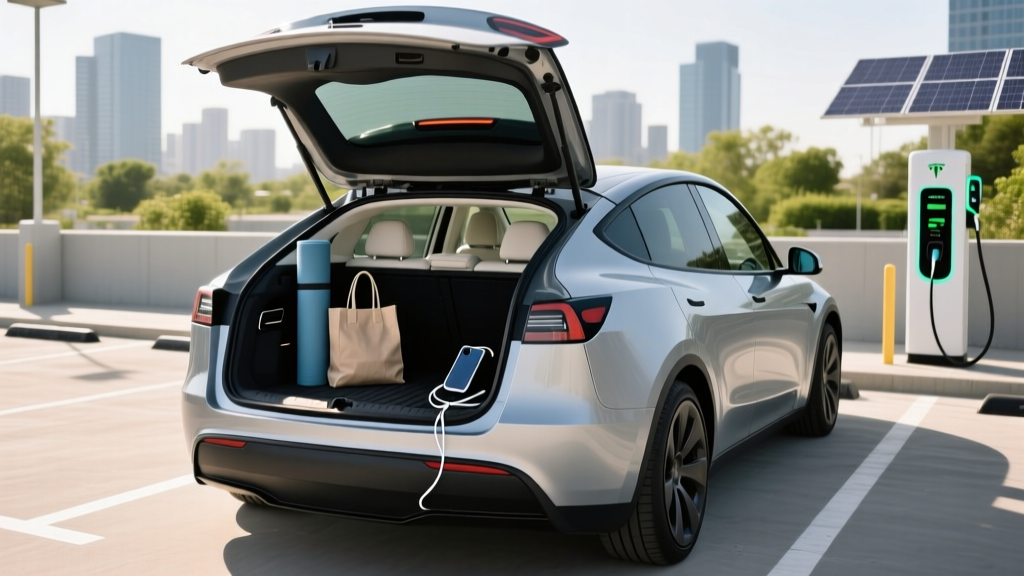
The headline number for the 2026 Model Y (post-refresh "Juniper" architecture) is 30.2 cubic feet of cargo volume behind the second row, expanding to 72.1 cubic feet with the 60/40 split rear seats folded flat. Tesla also retains a small front trunk (frunk) offering roughly 4.1 cubic feet — enough for a charging cable kit, a backpack, or a small soft cooler.
How That Compares to Rivals
| Vehicle | Behind 2nd Row (cu ft) | Max Cargo (cu ft) | Frunk |
|---|---|---|---|
| Tesla Model Y (2026) | 30.2 | 72.1 | 4.1 cu ft |
| Hyundai Ioniq 5 | 27.2 | 59.3 | 0.85 cu ft |
| Ford Mustang Mach-E | 29.7 | 59.7 | 4.7 cu ft |
| Kia EV6 | 24.4 | 50.2 | 0.7 cu ft |
The Model Y's liftgate opening is wide and the load floor is flat, which matters more in daily use than the raw cubic-foot number. A double stroller fits width-wise with room for two carry-on bags alongside it. With seats folded, we've loaded four full-size suitcases plus two duffels without stacking above the window line. The under-floor rear storage bin (where a spare tire would traditionally live) adds roughly another 2.5 cubic feet of hidden, secure storage — ideal for jumper cables, a tire inflator, or detailing supplies.
Passenger Space Context
Second-row legroom measures 40.5 inches, and rear headroom sits at 39.4 inches — adequate for two adults on a long trip, though the sloping roofline does cut into headroom for passengers over 6'2". The refresh improved rear-seat cushion angle and padding, addressing one of the pre-2025 Model Y's most common complaints.
Real-World Range: What the EPA Number Doesn't Tell You
Real-World Expectation: 270–290 mi highway at 70 mph; 240–260 mi in sub-30°F winter; 300+ mi in mild city/suburban driving with regen.
The Model Y Long Range AWD's ~75 kWh usable NMC battery delivers class-leading efficiency — roughly 28 kWh per 100 miles — which is why it extracts 320 EPA miles from a smaller pack than many competitors. That efficiency advantage shows up on road trips: at 70 mph on flat interstate in 65°F weather, expect roughly 280 miles before you want to stop at 10% SoC.
Cold weather is the great equalizer. In sustained sub-freezing temperatures (20°F–30°F), plan for a 20%–25% range reduction, dropping realistic highway range to around 250 miles. The Model Y's heat pump (standard since 2021) mitigates cabin-heating losses, but battery chemistry still resists charging and discharging in the cold. Always precondition the battery via the Tesla app or scheduled departure when winter fast-charging — skipping this step can cut peak charge rates in half.
Charging Speed: DC Fast, Level 2, and the Supercharger Advantage
The 2026 Model Y Long Range supports a peak DC fast-charge rate of 250 kW on V3 and V4 Superchargers. In practice, the charge curve peaks near 250 kW only between roughly 10%–30% SoC, then tapers progressively. A preconditioned 10%–80% session takes approximately 25 minutes, adding roughly 200 miles of range. Expect 15%–20% longer times in cold weather without thorough preconditioning.
| Level | Power | Miles Added | Notes |
|---|---|---|---|
| Level 1 (120V) | ~1.4 kW | ~4 mi/hr | Emergency/trickle only |
| Level 2 (240V, 48A) | 11.5 kW | ~44 mi/hr | Wall Connector; full overnight charge |
| Level 2 (240V, 32A Mobile) | 7.7 kW | ~30 mi/hr | Mobile Connector with NEMA 14-50 |
| DC Fast (Supercharger V3/V4) | 250 kW peak | ~200 mi in 25 min (10–80%) | Preconditioning required for peak rate |
| DC Fast (CCS via adapter) | ~150 kW typical | Varies by network | EA, EVgo, ChargePoint — adapter included on new cars |
With the 2025+ adoption of the NACS (North American Charging Standard) as the industry connector, the Model Y now has native access to an expanding network of non-Tesla chargers deploying NACS cables, alongside its longstanding Supercharger access. For CCS-only networks, Tesla includes a CCS adapter with new vehicles.
Home charging on a 48A Wall Connector on a 60A circuit delivers the full 11.5 kW — enough to replenish a 50%–100% charge in roughly 5 hours. If your panel can't support a 60A dedicated circuit, a 32A setup on a 40A breaker still provides ~30 mi/hr, which covers most daily driving needs.
Pricing, Trims, and Federal Tax Credit Eligibility
The 2026 Model Y is offered in two primary configurations:
- Long Range AWD: $44,990 MSRP (320 mi EPA)
- Performance AWD: $48,990 MSRP (295 mi EPA, 3.3-sec 0–60)
A base RWD variant has periodically been listed around $39,990 but availability fluctuates — confirm on Tesla.com before planning a purchase.
| Trim | MSRP | §30D Credit (if eligible) | Effective Price |
|---|---|---|---|
| Long Range AWD | $44,990 | Up to $7,500 | As low as $37,490 |
| Performance AWD | $48,990 | Up to $7,500 | As low as $41,490 |
§30D Federal Tax Credit Rules (2026)
The Model Y qualifies for the full $7,500 federal EV tax credit under IRS §30D, provided the buyer meets all of the following (rules current as of 2026 and subject to legislative change):
- MSRP cap: SUVs must be under $80,000 — both trims qualify.
- Buyer income cap: Modified AGI ≤ $150,000 (single) / $300,000 (married filing jointly).
- Battery sourcing: Critical-minerals and battery-component thresholds must be met — Tesla's US-assembled packs with qualified sourcing currently satisfy both halves for the full $7,500.
- Point-of-sale transfer: Buyers can apply the credit as an instant rebate at delivery, reducing the financed amount rather than waiting for a tax return.
Verify current eligibility on IRS.gov §30D before purchasing. State incentives (California, Colorado, Massachusetts, etc.) may stack on top but vary by jurisdiction — consult your state's energy office or a tax professional.
Tech, Driver Assistance, and What's Actually Standard
The refreshed Model Y carries Tesla's current infotainment stack on a 15.4-inch center touchscreen, with a secondary 8-inch rear screen for passengers. Navigation, over-the-air updates, Sentry Mode dashcam recording, and the Tesla mobile app's climate/preconditioning controls are all standard.
Basic Autopilot (Traffic-Aware Cruise Control + Autosteer) is included. Enhanced Autopilot ($6,000) adds Navigate on Autopilot, Auto Lane Change, and Smart Summon. Full Self-Driving (Supervised) ($8,000 or $99/month subscription) enables city-street autosteering — but this remains an SAE Level 2 system requiring continuous driver supervision. It is not autonomous driving, despite the branding. Hands-on-wheel monitoring and visual attention are mandatory at all times.
Pros, Cons, and Who the Model Y Actually Suits
Pros
- Class-leading cargo volume (30.2 / 72.1 cu ft) among electric crossovers
- Best-in-class efficiency (~28 kWh/100 mi) stretches the battery further
- Supercharger network reliability remains the gold standard for road trips
- Over-the-air updates continuously add features post-purchase
- Strong resale value relative to EV segment average
- Qualifies for full $7,500 federal credit (as of 2026)
Cons
- Minimalist interior isn't for everyone — no physical buttons, no instrument cluster
- Ride quality firm on larger wheel options (20" Inductions)
- FSD (Supervised) subscription is an ongoing cost for a Level 2 system
- No Apple CarPlay / Android Auto — Tesla-only ecosystem
- Rear visibility is compromised by the sloping roofline; relies on backup camera
- Insurance premiums run 15%–30% higher than comparable ICE crossovers
Who Should Buy It
Choose the Model Y if: you need maximum cargo flexibility in an EV, regularly road-trip beyond reliable non-Tesla charging networks, want the longest real-world range per dollar in the segment, and prefer a tech-forward, app-integrated ownership experience.
Look elsewhere if: you want physical buttons and a traditional instrument cluster (Ioniq 5, EV6), need three rows (Kia EV9), prioritize the softest ride quality, or want Apple CarPlay integration.
Warranty and Long-Term Ownership
Tesla covers the Model Y's battery and drive units for 8 years or 120,000 miles, whichever comes first, with a guaranteed minimum 70% capacity retention over that period. The limited vehicle warranty is 4 years / 50,000 miles. Real-world data from high-mileage Teslas shows NMC packs typically retaining 85%–90% State of Health at 100,000 miles when owners avoid habitual 100% charges and frequent DC fast-charging.
For battery longevity, Tesla recommends daily charging to 80%–90% for NMC packs and reserving 100% charges for road trips. This is different from LFP chemistry (used in some RWD variants), which tolerates regular 100% charges — always confirm your specific pack chemistry via the Tesla app.
Frequently Asked Questions
Does the Tesla Model Y trunk fit a full-size stroller?
Yes. A full-size double stroller (e.g., UPPAbaby Vista, Bugaboo Donkey) fits width-wise behind the second row with roughly 8–10 cubic feet remaining for a diaper bag and groceries.
How does the Model Y cargo space compare to a RAV4?
The gas Toyota RAV4 offers 37.6 cu ft behind the second row and 69.8 cu ft max. The Model Y trails slightly on the behind-seat number but wins on max volume (72.1 cu ft) due to its flat load floor and frunk.
Is the Model Y a good road-trip EV in 2026?
Yes — it remains the benchmark. With 320 EPA miles, 250 kW Supercharger capability (10–80% in ~25 min), and the densest fast-charging network in North America, long-distance travel is more seamless than any competitor.
Does the 2026 Model Y qualify for the $7,500 federal tax credit?
Yes, as of 2026 both the Long Range and Performance trims qualify for the full $7,500 under §30D, subject to buyer income caps ($150k single / $300k MFJ) and battery-sourcing rules. The credit can be transferred at point-of-sale as an instant rebate. Confirm current rules at IRS.gov.
What's the real-world winter range?
In sustained 20°F–30°F conditions at highway speeds, expect 240–260 miles. Use Scheduled Departure and battery preconditioning to mitigate losses, and rely on seat/steering-wheel heaters rather than cabin air when possible.
Can I tow with the Model Y?
Yes — the Model Y is rated to tow up to 3,500 lbs when equipped with the factory tow hitch. Expect a 30%–40% range reduction at highway speeds while towing a loaded trailer.