Tesla Model Y Trunk and Cargo: What the Numbers Actually Mean
Search "Tesla Model Y trunk" and you'll find forum debates about whether a double stroller fits, whether the sub-trunk is worth the hype, and whether the 2025 Juniper refresh changed the cargo math. The short answer: the Model Y remains one of the most practical compact electric SUVs on the market, but the real cargo story is more nuanced than the headline cubic-footage figure suggests.
The 2026 Tesla Model Y carries over the Juniper-generation architecture introduced in early 2025, with a slightly reshaped rear hatch, revised taillight bar, and a reconfigured rear load floor. Tesla officially rates the cargo volume at 30.2 cubic feet behind the second row and 72.1 cubic feet with the rear seats folded (per Tesla's spec page). Add the front trunk (frunk) — roughly 4.1 cu ft — and you're looking at a total enclosed storage figure near 76 cu ft.
But raw numbers don't tell the whole story. Let's break down the trunk's real-world usability, then evaluate the full vehicle: range, charging, pricing, and whether it still earns its spot against the Hyundai Ioniq 5, Ford Mustang Mach-E, and Chevrolet Equinox EV in 2026.
Trunk Dimensions, Sub-Trunk, and Real-World Packing
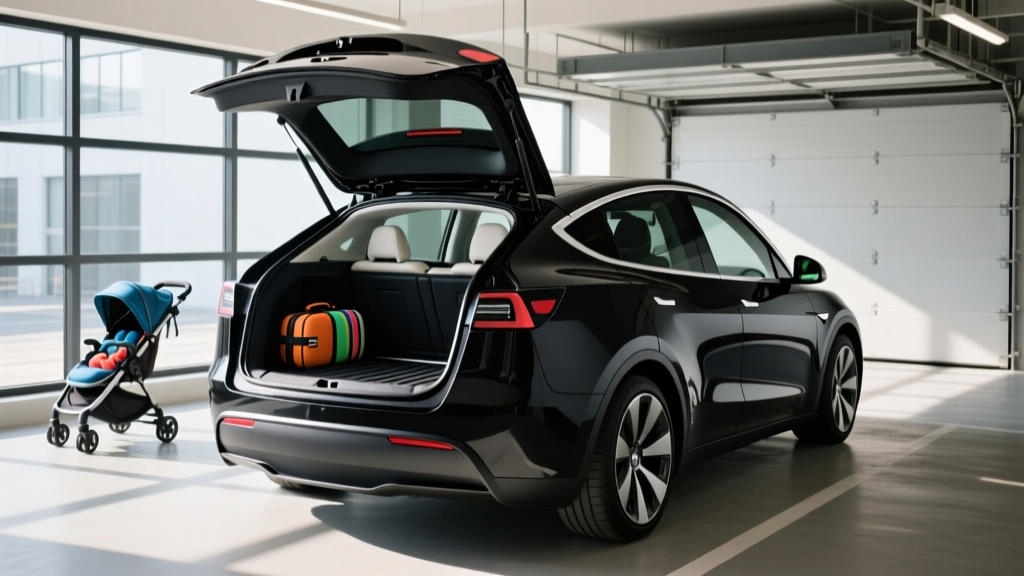
The Model Y's rear cargo area measures approximately 37 inches wide between the wheel wells, 31 inches deep (seatback to hatch), and 27 inches tall at the lowest point of the sloped hatch glass. That sloping roofline is the Model Y's cargo Achilles' heel: tall items like large dog crates or upright furniture lose clearance quickly toward the rear glass.
The Sub-Trunk Advantage
Below the main load floor sits a secondary storage compartment — often called the "sub-trunk" — offering roughly 2.8 cubic feet of additional sealed space. This is ideal for charging cables, emergency kits, groceries that might roll, or a laptop bag you don't want visible through the hatch glass. It's a feature competitors like the Ioniq 5 and Mach-E lack, and it meaningfully extends practical storage.
Frunk Usability
The front trunk (4.1 cu ft) accommodates a standard carry-on suitcase or a medium cooler. It's not the deepest frunk on the market — the Ford F-150 Lightning dwarfs it — but for a compact SUV, it's a genuine bonus that competitors with traditional front-end packaging can't match.
Real-World Packing Tests
- Double stroller (e.g., UPPAbaby Vista): Fits in the main trunk with room to spare for a diaper bag, but requires collapsing the stroller frame.
- Four carry-on suitcases: All four fit — two in the main trunk, one in the sub-trunk, one in the frunk.
- Mountain bikes (2): Front wheels off, both fit with seats folded. Tight squeeze at the hatch due to roofline slope.
- Costco run (large haul): Seats folded, you'll fit approximately 12-15 standard reusable bags plus flat items.
Full Specs: Range, Battery, and Charging
| Specification | Long Range AWD | Performance AWD | RWD (Base) |
|---|---|---|---|
| EPA Range | 320 mi | 295 mi | 295 mi |
| Battery (usable) | ~75 kWh (NMC) | ~75 kWh (NMC) | ~60 kWh (LFP) |
| Drivetrain | Dual Motor AWD | Dual Motor AWD | Single Motor RWD |
| Horsepower | 384 hp | 456 hp | 295 hp |
| 0–60 mph | 4.8 sec | 3.5 sec | 6.6 sec |
| MPGe (combined) | 122 MPGe | 111 MPGe | 130 MPGe |
| Efficiency | 28 kWh/100 mi | 30 kWh/100 mi | 26 kWh/100 mi |
| Max DC Charge Rate | 250 kW | 250 kW | 170 kW |
| 10–80% DC Time | ~25 min | ~25 min | ~30 min |
| Level 2 Home Rate | 11.5 kW (44 mi/hr) | 11.5 kW (44 mi/hr) | 11.5 kW (44 mi/hr) |
| Base MSRP | $47,990 | $52,490 | $44,990 |
Charging Speed and the Supercharger Advantage
Tesla's peak 250 kW DC fast-charge rate on Long Range and Performance trims isn't the highest on paper — the Hyundai Ioniq 5 peaks at 350 kW on an 800V architecture — but Tesla's charge-curve management is among the best. The Model Y sustains above 150 kW through roughly 50% state of charge before tapering. At a V3 or V4 Supercharger, a 10–80% session takes about 25 minutes. The LFP-equipped RWD model peaks lower (170 kW) and takes roughly 30 minutes for the same window.
For home Level 2 charging on a 48-amp circuit (the recommended Tesla Wall Connector setup), all trims accept 11.5 kW, adding roughly 44 miles of range per hour. A full overnight charge from 20% to 80% takes about 4 hours — well within a standard overnight window.
Pricing, Tax Credits, and Ownership Costs
The 2026 Model Y lineup starts at $44,990 for the RWD base model and climbs to $52,490 for the Performance trim. These prices include destination but exclude the $139 annual Supercharger membership (now required for non-Tesla Supercharger access for some legacy plans — Tesla's policies have shifted, so confirm at purchase).
Federal Tax Credit Eligibility (§30D)
Under current IRS rules (irs.gov §30D), the Model Y qualifies as an SUV with an MSRP cap of $80,000 — all trims clear this easily. However, eligibility for the full $7,500 credit depends on:
- Buyer income limits: Modified AGI ≤ $300,000 (joint), $225,000 (head of household), $150,000 (single).
- Critical minerals & battery component sourcing: As of 2026, 100% of battery components must be manufactured or assembled in North America, and a rising percentage of critical minerals must be sourced from the U.S. or FTA partners. Tesla's Fremont and Austin-built Model Y batteries have largely met these thresholds, but confirm your specific VIN's eligibility with your tax professional before purchase.
- Point-of-sale transfer: You can elect to transfer the credit to the dealer at purchase, reducing your out-of-pocket cost immediately — this effectively drops the RWD to roughly $37,490 and the Long Range to $40,490 for qualifying buyers.
| Trim | MSRP | After $7,500 Credit* | Est. Monthly (72-mo, 5.5%) |
|---|---|---|---|
| RWD (Base) | $44,990 | $37,490 | ~$618 |
| Long Range AWD | $47,990 | $40,490 | ~$668 |
| Performance AWD | $52,490 | $44,990 | ~$742 |
*Assumes full §30D eligibility. Verify income, sourcing, and MSRP requirements at irs.gov before purchase. State incentives vary — check AFDC for your state.
Technology, Driver Assistance, and Interior
The Juniper-refreshed Model Y interior is markedly improved over the pre-2025 generation. Ventilated front seats, ambient lighting, a rear-seat touchscreen, and power-folding second-row seats are now standard or widely available. The 15.4-inch center touchscreen runs Tesla's latest UI with improved navigation, a trip planner that accounts for charging-curve taper and elevation, and integrated dashcam/sentry mode recording.
Autopilot and FSD (Supervised)
Every Model Y ships with basic Autopilot (traffic-aware cruise control and lane centering). Full Self-Driving (Supervised) remains an $8,000 option or $99/month subscription. Important clarification: FSD is an SAE Level 2 system — it requires active driver supervision at all times. It does not make the Model Y a self-driving car. FSD handles city streets, stoplights, and highway lane changes competently but can hesitate at unprotected left turns, construction zones, and unusual intersections. Keep your hands on the wheel and your attention on the road.
Notable Drawbacks
- No physical buttons: Climate, mirror, and glovebox controls all route through the touchscreen. This is a deal-breaker for some buyers.
- Ride firmness: The Juniper refresh softened the suspension, but the Model Y still transmits more road imperfections than the Ioniq 5 or Equinox EV.
- Rear visibility: The sloping hatch glass and thick C-pillars limit rearward sight lines. The cabin camera partially compensates, but it's not a replacement for clear glass.
- No Apple CarPlay/Android Auto: Tesla's ecosystem is closed. If you rely on phone projection, this is a meaningful gap.
How It Compares: Model Y vs. Key Rivals
| Attribute | Tesla Model Y LR | Hyundai Ioniq 5 LR AWD | Ford Mach-E ER AWD | Chevy Equinox EV RS |
|---|---|---|---|---|
| EPA Range | 320 mi | 290 mi | 290 mi | 319 mi |
| Cargo (rear seats up) | 30.2 cu ft | 27.2 cu ft | 29.7 cu ft | 26.4 cu ft |
| Max DC Charge | 250 kW | 350 kW | 150 kW | 190 kW |
| 10–80% Time | ~25 min | ~18 min | ~36 min | ~30 min |
| Starting Price (AWD) | $47,990 | $50,850 | $48,995 | $44,900 |
| Frunk | Yes (4.1 cu ft) | Yes (0.85 cu ft) | Yes (4.7 cu ft) | No |
The Model Y wins on cargo volume and charging-network access (the Supercharger network remains the most reliable DC fast-charging ecosystem in North America, even as Tesla has opened it to NACS-equipped rivals). The Ioniq 5 charges faster on compatible 350 kW stations. The Equinox EV undercuts on price for an FWD configuration. The Mach-E offers a more traditional interior with physical controls.
Who Should Buy the Model Y?
- Need maximum cargo versatility in a compact EV footprint (the trunk + sub-trunk + frunk combo is hard to beat)
- Road-trip frequently and want reliable, widespread DC fast-charging via Superchargers
- Prefer over-the-air updates that meaningfully add features post-purchase
- Want strong acceleration and AWD traction for four-season climates
- Need physical buttons and knobs for climate/media (consider the Mach-E or Ioniq 5)
- Prioritize the fastest possible DC charging speed (Ioniq 5 at 350 kW)
- Want the lowest possible entry price and don't need AWD (Equinox EV FWD starts near $33,000 after credit)
- Require Apple CarPlay or Android Auto integration
Warranty and Long-Term Battery Outlook
Tesla covers the Model Y's battery and drive units for 8 years or 120,000 miles (Long Range/Performance) and 8 years or 100,000 miles (RWD), whichever comes first, with a minimum 70% capacity retention threshold. The vehicle limited warranty is 4 years / 50,000 miles — competitive but not class-leading (Hyundai offers 5/60,000 basic and 10/100,000 powertrain).
Real-world degradation data from Tesla's fleet reports and third-party aggregators like Recurrent Auto show the NMC packs in Long Range/Performance models retaining approximately 90–93% capacity after 100,000 miles. The LFP pack in the RWD model shows even lower degradation curves — LFP chemistry tolerates regular 100% charging and typically retains 92–95% after equivalent mileage. For a second-owner or high-mileage buyer, LFP is arguably the more durable long-term choice despite its lower energy density.
Frequently Asked Questions
Does a double stroller fit in the Tesla Model Y trunk?
Yes, most double strollers (including popular models like the UPPAbaby Vista and Baby Jogger City Mini GT2) fit in the main cargo area with the rear seats up, though you'll need to collapse the frame. You'll have remaining space for a diaper bag or two small grocery bags.
What is the real-world highway range of the Model Y Long Range?
Expect approximately 265–285 miles at sustained highway speeds of 70–75 mph in moderate temperatures. In freezing weather, reduce that to roughly 220–255 miles. The EPA's 320-mile rating reflects a blended city/highway cycle that favors regenerative braking in stop-and-go traffic.
Does the 2026 Model Y qualify for the $7,500 federal tax credit?
It is eligible, but your personal qualification depends on income caps ($150K single / $300K joint), battery-sourcing compliance, and MSRP limits ($80K for SUVs — all trims pass). Verify with your tax professional and check the IRS clean vehicle credit page before committing. The credit can be transferred at point of sale to reduce your purchase price directly.
How much cargo space does the Model Y have compared to a gas RAV4?
The Model Y offers 30.2 cu ft behind the second row vs. the RAV4's 37.6 cu ft. However, the Model Y adds a 4.1 cu ft frunk and a 2.8 cu ft sub-trunk, partially closing the gap. With seats folded, the Model Y's 72.1 cu ft is closer to the RAV4's 69.8 cu ft — the Tesla actually edges ahead here.
Is the Tesla Model Y still worth buying in 2026 vs. newer competitors?
If cargo versatility, Supercharger access, and software refinement top your priorities, yes. The Juniper refresh addressed most pre-2025 complaints (ride quality, interior materials, rear-seat comfort). If you prioritize ultra-fast charging (Ioniq 5), physical controls (Mach-E), or a lower entry price (Equinox EV), the alternatives are strong. The Model Y's trunk and total cargo system remain a genuine class advantage.
What's the difference between the LFP and NMC battery in the Model Y?
The RWD base model uses an LFP (lithium iron phosphate) battery — lower energy density (hence 295 mi range vs. 320 mi) but superior cycle life, better tolerance for daily 100% charging, and less degradation over time. The Long Range and Performance use NMC (nickel manganese cobalt) for higher energy density. For a commuter who charges at home nightly and rarely road-trips, LFP is the pragmatic pick.