Why the Tesla Model Y Still Sets the Bar for EV Road Trips
If you type "plan a trip Tesla" into any search bar, you're likely weighing whether an electric SUV can handle long-distance travel without turning into a logistics headache. The 2026 Tesla Model Y remains the default answer for good reason: it pairs a mature Supercharger network with competitive efficiency and a usable 320-mile EPA range. After spending time with the refreshed Juniper-generation Model Y on multi-state highway runs and cold-weather commutes, the verdict is clear — this is the EV that makes trip planning feel closest to driving a gas car, though not without caveats worth understanding before you buy.
The 2026 Model Y carries over the Juniper redesign introduced in early 2025, featuring a sleeker exterior, ventilated front seats, a rear touchscreen for passengers, and a retuned suspension that significantly improves ride quality over the pre-2025 model. Below, we break down every number that matters for trip planning and daily ownership.
2026 Tesla Model Y Core Specifications
| Spec | Value |
|---|---|
| EPA Range | 320 miles (Long Range AWD) |
| Battery Capacity | ~78.1 kWh usable (NMC chemistry) |
| Peak DC Fast Charge | 250 kW (Supercharger V3/V4) |
| 10–80% DC Charge Time | ~27 minutes |
| Level 2 Home Charge Rate | 11.5 kW (~44 mi/hr) |
| 0–60 mph | 4.8 seconds |
| Horsepower | 384 hp (dual-motor AWD) |
| Drivetrain | Dual-motor all-wheel drive |
| Efficiency | 122 MPGe combined / 28 kWh/100 mi |
| Cargo Volume | 30.2 cu ft (rear seats up) / 76.2 cu ft (folded) |
| Front Legroom | 41.8 in |
| Rear Legroom | 41.6 in |
| Base MSRP | $44,990 (Long Range AWD) |
| Battery Warranty | 8 years / 120,000 miles |
Sources: EPA fueleconomy.gov, Tesla.com Model Y
Real-World Range: What the EPA Sticker Doesn't Tell You
EPA Estimated: 320 miles
Real-World Highway (70–75 mph, mild weather): ~275–290 miles
Real-World Highway (cold weather, below 32°F): ~220–250 miles
City/Commuter Driving: ~310–330 miles (regen-friendly)
The EPA's 320-mile figure for the Long Range AWD is achievable in mixed suburban driving with moderate regenerative braking. On sustained highway runs at 75 mph in 65–80°F weather, expect to use roughly 28–30 kWh/100 mi, translating to about 275–290 miles before the battery buffer kicks in. That's a 9–14% reduction from the sticker — typical for any EV at highway speeds, where aerodynamic drag dominates.
Cold weather is the bigger variable. In sub-freezing conditions, lithium-ion cells lose efficiency and the cabin heater draws significant power (the Model Y uses a heat pump, which helps but doesn't eliminate the penalty). On a winter interstate run at 30°F, plan for roughly 220–250 miles of usable range. Tesla's in-car trip planner accounts for this automatically, factoring in elevation, temperature, wind, and speed when it suggests charging stops — a genuine advantage for trip planning over competitors whose nav systems offer less granular route optimization.
The Long Range AWD uses an NMC (nickel-manganese-cobalt) battery pack, which offers higher energy density than LFP chemistry but comes with Tesla's recommendation to charge to 80% for daily use and 100% only for trips. The base RWD Model Y uses an LFP pack, which you can charge to 100% regularly but sacrifices roughly 40 miles of range and some cold-weather performance.
Charging Speed: Supercharger Network and Home Setup
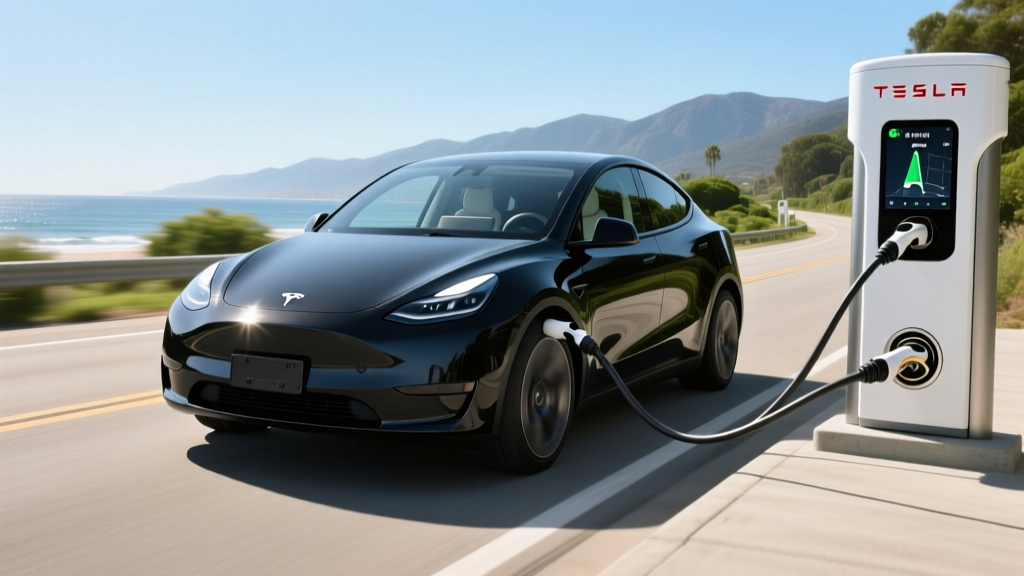
Charging infrastructure is where the "plan a trip Tesla" search intent gets answered definitively. Tesla's Supercharger network remains the most reliable and widespread DC fast-charging system in North America, with over 6,500 V3 and V4 stalls in the U.S. alone as of early 2026.
| Charging Level | Power (kW) | Miles Added per Hour | Typical Use Case |
|---|---|---|---|
| Level 1 (120V outlet) | ~1.4 kW | ~5 mi/hr | Emergency/trickle only |
| Level 2 (240V home) | 11.5 kW | ~44 mi/hr | Overnight home charging |
| DC Fast (Supercharger V3) | Up to 250 kW | ~1,000 mi/hr peak | Road trips, quick top-ups |
| DC Fast (Supercharger V4) | Up to 250 kW | ~1,000 mi/hr peak | Newer corridor stations |
| DC Fast (CCS adapter, EA/others) | Up to 150–175 kW | ~600 mi/hr peak | Non-Tesla networks (with adapter) |
Charge curve reality: The Model Y peaks at 250 kW only between roughly 10–30% state of charge. From 30–60%, it sustains around 150–180 kW, then tapers to ~100 kW approaching 80%, and drops sharply above 85%. The quoted 10–80% time of ~27 minutes reflects this taper. If you only need a 10–50% top-up on a road trip, you're looking at roughly 12–15 minutes — enough for a bathroom break and coffee.
For home charging, a Wall Connector on a 60-amp circuit delivers 11.5 kW, adding about 44 miles of range per hour. A full overnight charge from 20% to 80% takes roughly 5 hours. Installation costs typically range from $800–$2,000 depending on panel capacity and run length; homes with 200-amp panels usually accommodate this without an upgrade. Always have a licensed electrician confirm your panel's headroom before purchasing equipment.
With the 2026 Model Y's native NACS port, you can also access non-Tesla chargers via the growing NACS adoption across networks like Electrify America and EVgo — though you'll still want the included CCS adapter for legacy stations. The car's navigation will route you through Superchargers by default, which is almost always the fastest and most reliable option.
Performance, Efficiency, and Daily Drivability
The dual-motor Long Range AWD produces 384 horsepower and hits 0–60 mph in 4.8 seconds — quick enough for confident highway merging and passing, if not quite the thrill of the discontinued Performance trim. The Juniper suspension retune is the real story: the 2026 Model Y absorbs highway expansion joints and potholes with composure that the 2023–2024 models simply lacked. Road noise is also noticeably reduced thanks to acoustic glass and additional sound deadening.
Efficiency is a Tesla strong suit. At 122 MPGe combined (28 kWh/100 mi), the Model Y Long Range AWD extracts more miles per kilowatt-hour than nearly every competing electric SUV. For comparison, the Ford Mustang Mach-E Extended Range AWD rates at 101 MPGe combined, and the Hyundai Ioniq 5 AWD at 110 MPGe. Over 15,000 miles of annual driving at the U.S. average electricity rate of $0.17/kWh, that efficiency gap translates to roughly $100–$150 in annual energy savings versus less efficient rivals.
Pricing, Tax Credits, and Total Cost
| Trim | MSRP | Est. After §30D Credit* |
|---|---|---|
| Long Range RWD | $42,990 | As low as $35,490 |
| Long Range AWD | $44,990 | As low as $37,490 |
| Long Range AWD (w/ FSD) | $52,990 | As low as $45,490 |
*Federal tax credit amounts and eligibility are subject to IRS §30D rules. Not all buyers qualify. See checklist below.
- Vehicle MSRP cap: SUVs must be under $80,000 — all Model Y trims qualify
- Buyer income cap: Modified AGI ≤ $150,000 (single) / ≤ $300,000 (joint)
- Battery sourcing: Must meet critical minerals and battery component requirements set by the IRS; Tesla's U.S.-assembled packs have generally qualified, but verify at purchase
- Point-of-sale transfer: You can apply the credit as a down-payment reduction at the dealer (Tesla) rather than waiting for tax filing
- Credit amount: Up to $7,500 if all sourcing requirements are met; partial credits of $3,750 may apply if only one sourcing threshold is satisfied
Always verify current eligibility on IRS.gov and consult a tax professional before relying on credit amounts.
Beyond the purchase price, the Model Y's total cost of ownership benefits from minimal maintenance (no oil changes, no transmission fluid, reduced brake wear from regen), estimated annual insurance of $1,800–$2,400 depending on state and driver profile, and electricity costs that average $500–$700/year for 15,000 miles of driving. Over five years, a Model Y owner typically saves $4,000–$7,000 in fuel and maintenance compared to a similarly priced gas SUV like the BMW X3 or Audi Q5, even accounting for the higher upfront cost and slightly steeper EV depreciation.
Tech, Interior, and the Trip-Planning Experience
The 2026 Model Y's 15.4-inch front touchscreen runs Tesla's latest software, which includes native trip planning that automatically routes through Superchargers, preconditions the battery before you arrive (critical for achieving peak charge speeds in cold weather), and estimates your state of charge at each stop and at your destination. This integrated experience is the single biggest reason Tesla owners report less range anxiety on road trips than owners of competing EVs, who often juggle third-party apps like A Better Routeplanner alongside in-car systems.
The rear cabin gains a dedicated 8-inch touchscreen for climate and media controls, a meaningful upgrade for families on long drives. Cargo space measures 30.2 cubic feet behind the second row and 76.2 cubic feet with seats folded — competitive with the Mach-E (29.7/59.7) and slightly less than the Ioniq 5 (27.2/59.3) when accounting for the Model Y's deeper under-floor storage and front trunk (frunk).
Driver assistance: The Model Y comes standard with Tesla Autopilot (SAE Level 2), which includes adaptive cruise control and lane centering. Full Self-Driving (Supervised) remains a $8,000 add-on and is still a Level 2 system — you must keep your hands on the wheel and eyes on the road at all times. Despite the "FSD" name, it does not make the car autonomous. It handles highway interchanges and stoplights more smoothly than basic Autopilot, but driver vigilance is non-negotiable.
Tesla Autopilot and FSD (Supervised) are SAE Level 2 driver-assistance systems. The driver must remain fully engaged, monitor the road, and be prepared to take over instantly. These are not self-driving systems. True driverless operation (Level 4) is currently limited to geofenced robotaxi services like Waymo in select cities.
Pros, Cons, and How It Compares
- Supercharger network reliability — still unmatched for road-trip ease
- Class-leading efficiency (122 MPGe combined)
- Integrated trip planning with battery preconditioning
- Spacious interior with strong cargo versatility
- Improved Juniper ride quality and cabin quietness
- Strong safety ratings (NHTSA 5-star, IIHS Top Safety Pick+)
- NMC battery requires 80% daily charge limit (unlike LFP rivals)
- FSD (Supervised) is expensive ($8,000) and still Level 2
- No Apple CarPlay or Android Auto
- Insurance costs above segment average
- Rear visibility compromised by sloping roofline
- Turn-signal stalk removal (steering-wheel buttons) takes adjustment
Against the Ford Mustang Mach-E, the Model Y wins on range, charging speed, and road-trip infrastructure, while the Mach-E offers a more conventional interior layout and Apple CarPlay. Against the Hyundai Ioniq 5, the Model Y leads in range and Supercharger access, while the Ioniq 5 charges faster on 350-kW CCS stations (10–80% in ~18 minutes) and offers a more distinctive design. For buyers who road-trip more than twice a year, the Supercharger advantage is hard to overstate.
Who the 2026 Model Y Suits Best
- You take road trips 3+ times per year and value seamless charging
- You want an efficient family SUV with strong cargo space
- You can install Level 2 home charging
- You prefer integrated software over phone-mirroring
- You want Apple CarPlay/Android Auto (consider Mach-E or Ioniq 5)
- You need LFP chemistry for daily 100% charging (base Model Y RWD or Ioniq 5)
- You want the fastest possible DC charging on non-Tesla networks (Ioniq 5 at 350 kW)
- You prioritize driving dynamics over efficiency (BMW iX, Porsche Macan EV)
Frequently Asked Questions
What is the real-world range of the 2026 Tesla Model Y?
The EPA rates the Long Range AWD at 320 miles. In real-world highway driving at 70–75 mph, expect 275–290 miles in mild weather and 220–250 miles in freezing temperatures. City driving with regenerative braking can exceed the EPA estimate.
How fast does the Model Y charge at home and on road trips?
At home on a 240V Level 2 Wall Connector, the Model Y charges at 11.5 kW, adding about 44 miles of range per hour (a full overnight session covers most daily needs). On a Tesla Supercharger, it peaks at 250 kW and charges from 10–80% in approximately 27 minutes.
Does the 2026 Model Y qualify for the federal EV tax credit?
The Model Y qualifies for up to $7,500 under IRS §30D, provided the buyer meets income caps ($150K single / $300K joint), the vehicle MSRP is under $80,000 (all trims qualify), and battery sourcing requirements are met at time of purchase. The credit can be transferred at point of sale to reduce your down payment. Verify current rules at IRS.gov.
Is the Tesla Model Y worth buying over the Mach-E or Ioniq 5?
For road-trip planning, yes — the Supercharger network and integrated trip planner give Tesla a tangible edge. For buyers who prioritize faster non-Tesla DC charging, CarPlay support, or LFP battery chemistry, the Ioniq 5 or Mach-E may be better fits. The Model Y's efficiency and cargo space are class-leading.
How does Tesla's trip planner work for long drives?
Enter your destination in the Model Y's navigation, and the system automatically plots Supercharger stops, estimates arrival SoC at each stop and your destination, accounts for elevation and weather, and preconditions the battery before you arrive at each charger. This integrated approach eliminates most of the guesswork from EV road-trip planning.
What is the battery warranty on the 2026 Model Y?
Tesla covers the battery and drive unit for 8 years or 120,000 miles (whichever comes first) with a minimum 70% capacity retention guarantee. If degradation exceeds 30% within the warranty period, Tesla will repair or replace the battery to restore it above that threshold.