If you're researching a trailer hitch for Tesla Model Y, you're likely weighing whether this compact electric crossover can double as a capable light-duty hauler. The short answer: yes, the Model Y can tow — and it does so more competently than most EVs in its class — but towing changes the range, efficiency, and charging math significantly. This guide covers the 2026 Tesla Model Y's full spec sheet, how a trailer hitch affects real-world ownership, and whether it's the right electrified tow rig for your needs.
2026 Tesla Model Y: The Core Specs at a Glance
Before bolting on a hitch, let's establish the baseline vehicle. The 2026 Model Y (refreshed "Juniper" generation) continues as Tesla's best-selling vehicle globally, now with updated styling, a quieter cabin, ambient lighting, and a rear touchscreen for passengers. Here are the numbers that matter for buyers and towers alike.
| Specification | Long Range AWD | Performance AWD |
|---|---|---|
| EPA Estimated Range | 320 miles | 298 miles |
| Battery Capacity (usable) | ~75 kWh (NMC) | ~75 kWh (NMC) |
| Drivetrain | Dual-Motor AWD | Dual-Motor AWD |
| Horsepower | ~384 hp | ~456 hp |
| 0-60 mph | 4.8 seconds | 3.5 seconds |
| Max DC Fast Charge | 250 kW (peak) | 250 kW (peak) |
| 10-80% DC Charge Time | ~25 minutes | ~25 minutes |
| Level 2 Home Charge Rate | 11.5 kW (~44 mi/hr) | 11.5 kW (~44 mi/hr) |
| Max Towing Capacity | 3,500 lbs | 3,500 lbs |
| Cargo Volume (rear seats up) | 30.2 cu ft | 30.2 cu ft |
| Cargo Volume (rear seats folded) | 72.0 cu ft | 72.0 cu ft |
| EPA Efficiency | 122 MPGe (28 kWh/100mi) | 111 MPGe (30 kWh/100mi) |
| Base MSRP | $46,630 | $51,630 |
The Model Y uses nickel-manganese-cobalt (NMC) battery chemistry, which offers higher energy density than lithium iron phosphate (LFP) — important for packaging enough kWh into a crossover footprint while preserving towing payload headroom. Tesla's battery and drive unit warranty covers 8 years or 120,000 miles (whichever comes first) with a minimum 70% capacity retention threshold, per Tesla's official warranty page.
Trailer Hitch for Tesla Model Y: Options, Capacity, and Installation
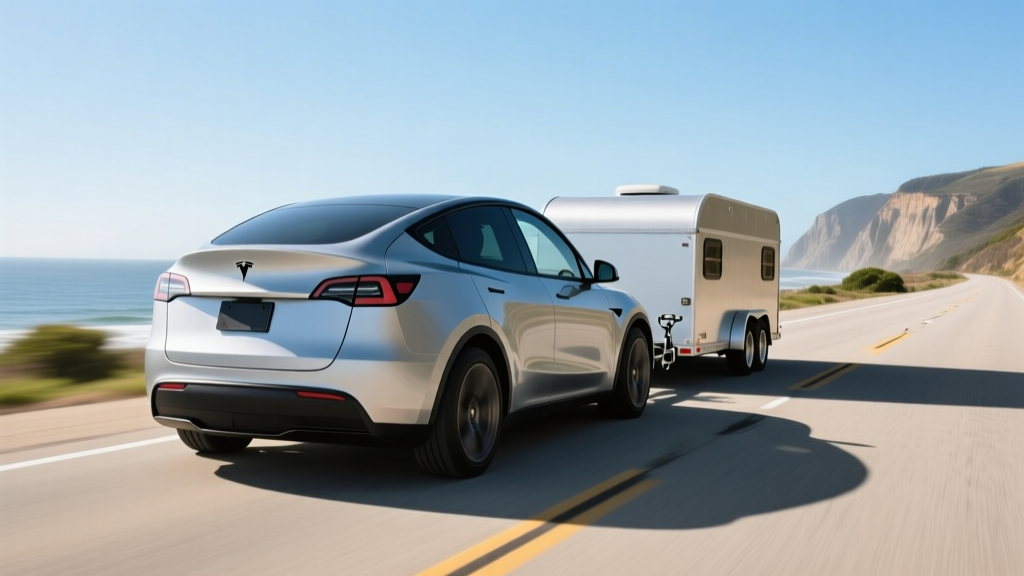
Tesla offers a factory tow hitch accessory for the Model Y, available through the Tesla Shop. It's a 2-inch receiver hitch rated for the vehicle's maximum 3,500-pound tow rating. Here's what you need to know before ordering one:
- Factory hitch price: Approximately $1,200 (hitch hardware plus wiring harness), available directly from Tesla.
- Tongue weight limit: 350 lbs (10% of max tow rating, standard for the class).
- Tow mode software: Once the factory hitch is installed and connected, the Model Y activates a dedicated Tow Mode in the vehicle settings. This adjusts stability control, regenerative braking behavior, and rear-camera overlay guidelines for trailer awareness.
- Aftermarket hitches: Companies like Curt and Draw-Tite offer compatible Class III hitches at lower hardware cost (~$200-$350), but you'll need to handle wiring separately and may forfeit certain warranty protections if installation damages vehicle electronics.
What 3,500 lbs actually gets you: This capacity handles a small utility trailer, a pair of jet skis, a lightweight teardrop camper (~2,000-2,800 lbs loaded), or a hitch-mounted bike rack with 4 bikes. It does not cover a loaded travel trailer, a horse trailer, or a large boat. If you need 5,000+ lbs of tow capacity, you'll need to look at the Ford F-150 Lightning, Rivian R1S, or Tesla Cybertruck.
Real-World Range: What Happens When You Tow
EPA Sticker: 320 miles (Long Range AWD)
Real-World Without Trailer: Expect ~270-290 miles on the highway at 70-75 mph; ~290-310 miles in mixed city/suburban driving. In cold weather (below 30°F), plan for 230-260 miles due to battery resistance and cabin heating load.
Real-World While Towing: Towing a 2,500-lb trailer at highway speeds typically cuts range by 40-55%, yielding an effective range of 130-170 miles depending on trailer aerodynamics, terrain, and speed. A boxy travel trailer hits harder than a sleek teardrop or low-profile cargo trailer.
This is the single most important calculation for anyone adding a trailer hitch to a Model Y. EV towing range loss is steep because aerodynamic drag scales with the square of speed, and a trailer adds both frontal area and turbulence. At 65 mph with a moderately aerodynamic trailer, you'll see energy consumption climb from the normal ~28 kWh/100mi to roughly 50-65 kWh/100mi. That means a 75 kWh usable battery gives you approximately 115-150 miles before you need to find a charger — and you'll want a buffer.
Practical towing range tip: Keep speed at or below 60 mph when towing. The difference between 60 and 70 mph can recover 15-20 miles of range with a trailer. Plan routes around DC fast-charger locations and precondition the battery before each stop.
Charging Speed: DC Fast, Level 2, and Towing Logistics
| Charging Level | Power (kW) | Speed (miles of range per hour) | Notes |
|---|---|---|---|
| Level 1 (120V household) | ~1.4 kW | ~4-5 mi/hr | Emergency/trickle only; impractical for daily use |
| Level 2 (240V home, 48A) | 11.5 kW | ~44 mi/hr | Full overnight charge in ~7-8 hours; ideal daily solution |
| DC Fast Charge (V3 Supercharger) | 250 kW peak | ~1,000 mi/hr at peak | 10-80% in ~25 min; tapers significantly above 80% |
| DC Fast Charge (V4 Supercharger) | Up to 350 kW* | Faster mid-curve sustained rate | *Model Y Juniper architecture supports higher sustained rates at newer V4 stalls |
The Model Y's charge curve peaks at 250 kW but holds that rate only briefly (typically between 10-30% state of charge). It tapers to ~150 kW by 50% and drops to ~60 kW by 80%. This is normal for NMC chemistry and why the "10-80%" metric is the industry standard — charging past 80% adds diminishing returns and extends your stop considerably.
Towing-specific charging reality: When towing, you'll charge more often and each stop takes slightly longer because the battery is working harder (higher average discharge rate means the battery may be warmer on arrival at a charger, which can help preconditioning but also means thermal management is active). Plan for 25-35 minute Supercharger stops every 120-150 miles when towing a mid-size trailer. The Supercharger network's reliability remains the Model Y's strongest towing advantage over competing EVs, as noted in DOT/EPA EV infrastructure data.
Pricing, Tax Credits, and Total Cost with Hitch
| Cost Item | Long Range AWD | Performance AWD |
|---|---|---|
| Base MSRP | $46,630 | $51,630 |
| Factory Tow Hitch (installed) | +$1,200 | +$1,200 |
| Destination Fee | +$1,390 | +$1,390 |
| Typical As-Tested (with hitch, FSD, paint) | ~$53,000-$56,000 | ~$58,000-$62,000 |
| Federal §30D Tax Credit (max) | Up to $7,500 | Up to $7,500 |
| Effective Price After Max Credit | ~$39,130+ | ~$44,130+ |
Federal tax credit eligibility (§30D) requires meeting ALL of these conditions:
- MSRP cap: Vehicle base MSRP must not exceed $80,000 for SUVs/crossovers (Model Y qualifies).
- Buyer income cap: Modified adjusted gross income ≤ $150,000 (single), $225,000 (head of household), or $300,000 (joint filers).
- Battery sourcing: A percentage of critical minerals and battery components must be sourced from the U.S. or free-trade-agreement countries. These thresholds increase annually. Verify current-year compliance on IRS.gov §30D guidance.
- Point-of-sale transfer: As of 2024+, you can transfer the credit to the dealer at purchase, reducing your out-of-pocket cost immediately rather than waiting for tax filing.
- Assembly: Final assembly must occur in North America (the Fremont-built Model Y qualifies).
Important caveat: Battery sourcing requirements tighten each year under the Inflation Reduction Act. A Model Y that qualifies for the full $7,500 in early 2026 may see partial credit eligibility later if supply-chain composition changes. Always verify at the point of purchase using the IRS's official clean vehicle credit list.
Who Should Add a Trailer Hitch to the Model Y?
Choose the Model Y with a hitch if:
- You need to tow a light trailer (teardrop camper, utility trailer, bike rack) on weekend trips under 150 miles from home.
- You primarily commute solo or as a couple during the week and tow occasionally.
- You have home Level 2 charging and access to Superchargers on your typical towing routes.
- You value the lowest operating cost per mile in the compact crossover segment.
Look elsewhere if:
- You regularly tow more than 2,500 lbs or need 200+ miles of towing range without stopping.
- You tow in mountainous terrain frequently (range loss compounds with elevation gain).
- You need a full-size spare tire (the Model Y has no spare; it uses a tire inflator kit).
- You need 5,000+ lb capacity — consider the F-150 Lightning (7,700 lbs) or Rivian R1S (7,700 lbs).
The Model Y is an outstanding daily driver that can occasionally tow. It is not a dedicated tow vehicle. If towing is a weekly activity for you, a plug-in hybrid like the Toyota RAV4 Prime (1,500 lb rating but gas backup for range) or a full-size electric truck may serve you better.
Pros and Cons: Model Y as a Light-Duty Tow Vehicle
Pros
- 3,500-lb tow rating is best-in-class for compact electric crossovers
- Factory hitch integrates with Tow Mode software (stability control, camera overlay)
- Supercharger network makes route planning for towing more viable than any other EV brand
- Instant torque (384-456 hp) makes merging and hill-climbing with a trailer effortless
- Low operating cost: ~$0.10-$0.14/mile on electricity vs. $0.18-$0.24/mile for a gas equivalent
- Dual-motor AWD provides excellent traction when starting on boat ramps or gravel
- Eligible for up to $7,500 federal tax credit (with sourcing/income caveats)
Cons
- Towing range drops to 130-170 miles — frequent charging stops required
- No spare tire — a blowout on a remote towing route is a serious inconvenience
- Aftermarket hitch options risk voiding electrical warranty if improperly installed
- 3,500-lb limit rules out most enclosed car haulers, large campers, and horse trailers
- No integrated trailer brake controller — you'll need an aftermarket wireless unit for trailers with electric brakes
- Rear visibility is already limited; a trailer blocks the backup camera entirely (use trailer-mounted camera)
Model Y vs. Competitors for Towing
How does the Model Y stack up against other electrified crossovers when you add a trailer hitch?
| Vehicle | Max Tow Rating | EPA Range | Starting MSRP | Hitch Availability |
|---|---|---|---|---|
| Tesla Model Y (2026) | 3,500 lbs | 320 mi | $46,630 | Factory + aftermarket |
| Ford Mustang Mach-E | 1,500 lbs (w/ hitch) | 320 mi (Ext Range) | $42,995 | Aftermarket only |
| Hyundai Ioniq 5 | 2,300 lbs (AWD) | 305 mi | $44,900 | Factory option |
| Kia EV6 | 2,700 lbs (AWD) | 282 mi | $43,900 | Factory option |
| VW ID.4 (AWD) | 2,700 lbs | 291 mi | $45,300 | Factory option |
The Model Y's 3,500-lb rating leads this segment decisively. The Kia EV6 and VW ID.4 come closest at 2,700 lbs, but neither offers the Supercharger infrastructure advantage for towing trips. The Mach-E's low 1,500-lb rating makes it impractical for anything beyond a bike rack.
Frequently Asked Questions
What is the real-world range of the Tesla Model Y?
The EPA rates the 2026 Long Range AWD at 320 miles. In real-world highway driving at 70-75 mph, expect 270-290 miles. In cold weather (below freezing), plan for 230-260 miles. While towing a 2,500-lb trailer, effective range drops to roughly 130-170 miles depending on trailer shape and speed.
How fast does the Model Y charge at home and on the road?
At home on a 240V Level 2 charger (48A circuit), the Model Y charges at 11.5 kW, adding about 44 miles of range per hour — a full charge takes roughly 7-8 hours. On a V3 Supercharger, it peaks at 250 kW and charges from 10-80% in approximately 25 minutes. Charging slows significantly past 80% to protect battery health.
How much does the Model Y cost after tax credits?
The Long Range AWD starts at $46,630 before destination. With the maximum $7,500 federal §30D credit (subject to income, MSRP, and battery-sourcing eligibility per IRS rules), the effective price can drop to approximately $39,130. Add $1,200 for the factory tow hitch.
Is the Model Y worth buying vs. competitors for towing?
If you need 3,500 lbs of tow capacity in an electric crossover and want the most reliable DC fast-charging network, the Model Y is the segment leader. If you need more than 3,500 lbs, you'll need to move to an electric truck. If towing is rare and you prioritize ride comfort or interior materials, the Hyundai Ioniq 5 or Kia EV6 are strong alternatives with slightly lower tow ratings.
Does the Model Y qualify for the federal EV tax credit?
The Model Y is assembled in Fremont, California (North American final assembly ✓), and its MSRP is well under the $80,000 SUV cap ✓. Eligibility for the full $7,500 depends on your income (≤$300,000 joint / ≤$150,000 single), the battery's critical-mineral and component sourcing percentages for the current tax year, and whether you have not exceeded the per-buyer vehicle credit limit. Verify current-year eligibility on IRS.gov before purchasing.
Do I need a trailer brake controller for the Model Y?
The Model Y does not come with an integrated trailer brake controller. If your trailer has electric brakes (common on trailers above 2,000 lbs), you'll need an aftermarket wireless brake controller such as the Curt Echo or Tekonsha Prodigy RF. These plug into the trailer's 7-pin connector and pair with your smartphone for brake-gain adjustment.
Can I install an aftermarket hitch instead of the Tesla factory hitch?
Yes, aftermarket Class III hitches from Curt, Draw-Tite, and others are available for the Model Y at a lower hardware cost ($200-$350 vs. ~$1,200 for the factory unit). However, aftermarket installations that require cutting into the vehicle's electrical harness for trailer lighting may affect your warranty coverage for related electrical components. The factory hitch ensures full Tow Mode software integration and preserves warranty protection.