Rivian's R1T pickup and R1S SUV have carved out a unique niche in the electric truck and SUV segment by pairing serious off-road capability with clever, space-maximizing design. But for buyers weighing these against the Tesla Cybertruck, Ford F-150 Lightning, or Chevy Silverado EV, the practical question is always utility: how much can you actually carry, and how usable is the space? This review dissects every cubic foot of Rivian cargo space across both models, while covering the full ownership picture — range, charging, pricing, and tax-credit eligibility for the 2026 model year.
Rivian R1T Cargo Space: Dimensions and Real-World Usability
The R1T is a midsize crew-cab pickup with a 4.5-foot bed — shorter than the 5.5- or 6.5-foot beds on most gas midsize trucks, but Rivian compensates with the Gear Tunnel, a lockable, pass-through storage compartment spanning the width of the vehicle between the cab and the bed. Here's how the numbers stack up:
| Area | Volume | Notes |
|---|---|---|
| Bed (4.5 ft) | ~54 cu ft | With tailgate closed; 11 cu ft added with tailgate down (extending to ~6 ft usable length) |
| Gear Tunnel | 11 cu ft | Lockable, weather-sealed, accessible from both sides; fits golf bags, skis, camping gear |
| Frunk (Front Trunk) | 11 cu ft | Drainable; ideal for wet gear, groceries, or charging cables |
| In-Cabin Storage | ~8 cu ft (center console + door pockets + under-seat) | Deep center bin with removable dividers |
| Total Usable Cargo | ~84 cu ft | Bed + Gear Tunnel + frunk combined |
The Gear Tunnel is the R1T's defining feature. Unlike a traditional truck bed, it's enclosed and secure — you can leave luggage or equipment in it at a trailhead without worrying about weather or theft. Rivian also sells the Gear Tunnel Shuttle, a motorized sliding drawer ($1,800 accessory) that extends the full width of the tunnel for easier access. The trade-off: the 4.5-foot bed won't swallow 8-foot lumber or a full-size ATV without the tailgate down, and even then you're at roughly 6 feet of flat load floor.
Rivian R1S Cargo Space: Three-Row SUV Practicality
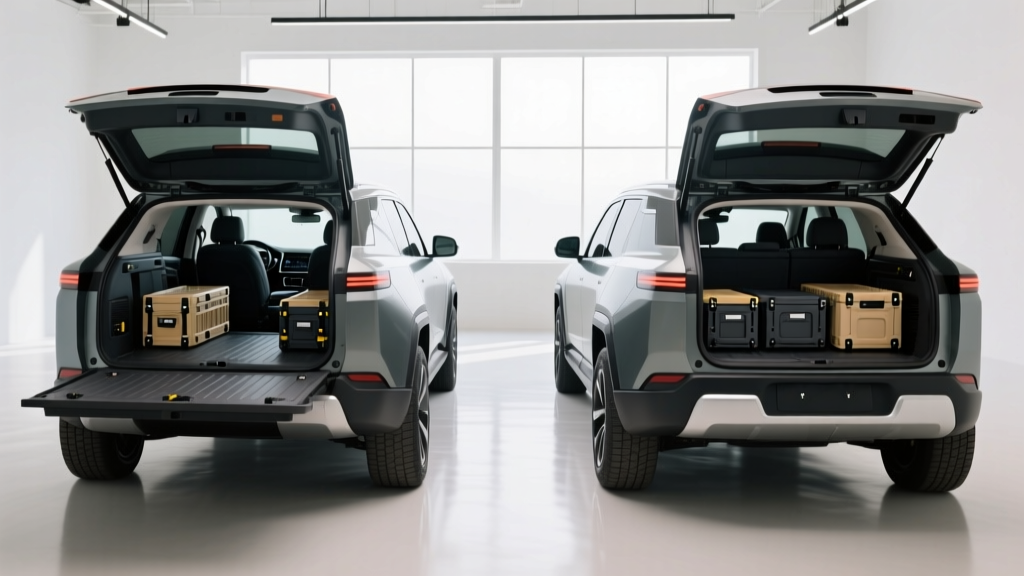
The R1S shares the R1T's skateboard platform but wraps it in a three-row SUV body. Cargo flexibility is strong, though the third row does eat into total volume when deployed:
| Configuration | Volume (behind row) | Notes |
|---|---|---|
| Behind 3rd row | 20.1 cu ft | Adequate for 2-3 carry-ons or a week of groceries |
| Behind 2nd row (3rd row folded) | 57.1 cu ft | Competitive with midsize two-row SUVs |
| Behind 1st row (all rear rows folded) | 104.7 cu ft | Flat load floor; fits a queen mattress with room to spare |
| Frunk | 11 cu ft | Same drainable design as R1T |
| Max Total Cargo | ~115.7 cu ft | All rows folded + frunk |
With all three rows in use, 20.1 cubic feet is tighter than the Chevy Tahoe's ~25 cu ft but on par with the Kia EV9's ~20 cu ft. Fold the third row and you get a genuinely useful 57.1 cu ft — enough for a Costco run, a stroller, and dog crates simultaneously. The flat load floor with both rear rows down is a standout for camping conversions or hauling bulky items.
Range, Efficiency, and Battery Specs
Rivian offers multiple battery packs for 2026, and your choice directly affects both range and payload. Here's the full breakdown:
| Pack | Usable kWh | Chemistry | EPA Range (R1T Dual-Motor) | EPA Range (R1S Dual-Motor) | Efficiency |
|---|---|---|---|---|---|
| Standard | ~95 kWh | LFP (lithium iron phosphate) | ~270 mi | ~260 mi | ~48 kWh/100 mi (2.1 MPGe-equivalent) |
| Large | ~112 kWh | NMC (nickel manganese cobalt) | ~340 mi | ~330 mi | ~44 kWh/100 mi |
| Max | ~141 kWh | NMC (2170 cylindrical cells) | ~410 mi | ~390 mi | ~42 kWh/100 mi |
For authoritative efficiency data, check the EPA's EV comparison tool at fueleconomy.gov.
Charging Speed: DC Fast, Level 2, and What to Expect
Rivian uses the NACS (North American Charging Standard) connector on all 2026 models, granting native access to Tesla Superchargers — the most reliable DC fast-charging network in the U.S. Charging performance varies significantly by pack size:
| Charge Type | Standard Pack (LFP) | Large Pack (NMC) | Max Pack (NMC) |
|---|---|---|---|
| Peak DC Fast Charge | ~180 kW | ~220 kW | ~220 kW |
| 10-80% DC Fast Charge | ~30 min | ~25 min | ~35 min (larger battery) |
| Level 2 Home Charging | 11.5 kW (~25 mi/hr) | 11.5 kW (~25 mi/hr) | 11.5 kW (~25 mi/hr) |
| Full Level 2 Charge (0-100%) | ~8.5 hours | ~10 hours | ~12.5 hours |
Charging-curve reality check: The 220 kW peak on Large and Max packs is not sustained. You'll see peak speeds between 10-30% State of Charge (SoC), after which the rate tapers progressively. By 60% SoC you're typically at ~150 kW, and above 80% it drops below 50 kW to protect battery health. This is why Rivian (and every other automaker) quotes 10-80% times — charging past 80% on DC fast chargers is slow and generally unnecessary for road trips.
At home on a Level 2 wall connector (48-amp circuit, 60-amp breaker), expect roughly 25 miles of range added per hour of charging. That means an overnight charge from 20% to 80% takes about 6-7 hours — perfectly practical for daily use. Rivian's Wall Connector costs $650 and includes a 25-foot cable. Installation by a licensed electrician typically runs $500-$2,000 depending on whether your panel needs an upgrade.
Performance, Drivetrain, and Towing
Both the R1T and R1S offer dual-motor AWD as standard on most trims, with a quad-motor option for maximum performance:
| Drivetrain | Horsepower | Torque (lb-ft) | 0-60 mph | Max Towing |
|---|---|---|---|---|
| Dual-Motor AWD | 533 hp | 610 | 4.5 sec (R1T) | 11,000 lbs (R1T) / 7,700 lbs (R1S) |
| Performance Dual-Motor | 665 hp | 829 | 3.4 sec (R1T) | 11,000 lbs (R1T) |
| Quad-Motor AWD | 1,025 hp | 1,198 | 2.5 sec (R1T) | 11,000 lbs (R1T) |
The dual-motor setup is the sweet spot for most buyers — 533 hp and 4.5-second 0-60 times are more than adequate, and you avoid the $10,000+ upcharge for quad-motor. Towing capacity of 11,000 lbs (R1T) leads the EV truck segment, out-pulling the F-150 Lightning's 10,000 lbs. However, towing any heavy trailer will cut range by 40-50%, so a 340-mile Large Pack drops to roughly 170-200 miles per charge when towing near max capacity.
Pricing, Trims, and Federal Tax Credit Eligibility
Rivian simplified its trim structure for 2026, but pricing still climbs quickly with pack and motor upgrades:
| Model / Configuration | Base MSRP | §30D Federal Credit | Effective Price |
|---|---|---|---|
| R1T Dual-Motor Standard Pack | $69,900 | $0 (exceeds $80K truck MSRP cap on most configs) | $69,900 |
| R1T Dual-Motor Large Pack | $75,900 | $0 (MSRP cap issue) | $75,900 |
| R1S Dual-Motor Standard Pack | $74,900 | Up to $7,500 (SUV cap is $80K) | ~$67,400 |
| R1S Dual-Motor Large Pack | $79,900 | Up to $7,500 (at MSRP cap limit) | ~$72,400 |
| R1S Quad-Motor Max Pack | $99,000 | $0 (exceeds $80K SUV cap) | $99,000 |
Warranty, Safety, and Driver-Assist Technology
Rivian's warranty coverage is competitive within the premium EV segment:
- Battery & Powertrain: 8 years / 175,000 miles (whichever comes first), with a minimum 70% capacity retention threshold
- Bumper-to-Bumper: 5 years / 60,000 miles
- Corrosion: 12 years, unlimited miles
- Roadside Assistance: 5 years / 60,000 miles
The 175,000-mile battery warranty is notably generous — Tesla offers 120,000-150,000 miles depending on the model, and Ford provides 100,000 miles on the F-150 Lightning.
On the safety front, the R1T earned an IIHS Top Safety Pick+ rating, and both models come standard with Rivian's Driver+ system — a Level 2 driver-assist suite (SAE classification) that includes adaptive cruise control, lane-centering, and automatic emergency braking. This is not autonomous driving; the driver must remain engaged with hands on the wheel at all times. Rivian has been gradually expanding hands-free highway capability, but as of 2026, it still requires periodic steering-wheel touch confirmation.
The 15.6-inch center touchscreen runs Rivian's proprietary OS, which is responsive and well-designed but lacks Apple CarPlay and Android Auto — a persistent complaint among buyers who prefer phone-mirroring. Wireless phone charging, a premium 1,800-watt Meridian audio system, and over-the-air updates are standard across all trims.
Pros
- Gear Tunnel gives R1T unique secure, weatherproof storage no competitor matches
- Best-in-class 11,000-lb towing (R1T) among EV trucks
- 175,000-mile battery warranty exceeds most competitors
- Native NACS / Tesla Supercharger access for reliable road-trip charging
- 104.7 cu ft max cargo (R1S) with flat load floor
- Quad-motor option delivers supercar acceleration in a truck
Cons
- 4.5-ft R1T bed is short for traditional truck tasks (lumber, full-size ATV)
- No Apple CarPlay or Android Auto
- R1S third-row cargo (20.1 cu ft) is tight with all seats in use
- Most R1T configurations exceed the $80K §30D MSRP cap, disqualifying from federal credit
- Towing cuts range by 40-50% — plan charging stops accordingly
- Premium pricing; base models start near $70K-$75K
Who the Rivian R1T and R1S Are For
Choose the R1T if:
- You want a daily-drivable truck with secure, enclosed storage (Gear Tunnel) rather than an open bed
- You tow boats, trailers, or campers up to 11,000 lbs and want EV torque for the job
- Your typical drives are under 250 miles, or you have reliable DC fast-charging along your routes
- You prioritize adventure utility (ski trips, trailhead runs, camping) over raw bed length
Choose the R1S if:
- You need three rows for family duty but want 104.7 cu ft of cargo with seats folded
- You want §30D tax credit eligibility (base models fit under the $80K SUV cap)
- You prefer SUV refinement and don't need a pickup bed
- You want an EV that handles school runs, road trips, and light off-roading equally well
Frequently Asked Questions
What is the real-world range of the Rivian R1T and R1S?
Real-world range depends heavily on pack size and conditions. The Large Pack (112 kWh, EPA 340 mi R1T / 330 mi R1S) delivers roughly 290-305 highway miles at 70-75 mph in mild weather, dropping to 250-270 in freezing temperatures. The Max Pack (141 kWh, EPA 410/390 mi) yields ~340-360 highway miles in summer. The Standard LFP pack (95 kWh, EPA 270/260 mi) is best suited to commuters with home charging, providing ~220-240 real highway miles.
How fast does a Rivian charge at home and on the road?
On DC fast chargers, the Large and Max packs peak at ~220 kW with 10-80% charges in 25-35 minutes. The Standard LFP pack peaks at ~180 kW (10-80% in ~30 min). At home on a Level 2 Rivian Wall Connector (11.5 kW), you add roughly 25 miles of range per hour — an overnight session from 20-80% takes 6-7 hours depending on pack size.
Does the Rivian R1T or R1S qualify for the $7,500 federal EV tax credit?
The R1S in base Dual-Motor Standard ($74,900) and Large ($79,900) configurations can qualify for up to $7,500 under IRS §30D, since the SUV MSRP cap is $80,000 — provided the buyer's income is under $150K single / $300K joint and battery sourcing requirements are met. Most R1T configurations, when equipped with common options, push above the $80,000 truck MSRP cap and lose eligibility. Always verify current-year rules at IRS.gov before purchasing.
Is the Rivian worth buying versus the Tesla Cybertruck or F-150 Lightning?
The R1T wins on build quality, interior refinement, and the Gear Tunnel's unique utility. The Cybertruck offers a longer 6-foot bed and stainless-steel exoskeleton but has polarizing styling and limited service infrastructure. The F-150 Lightning provides a larger 5.5-foot bed and lower starting price but less range per kWh and slower DC charging. If secure enclosed storage and premium fit-and-finish matter more than maximum bed length, the R1T is the strongest choice in the segment.
How does Rivian cargo space compare to gas trucks?
The R1T's 4.5-foot bed (~54 cu ft) is shorter than the Toyota Tacoma's 5-foot bed (~60 cu ft) and far shorter than a full-size F-150's 6.5-foot bed (~85 cu ft). However, adding the Gear Tunnel (11 cu ft) and frunk (11 cu ft) brings total enclosed cargo to ~84 cu ft — more usable secure space than many gas trucks offer without a tonneau cover. The R1S's 104.7 cu ft max cargo volume is competitive with midsize three-row SUVs and significantly more than the Tesla Model X (~88 cu ft max).