Quick Verdict: The Tesla Model Y as a Towing EV
The Tesla Model Y Long Range AWD carries a 3,500-pound maximum towing capacity when equipped with the factory tow package — enough for a light aluminum utility trailer, a pair of personal watercraft, a small teardrop camper, or a compact boat. That number is modest next to a body-on-frame truck, but it's meaningful in the electric-crossover segment, where many competitors either offer no tow rating at all or match it only on higher trims. If you're researching Tesla Model Y towing capability, this review breaks down exactly what that 3,500-lb rating means in practice — and the real trade-offs in range, efficiency, and charging you'll face when pulling a trailer.
For 2026, the Model Y lineup has been refreshed with updated styling, a revised interior, and the continuation of both Long Range and Performance trims built at Gigafactory Texas. The Standard Range RWD variant returns as the entry point. Below, we cover every spec that matters — from battery chemistry and DC fast-charging curves to cargo dimensions and §30D federal tax credit eligibility.
Full Specifications at a Glance
| Spec | Model Y Long Range AWD | Model Y Performance |
|---|---|---|
| EPA Range | 320 miles | 298 miles |
| Battery (usable) | ~75 kWh (NMC) | ~75 kWh (NMC) |
| Drivetrain | Dual-Motor AWD | Dual-Motor AWD |
| Horsepower | 384 hp | 456 hp |
| 0-60 mph | 4.8 sec | 3.5 sec |
| Max DC Fast Charge | 250 kW peak | 250 kW peak |
| 10-80% DCFC Time | ~27 min | ~27 min |
| Level 2 Home Charging | 11.5 kW (~44 mi/hr) | 11.5 kW (~44 mi/hr) |
| Efficiency (EPA) | 122 MPGe / 28 kWh/100mi | 115 MPGe / 30 kWh/100mi |
| Towing Capacity | 3,500 lbs (w/ tow pkg) | Not rated for towing |
| Cargo Volume (rear seats up) | 30.2 cu ft | 30.2 cu ft |
| Cargo Volume (rear seats folded) | 72.1 cu ft | 72.1 cu ft |
| Rear Legroom | 41.6 in | 41.6 in |
| Base MSRP | $47,990 | $52,490 |
| Battery/Drive Unit Warranty | 8 yr / 120,000 mi | 8 yr / 120,000 mi |
Source: EPA / fueleconomy.gov and Tesla Model Y design page. Specs reflect 2025/2026 model year. Pricing excludes destination.
Real-World Range: What to Actually Expect
Real-World Highway (70-75 mph, no trailer): ~250-275 miles
Real-World Highway (with 3,000-lb trailer): ~140-170 miles
Cold-Weather (below 30°F, no trailer): ~220-250 miles
The EPA's 320-mile estimate assumes a mix of city and highway driving at moderate temperatures. In real-world highway use at sustained speeds above 70 mph, aerodynamic drag increases exponentially, and the Model Y — like every EV — loses roughly 15-22% of its rated range. Owners consistently report 250-275 miles on long interstate runs in fair weather.
When towing, the picture changes dramatically. A loaded trailer adds frontal area, weight, and rolling resistance. Expect range to drop by 40-55% depending on trailer profile and weight. A boxy 3,200-lb travel trailer will hit harder than a streamlined 2,000-lb boat on a low-profile trailer. Plan conservatively: if your trailer weighs near the 3,500-lb limit and has a flat face, you may see as little as 130-150 miles before needing a charge.
The Model Y's heat pump (standard on all current trims) helps mitigate cold-weather losses compared to older EVs with resistive heaters, but sub-freezing temperatures still reduce usable range by 15-25%. In northern winters, expect around 220-250 miles unladen.
Charging Speed: DC Fast and Home Level 2
| Charging Level | Power | Speed | Notes |
|---|---|---|---|
| Level 1 (120V household) | ~1.4 kW | ~4-5 mi/hr | Emergency/trickle only |
| Level 2 (240V, 48A) | 11.5 kW | ~44 mi/hr | Full charge in ~7 hours |
| DC Fast Charge (V3 Supercharger) | 250 kW peak | 10-80% in ~27 min | Peak rate only below 50% SoC |
| DC Fast Charge (V4 Supercharger) | Up to 250 kW | Similar to V3 | Rolling out at newer stations |
The Model Y's charging curve is a critical detail many spec sheets gloss over. The 250 kW peak rate applies only at low state-of-charge (roughly 10-50% SoC) and with a warm battery — which Tesla's navigation-based battery preconditioning handles automatically when you route to a Supercharger. Above 50% SoC, the charge rate tapers progressively: expect ~150 kW at 60%, dropping to ~60-80 kW near 80%, and under 30 kW above 90%. This is why the industry-standard 10-80% metric (~27 minutes) is more useful than the peak number.
For home charging, the Model Y's onboard charger accepts up to 11.5 kW on a 60-amp, 240V circuit (48 amps continuous draw per NEC 80% rule). This adds roughly 44 miles of range per hour of charging — enough to fully replenish the ~75 kWh battery overnight in about 7 hours. If your electrical panel supports it, a Tesla Wall Connector ($420) or equivalent Level 2 EVSE on a dedicated 60A circuit is the optimal daily setup.
Towing-specific charging note: When pulling a trailer on a road trip, plan Supercharger stops every 120-150 miles rather than the usual 200-220. Also note that many Supercharger stalls are pull-through or have adequate space, but standard perpendicular stalls may require unhitching or careful positioning with a trailer attached.
Performance and Drivetrain
The Long Range AWD pairs a permanent-magnet motor on the rear axle with an induction motor up front, delivering 384 combined horsepower and a 4.8-second 0-60 mph time. The Performance trim bumps output to 456 hp with a 3.5-second sprint, though it sacrifices some range (298 miles EPA) and — critically for this article — is not rated for towing.
Dual-motor AWD provides excellent traction for trailer launches on wet boat ramps and gravel driveways. The low center of gravity from the under-floor battery pack reduces the sway and top-heaviness common in ICE crossovers when towing. Regenerative braking also helps manage downhill speed with a trailer, reducing brake wear — though you should still use the trailer's own brakes (electric or surge) for anything near the 3,500-lb limit.
Tesla Model Y Towing: What You Need to Know
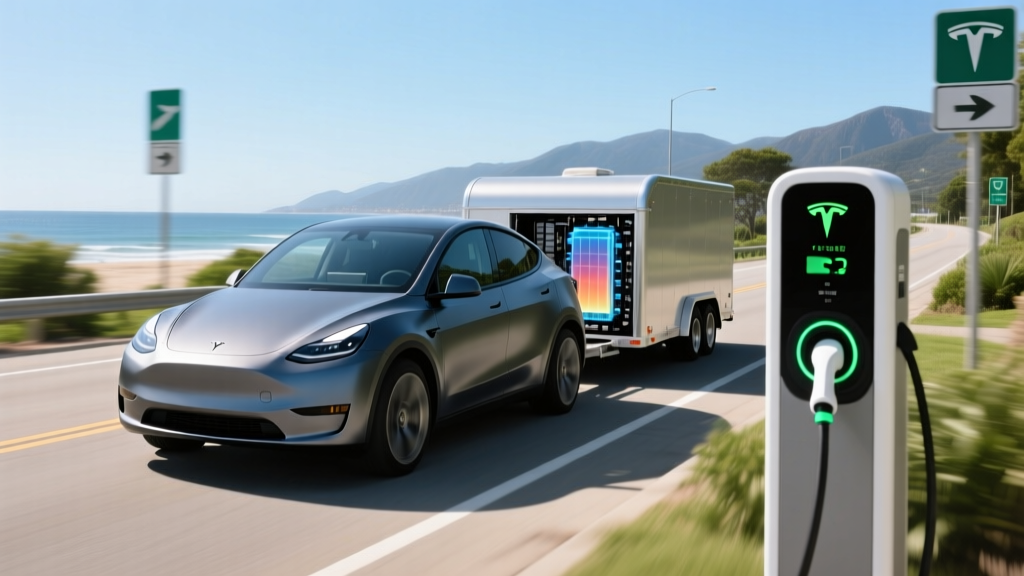
The Model Y Long Range AWD's 3,500-lb tow rating requires the $1,000 factory tow package, which includes a Class III 2-inch receiver hitch, a 4-pin/7-pin wiring harness, and a software-enabled Trailer Mode. Trailer Mode adjusts stability control, regenerative braking behavior, and Autopilot availability when a trailer is detected.
What 3,500 lbs actually gets you:
- Small teardrop or pop-up camper (1,500-2,500 lbs loaded)
- Lightweight aluminum utility trailer with ATV or motorcycle
- 16-18 ft aluminum boat on a single-axle trailer
- Two personal watercraft on a dual-rail trailer
- Small enclosed cargo trailer (5x8 ft, lightly loaded)
What it does NOT cover:
- Most hard-sided travel trailers (typically 4,000-7,000+ lbs)
- Large boats (20+ ft) on tandem-axle trailers
- Horse trailers or livestock trailers
- Car haulers with a vehicle loaded
Tongue weight is rated at 350 lbs (10% of max trailer weight). This is important: many loaded trailers exceed their dry tongue weight significantly once propane tanks, batteries, and cargo are added. A weight-distribution hitch is not supported by Tesla for the Model Y, so staying within the tongue-weight limit is non-negotiable.
Range impact is the biggest practical constraint. On a 200-mile trip with a 3,000-lb trailer, you'll likely need one Supercharger stop. On a 400-mile trip, budget for three stops instead of one or two. This makes the Model Y viable for regional towing — weekend trips to a lake or campsite within ~150 miles — but impractical for long-distance trailer hauling.
Pricing, Trims, and Federal Tax Credit Eligibility
| Trim | Base MSRP | Tow Pkg | Est. Federal Credit | Effective Price |
|---|---|---|---|---|
| Standard Range RWD | $44,990 | N/A | Up to $7,500* | ~$37,490* |
| Long Range AWD | $47,990 | +$1,000 | Up to $7,500* | ~$41,490* |
| Performance AWD | $52,490 | N/A | Up to $7,500* | ~$44,990* |
*Federal tax credit eligibility under IRS §30D depends on multiple requirements that change periodically:
- MSRP Cap: SUVs/crossovers must have an MSRP at or below $80,000 (all Model Y trims qualify)
- Buyer Income Cap: AGI must not exceed $150,000 (single), $225,000 (head of household), or $300,000 (joint)
- Battery Component Sourcing: A percentage of battery components must be manufactured or assembled in North America (threshold increases annually)
- Critical Minerals: A percentage of critical minerals must be sourced from the U.S. or FTA partners
- Point-of-Sale Transfer: Eligible buyers can transfer the credit to the dealer at purchase, reducing the purchase price directly rather than waiting for a tax refund
As of early 2026, the Long Range AWD with tow package typically qualifies for at least a partial credit ($3,750-$7,500 depending on current sourcing thresholds). Tesla provides a credit-eligibility indicator on their checkout page, and the point-of-sale transfer option simplifies the process. Always verify your specific eligibility with a tax professional — rules tighten annually and prior-year guidance may not apply.
Interior, Cargo, and Technology
The refreshed Model Y interior features a 15.4-inch center touchscreen running Tesla's latest software, ventilated front seats, ambient lighting, and a rear-seat entertainment screen. The panoramic glass roof creates an airy cabin but adds solar heat gain in summer — Tesla includes a factory tint, though many owners add an aftermarket sunshade.
Cargo space remains a Model Y strength: 30.2 cubic feet behind the second row and 72.1 cubic feet with the 60/40 split rear seats folded. The front trunk (frunk) adds roughly 4.1 cubic feet for charging cables and small bags. Rear legroom at 41.6 inches is competitive with midsize crossovers like the Hyundai Ioniq 5 and Ford Mustang Mach-E.
Driver Assistance: Tesla's Basic Autopilot (Traffic-Aware Cruise Control and Autosteer) is standard. Full Self-Driving (FSD) Supervised — which adds automated lane changes, Navigate on Autopilot, and Smart Summon — is a $8,000 option or $99/month subscription.
Pros, Cons, and Key Competitors
Pros
- 3,500-lb tow rating covers light trailers, boats, and campers
- Supercharger network offers the most reliable DC fast-charging ecosystem
- 320-mile EPA range (Long Range) is among the best in the segment
- Low center of gravity improves stability when towing
- Over-the-air updates continuously add features
- Strong cargo volume (72.1 cu ft) for the class
Cons
- Towing range drops 40-55% — limits trip radius significantly
- No weight-distribution hitch support
- Performance trim not rated for towing at all
- FSD Supervised is expensive and still requires full driver attention
- Minimal physical controls — everything routes through the touchscreen
- Insurance premiums tend to run higher than segment average
Key Competitors for Towing-Oriented EV Buyers:
- Ford Mustang Mach-E (Select/Premium AWD): Not rated for towing on most trims; GT limited. Not a strong towing alternative.
- Hyundai Ioniq 5 (AWD): 2,300-lb tow rating — less than the Model Y, but lower starting price.
- Kia EV6 (AWD): 2,700-lb tow rating — middle ground between Ioniq 5 and Model Y.
- Rivian R1S (SUV): 7,700-lb tow rating — far more capable, but starts above $79,000 and is a different vehicle class.
If towing is a priority within the compact/midsize electric crossover segment, the Model Y Long Range AWD currently offers the highest tow rating at its price point. The trade-off is range loss under load — a physics constraint shared by every EV, not unique to Tesla.
Warranty and Long-Term Ownership
Tesla covers the Model Y's battery pack and drive units for 8 years or 120,000 miles (whichever comes first) on Long Range and Performance trims, with a minimum 70% capacity retention threshold during the warranty period. The basic vehicle warranty is 4 years or 50,000 miles.
The Long Range uses an NMC (nickel manganese cobalt) chemistry pack, which offers higher energy density than LFP (lithium iron phosphate) but is more sensitive to sustained high-SoC storage. For daily driving, Tesla recommends charging to 80-90% and only going to 100% before long trips. NMC packs in Tesla vehicles have demonstrated average degradation of roughly 10-12% over the first 100,000 miles based on fleet data, with the steepest drop occurring in the first 15,000-20,000 miles before leveling off.
Who Should Buy the Model Y for Towing?
- You need to pull a light trailer (under 3,000 lbs) on weekend trips within ~150 miles
- You want a daily-driver EV that can occasionally tow — not a dedicated tow vehicle
- You value Supercharger network access for both daily and trip charging
- You want the segment's best combination of range, cargo space, and tow rating
- You regularly tow over 3,000 lbs or need to pull a full-size travel trailer
- Your towing trips exceed 250 miles one-way and you don't want to plan multiple charge stops
- You need a weight-distribution hitch for trailer stability
- You want a dedicated tow vehicle — consider the Rivian R1S, Ford F-150 Lightning, or a diesel SUV
Frequently Asked Questions
Can the Tesla Model Y tow a travel trailer?
It depends on the trailer's loaded weight. Most hard-sided travel trailers weigh 4,000-7,000+ lbs loaded, which exceeds the Model Y's 3,500-lb rating. However, lightweight teardrop campers (1,200-2,500 lbs) and pop-up trailers (1,500-2,800 lbs) fall well within the limit. Always check your specific trailer's GVWR, not just dry weight.
How much range do I lose when towing with the Model Y?
Expect a 40-55% range reduction depending on trailer weight, frontal area, speed, and terrain. A 3,000-lb boxy trailer at 65 mph may cut range to 140-170 miles. A lighter, aerodynamic trailer at 55 mph might leave you with 180-200 miles. Plan stops conservatively and monitor real-time energy consumption on the trip planner.
Does the Model Y Performance have a tow rating?
No. Tesla only rates the Long Range AWD for towing (3,500 lbs with the factory tow package). The Performance trim is not rated for towing. The Standard Range RWD is also not rated for towing.
Does the Tesla Model Y qualify for the $7,500 federal tax credit?
Eligibility under IRS §30D depends on your income (AGI caps: $150K single / $300K joint), the vehicle's MSRP (must be ≤$80K for SUVs — all trims qualify), and battery-sourcing requirements that tighten each year. As of 2026, the Long Range AWD typically qualifies for at least $3,750 and potentially the full $7,500 depending on current critical-mineral and component-sourcing thresholds. The credit can be transferred at point of sale. Verify at IRS.gov or with a tax professional.
Can I install a weight-distribution hitch on the Model Y?
Tesla does not support or recommend weight-distribution hitches on the Model Y. The unibody construction and hitch mounting points are not engineered for the additional leverage forces. Stay within the 350-lb tongue weight limit and distribute trailer load carefully to maintain proper tongue weight without WDH.
How fast does the Model Y charge at home?
On a 240V Level 2 charger with a 60-amp circuit, the Model Y charges at up to 11.5 kW, adding approximately 44 miles of range per hour. A full charge from near-empty takes about 7 hours. This is the practical daily charging solution for most owners.