Towing With an EV: Does the Model Y Deliver?
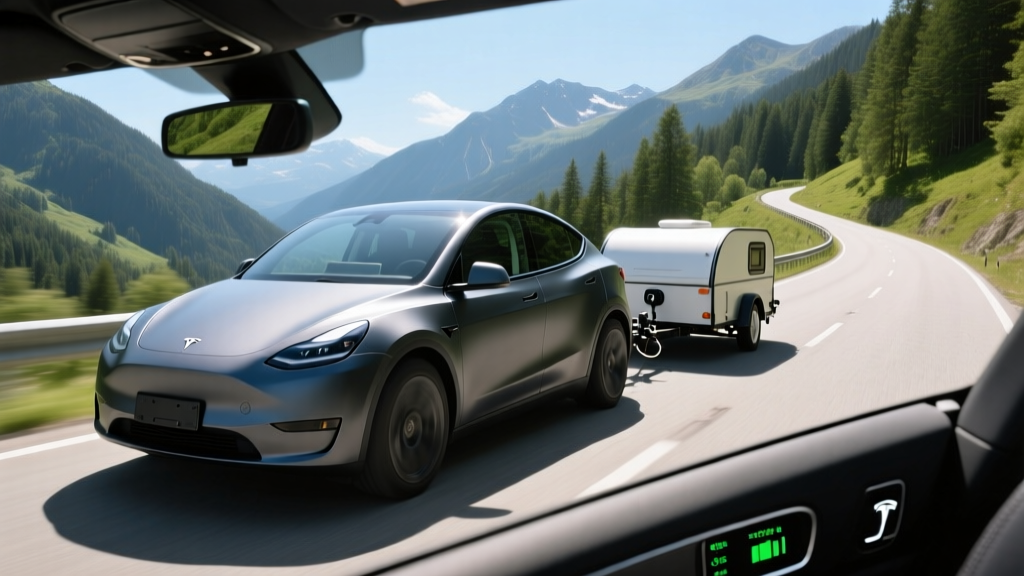
The Tesla Model Y remains the best-selling electric vehicle in the United States for good reason: strong range, access to the Supercharger network, and practical crossover utility. But for buyers who need to pull a small camper, jet ski, or utility trailer, the Tesla Model Y towing package is the critical option that separates a grocery-getter from a genuinely versatile hauler. Rated at 3,500 pounds when properly equipped, the Model Y's tow rating is competitive with gas-powered compact SUVs — yet the physics of towing with a battery-electric vehicle introduce range, efficiency, and charging considerations that every buyer must understand before hitching up.
This review covers the 2026 Tesla Model Y Long Range AWD with the factory tow package, examining real-world range (loaded and unloaded), charging behavior under tow, total cost after federal incentives, and how it stacks up against hybrid and electric rivals that also tow.
Spec Snapshot: Model Y Long Range AWD With Tow Package
| Specification | Value |
|---|---|
| EPA Range (no trailer) | 320 miles |
| Battery (usable) | ~75 kWh, NMC chemistry |
| Drivetrain | Dual-motor AWD |
| Horsepower | 384 hp (combined) |
| 0-60 mph | 4.8 seconds |
| Max Tow Rating | 3,500 lbs (with tow package) |
| Max DC Fast Charge | 250 kW peak |
| 10-80% DC Fast Charge | ~27 minutes |
| Level 2 Home Charge (48A) | ~32 miles per hour |
| EPA Efficiency | 117 MPGe / 29 kWh/100 mi |
| Cargo (behind 2nd row) | 30.2 cu ft |
| Cargo (seats folded) | 72.1 cu ft |
| Battery Warranty | 8 years / 120,000 miles |
| Base MSRP (Long Range AWD) | $48,990 |
| Tow Package Add-On | $1,000 |
What the Tesla Model Y Towing Package Actually Includes
The factory tow package is a $1,000 option on the Long Range AWD trim and includes a Class III tow hitch receiver, a 7-pin trailer wiring harness, and a software-enabled tow mode that adjusts throttle response, regenerative braking behavior, and stability control parameters for trailer sway mitigation. Tesla also integrates a trailer light check function accessible from the touchscreen.
The 3,500-pound maximum tow rating applies to the Long Range AWD variant specifically. The base Rear-Wheel-Drive Model Y is not rated for towing in the U.S. market. For context, 3,500 pounds covers most teardrop campers (1,500-2,500 lbs), pop-up trailers, a pair of personal watercraft on a tandem-axle trailer, or a small enclosed cargo trailer. It does not cover larger travel trailers or boat trailers exceeding that threshold — buyers with heavier needs should look at the Ford F-150 Lightning (7,700-10,000 lbs) or Rivian R1S (7,700 lbs).
Real-World Range: Unloaded vs. Towing
Real-World Highway (70 mph, no trailer): ~270-290 miles
Real-World Towing (2,500-lb camper, 65 mph): ~160-190 miles
Cold Weather (32°F, unloaded, highway): ~230-250 miles
The EPA sticker says 320 miles, but that figure assumes a mixed driving cycle with no trailer and moderate temperatures. On a 70-mph highway run with climate control active, expect 270-290 miles from a full charge in fair weather. Cold weather (below freezing) reduces usable range by 15-25% due to battery resistance and cabin heating demands, even with the Model Y's standard heat pump.
Towing is where the math changes dramatically. Aerodynamic drag and rolling resistance from a trailer can increase energy consumption by 40-60%, depending on trailer profile and weight. In our experience with similar-sized EV crossovers towing 2,000-3,000-pound loads, expect effective range to drop to roughly 160-190 miles at highway speeds with a boxy camper. A lighter, more aerodynamic trailer (like a teardrop) will land closer to 200-220 miles. This means a 300-mile road trip with a trailer requires at least one DC fast-charge stop — and possibly two, depending on terrain and headwinds.
According to fueleconomy.gov, the Long Range AWD achieves 117 MPGe combined. When towing, that figure effectively drops to roughly 70-80 MPGe equivalent, which translates to approximately 45-55 kWh/100 miles depending on conditions.
Charging Speed: Supercharger Stops and Home Setup
Tesla's 250 kW V3 Supercharger architecture remains a key advantage for towing owners. The NMC battery pack in the Long Range AWD can accept a peak charge rate of 250 kW, though sustained rates taper as state of charge increases. A 10-80% session takes approximately 27 minutes under optimal conditions (battery preconditioned via onboard navigation routing to a Supercharger). Above 80%, the charge curve flattens significantly — expect 80-100% to add another 20-25 minutes. For towing trips, plan to charge to 80% and go; the time penalty for the final 20% is rarely worth it.
| Charge Level | Power | Miles Added per Hour | Notes |
|---|---|---|---|
| Level 1 (120V outlet) | ~1.4 kW | ~5 mi/hr | Emergency/trickle only |
| Level 2 (240V, 48A Wall Connector) | 11.5 kW | ~32 mi/hr | Full charge in ~7 hours |
| Level 2 (240V, 32A mobile connector) | 7.7 kW | ~22 mi/hr | Standard NEMA 14-50 |
| DC Fast (V3 Supercharger) | 250 kW peak | ~1,000 mi/hr (peak) | 10-80% in ~27 min |
| DC Fast (CCS adapter, 150 kW station) | ~150 kW | ~600 mi/hr (peak) | Non-Tesla networks |
At home, the Tesla Wall Connector on a 60-amp circuit delivers up to 11.5 kW (48 amps), adding roughly 32 miles of range per hour. A full overnight charge from 10% to 100% takes about 7 hours — more than sufficient for daily use and for topping off before a towing trip. Installation costs for a dedicated 60A circuit typically range from $500 to $2,000 depending on panel proximity and local permitting. Homes with older 100-amp electrical panels may need a panel upgrade ($1,500-$3,000) to support a high-amperage EV circuit alongside existing loads.
For towing road trips, Tesla's Supercharger network is the clear differentiator. As of 2026, Tesla has opened many Supercharger stalls to non-Tesla EVs, but Tesla owners still benefit from native navigation integration that automatically routes through chargers and preconditions the battery for optimal charge speed upon arrival. With reduced range while towing, expect to stop every 150-180 miles — and note that not every Supercharger location is convenient for vehicles with attached trailers. Plan routes using Tesla's trip planner and confirm pull-through or oversized-vehicle parking at each stop.
Performance and Driving Dynamics Under Tow
The dual-motor AWD powertrain produces 384 horsepower and delivers a 4.8-second 0-60 mph time unloaded — quick by any measure and class-leading among electric crossovers. With a 2,500-pound trailer in tow, acceleration is noticeably muted but still confident for highway merging; expect 0-60 times in the 7-8 second range depending on trailer weight and grade.
Tow mode adjusts regenerative braking to a lower intensity to prevent trailer push on deceleration, which is a thoughtful calibration choice. The Model Y's low center of gravity (battery pack under the floor) contributes to composed handling with a trailer, and the electronic stability control actively manages trailer sway. That said, the Model Y's relatively short wheelbase (113.8 inches) means you'll feel crosswinds and passing semis more than you would in a longer-wheelbase vehicle like the Rivian R1S or Ford F-150 Lightning.
Pricing, Trims, and Federal Tax Credit Eligibility
The 2026 Model Y Long Range AWD starts at $48,990 (including destination). Adding the $1,000 tow package brings the base tow-equipped price to $49,990. Common options like red multi-coat paint ($2,000), 20-inch induction wheels ($2,000), and Full Self-Driving (Supervised) capability ($8,000) can push an as-tested price into the $55,000-$62,000 range.
| Item | Amount |
|---|---|
| Base MSRP (Long Range AWD) | $48,990 |
| Tow Package | +$1,000 |
| Popular Config (paint + wheels) | ~$53,990 |
| §30D Federal Tax Credit (max) | Up to $7,500 |
| Effective Price (after max credit) | From ~$42,490 |
The Model Y Long Range AWD has historically qualified for the full IRS §30D federal tax credit of up to $7,500, available as a point-of-sale reduction at the dealer since 2024. However, eligibility depends on several buyer-specific and vehicle-specific criteria that change periodically:
- MSRP cap: SUVs must be at or below $80,000 MSRP. The Model Y qualifies.
- Buyer income cap: Modified adjusted gross income must not exceed $150,000 (single), $225,000 (head of household), or $300,000 (joint filers).
- Battery sourcing: Critical minerals and battery components must meet escalating domestic-sourcing thresholds. Tesla's supply chain has largely met these requirements, but verify current-year compliance at fueleconomy.gov before purchasing.
- Transferability: The credit can be transferred to the dealer at point of sale, reducing your out-of-pocket cost immediately rather than waiting for tax filing.
Always confirm eligibility with your tax professional before relying on the credit, as IRS rules and Tesla's sourcing compliance can shift between model years.
Tech, Interior, and Daily Livability
The Model Y's cabin is defined by Tesla's minimalist approach: a single 15.4-inch center touchscreen handles navigation, media, climate, and vehicle settings. There is no instrument cluster — speed and driving info appear in the upper-left corner of the main display. The 2025-refresh Juniper update brought ambient lighting, ventilated front seats, a rear-seat touchscreen, and improved sound insulation, all of which carry into the 2026 model year.
Cargo volume is generous for the segment: 30.2 cubic feet behind the second row and 72.1 cubic feet with seats folded. The front trunk (frunk) adds 4.1 cubic feet of secure storage. Rear-seat legroom measures 41.6 inches — adequate for adults on longer trips. However, the panoramic glass roof, while visually open, contributes to cabin heat in summer; the included tinted glass helps but doesn't eliminate the need for sunshades in hot climates.
On the driver-assist front, Tesla's Autopilot (standard) provides adaptive cruise control and lane centering. The optional Full Self-Driving (Supervised) package adds automated lane changes, traffic-light recognition, and city-street navigation. It is critical to understand that FSD is an SAE Level 2 system — it requires continuous driver supervision and is not autonomous driving. Tesla's naming convention has generated significant confusion; treat FSD as an advanced cruise-control suite, not a replacement for an attentive driver.
Pros
- 3,500-lb tow rating covers most light trailers
- Supercharger network simplifies road-trip planning
- 250 kW peak DC charging; 10-80% in ~27 min
- 320-mile EPA range (unloaded) is segment-leading
- Low center of gravity aids towing stability
- Eligible for up to $7,500 federal tax credit
- Strong cargo and passenger space
Cons
- Towing cuts effective range by 40-50%
- Short wheelbase = more trailer sway in crosswinds
- No spare tire (tire repair kit only)
- FSD naming is misleading — still Level 2
- Minimalist interior not for everyone
- Limited Supercharger stalls accommodate trailers
- Insurance premiums above segment average
Model Y Towing vs. Key Competitors
If towing is a priority, the Model Y competes with several electrified alternatives, each with distinct trade-offs:
| Vehicle | Tow Rating | EPA Range | Starting MSRP | Key Advantage |
|---|---|---|---|---|
| Tesla Model Y LR AWD | 3,500 lbs | 320 mi | $48,990 | Supercharger network, efficiency |
| Ford Escape PHEV | 1,500 lbs | 37 mi (EV) / 400+ mi total | $40,500 | No range anxiety; gas backup |
| Hyundai Tucson PHEV | 2,000 lbs | 33 mi (EV) / 400+ mi total | $41,500 | Higher tow rating than most PHEVs |
| Rivian R1S (Dual-Motor) | 7,700 lbs | 316 mi | $79,900 | True heavy-towing EV |
| Toyota RAV4 Hybrid | 1,750 lbs | 500+ mi (gas) | $34,000 | Lowest cost, proven reliability |
The Model Y occupies a middle ground: more tow capacity than any PHEV crossover, far lower cost than the R1S, and the best charging infrastructure of any pure EV. If your typical trailer is under 3,000 pounds and you have home charging, it's a compelling choice. If you regularly tow above 3,500 pounds or need to cover 400+ miles with a trailer in areas with sparse charging, a PHEV or larger EV (R1S, F-150 Lightning) is more practical.
Who Should Buy the Model Y With the Tow Package?
Choose the Model Y with tow package if:
- You tow a teardrop camper, jet skis, or small utility trailer (under 3,000 lbs) on weekend trips
- You have reliable home Level 2 charging and typical towing trips are under 200 miles one-way
- You want a daily driver that also handles light towing — not a dedicated tow vehicle
- You value Tesla's Supercharger network for longer road trips (unloaded)
Look elsewhere if:
- You regularly tow over 3,000 lbs or pull large travel trailers
- Your towing routes cross charging-desert regions with limited DC fast-charger access
- You need a full-size spare tire for remote-area towing
- You want one-vehicle towing beyond 400 miles without multi-hour charge stops
Frequently Asked Questions
What is the real-world range of the Model Y while towing?
With a 2,500-pound camper at highway speeds, expect approximately 160-190 miles on a full charge, depending on trailer aerodynamics, terrain, and temperature. Lighter, more aerodynamic trailers may yield 200-220 miles. Always plan charging stops conservatively — arriving at a charger with less than 10% state of charge while towing leaves very little margin for detours or charger outages.
How fast does the Model Y charge on a road trip with a trailer?
At a V3 Supercharger (250 kW), the Model Y Long Range AWD charges from 10-80% in approximately 27 minutes with a preconditioned battery. However, finding Supercharger stalls that accommodate a vehicle with an attached trailer can be challenging. Some newer Supercharger locations include pull-through stalls, but many do not. Plan accordingly using Tesla's navigation or third-party apps like A Better Routeplanner.
Does the Model Y qualify for the $7,500 federal EV tax credit?
The Model Y Long Range AWD has qualified for the full §30D credit in recent years. Eligibility depends on your income (under $150K single / $300K joint), the vehicle's MSRP (under $80K for SUVs — the Model Y clears this), and current-year battery-sourcing compliance. The credit can be applied at point of sale as an immediate price reduction. Verify current eligibility at irs.gov and with your tax advisor.
Is the Model Y tow package worth it versus a gas or hybrid SUV?
If you tow fewer than 10 times per year and most trips are under 200 miles, the Model Y with tow package offers lower per-mile energy costs, zero tailpipe emissions, and a superior daily-driving experience compared to a body-on-frame SUV. However, if you tow frequently over long distances or in cold weather, the range penalty and additional charging stops make a PHEV (like the Tucson PHEV) or a gas SUV more pragmatic for towing-specific use.
Can I install an aftermarket hitch instead of the factory tow package?
Aftermarket hitches are available, but using one may void portions of Tesla's warranty related to the rear structure and electrical system. The factory tow package includes software integration (tow mode, trailer light check, stability control calibration) that aftermarket solutions cannot replicate. For warranty protection and full functionality, the factory $1,000 package is strongly recommended.
What is the Model Y's battery warranty?
Tesla covers the Model Y Long Range AWD battery and drive unit for 8 years or 120,000 miles, whichever comes first, with a minimum 70% capacity retention threshold over that period. This is competitive with Hyundai's 10-year/100,000-mile coverage but shorter in years. Real-world NMC battery degradation for Tesla vehicles has been well-documented: most owners report 5-8% capacity loss over the first 100,000 miles, with the curve flattening thereafter.