The Tesla Model Y as a Tow Vehicle: Quick Verdict
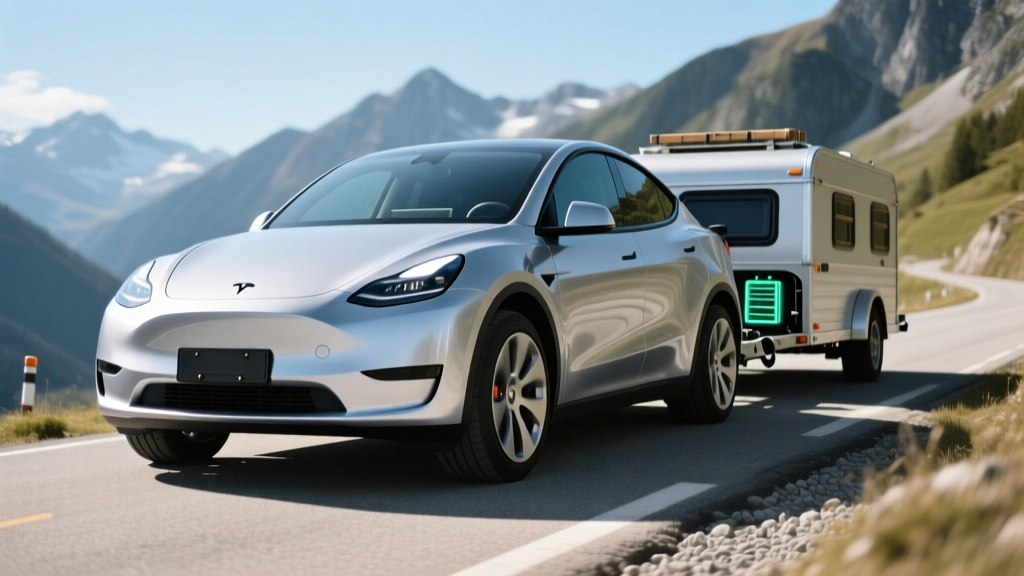
The Tesla Model Y's maximum towing capacity is 3,500 pounds when properly equipped with the factory tow package. That's enough for a small utility trailer, a pair of jet skis, a lightweight teardrop camper, or a single-axle boat — but it falls well short of what midsize SUVs like the Ford Explorer or Toyota Highlander can pull. For most EV buyers who tow occasionally rather than habitually, the Model Y's combination of 3,500-lb capacity, instant torque, and standard all-wheel drive makes it surprisingly competent. But towing slashes range dramatically, and understanding the real numbers is critical before you hitch up.
| Spec | Value |
|---|---|
| EPA Range | 320 miles |
| Battery Capacity | ~75 kWh usable (NMC chemistry) |
| Max DC Fast Charge | 250 kW (peak) |
| 10–80% DC Fast Charge | ~25 minutes |
| Level 2 Home Charging | 11.5 kW (~44 mi/hr) |
| 0–60 mph | 4.8 seconds |
| Horsepower | 384 hp (dual motor) |
| Drivetrain | Dual-motor AWD |
| Towing Capacity | 3,500 lbs (w/ factory tow package) |
| Efficiency | 117 MPGe combined / 29 kWh/100 mi |
| Cargo (rear seats up) | 30.2 cu ft |
| Cargo (rear seats folded) | 72.1 cu ft |
| Base MSRP (Long Range AWD) | $44,990 |
| Battery Warranty | 8 years / 120,000 miles |
Towing Capacity Breakdown: What 3,500 Pounds Actually Gets You
The 3,500-pound rating applies to the Long Range AWD and Performance trims when equipped with Tesla's factory-installed tow hitch and wiring harness (a $1,000 option at time of ordering, or retrofitted through service centers). The base Rear-Wheel Drive model is not rated for towing.
Here's what fits within 3,500 lbs:
- Teardrop trailers: Most weigh 1,000–2,500 lbs loaded — well within limits
- Small utility trailers (5×8 ft): ~800 lbs empty, up to ~2,000 lbs with cargo
- Jet skis on a single-axle trailer: ~1,500–2,200 lbs total
- Lightweight pop-up campers: Some models (e.g., SylvanSport GO) at ~1,800 lbs
- Small aluminum boats (14–16 ft) with trailer: ~2,000–3,000 lbs
What exceeds the Model Y's rating:
- Most travel trailers and A-frame campers (3,500–5,000+ lbs)
- Enclosed car haulers with a vehicle inside
- Large boats on dual-axle trailers
- Horse trailers (even single-horse models typically exceed 3,500 lbs loaded)
⚡ Real-World Range While Towing
EPA rated range: 320 miles (Long Range AWD, no trailer)
Expect while towing: 160–210 miles depending on trailer weight, aerodynamics, speed, and terrain. A boxy travel trailer at highway speeds will hit range harder than a low-profile boat. Plan charging stops at roughly 150-mile intervals for safety margin.
Cold-weather caveat: Below freezing, battery efficiency drops 15–30% even without a trailer. Towing in winter can push effective range below 140 miles between charges.
Battery, Charging, and the Towing-Range Math
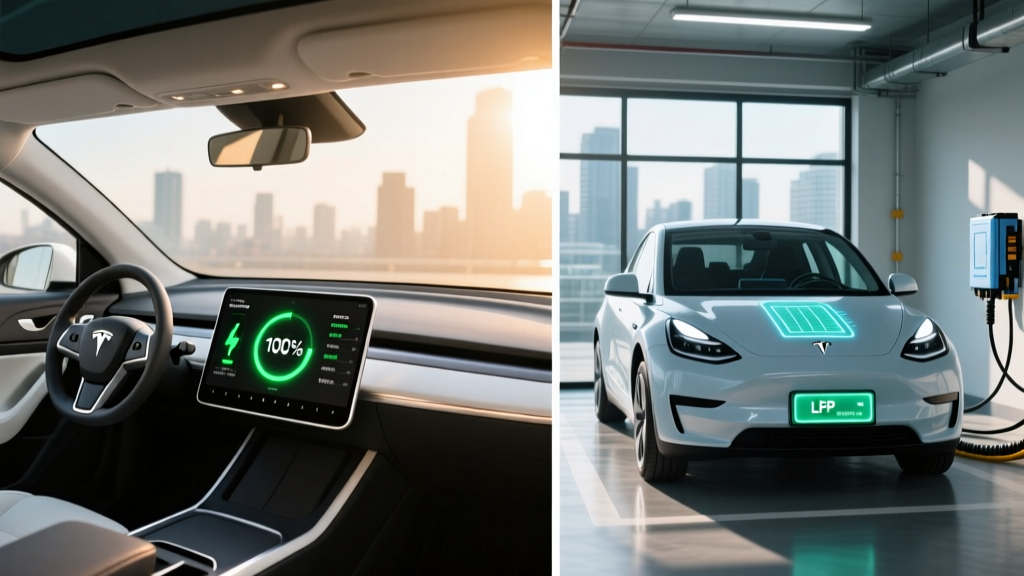
The Model Y Long Range uses an approximately 75 kWh (usable) nickel-manganese-cobalt (NMC) lithium-ion battery pack. NMC chemistry offers higher energy density than LFP (lithium iron phosphate), which is why the Long Range and Performance trims use it — critical for packaging enough capacity into the vehicle's floor while maintaining ground clearance and cargo space.
Charging speed matters enormously when towing, because you'll be stopping more frequently:
| Charge Level | Power | Speed (approx.) |
|---|---|---|
| Level 1 (120V outlet) | ~1.4 kW | ~3–4 miles per hour |
| Level 2 (240V, 48A) | 11.5 kW | ~44 miles per hour |
| DC Fast (Tesla Supercharger V3) | Up to 250 kW peak | 10–80% in ~25 min |
| DC Fast (CCS adapter, non-Tesla) | Up to 250 kW peak | Similar, varies by station |
Charging curve reality: The 250 kW peak only holds from roughly 10–30% state of charge. By 50% SoC, speed tapers to ~150 kW, and above 80% it drops below 50 kW. When towing and arriving at a charger with 5% remaining, expect 20–25 minutes to reach 80% at a V3 Supercharger — fast, but you'll be doing this every 150–200 miles on the road.
Home Level 2 charging at 11.5 kW fully replenishes the battery in about 6.5 hours. Tesla's Mobile Connector with a NEMA 14-50 outlet delivers up to ~30 mi/hr; a Wall Connector on a 60A circuit hits the full 44 mi/hr.
Efficiency and Performance Numbers
Without a trailer, the Model Y Long Range AWD achieves 117 MPGe combined (per fueleconomy.gov), consuming about 29 kWh per 100 miles. That's among the most efficient vehicles in the compact luxury SUV segment — roughly $0.04–0.06 per mile on average US electricity rates ($0.16/kWh).
Performance figures remain strong:
- 0–60 mph: 4.8 seconds (Long Range AWD); 3.5 seconds (Performance)
- Horsepower: 384 hp (Long Range); 456 hp (Performance)
- Drivetrain: Dual-motor all-wheel drive with independent front and rear motors
When towing, instant electric torque is a genuine advantage — there's no transmission downshift lag or turbo spool-up. Acceleration from stop and merging feel confident even with 2,000+ lbs behind you. The low center of gravity from the floor-mounted battery also reduces trailer sway compared to taller, body-on-frame SUVs.
Pricing, Trims, and Federal Tax Credit Eligibility
For 2025–2026, the Model Y lineup includes:
| Trim | Base MSRP | §30D Credit Eligible? | Effective Price (if eligible) |
|---|---|---|---|
| Long Range AWD | $44,990 | Up to $7,500 (subject to sourcing rules) | ~$37,490 |
| Performance AWD | $48,990 | Up to $7,500 (subject to sourcing rules) | ~$41,490 |
Tax credit caveats (IRS §30D, current rules):
- MSRP cap: SUVs must be at or below $80,000 — all Model Y trims qualify
- Buyer income cap: Modified AGI ≤ $150,000 (single) / $300,000 (joint)
- Battery sourcing: The full $7,500 requires meeting both critical-minerals and battery-component sourcing thresholds. Tesla's supply chain has progressively qualified, but the exact credit amount ($3,750 or $7,500) can shift with annual rule tightening. Check the IRS clean vehicle credit page for current eligibility before purchasing.
- Point-of-sale transfer: You can transfer the credit to the dealer (Tesla) to reduce your purchase price at delivery rather than waiting for tax filing
Adding the factory tow package costs $1,000. With destination fees and common options, a Long Range AWD with tow hitch typically lands around $46,500–$48,000 before credits.
Cargo, Interior, and Practical Ownership
The Model Y offers 30.2 cubic feet behind the second row and 72.1 cubic feet with rear seats folded — competitive with the BMW X3 and Audi Q5. The front trunk (frunk) adds another 4.1 cu ft for charging cables or a soft cooler.
Interior dimensions accommodate adults comfortably in all five seats, with 41.6 inches of front legroom and 37.3 inches in the rear. The optional third row (available in some markets) is realistically usable only for small children and eats into cargo volume.
Standout tech:
- 15.4-inch center touchscreen with navigation, media, and vehicle controls
- Over-the-air software updates that add features post-purchase
- Autopilot standard (SAE Level 2 driver assistance — requires active driver supervision)
- Full Self-Driving (Supervised) available as a $8,000 option or $99/mo subscription — still Level 2, not autonomous
- Sentry Mode dashcam recording, Dog Mode climate control for pets
- Heat pump for improved cold-weather efficiency and range preservation
Notable drawbacks:
- No traditional instrument cluster — all info is on the center screen
- Minimalist interior lacks physical buttons for climate and mirrors
- Ride quality can feel firm on rough roads (sport-tuned suspension)
- Tow package must be ordered at time of purchase or retrofitted — not all used inventory has it
- Insurance premiums tend to run 15–25% higher than comparable gas SUVs
✅ Pros
- 3,500-lb towing adequate for light trailers and watercraft
- Instant torque makes towing feel confident and smooth
- Access to Tesla Supercharger network (17,000+ stalls in North America)
- 320-mile EPA range (without trailer) covers most daily needs easily
- Low running costs: ~$0.05/mi vs. $0.15+/mi for gas equivalents
- Strong safety ratings (NHTSA 5-star, IIHS Top Safety Pick+)
❌ Cons
- Towing cuts range by 35–50% — plan extra charging stops
- 3,500-lb limit rules out most travel trailers and campers
- No spare tire (tire repair kit only)
- Tow package not included standard — $1,000 add-on
- Steep charging-curve taper above 80% SoC
- Higher insurance and upfront cost vs. gas competitors
Warranty and Long-Term Ownership
Tesla provides the following coverage for the Model Y:
- Basic vehicle warranty: 4 years / 50,000 miles
- Battery & drive unit warranty: 8 years / 120,000 miles (Long Range/Performance) with a minimum 70% capacity retention guarantee
- Towing-related wear: Tesla's warranty does not exclude towing as long as you stay within the 3,500-lb rating and use the approved hitch. However, accelerated brake or suspension wear from towing is considered normal wear, not a warranty claim.
Battery degradation data from aggregated fleet reports suggests Model Y owners see roughly 5–8% capacity loss over the first 100,000 miles, with the curve flattening significantly afterward. The NMC pack is designed for longevity, and Tesla's thermal management system (active liquid cooling/heating) helps preserve cell health.
Is the Model Y the Right EV for Towing?
Choose the Model Y if: You tow light loads (under 3,000 lbs) a few times a year — boats, jet skis, utility trailers — and want an efficient daily driver the other 350 days. The Supercharger network makes road-trip towing feasible with planning, and the low per-mile energy cost saves money versus a gas SUV on every non-towing commute.
Look elsewhere if: You regularly tow over 3,500 lbs, need to pull a full-size travel trailer, or tow long distances in winter where range loss compounds. Consider the Ford F-150 Lightning (7,700–10,000 lb rating), Rivian R1S (7,700 lbs), or a plug-in hybrid like the Jeep Grand Cherokee 4xe (6,200 lbs) for heavier or more frequent towing duty.
Frequently Asked Questions
Does the Tesla Model Y come with a tow hitch standard?
No. The tow hitch and wiring harness are a $1,000 factory option that must be specified at order time. Retrofitting through a Tesla Service Center is possible but may cost more and require scheduling. Aftermarket hitches exist but may void warranty claims related to the electrical system or rear structure.
How much range do I lose when towing with the Model Y?
Expect a 35–50% reduction. The 320-mile EPA rating drops to roughly 160–210 miles with a loaded trailer, depending on weight, aerodynamics, speed, and temperature. A sleek, lightweight teardrop at 55 mph will lose less than a boxy utility trailer at 70 mph.
Can the Model Y tow a camper or travel trailer?
Only very small, lightweight ones. Most conventional travel trailers weigh 4,000–7,000+ lbs — well above the 3,500-lb limit. Teardrop campers (1,000–2,500 lbs) and some pop-up models are viable. Always check the trailer's GVWR (gross vehicle weight rating), not just its dry weight.
Does the Model Y qualify for the $7,500 federal EV tax credit?
The Model Y's MSRP is under the $80,000 SUV cap, so it passes that threshold. Full credit eligibility depends on your income (≤$150K single / ≤$300K joint), battery-component sourcing, and critical-minerals requirements per IRS §30D rules. Tesla's credit amount has fluctuated — confirm the exact figure on the IRS qualified vehicles list at time of purchase. The credit can be transferred at point of sale to reduce your purchase price.
What's the real-world range without towing?
In mixed driving at moderate temperatures, expect 280–310 miles from a full charge — close to the 320-mile EPA estimate. Sustained highway driving at 75+ mph drops that to roughly 260–280 miles. In sub-freezing winter conditions, 230–270 miles is typical, helped by the Model Y's standard heat pump which reduces cabin-heating energy draw.
Is the Model Y better for towing than the Ford Mustang Mach-E?
The Mach-E's towing capacity is just 1,500 lbs (with the optional tow package on select trims), making the Model Y's 3,500-lb rating more than double. For any meaningful towing, the Model Y is the stronger choice among electric crossovers in this price range.