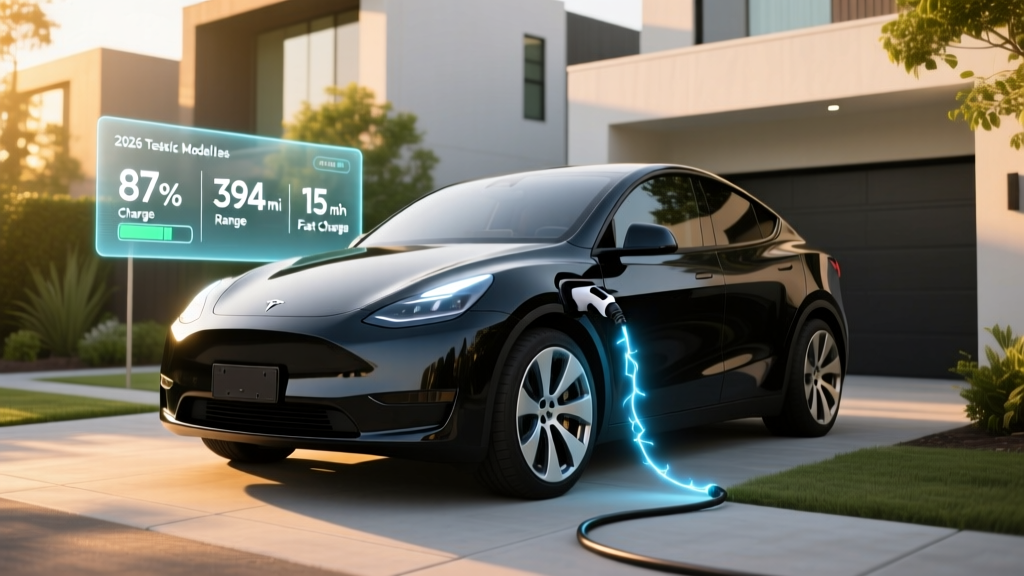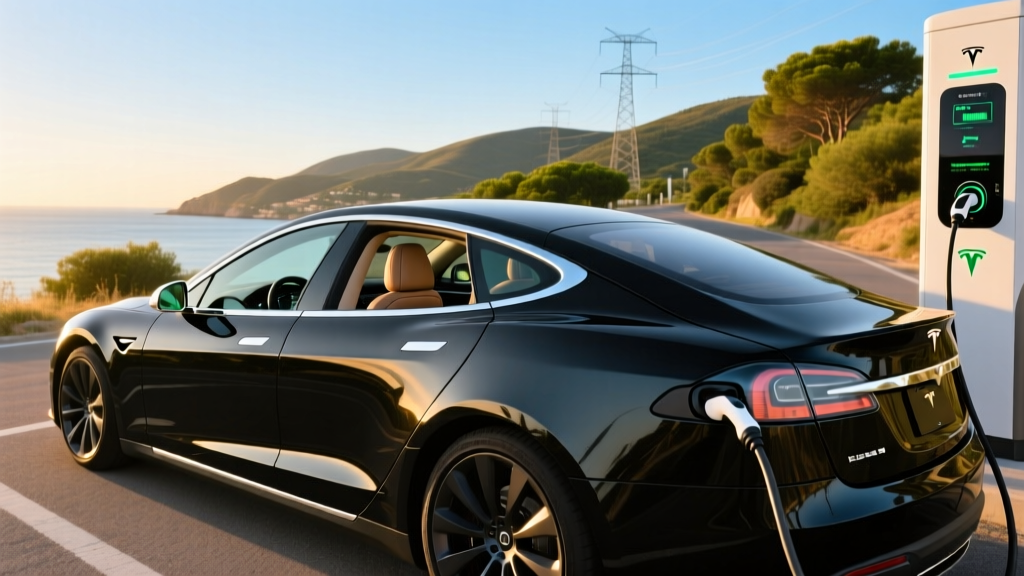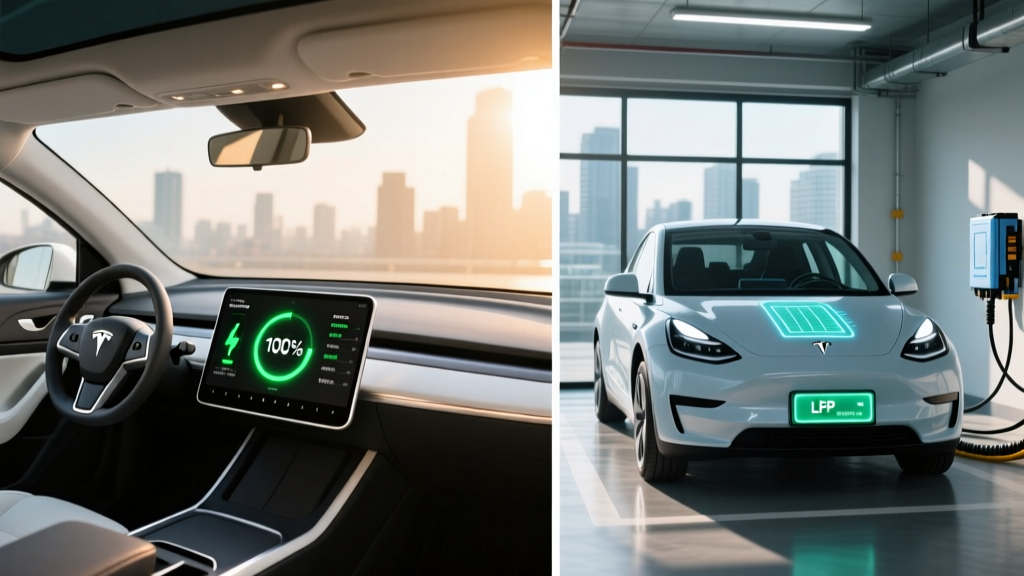
If you own a Tesla — or are about to buy one — you've almost certainly encountered conflicting advice about charging to 100%. Some owners swear by it; others treat 80% like a hard ceiling. The truth is that the right answer depends entirely on one variable most buyers never check: battery chemistry. Tesla uses two fundamentally different lithium-ion chemistries across its 2026 lineup, and each demands a different charging strategy to maximize longevity.
This guide breaks down exactly when you should (and shouldn't) charge to 100%, which Tesla models use which chemistry, and how to set up your charging routine for maximum battery life — backed by Tesla's own recommendations and real-world degradation data.
The Short Answer: It Depends on Your Battery Chemistry
Tesla currently uses two battery chemistries across its fleet:
- LFP (Lithium Iron Phosphate) — used in the Model 3 Rear-Wheel Drive and Model Y Rear-Wheel Drive. Tesla explicitly recommends charging to 100% at least once per week.
- NMC/NCA (Nickel Manganese Cobalt / Nickel Cobalt Aluminum) — used in Long Range and Performance variants. Tesla recommends a daily charge limit of 80%, reserving 100% for trips.
LFP batteries need periodic 100% charges so the Battery Management System (BMS) can accurately calibrate the state of charge. Without it, the car's range estimate drifts, and you may lose access to usable capacity. NMC/NCA batteries, by contrast, experience accelerated degradation when held at high states of charge — so daily 100% charges actively shorten their lifespan.
Which 2026 Tesla Models Use LFP vs NMC?
| Model / Trim | Chemistry | Battery (kWh usable) | Charge to 100% Weekly? |
|---|---|---|---|
| Model 3 Rear-Wheel Drive | LFP | ~57.5 | Yes — recommended |
| Model 3 Long Range AWD | NMC | ~75 | No — 80% daily, 100% for trips |
| Model 3 Performance | NMC | ~75 | No — 80% daily, 100% for trips |
| Model Y Rear-Wheel Drive | LFP | ~57.5 | Yes — recommended |
| Model Y Long Range AWD | NMC | ~75 | No — 80% daily, 100% for trips |
| Model Y Performance | NMC | ~75 | No — 80% daily, 100% for trips |
| Model S Long Range / Plaid | NMC/NCA | ~95 | No — 80% daily, 100% for trips |
| Model X Long Range / Plaid | NMC/NCA | ~95 | No — 80% daily, 100% for trips |
Note: Tesla has shifted battery suppliers and chemistries across model years. Always verify your specific vehicle's chemistry in the Tesla app under Software → Additional Vehicle Information, or check your window sticker. The information above reflects the 2026 model-year lineup as of publication.
Why LFP Batteries Need 100% Charges
LFP cells have a very flat voltage curve across most of their state of charge. Unlike NMC, where voltage rises predictably as the battery fills, LFP voltage stays nearly constant between roughly 20% and 80% SoC. This makes it extremely difficult for the BMS to estimate how much energy remains based on voltage alone.
The BMS uses coulomb counting (tracking energy in and out) to supplement voltage readings, but small measurement errors accumulate over time. Without a full charge to 100% — where voltage rises sharply and provides a clear reference point — the BMS gradually loses track of the true state of charge.
The practical consequences:
- Range estimate inaccuracy: Your displayed range may show more or fewer miles than the battery actually holds.
- Phantom capacity loss: The battery hasn't degraded — but the BMS thinks it has, and may restrict usable capacity to protect against perceived overcharge.
- Sudden range drops: Owners who never charge to 100% sometimes report the car showing 30% remaining, then suddenly dropping to 0% within a few miles.
Tesla's official recommendation, stated in the Model 3 owner's manual, is to charge LFP-equipped vehicles to 100% at least once per week. Many LFP owners find that setting the charge limit to 100% as their default and leaving the car plugged in (with scheduled departure or off-peak charging) works well in practice.
Why NMC/NCA Batteries Should Avoid Frequent 100% Charges
Nickel-rich chemistries (NMC and NCA) are more energy-dense than LFP — which is why they power Long Range and Performance models — but they are also more sensitive to high states of charge. The degradation mechanisms include:
- Cathode surface instability: At high SoC, the cathode's crystal structure becomes more reactive, accelerating micro-cracking and capacity fade.
- Electrolyte oxidation: Higher cell voltages (above ~4.0V per cell, which corresponds to roughly 80% SoC) increase the rate of electrolyte decomposition.
- Lithium plating risk: Charging to 100% and then sitting at full charge — especially in warm conditions — can promote lithium metal deposition on the anode.
Research published by battery analyst Jeff Dahn's group at Dalhousie University (a long-time Tesla collaborator) has consistently shown that NMC cells cycled between 20–80% SoC last significantly longer than those cycled 0–100%. The difference can be 2–3× in cycle life under controlled conditions.
In practice, this means NMC Tesla owners should:
- Set the daily charge limit to 80% (the car's default recommendation for Long Range and Performance models).
- Charge to 100% only when departing on a road trip — and ideally, time the charge so the car reaches 100% shortly before you leave, rather than sitting at full charge overnight.
- Avoid leaving the car at 100% SoC for extended periods (days) in hot weather.
According to Tesla's 2024 Impact Report (the most recent published data), Model 3 and Model Y vehicles with NMC batteries show approximately 12% average range degradation at 200,000 miles. LFP-equipped vehicles in the fleet show lower degradation curves, with many owners reporting less than 5% loss at 100,000 miles — though LFP packs are newer to the fleet and long-term data is still accumulating. Source: Tesla Impact Report.
2026 Tesla Model 3: Range, Charging, and Specs by Trim
Because the "charge to 100%" question is most relevant to the Model 3 and Model Y (where both LFP and NMC options exist), here's a detailed spec breakdown for the 2026 Model 3 lineup.
| Spec | RWD (LFP) | Long Range AWD (NMC) | Performance (NMC) |
|---|---|---|---|
| EPA Range | 272 mi | 341 mi | 315 mi |
| Battery (usable) | ~57.5 kWh LFP | ~75 kWh NMC | ~75 kWh NMC |
| Efficiency | 132 MPGe / 25 kWh/100mi | 134 MPGe / 25 kWh/100mi | 121 MPGe / 28 kWh/100mi |
| Max DC Fast Charge | 170 kW peak | 250 kW peak | 250 kW peak |
| 10–80% DCFC Time | ~25 min | ~22 min | ~22 min |
| Level 2 Home Charging | 11.5 kW / ~38 mi/hr | 11.5 kW / ~44 mi/hr | 11.5 kW / ~40 mi/hr |
| 0–60 mph | 5.8 sec | 4.2 sec | 2.9 sec |
| Horsepower | 271 hp | 346 hp | 510 hp |
| Drivetrain | RWD | Dual-Motor AWD | Dual-Motor AWD |
| Base MSRP | $38,990 | $45,990 | $52,990 |
The EPA numbers above assume a mix of city and highway driving at moderate temperatures. In real-world testing:
• Highway-only at 75 mph: Expect ~10–15% less than EPA (e.g., Model 3 LR AWD delivers roughly 290–305 miles on a full charge at sustained highway speeds).
• Cold weather (below 32°F): Range can drop 20–30% due to battery resistance and cabin heating demands. An LFP Model 3 RWD may deliver ~190–215 miles in freezing conditions.
• City driving with regen: Often matches or slightly exceeds EPA estimates, especially in mild weather.
Charging Speed Reality: Peak kW Is Not Sustained kW
Tesla advertises peak DC fast-charge rates — 250 kW for Long Range/Performance, 170 kW for the LFP RWD. But no EV sustains its peak rate for the entire session. The charge curve tapers as the battery fills:
- 10–30% SoC: The car pulls close to peak kW (250 kW for NMC, ~170 kW for LFP).
- 30–60% SoC: Rate gradually decreases to manage cell temperature.
- 60–80% SoC: Significant taper; NMC models may drop to 80–120 kW.
- Above 80% SoC: Sharp taper to protect cells; charging slows to 30–50 kW and eventually trickle-charges near 100%.
This is why Tesla (and every other EV maker) quotes 10–80% charge times rather than 0–100%. Charging from 80–100% on a DC fast charger can take as long as the 10–80% portion — and generates significant heat. For NMC batteries, regularly DC fast-charging to 100% accelerates degradation. For LFP batteries, an occasional 100% DC charge is fine for BMS calibration, but doing it daily at a Supercharger is unnecessary wear.
Practical recommendation: Use DC fast charging to 80% on road trips. If you need 100%, let the car finish the last 20% at home on Level 2, where the slower rate generates less heat.
How to Set Up the Right Charging Routine
The Tesla app and in-car settings make it straightforward to automate the right charging behavior for your chemistry:
For LFP Owners (Model 3 RWD, Model Y RWD)
- Set charge limit to 100% as the default.
- Enable Scheduled Charging to start during off-peak utility hours (e.g., midnight–6 AM).
- Plug in whenever convenient — the car will hold at your scheduled time.
- If you forget to plug in for a week, the BMS calibration will drift slightly; one 100% charge will reset it.
For NMC/NCA Owners (Long Range, Performance, Model S, Model X)
- Set the daily charge limit to 80% (the car's default recommendation).
- Before a road trip, increase the limit to 100% and time the charge to finish just before departure — use Scheduled Departure in the Tesla app.
- Avoid leaving the car at 100% SoC for more than a few hours, especially in summer.
- If your daily commute requires more than 80% of range, consider whether an LFP model or a larger NMC pack (Model S/X) better fits your needs.
Some NMC owners set the charge limit to 100% "just in case" and leave the car plugged in at full charge for days. This is one of the fastest ways to accelerate NMC degradation. The car's BMS will not protect you from the chemistry-level stress of sitting at 4.2V per cell for extended periods. Set 80% as your default and only change it when you have a specific trip planned.
2026 Tesla Pricing and Federal Tax Credit Eligibility
The federal EV tax credit under IRS §30D offers up to $7,500 for qualifying new EVs — but eligibility depends on MSRP caps, buyer income limits, and battery-component/critical-mineral sourcing requirements that shift annually.
| Model / Trim | Base MSRP | Under §30D MSRP Cap? | Est. Credit |
|---|---|---|---|
| Model 3 RWD | $38,990 | Yes (sedan cap: $55,000) | Up to $7,500* |
| Model 3 Long Range AWD | $45,990 | Yes (sedan cap: $55,000) | Up to $7,500* |
| Model 3 Performance | $52,990 | Yes (sedan cap: $55,000) | Up to $7,500* |
| Model Y RWD | $44,990 | Yes (SUV cap: $80,000) | Up to $7,500* |
| Model Y Long Range AWD | $48,990 | Yes (SUV cap: $80,000) | Up to $7,500* |
| Model S Long Range | $79,990 | No (exceeds $55K sedan cap) | $0 |
| Model X Long Range | $84,990 | No (exceeds $80K SUV cap) | $0 |
*Credit amount depends on battery-component and critical-mineral sourcing requirements, which change annually under the Inflation Reduction Act. Buyer income must not exceed $150,000 (single) / $225,000 (head of household) / $300,000 (joint). The credit can be transferred to the dealer at point of sale as an instant discount. Always verify current eligibility on IRS.gov and consult a tax professional. Tesla's website also maintains a real-time eligibility indicator at checkout.
Battery Warranty: What Tesla Actually Covers
All 2026 Tesla vehicles include an 8-year battery and drive unit warranty, with mileage limits that vary by model:
- Model 3 RWD (LFP): 8 years / 100,000 miles, whichever comes first
- Model 3 Long Range & Performance: 8 years / 120,000 miles
- Model Y (all trims): 8 years / 120,000 miles
- Model S & Model X: 8 years / 150,000 miles
The warranty guarantees that the battery will retain at least 70% of its original capacity during the coverage period. If degradation exceeds 30%, Tesla will repair or replace the battery pack at no cost. In practice, reaching the 70% threshold within the warranty period is rare for vehicles charged according to Tesla's recommendations — the chemistry-specific charging guidelines above exist precisely to keep you well within warranty bounds.
Note that the warranty does not cover capacity loss from consistently ignoring Tesla's charging recommendations (e.g., routinely leaving an NMC pack at 100% for extended periods), though proving this in a warranty claim is difficult and Tesla has not publicly denied claims on this basis.
Frequently Asked Questions
Should I charge my Tesla to 100% once a week?
If your Tesla has an LFP battery (Model 3 RWD or Model Y RWD), yes — Tesla recommends charging to 100% at least weekly to keep the BMS calibrated. If your Tesla has an NMC/NCA battery (Long Range, Performance, Model S, Model X), no — stick to 80% daily and save 100% for road trips.
How do I know if my Tesla has an LFP or NMC battery?
In the Tesla app, go to your vehicle's Software screen. If you see a recommendation to "charge to 100% regularly," you have an LFP pack. You can also check your window sticker or VIN decoder. Generally, 2026 RWD trims use LFP; Long Range and Performance trims use NMC.
Is it bad to Supercharge to 100% occasionally?
For LFP vehicles, an occasional 100% Supercharge is fine and helps BMS calibration. For NMC vehicles, doing it once or twice a year on road trips won't meaningfully impact longevity — but avoid making it a habit. The heat generated during DC fast charging combined with high SoC is the worst-case scenario for NMC degradation.
What happens if I never charge my LFP Tesla to 100%?
The BMS will gradually lose calibration. You may notice the displayed range estimate becoming unreliable, and in extreme cases, the car may show remaining range that doesn't match actual capacity — leading to unexpected low-charge warnings. You won't damage the battery cells themselves, but you'll lose access to some usable capacity until you perform a full charge to recalibrate.
Does charging to 80% instead of 100% double my battery life?
Not exactly double, but the difference is significant. Laboratory data from Dalhousie University shows NMC cells cycled 20–80% can achieve 3–5× more equivalent full cycles than cells cycled 0–100%. In real-world driving, this translates to measurably slower degradation over 150,000+ miles. For most owners, the battery will outlast the car regardless — but if you plan to keep your Tesla for 200,000+ miles, the 80% habit matters.
Should I leave my Tesla plugged in when not driving?
Yes. Tesla recommends keeping the car plugged in whenever possible. The vehicle's thermal management system uses grid power (not battery) to maintain optimal battery temperature, and the BMS can perform maintenance tasks. For NMC owners, set the charge limit to 80% so the car doesn't sit at a high SoC. For LFP owners, 100% is fine.