Can the Tesla Model Y Actually Tow? The Quick Verdict
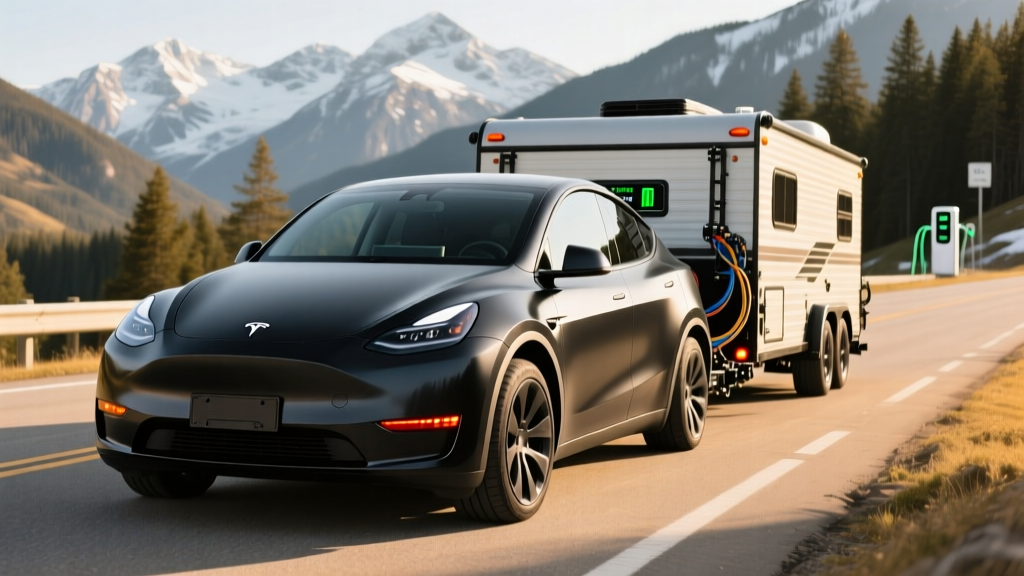
The Tesla Model Y remains one of the best-selling electric vehicles in the United States, and for good reason: strong efficiency, access to the Supercharger network, and practical crossover packaging. But for buyers who need to pull a small trailer, boat, or bike rack, the Model Y tow package is the critical add-on that unlocks a 3,500-pound maximum towing capacity. For the 2026 model year, Tesla continues to offer the factory tow package across Long Range and Performance trims, integrating a high-strength steel tow bar, 7-pin wiring harness, and software-based trailer sway control.
This review breaks down everything you need to know about the Model Y with the tow package — from real-world range degradation while towing, to DC fast-charging speeds, battery chemistry, and whether the federal EV tax credit applies. If you're cross-shopping the Ford Mustang Mach-E, Hyundai Ioniq 5, or Kia EV6, the towing story is where the Model Y diverges sharply from the pack.
Model Y Tow Package: What You Get and How It Works
The Model Y tow package is a factory-installed option — it cannot be retrofitted at a third-party shop without potentially voiding warranty coverage on related electrical systems. Here's what the package includes:
- High-strength steel tow hitch with a 2-inch receiver (Class III equivalent)
- 7-pin electrical connector for trailer brake lights, turn signals, and electric trailer brakes
- Software-integrated trailer sway control using the vehicle's stability system to detect and mitigate trailer oscillation
- Tow Mode in the drive settings that adjusts regenerative braking aggressiveness, throttle mapping, and energy estimation to account for trailer load
- Maximum towing capacity: 3,500 lbs (1,588 kg) with a maximum tongue weight of 350 lbs
The tow package is available on the Long Range AWD and Performance trims. The base Rear-Wheel-Drive (RWD) Model Y does not offer the tow package in the U.S. market for 2026. Tesla prices the tow package at $1,000 when added at the time of order.
| Specification | Long Range AWD | Performance |
|---|---|---|
| EPA Estimated Range | 320 miles | 298 miles |
| Usable Battery Capacity | ~78 kWh (NMC) | ~78 kWh (NMC) |
| Max Towing Capacity | 3,500 lbs | 3,500 lbs |
| Max Tongue Weight | 350 lbs | 350 lbs |
| 0–60 mph (no trailer) | 4.8 seconds | 3.3 seconds |
| Horsepower | 384 hp (dual motor) | 456 hp (dual motor) |
| Drivetrain | AWD (dual motor) | AWD (dual motor) |
| Efficiency (no trailer) | 122 MPGe / 28 kWh/100mi | 111 MPGe / 30 kWh/100mi |
| DC Fast Charge (peak) | 250 kW (CCS/NACS) | 250 kW (CCS/NACS) |
| 10–80% DC Charge Time | ~27 minutes | ~27 minutes |
| Level 2 Home Charging | 11.5 kW (~44 mi/hr) | 11.5 kW (~44 mi/hr) |
| Tow Package Cost | $1,000 | $1,000 |
| Battery/Drive Unit Warranty | 8 yr / 120,000 mi | 8 yr / 120,000 mi |
Real-World Range: What Happens When You Actually Tow
This is where most buyers need the most honest data. The EPA range sticker does not account for towing — and towing a trailer dramatically increases energy consumption due to added weight, rolling resistance, and aerodynamic drag.
EPA sticker (no trailer): 320 miles
Real-world, no trailer (mixed driving): ~280–305 miles depending on speed, temperature, and elevation
Real-world, towing ~2,000 lb enclosed trailer (highway, 65 mph): ~160–190 miles
Real-world, towing ~3,500 lb max load (highway, 65 mph): ~130–160 miles
Cold weather (below 32°F), no trailer: ~240–270 miles
Cold weather + towing: Expect 40–55% range reduction vs. EPA — plan for ~130–170 miles max with a moderate load
Why the massive reduction? Towing pushes energy consumption from ~28 kWh/100 miles up to 55–75 kWh/100 miles depending on trailer weight and aerodynamic profile. An enclosed cargo trailer is worse than an open utility trailer at highway speeds because of the wall of air resistance it creates. A lightweight teardrop camper (~1,500 lbs) is the sweet spot — you'll see roughly 45–55 kWh/100mi, yielding around 175–200 real-world miles per charge.
Tesla's onboard trip planner and Tow Mode do a respectable job of predicting energy use and routing you through Superchargers when towing. The navigation system will automatically adjust estimated arrival SoC (State of Charge) when it detects the trailer is connected. However, you should always build in a 15–20% buffer — real-world conditions like headwinds, mountain grades, and cold batteries can exceed the car's predictions.
Charging While Towing: DC Fast-Charge Speeds and Logistics
Charging speed is measured in kW (kilowatts) — the rate of power delivery — while battery capacity is measured in kWh (kilowatt-hours), the total energy stored. The Model Y Long Range and Performance support a peak DC fast-charge rate of 250 kW at V3/V4 Superchargers and compatible CCS/NACS stations.
| Charging Level | Power (kW) | Speed (miles of range per hour) | Notes |
|---|---|---|---|
| Level 1 (120V household) | ~1.4 kW | ~5 mi/hr | Emergency/trickle only |
| Level 2 (240V home, Wall Connector) | 11.5 kW | ~44 mi/hr | Full charge in ~7–8 hours |
| Level 2 (public, 7.2 kW) | 7.2 kW | ~28 mi/hr | Common at destinations |
| DC Fast (V3 Supercharger, peak) | 250 kW | ~1,000+ mi/hr (peak) | 10–80% in ~27 min |
| DC Fast (50 kW CCS station) | 50 kW | ~190 mi/hr | 10–80% in ~75 min |
Important charging-curve reality: The 250 kW peak only holds between roughly 10–30% SoC. From 30–60%, expect ~150–180 kW. From 60–80%, the rate tapers to ~80–100 kW. Above 80%, charging slows dramatically to protect battery health — this is normal for all lithium-ion NMC batteries. When towing and arriving at a Supercharger with a low SoC, you'll see the fastest portion of the curve, but a full 10–80% session still takes approximately 27 minutes.
The practical implication for towing road trips: plan for more frequent stops. If your towing range is ~170 miles, you'll want to stop every 120–140 miles to maintain a safety buffer. A 300-mile towing trip that would take 4.5 hours in a gas truck will likely take 6–7 hours in the Model Y including two 25–30 minute Supercharger stops. For occasional weekend towing to a lake or campground, this is manageable. For daily commercial towing, it's a dealbreaker.
One logistical note: many Supercharger stalls are pull-through or have adequate space for a small trailer, but busy urban Supercharger locations may require you to disconnect the trailer before pulling in. Tesla's in-app navigation does not yet flag which stations offer trailer-friendly pull-through stalls — a notable software gap.
Battery, Powertrain, and Warranty Details
The 2026 Model Y Long Range and Performance use an NMC (nickel manganese cobalt) lithium-ion battery pack with approximately 78 kWh of usable capacity. NMC chemistry offers higher energy density than LFP (lithium iron phosphate), which is why Tesla reserves it for the Long Range and Performance trims that need maximum range. The trade-off: NMC batteries are more sensitive to sustained high-SoC storage and benefit from daily charging limits of 80–90% for longevity (Tesla's software lets you set a custom charge limit).
The dual-motor AWD powertrain provides independent torque vectoring between front and rear axles, which is beneficial when towing on wet or uneven surfaces. The Model Y's low center of gravity (battery pack mounted under the floor) contributes to stable towing dynamics compared to body-on-frame SUVs with a higher center of mass.
Warranty coverage:
- Battery and Drive Unit: 8 years or 120,000 miles (whichever comes first), with a minimum 70% capacity retention guarantee
- Vehicle Limited Warranty: 4 years or 50,000 miles
- Tow hitch hardware: Covered under the vehicle limited warranty; software-related trailer features covered for the same period
Does towing void the battery warranty? No — Tesla's warranty does not exclude towing use. However, if battery degradation is accelerated by repeated deep-discharge towing cycles (regularly running the pack below 10% SoC under heavy load), a warranty claim could face scrutiny. Best practice: keep SoC above 20% when towing and use Tesla's preconditioning feature before fast-charging stops.
Pricing, Trims, and Federal Tax Credit Eligibility
Here's the current pricing landscape for the 2026 Model Y with the tow package, before any incentives:
| Trim | Base MSRP | + Tow Package | As-Tested (with tow) | §30D Credit Eligibility |
|---|---|---|---|---|
| Long Range AWD | $48,990 | +$1,000 | $49,990 | Potentially up to $7,500* |
| Performance | $52,490 | +$1,000 | $53,490 | Potentially up to $7,500* |
*Federal §30D tax credit eligibility depends on buyer income, battery component sourcing, and critical mineral requirements. See IRS rules below.
Federal EV Tax Credit (§30D) — 2026 Rules:
The Model Y qualifies for the federal tax credit, but eligibility is not automatic for every buyer. Under current IRS §30D rules, you must meet all of the following:
- MSRP cap: The vehicle's MSRP must not exceed $80,000 for SUVs — both Model Y trims clear this easily
- Buyer income cap: Modified adjusted gross income (MAGI) must not exceed $300,000 (married filing jointly), $225,000 (head of household), or $150,000 (single)
- Battery sourcing: At least a percentage of critical minerals and battery components must be sourced from the U.S. or free-trade-agreement countries — Tesla's Fremont-built Model Y has progressively increased domestic sourcing, but the exact credit amount ($3,750 or $7,500) depends on the specific battery batch and model year. Check the fueleconomy.gov tax credit tracker for the latest eligibility
- Point-of-sale transfer: As of 2024, you can transfer the credit to the dealer at purchase, reducing your out-of-pocket cost immediately rather than waiting for a tax refund
Always consult a tax professional and verify current eligibility on irs.gov before finalizing a purchase — sourcing requirements tighten annually.
Cargo Space, Interior, and Tech Features
The Model Y's crossover form factor is its practical ace. With the tow package, you don't lose any cargo or passenger volume — the hitch mounts externally below the rear bumper.
- Cargo volume (rear seats up): 30.2 cu ft
- Cargo volume (rear seats folded): 72.1 cu ft
- Front trunk (frunk): 4.1 cu ft
- Rear legroom: 41.6 inches
- Front headroom: 41.0 inches
- Seating: 5 passengers standard; optional 7-seat config (third row best for children only)
Standout tech:
- 15.4-inch center touchscreen with Tesla's latest UI (no physical buttons for climate or mirrors — everything is screen-controlled)
- Over-the-air (OTA) software updates that continuously add features
- Autopilot standard (SAE Level 2 driver assist — not self-driving; requires active driver supervision at all times)
- Full Self-Driving (Supervised) available as a $8,000 add-on or $99/month subscription — still SAE Level 2, despite the name
- Sentry Mode dashcam recording, Dog Mode climate control, and camp mode for overnight stays
Tesla's Autopilot and Full Self-Driving (Supervised) are SAE Level 2 driver-assistance systems. The driver must keep hands on the wheel, eyes on the road, and remain fully responsible for vehicle control at all times. These systems do not make the Model Y autonomous. Towing a trailer may affect sensor performance and Autopilot availability — Tesla recommends disabling Autosteer when towing in certain conditions.
Notable drawbacks:
- No physical buttons — even glovebox and mirror adjustments require screen taps, which can be distracting while driving
- Ride quality on the Performance trim is firm, especially noticeable when the trailer tongue weight compresses the rear suspension
- No Apple CarPlay or Android Auto — Tesla's proprietary infotainment is capable but a dealbreaker for some
- Build quality has improved significantly since 2023, but panel-gap inconsistency still appears on some units
- Towing-specific Supercharger routing data (pull-through stall availability) is still lacking in the navigation system
Model Y Tow Package vs. Key Competitors
How does the Model Y stack up against other EVs with towing capability?
| Vehicle | Max Tow Capacity | EPA Range | Est. Tow Range | Starting MSRP (with tow) |
|---|---|---|---|---|
| Tesla Model Y LR AWD | 3,500 lbs | 320 mi | ~170 mi | $49,990 |
| Ford Mustang Mach-E (w/ tow) | 3,500 lbs | 312 mi | ~165 mi | $53,500 |
| Hyundai Ioniq 5 (w/ tow prep) | 2,300 lbs | 303 mi | ~155 mi | $51,200 |
| Kia EV6 (w/ tow prep) | 2,700 lbs | 282 mi | ~140 mi | $53,900 |
| Rivian R1S (Dual Motor) | 7,700 lbs | 352 mi | ~200 mi | $82,000 |
The Model Y's advantage is clear: it offers the best combination of towing capacity, range, price, and Supercharger network access. The Mach-E matches tow capacity but costs more and lacks equivalent DC charging infrastructure. The Ioniq 5 and EV6 have lower tow ratings. The Rivian R1S dominates in towing and range but costs nearly double.
- 3,500-lb capacity at a sub-$50K starting price (Long Range)
- Access to 6,000+ Tesla Supercharger stalls (including NACS adapters now standard)
- Integrated trailer sway control and Tow Mode software
- Best-in-class efficiency when not towing (28 kWh/100mi)
- Strong OTA update track record adds features over time
- Spacious cargo area with flat load floor
- Towing cuts range roughly in half — requires careful trip planning
- No pull-through Supercharger stall data in navigation
- All-screen controls can be distracting when managing trailer connections
- Not available on the lower-priced RWD base trim
- FSD/Autopilot features may be limited or disabled while towing
- Firm ride on Performance trim worsens under tongue weight
Who Should Buy the Model Y with the Tow Package?
- You tow a light trailer (teardrop camper, small boat, bike/motorcycle carrier) 5–15 times per year
- You have home Level 2 charging and want a daily-driver EV that can occasionally tow
- You value Supercharger network access for longer towing trips
- Your typical towing route has Supercharger coverage every 100–130 miles
- You want the lowest total cost of ownership in the EV towing segment
- You tow heavy loads (5,000+ lbs) regularly — consider a Rivian R1T, Ford F-150 Lightning, or Chevy Silverado EV
- You tow commercially or daily — the range penalty and charge-stop frequency will erode productivity
- You frequently tow in extreme cold (below 10°F) where range drops below 130 miles per charge
- You need a full-size spare tire (Model Y has no spare — only a tire repair kit)
Frequently Asked Questions
What is the real-world range of the Model Y when towing?
With a moderate ~2,000 lb trailer at highway speeds, expect 160–190 miles from the Long Range AWD. At maximum 3,500 lb capacity, range drops to roughly 130–160 miles. Cold weather compounds the loss by an additional 15–25%.
How fast does the Model Y charge while on a towing road trip?
At a V3/V4 Supercharger, the Model Y peaks at 250 kW and charges from 10–80% in approximately 27 minutes. However, you'll typically arrive with a lower SoC when towing, meaning you'll experience the fastest portion of the charge curve. Plan on 20–30 minutes per stop.
Does the Model Y tow package qualify for the federal EV tax credit?
The Model Y itself is eligible for the §30D credit, but your personal eligibility depends on income caps ($150K single / $300K joint), and the vehicle must meet battery sourcing requirements. The $1,000 tow package does not affect eligibility. Verify on irs.gov before purchasing.
Can I add a tow hitch to a Model Y after delivery?
Tesla only supports the factory-installed tow package. Aftermarket hitches exist, but using one may void warranty coverage on the rear electrical system, and you won't get the integrated trailer sway control or Tow Mode software features.
Is the Model Y tow package worth it vs. a gas SUV?
If you tow infrequently (weekends, a few times a year), the Model Y's lower operating cost ($0.10–0.14/mi electricity vs. $0.25–0.35/mi gas for a comparable SUV) and daily-driver efficiency make it a smart choice. For frequent heavy towing, a gas or diesel SUV still wins on range and refueling convenience.
Does towing affect the Model Y battery warranty?
No. Tesla's 8-year/120,000-mile battery warranty covers the pack regardless of towing use, provided you maintain at least 70% capacity retention. Avoid regularly deep-discharging below 10% SoC while towing to preserve long-term battery health.