The Tesla Model Y remains one of the best-selling electric vehicles in the United States, and for good reason: it blends SUV practicality with sedan-like efficiency. But a growing number of owners are asking a very specific question — can you add a tow hitch for the Tesla Model Y, and what happens to range, charging, and daily usability when you actually hook up a trailer? This review covers the 2026 Model Y (the refreshed "Juniper" generation introduced for the 2025 model year), its factory towing capability, real-world range expectations, charging performance, and whether it still makes sense as a daily driver and light-duty hauler.
Tesla Model Y Towing: Hitch Options and Capacity
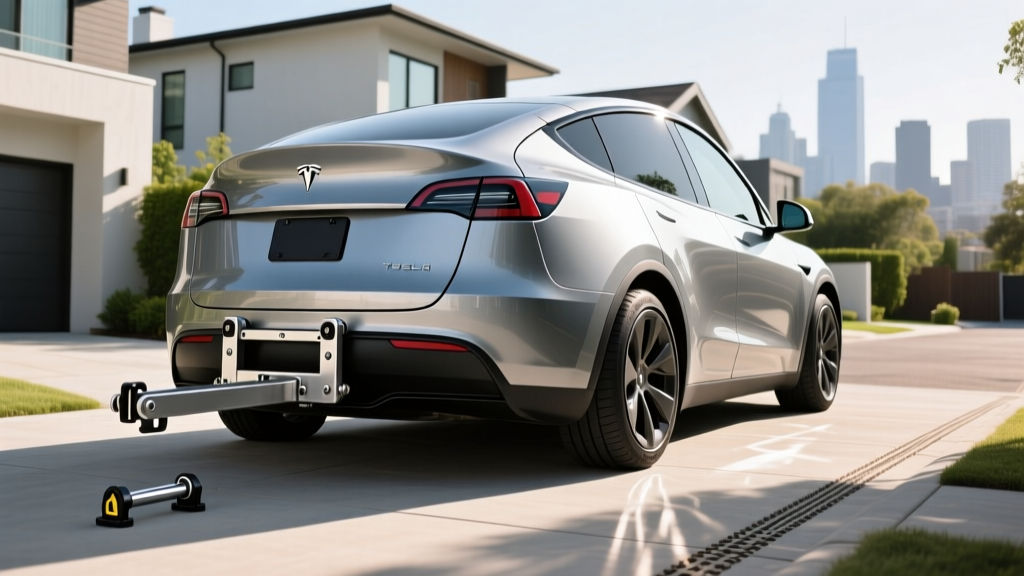
Tesla offers a factory-installed tow hitch on the Model Y Long Range AWD and Performance trims. The hitch is a 1.25-inch receiver (Class II) rated for up to 3,500 pounds of towing capacity and 350 pounds of tongue weight. This is an order-time option — Tesla does not currently support retrofitting the factory hitch to vehicles that were built without one, though third-party aftermarket hitches (such as those from Curt or Draw-Tite) are available for owners who didn't spec it at purchase.
The factory hitch includes a wiring harness with a 4-pin flat connector for trailer lights, and the vehicle's software integrates trailer light-check functionality. When a trailer is connected, the Model Y's stability control system adjusts to account for the additional load, and the navigation system can factor trailer weight into route planning and Supercharger stops.
- Max towing capacity: 3,500 lbs (Long Range AWD / Performance)
- Max tongue weight: 350 lbs
- Receiver size: 1.25-inch (Class II)
- Connector: 4-pin flat (factory); adapter needed for 7-pin
- RWD trim: Not rated for towing
For context, 3,500 pounds covers a small utility trailer, a pair of jet skis, a lightweight teardrop camper (typically 1,500–2,500 lbs), or a small boat on a single-axle trailer. It does not cover a full-size travel trailer or a horse trailer. If you need 5,000+ lb towing, you're looking at the Ford F-150 Lightning or Rivian R1S instead.
Range, Battery, and the Real-World Towing Penalty
The 2026 Model Y Long Range AWD carries an EPA-estimated range of 320 miles on its approximately 75 kWh usable battery pack (Tesla does not publish exact pack capacity; third-party teardowns and telemetry data place the Juniper Long Range pack at roughly 75–78 kWh usable, using a nickel-manganese-cobalt (NMC) chemistry). The RWD base model uses a lithium iron phosphate (LFP) pack with approximately 60 kWh usable and an EPA range of around 270 miles.
EPA estimate: 320 miles
Real-world highway (70 mph, 72°F): ~275–295 miles
Cold weather (30°F, highway): ~230–260 miles
While towing (2,000–3,000 lb trailer): ~150–190 miles
Towing is the single biggest range killer for any EV. Aerodynamic drag and rolling resistance from a trailer roughly double energy consumption, dropping efficiency from the Model Y's typical 28–30 kWh/100mi to 50–65 kWh/100mi depending on trailer profile and speed. Plan charging stops accordingly.
According to fueleconomy.gov, the 2026 Model Y Long Range AWD achieves an EPA-rated 122 MPGe combined (approximately 28 kWh/100 miles). This is among the most efficient vehicles in the compact electric SUV segment. However, efficiency drops sharply when towing — expect to consume roughly twice that energy per mile, which directly cuts range in half or more.
| Spec | Long Range AWD | Performance |
|---|---|---|
| EPA Range | 320 mi | 298 mi |
| Battery (usable) | ~75 kWh (NMC) | ~75 kWh (NMC) |
| Drivetrain | Dual-motor AWD | Dual-motor AWD |
| Horsepower | 384 hp | ~456 hp |
| 0–60 mph | 4.8 sec | 3.5 sec |
| Max DC Charge Rate | 250 kW | 250 kW |
| 10–80% DC Time | ~27 min | ~27 min |
| Max Towing | 3,500 lbs | 3,500 lbs |
| MPGe (combined) | 122 MPGe | 111 MPGe |
Charging Speed: DC Fast, Level 2, and Towing Logistics
The 2026 Model Y supports a peak DC fast-charge rate of 250 kW on Tesla's V3 and V4 Superchargers (and, with the native NACS connector, on any NACS-equipped station). In practice, the charge curve peaks near 250 kW at low state-of-charge (around 10–20%) and tapers progressively. A 10–80% session takes approximately 27 minutes under ideal battery preconditioning. Above 80%, charging slows dramatically — expect 80–100% to add another 20+ minutes, which is typical for NMC chemistry.
| Level | Power (kW) | Miles Added per Hour | Notes |
|---|---|---|---|
| Level 1 (120V) | ~1.4 kW | ~3–4 mi/hr | Emergency/trickle only |
| Level 2 (240V, 48A) | 11.5 kW | ~37 mi/hr | Home Wall Connector; ~8.5 hrs for full charge |
| DC Fast (Supercharger) | Up to 250 kW | ~1,000+ mi/hr (peak) | 10–80% in ~27 min; tapers above 80% |
For towing trips, route planning is critical. Tesla's built-in navigation will automatically route through Superchargers and estimate arrival state-of-charge, factoring in trailer mode when enabled. However, with range cut roughly in half while towing, expect to stop every 120–160 miles on the highway. Supercharger stalls with pull-through layouts (increasingly common at V4 sites) make trailer hookups far easier — but not all stations offer them yet.
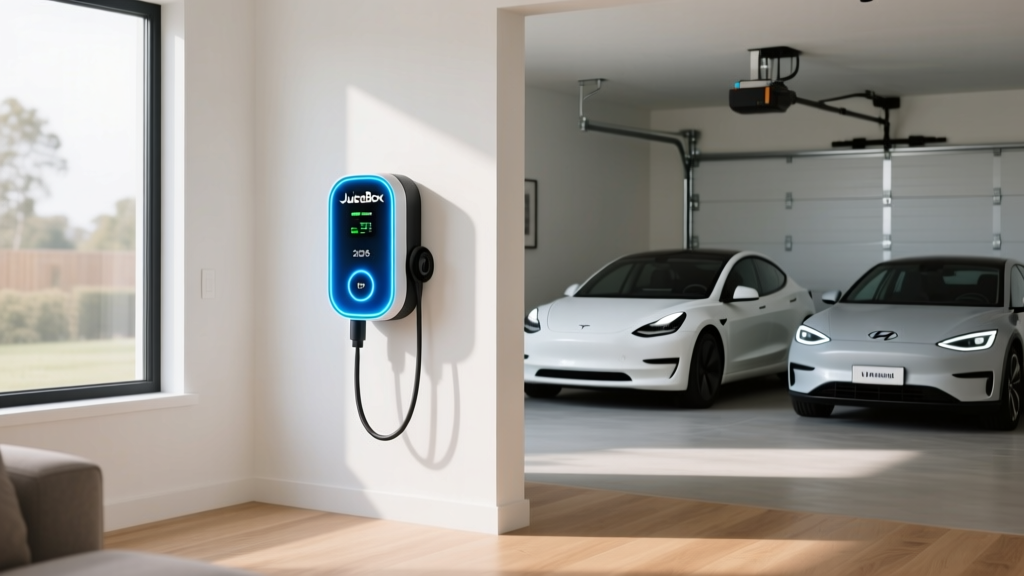
At home, the Tesla Wall Connector on a 60-amp circuit delivers 11.5 kW (48 amps continuous), adding roughly 37 miles of range per hour. A full overnight charge from 20% to 100% takes about 8–9 hours. If your electrical panel supports it, this is the most convenient and cost-effective charging method — typically $0.12–$0.18 per kWh depending on your utility, or roughly $9–$14 for a full charge.
Interior, Cargo, and Practicality for Haulers
The Juniper-generation Model Y received a meaningful interior refresh: a quieter cabin (acoustic glass all around), ventilated front seats, ambient lighting, a rear-seat touchscreen, and a power-folding second row. Cargo space measures 30.2 cubic feet behind the second row and 72.1 cubic feet with the rear seats folded. The front trunk (frunk) adds approximately 4.1 cubic feet — useful for charging cables, a weight-distribution hitch ball mount, or gear you want separated from the main cargo area.
Legroom is generous: 41.9 inches up front and 37.4 inches in the rear. The flat floor (no transmission tunnel) makes the rear seat comfortable for three adults on shorter trips. For towing families, the combination of rear-seat space, cargo volume, and the available hitch makes the Model Y competitive with mid-size gas crossovers — though vehicles like the Hyundai Ioniq 5 (no factory tow rating) or the Kia EV6 (2,700-lb tow rating on GT-Line AWD) fall short on towing capacity.
Pricing, Trims, and Federal Tax Credit Eligibility
For 2026, the Model Y lineup is streamlined:
| Trim | Base MSRP | Hitch Option | Est. §30D Credit | Est. Net Price |
|---|---|---|---|---|
| Long Range AWD | ~$48,990 | +$1,000 | Up to $7,500* | ~$42,490 |
| Performance | ~$53,990 | +$1,000 | Up to $7,500* | ~$47,490 |
*Federal tax credit eligibility under IRS §30D depends on multiple factors:
- MSRP cap: SUVs must be under $80,000 — the Model Y qualifies.
- Buyer income cap: Modified AGI must not exceed $150,000 (single), $225,000 (head of household), or $300,000 (joint).
- Battery sourcing: The credit is split into two $3,750 halves — one for critical minerals and one for battery component assembly. Tesla's supply chain has shifted significantly; check the latest fueleconomy.gov tax credit listings for current Model Y eligibility, as sourcing requirements tighten annually.
- Point-of-sale transfer: As of 2024+, eligible buyers can transfer the credit to the dealer at purchase, reducing the out-of-pocket cost immediately rather than waiting for tax filing.
Tax credit rules are subject to change. Always verify eligibility with a tax professional and the IRS before relying on the credit in your purchase decision.
Driver Assistance, Tech, and the Towing Experience
The Model Y comes standard with Tesla's Basic Autopilot (lane centering, adaptive cruise control, traffic-aware features). This is an SAE Level 2 driver-assistance system — the driver must remain fully engaged, hands on or near the wheel, and eyes on the road at all times. Full Self-Driving (Supervised), a $8,000 option or $99/month subscription, adds automatic lane changes, intersection handling, and parking assist, but remains Level 2 and requires constant supervision.
Tesla Autopilot and FSD (Supervised) are SAE Level 2 systems. They do not make the vehicle self-driving. The driver is legally and operationally responsible at all times. When towing, added trailer sway, longer braking distances, and wider turns demand even greater driver attention. Do not rely on driver-assist systems to compensate for reduced visibility or altered vehicle dynamics while towing.
The 15.4-inch center touchscreen handles all vehicle functions, navigation, and entertainment. The Juniper refresh added a rear 8-inch screen for climate and media controls. Over-the-air updates continue to add features — Tesla's software ecosystem remains a key differentiator. For towing specifically, the navigation system's trailer-mode routing (which accounts for reduced range and suggests Supercharger stops) is a genuine advantage over competitors that lack integrated tow-aware navigation.
How the Model Y Stacks Up Against Competitors
If towing is a priority, the Model Y's main electric competitors include:
- Ford Mustang Mach-E: No factory tow rating (not recommended for towing).
- Hyundai Ioniq 5: No official US tow rating; aftermarket hitches available but not manufacturer-supported.
- Kia EV6 (GT-Line AWD): Rated for 2,700 lbs — less than the Model Y.
- Volkswagen ID.4 (AWD): Rated for 2,700 lbs with factory hitch.
- Rivian R1S: Rated for 7,700 lbs — vastly more capable, but starts above $75,000.
- Ford F-150 Lightning: Rated for 7,700–10,000 lbs depending on config — a truck, not an SUV.
In the compact/mid-size electric SUV segment, the Model Y's 3,500-lb rating is the highest available. If your towing needs stay under that limit, it is the most efficient and tech-forward option. If you need more, you must move to a larger, more expensive platform.
- Best-in-class 3,500-lb EV SUV tow rating
- 122 MPGe — segment-leading efficiency
- 250 kW Supercharger network advantage
- Trailer-aware navigation and route planning
- Spacious cargo area (72.1 cu ft max)
- OTA updates continuously improve functionality
- Range drops to ~150–190 mi while towing
- 1.25-inch receiver limits hitch accessory options
- No factory retrofit — must order hitch at purchase
- Performance trim sacrifices range for speed
- Insurance premiums above segment average
- FSD subscription cost adds up if not purchased outright
Warranty and Long-Term Ownership
Tesla provides a 4-year/50,000-mile basic vehicle warranty and an 8-year/120,000-mile battery and drive unit warranty for the Long Range and Performance trims (the RWD with LFP battery carries an 8-year/100,000-mile battery warranty). The battery warranty guarantees retention of at least 70% of original capacity during the coverage period. According to Tesla's impact reports and third-party fleet data, Model Y NMC packs typically degrade around 10–12% over the first 100,000 miles — well within the warranty threshold.
For owners who tow frequently, battery degradation may accelerate slightly due to higher average discharge rates and more frequent DC fast-charging sessions. Staying within the 20–80% daily charge window and using DC fast charging primarily for road trips (rather than daily charging) will help maximize long-term battery health.
Frequently Asked Questions
Can I add a tow hitch to a Tesla Model Y after purchase?
Tesla does not officially support retrofitting the factory tow hitch to vehicles not originally equipped with one. However, aftermarket hitches from manufacturers like Curt (model C13427 or similar) and Draw-Tite are available and can be installed by a qualified shop. Note that aftermarket installations may not integrate with the vehicle's trailer light-check software, and wiring may require an independent harness. Check whether an aftermarket hitch affects your warranty before proceeding.
How much range do I actually lose while towing?
Expect a 40–55% range reduction depending on trailer weight, aerodynamic profile, speed, and terrain. A 2,000-lb teardrop camper at 65 mph on flat terrain might yield 180–190 miles from a full charge. A 3,200-lb boxy trailer at 70 mph into headwinds could drop that to 140–155 miles. Always plan conservatively and use Tesla's trailer-mode navigation for route estimates.
Does the Model Y qualify for the $7,500 federal EV tax credit in 2026?
The Model Y's MSRP is well under the $80,000 SUV cap, so it passes that test. Whether you receive the full $7,500, a partial $3,750, or nothing depends on your income, the battery's critical-mineral and component sourcing at the time of manufacture, and current IRS rules. Check IRS.gov and the point-of-sale transfer option at the time of purchase. Eligibility changes as sourcing requirements tighten annually.
Is the Model Y worth buying for towing vs. a gas SUV?
If you tow 3–5 times per year and your daily driving is under 60 miles, the Model Y makes strong economic sense: you save significantly on fuel for daily commuting, and the towing range penalty is manageable with Supercharger route planning. If you tow weekly over long distances (200+ miles one-way with a heavy trailer), a gas or diesel SUV still offers faster refueling and longer effective range under load. The Model Y is an excellent dual-purpose vehicle — outstanding daily driver, capable light-duty hauler — but it is not a heavy-duty tow rig.
What is the real-world range of the 2026 Model Y Long Range AWD?
The EPA rates it at 320 miles. In real-world mixed driving at moderate temperatures, expect 280–300 miles. At sustained highway speeds (72–75 mph), plan for 265–285 miles. In cold weather (below freezing), reduce that by another 15–25%, landing around 220–250 miles. These figures assume no towing and standard tire configuration.